Dust flux, Vostok ice core

Dust flux, Vostok ice core
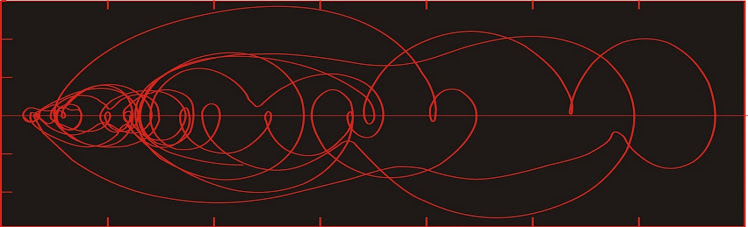
Two dimensional phase space reconstruction of dust flux from the Vostok core over the period 186-4 ka using the time derivative method. Dust flux on the x-axis, rate of change is on the y-axis. From Gipp (2001).

Wednesday, October 30, 2013

Monday, October 28, 2013

This chart is meaningless

I am very sorry to be picking on this article, but others have been saying much the same thing so this may be worth a brief mention.


(I did look around sharelynx a bit, but didn't find it).

The contention is that the creation of new debt in the past couple of years must bring about an increase in the gold price. This conclusion is supported by an illusion which is fostered by the purely arbitrary choice of a scale for the gold price. Unfortunately I am too lazy to go and put the data for these time series together so you will have to follow along with the plots I have below.

We compare the production of bedknobs from broomsticks with the production of broomsticks from bedknobs.


From this graph, we can see that bedknob and broomstick production grew more-or-less in tandem, until recently, when bedknob production suddenly fell. You would use this graph to support your prediction of an increase in bedknob production.


Same data, but with a slightly different scaling for bedknob production. You could use this graph to support your contention that there was a bit of a blow-off top in bedknob production in the recent past, but it is now back in line with broomstick production, in which state you expect it to continue.


Same data, different scaling. Here, not only was there a recent blow-off top in bedknob production, but it is quite clear that bedknob production still has further to fall to come back into line with broomstick production.

You can do the same with the chart at top. Whatever story you want to push--gold to rise; gold to fall; gold to stay the same--all you have to do is change the scale accordingly. Hence the title of this post.

This graph is seductive because it does seem logical that increasing the creation of debt and money should increase the gold price. But we don't know what the correct relationship is, so have no real way of stating whether gold should rise, fall, or remain neutral from these data alone.

Friday, October 25, 2013

Darling, be home soon

I've been listening to this a lot lately, having just rediscovered my Lovin' Spoonful tape behind the desk. I had forgotten what a great song this is.


Wednesday, October 23, 2013

Economic policy and the price of gold

Then the rumour circulated that at night the Fed Governors neglected their sacrifices and prayers. A great depression seized everyone. One day the President said to the Fed Chief, "When will we celebrate the return of normal unemployment rates? I would like to make a journey and return in time for the feast. How long is it until the day of the feast?" The Fed Chief was embarrassed. It had been several days since she had looked at the moon and the stars. She had learned nothing more about their courses. The Fed Chief said, "Wait one more day and I will tell you." The President said, "Thank you. Tomorrow I will come to see you again."
The Fed Chief gathered the Fed Governors together and asked, "Which of you lately has observed the course of the stars?" None of Fed Governors answered, because they had all stayed to listen to the stories of Fiat-do-lar. The Fed Chief asked again, "Hasn't even one of you observed the course of the stars and the position of the moon?"
                                                 -- modified from The Ruin of Kasch

Economics isn't a science. It is a mistake to think it would be so. Science does not have schools. Only philosophies have schools.

The difference between a science and a philosophy is the difference between seeking truth while honestly admitting you don't know it and declaring that truth is something you define.

Ideally science is described by working hypotheses, which are constantly tested, and if falsified, replaced (unless pride is involved or money). In philosophy, you begin with axioms, which are untestable statements that are defined as being true. Each school of economics has its own set of axioms. From axioms, you apply rules of inference (logic) in order to generate new statements, which are also true. These generated statements are called theorems. Thus all theorems are true (within the school of philosophy) but not necessarily applicable to the real world!

In the early days of geology, there were competing schools: the Neptunists and the Plutonists being two that come to mind immediately. The Neptunists believed that all rocks formed in the sea, either as sediments, or by crystallization as salts (this was their central axiom). The Plutonists believed that all rocks formed from magma (as their central axiom). Debates between adherents of the two schools were rowdy, fruitless affairs, because the nature of philosophy is that it cannot be overturned by mere observations.

The distinction between science and philosophy with respect to economics is important because economists have an annoying ability to set policy--policy that affects the quality of your lives. It probably doesn't matter much to you whether some geologists can't decide among themselves whether a particular rock formed in the sea or on a volcano (or even on a volcano in the sea). But it does make a difference if some Fed official acts on her belief that bankrupting the elderly eliminating interest on savings is a cure for unemployment.

Application of economic policy follows the axiomatic approach. Some high priest of an obscure caste decides on a cure for economic woes. Perhaps he dances around like a medicine man. The evil spirits are expunged, so that unemployment levels will finally fall. Maybe.

Recently, The World Complex presented the inverse correlation between the unemployment rate in the UK and its "confidence ratio" (dollar value of public debt divided by the dollar value of gold holdings). The idea was that a high ratio could only be supported if bondholders had high confidence that the debt would be properly serviced (forget about repayment). The flip side is that a high ratio could be interpreted as a measure of a country's ruin.

In the article I had suggested that government economists might cheer a decline in the price of gold.

So today, we look at the same relationship for the United States.


Once again we see a strong inverse relationship between confidence ratio and unemployment.

One of the goals set out for the Federal Reserve is to manage the unemployment rate. Looking at this chart, the answer is clear--to reduce unemployment, increase the confidence. Confidence (as defined above) can be increased in three ways: 1) raise debt, 2) sell gold, 3) lower the gold price.

Of course we all know that correlation does not imply causation. But it doesn't have to in order to impact on Fed policy. That's the beauty of politics--reality and truth don't really matter when there are elections to be won.

There was a comment that perhaps I have too much time on my hands. I'm not sure if the intent was to say that only someone with a lot of time on his hands would notice this relationship. The economists at the Fed have far more PhD's and time on their hands than does this corner of webspace. So I'm sure they have already seen this.

So the question becomes--even if no causation can be established, can it be used to set policy? And what policies will be followed?

Raising debt is the old standby--but as we see in the clarified chart below, it doesn't seem to be working anymore.


Since the 2001 peak (on September 10, perhaps?), the increasing debt has been more than compensated by the rising price of gold. Don't be fooled into thinking the US is sinking into solvency--it is creating debt faster than any time in history. But the price of gold has been rising faster still (although we shall see about 2013).

It appears that policy #2, the sale of gold, is politically untenable. Officially at least. Selling gold is for lesser countries. So that leaves option #3--hope the price of gold falls. Perhaps they do more than hope.

. . . at first the story of Fiat-do-lar was like hashish when it makes wakefulness happy. Then the story was like hashish when it makes dreams delirious. Toward morning, Fiat-do-lar raised his voice. As the Nile rises in the hearts of men, so his words swelled. To some, his words brought serenity; to others, they were as terrifying as the appearance of Azrael, the angel of death. Happiness filled the spirits of some, horror the hearts of others. The closer morning came, the mightier that voice grew and the more it resounded within the people. The hearts of men rose up against one another like clouds in the sky on a stormy night. Flashes of wrath met thunderbolts of fury. When the sun rose, the tale of Fiat-do-lar reached its end. Ineffable wonder filled the confused minds of the people. For when the living looked around, their gaze fell upon the Fed Chief and Governors. They were stretched out on the ground, dead.
                                        -- modified from The Ruin of Kasch 
Monday, October 21, 2013

Why we face ruin

A nice compendium of UK economic data has recently appeared (h/t NESS). You are encouraged to download data sets for your own nefarious purposes.

As an example, I have decided to plot UK unemployment rate against the measure of confidence I proposed on these pages a couple of years ago. To recap, the confidence ratio is the ratio of outstanding public debt (in dollars) to the dollar value of the country's gold holdings. I chose "confidence" as presumably this ratio can only be high for a country in which investors have great confidence. For those of a different mindset, it can be viewed as a measure of a country's ruin (although it would be better to include other foreign currency reserves).


UK unemployment data from the site mentioned above. UK debt came from google public data. UK gold holdings came from the data sets available from the World Gold Council. To find the dollar value of gold holdings, I used averaged annual prices available at Kitco. Average conversion rate of GBP to USD available here (although I don't remember where I got it for the original posting, which was up to 2011).

That is a good-looking example of negative correlation. It tells us that the unemployment falls when the confidence ratio is high. Now, there are three ways for a government to increase that confidence ratio:

1) increase debt
2) sell off gold
3) pray for the price of gold to fall (obviously in a non-manipulative manner that doesn't direct profits to favoured entities).

The fall in confidence that we observed in the latter half of the last decade was entirely due to the rising price of gold. Look at what that did to the unemployment rate! Clearly the fault of gold-bugs and conspiracy theorists. The rising price of gold completely overrode the excellent work of the British Parliament in driving up the country's debt. As for Gordon Brown, he was a hero! His only flaw was in not going far enough. If he had sold all the UK's gold, imagine how low unemployment would be today!

This wouldn't be a post on the World Complex if we didn't do some kind of state space portrait, so here it is: unemployment rate vs. confidence ratio.


Policy decisions of British Parliament and their impact on unemployment can be followed from the above chart. Clearly the government in the 1970s laboured under the delusion that reducing debts would benefit the economy(1). They were rewarded for their imprudence by spiking unemployment in the early 1980s.

By the mid-1990s, they had discovered the golden ticket. With the rising confidence ratio, the UK was rewarded with a falling unemployment rate. Then came Gordon Brown's heroics--by aggressively selling gold he caused the confidence ratio to rise and the UK was showered with new jobs!

There was a small crisis in the latter part of the last decade. But since then--clearly back on track. If the forward evolution of the system follows a similar catenary to the period 1993-2005, then a mere quadrupling of the confidence ratio will restore the unemployment rate to about 6%. The most prudent way to achieve this would be to immediately sell off 75% of Britain's remaining gold (2).

I find this approach to finances inspiring, and am willing to give it a try. Here at The World Complex, the unemployment rate is unusually high (technically I am welcome to go to the office, but the treasury is empty). Looking at my finances, I see the problem--I have very little debt and high savings (although much lower than they were two years ago, thanks to the ongoing turmoil in the junior mining market). To rectify this oversight, I will be issuing bonds. For reasons of fiscal prudence, I will try to keep my confidence ratio below 100, and will begin an auction for $25 million in debt next Thursday (3). No cheap google ad payouts here!

Notes:

(1) the rising price of gold may have had something to do with this. But this proves my point! Rising gold price = rising unemployment, you naughty gold bugs.

(2) in my opinion it would be too difficult to drive the gold price back down to $300/oz.

(3) securities officers and other sarcastically challenged individuals take note--this is intended as sarcasm. Your participation is welcome.