Apart from its natural beauty, Yuntaishan is also famous as one of the key places in the development of Taoisim. The highest point in Yuntaishan, and the site of an ancient temple, is Zhuyu Peak. A rapid bus ride up a winding road and through numerous tunnels brings you to a major platform about 200 m below the peak--you get to climb the rest of the way.


Part way up is the Cave of Medicine. Unfortunately, there is not much English documentation on the significance of the cave, but there is one document suggesting that Sun Simiao, the king of medicine during the Sui and Tang dynasties, made medicine here.


The cave has become a shrine, where people not only pray, but leave offerings (typically money) wedged into crevices in the cave walls.


The red tags represent prayers. Apart from the pagodas at the entrance, they are also left hanging from the railings all over the grounds.
Climbing back down from the peak, there is a trail that heads off about 2 km to the east, towards Phoenix Ridge. At the end of the path is a nice pavilion (seen below), as well as (you guessed it) another temple.


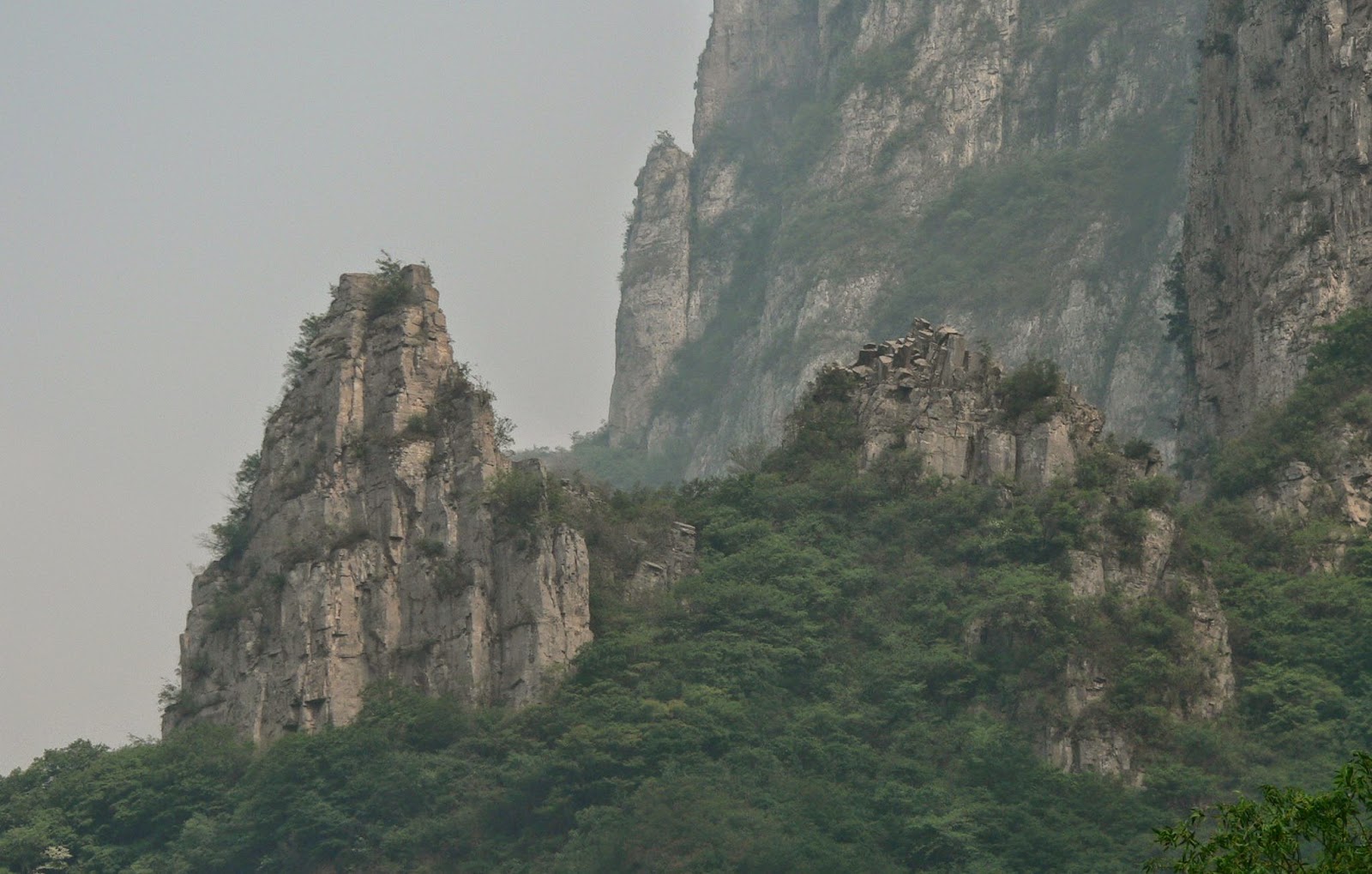
There was a lot of haze. At times, there was even fog. Later it began to rain, which complicated my descent somewhat.

The pavilion has a number of examples of paintings and calligraphy, but the lighting and reflections make most of them impossible to photograph.


Some views from the top of the pavilion.
From the pavilion, there is a 3 km walk down the side of the escarpment to Wanshan temple, which is about 800 m below the peak of the escarpment. Most of this drop occurs in the first km of the walk, which is almost entirely composed of stone stairs, occasionally without handrails.


It was raining, and I was concentrating very hard on not falling as the stairs were very narrow. I never saw anyone else the whole way down (it would be difficult to imagine anyone making this climb, except possibly as proof of devotion). It occurred to me if I took a tumble I might be in some difficulty as there was no cellphone reception at most points along the trail.
But there were advantages to the solitude. At times I would hear a sudden rustling of something big moving through the under brush. The first time it was on the ledge above me, and I jumped against the cliff and waited for the crash. Nothing. A little while later, I heard a sudden explosion of movement about 15 m to my right and a little below me, and just caught a glimpse of a wild macaque fleeing into the bush. It was the hands and feet that mostly stick in my memory. Probably it first froze as I was approaching until I got too close.


Part way up is the Cave of Medicine. Unfortunately, there is not much English documentation on the significance of the cave, but there is one document suggesting that Sun Simiao, the king of medicine during the Sui and Tang dynasties, made medicine here.


The cave has become a shrine, where people not only pray, but leave offerings (typically money) wedged into crevices in the cave walls.


Apart from the famous views, there is a temple complex. But it really isn't any different from any other temple complex in China.


The red tags represent prayers. Apart from the pagodas at the entrance, they are also left hanging from the railings all over the grounds.
Climbing back down from the peak, there is a trail that heads off about 2 km to the east, towards Phoenix Ridge. At the end of the path is a nice pavilion (seen below), as well as (you guessed it) another temple.


There was a lot of haze. At times, there was even fog. Later it began to rain, which complicated my descent somewhat.

The pavilion has a number of examples of paintings and calligraphy, but the lighting and reflections make most of them impossible to photograph.


Some views from the top of the pavilion.
From the pavilion, there is a 3 km walk down the side of the escarpment to Wanshan temple, which is about 800 m below the peak of the escarpment. Most of this drop occurs in the first km of the walk, which is almost entirely composed of stone stairs, occasionally without handrails.


It was raining, and I was concentrating very hard on not falling as the stairs were very narrow. I never saw anyone else the whole way down (it would be difficult to imagine anyone making this climb, except possibly as proof of devotion). It occurred to me if I took a tumble I might be in some difficulty as there was no cellphone reception at most points along the trail.
But there were advantages to the solitude. At times I would hear a sudden rustling of something big moving through the under brush. The first time it was on the ledge above me, and I jumped against the cliff and waited for the crash. Nothing. A little while later, I heard a sudden explosion of movement about 15 m to my right and a little below me, and just caught a glimpse of a wild macaque fleeing into the bush. It was the hands and feet that mostly stick in my memory. Probably it first froze as I was approaching until I got too close.