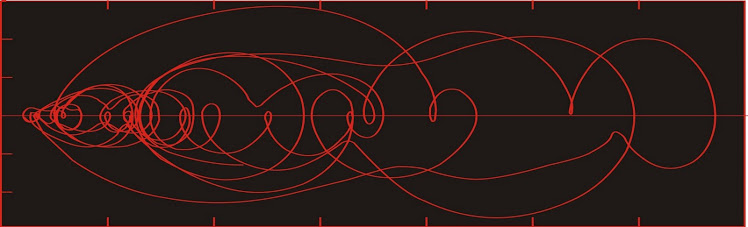
Dust flux, Vostok ice core

Dust flux, Vostok ice core
Two dimensional phase space reconstruction of dust flux from the Vostok core over the period 186-4 ka using the time derivative method. Dust flux on the x-axis, rate of change is on the y-axis. From Gipp (2001).

Sunday, December 11, 2016

Modern art in Zhengzhou


I am not a huge fan of modern art, as I mostly don't understand it. But, here was a brand new display in a brand new building in Zhengzhou, so let's go explore.


The display was in the twin of the above building. Interestingly, both buildings were not yet open to the public, as they weren't yet complete. There was construction detritus all over the floors, and only freight elevators were working. But they had displays at roughly nine-floor intervals (corresponding to the levels with the notches in the above picture--which are accessible outdoor patios, which I presume will have guardrails installed once open to the public). But maybe not--in China, you are expected to look after yourself to a large extent, and third-party liability is extremely limited.


 I'm not sure if the dirt and the pail are part of the exhibit or not. I'm leaning towards yes. I think it is meant as a reminder that all modern construction sites may potentially encounter cultural relics of the past. It is not uncommon to see construction workers wandering the streets near their workplace trying to hawk old pieces of porcelain or bronze.


 A couple of young women try their luck with the auto-decapitator.


Inside--a cityscape maybe?


Some exhibits moved. The motion of some was tied to motion detectors.


Chinese herbal medicine products on woofers, which would hum (vibrating the herbs) every so often.


I have no explanation for this.


A self-portrait. I don't know if the smashed mirror was part of the display or not.


 Viewers reacted favourably to the saliva-collection experiment.


My favourite was the liquid-metal pterodactyl. It flapped its wings to the chiming of a bell, but was hooked up to a motion detector which switched it off when anyone looked at it too closely.


My favourite display consisted of a couple of screens comparing China in the 1970s to the China of today. One screen showed typical scenes from modern-day China, while the other showed scenes from the early 1970s. Both showed analogous activities--for instance while you watched Chinese people exercising in their machine-equipped public parks in the present, you also saw old men in Mao suits practicing tai chi in the park.


Possibly art. Or maybe spilled insulation.


Monday, December 5, 2016

Gold has failed its latest breakout attempt

It looked to be a bold move.


Immediately after the Brexit vote, gold x USDX broke out of the lower circle--a region of phase space to which it had been confined since the middle of 2013, and which it had occupied for about a year until late summer 2011. I was hoping it would be able to make its way to the region of stability in the upper right part of the graph. The trajectory since Brexit is outlined in blue. It just reached the target yellow circle, but has since dropped below it and is destined to return to the larger yellow circle again. What a tease!

Wednesday, November 30, 2016

Terelj Park

Continuing with the Mongolia trip, which was completed almost two months ago. I have had very few days where internet has been good enough to upload photos.

Terelj National Park is probably the most significant tourist site in Mongolia, due mainly to its proximity to Ulaanbaatar.


The gigantic statue of Genghis Khan is a very common tourist location. However, having spent some time in Newfoundland, there's something about his hat that makes me think this is a stature of a Newfie on a horse.


This is the largest boot in the world. When our tour guide said he was taking us to see it, I thought he said "Buuz," which would be a dumpling.


The landscape is variable, but quite bleak in places. Larch trees are common, as well as evergreens. Surprisingly, the south-facing slopes frequently were treeless, whereas the trees were more commonly seen on north-facing slopes. My guess is it has to do with soil moisture. The soils facing the sun dry out too quickly.


Speaking of horses, it is not uncommon to see herds of domestic horses driven hither and yon. Land outside the cities is not owned--the original population of Mongolia consisted of nomads. I was not able to find out about dispute resolution mechanisms if there is a conflict between roaming families, but I expect it would be a lot like those in other similar societies--meetings with the elders.


Before embarking on a journey, it is good luck to pace three times around one of these, and make some kind of offering. Common offerings are stones and string.


Me and my new pet. That's a ger in the background.


Braided rivers, with gravel banks and bars were common everywhere we went. And not a single panner in sight. Our guide said that prospecting activities are illegal (presumably in the absence of some kind of exploration permit).


In the early days of Communism, religion was heavily suppressed, with temples being destroyed, and monks imprisoned or killed. This crevice in the rock was the hiding place of 100 Buddhist monks for about a year before their eventual discovery.


There has been a lot of development recently--ger camps for tourists. Sadly, they only look like the real thing.


Monday, November 28, 2016

Dr. Copper strikes back

Some time ago I compared the price of copper to an old man falling slowly down the stairs.

Not anymore.


The current move marks a major change. Whether this is supply driven or demand driven is unclear to this author. So I can't say whether a new developing country (India, or perhaps the US?) has appeared, or whether China has re-ignited its building boom. I do note that subway line 2 has now opened in Zhengzhou, and several more are under construction. The same is true in Changsha, and undoubtedly in other cities across China.

Let's see what I mean.

I have used reconstructed state space portraits as a way of highlighting changes in dynamics in systems, particularly in pricing. One of the easiest graphs to plot is an absolute measure against its rate of change. Below we see the gold-copper ratio plotted against its rate of change since the start of 2015.


Because I calculate the rate of change over a five-week period, and plot it in the middle--it means the most recent point on the graph reflects the ratio about two weeks ago. Currently, the gold-copper ratio is about 450.

Essentially, the graph shows two metastable states--one where the gold/copper ratio is between 400 and 500, and one with the ratio between 550 and 650. The transition from one state to the other occurred in January this year, prompting this.

Well, if we assume that a lower gold/copper ratio means the perception of increased demand, and given the timing of the breakout relative to the recent election, maybe the market is taking Mr. Trump's remarks about a major infrastructure build-out in the US seriously.

Monday, November 14, 2016

Development in Ulaanbaatar


Compared to other capitals around the world, Ulaanbaatar is relatively young. Furthermore, the lifestyle of the Mongols was not conducive to permanent residency. Their most important domicile, the ger, was by its nature, mobile. Even now, a significant part of the population live in them--many in the country, but there are some semi-permanent ones in the city.


In response to the rapid growth of the city's population, they are building up great blocks of apartments all around the outskirts of the city, hard up against the hills that surround the city.


The gers are the small round structures in the picture above. They look like little oil storage tanks.


Here are some gers in a smaller town outside the capital.


This one, in Terelj National Park, is actually occupied.


The city maps mark the outlying territories as all gers, although the reality is that a lot of the buildings (the clutter near the top of the above photo) are houses.

 The ger is a good response to a certain lifestyle choice--it is reasonably mobile, and you can add insulating layers to it to make it through the winter. But from the centralized government perspective, a mobile population isn't the easiest thing to keep tabs on. So why not encourage them to put down roots in apartment complexes.

I think they should build higher up on the hills so they can escape the worst of the bad air in the winter.