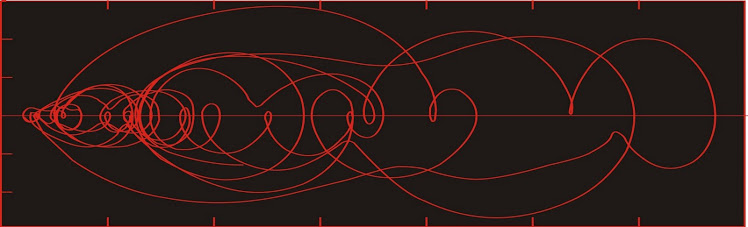
Dust flux, Vostok ice core
Two dimensional phase space reconstruction of dust flux from the Vostok core over the period 186-4 ka using the time derivative method. Dust flux on the x-axis, rate of change is on the y-axis. From Gipp (2001).
Sunday, August 20, 2017
Wednesday, August 16, 2017
Emergency storage for Canada's gold
The Diefenbunker--a cold-war-era bunker built to house the Canadian government in case of a nuclear attack by the Soviet Union--has a deep vault which was intended to house Canada's gold reserves during just such an emergency. The bunker is in Carp, a small town on the rail line just west of Ottawa.
The vault is about 25 metres below the surface, and looks like it would make a pretty good discotheque. Obviously, there is no gold there now.
Changes in pressure could make it impossible to open the vault door, so they had a smaller door that could be opened in order to equalize pressure between the vault and the entry hall.
They also created a narrow passageway completely around the vault, so it was less likely to be damaged in an earthquake. The vault would have been guarded, but rather than walk around the vault, each corner had a mirror in it, so that the guard could see all around the vault from one place.
The plan was to move the gold somewhere where it couldn't be irradiated. Maybe the thinking was that radioactive gold wouldn't be suitable as a monetary base. I'm not sure I agree. The velocity of money idea suggests that the faster money circulates, the better off the economy is, and if all the gold had been minted into coinage and pumped into circulation, I think the radioactive coins would have really circulated.
Anyway, I took a close look for Canada's gold reserves, but didn't find any.
The vault is about 25 metres below the surface, and looks like it would make a pretty good discotheque. Obviously, there is no gold there now.
Behold! Canada's gold reserves.
The vault was to be guarded by an impressive vault door.Changes in pressure could make it impossible to open the vault door, so they had a smaller door that could be opened in order to equalize pressure between the vault and the entry hall.
They also created a narrow passageway completely around the vault, so it was less likely to be damaged in an earthquake. The vault would have been guarded, but rather than walk around the vault, each corner had a mirror in it, so that the guard could see all around the vault from one place.
Welcome to the underground
The plan was to move the gold somewhere where it couldn't be irradiated. Maybe the thinking was that radioactive gold wouldn't be suitable as a monetary base. I'm not sure I agree. The velocity of money idea suggests that the faster money circulates, the better off the economy is, and if all the gold had been minted into coinage and pumped into circulation, I think the radioactive coins would have really circulated.
Anyway, I took a close look for Canada's gold reserves, but didn't find any.
Tuesday, July 25, 2017
Peonies in Luoyang
Peonies are the flower in Luoyang. Every spring there is a festival in their honour where peonies are on display at numerous sites around the city.
I don't know too much about them, so I can't tell you the names of the different varieties, but they are many.
Some venues are more substantial than others.
Just be careful if you invite a young lady to accompany you that you check your text message for any autocorrect errors.
I don't know too much about them, so I can't tell you the names of the different varieties, but they are many.
Some venues are more substantial than others.
Just be careful if you invite a young lady to accompany you that you check your text message for any autocorrect errors.
Labels:
China
Monday, July 24, 2017
Ancient tombs of China
Luoyang, the one-time capital of China, is probably most famous for the Longmen grottoes.The most famous set of sculptures was commissioned by Empress Wu.
Under her encouragement, the practice of Buddhism in China greatly flourished. She had a political motive of course. She encouraged an interpretation of an ancient scripture which prophesied the appearance of a female follower of the Buddha would rise to rule the entire continent--an interpretation clearly meant to refer to her.
Peonies were already popular in Luoyang before the Song Dynasty, and were a common decoration in local tombs.
Although grave goods disappeared, the elaboration of the tombs increased through the Song Dynasty, with octagonal tombs and all manner of decorative details on bricks, and frescoes.
Under her encouragement, the practice of Buddhism in China greatly flourished. She had a political motive of course. She encouraged an interpretation of an ancient scripture which prophesied the appearance of a female follower of the Buddha would rise to rule the entire continent--an interpretation clearly meant to refer to her.
Luoyang was the capital city at times during the Tang dynasty--at least until the supply problems at the preferred capital city of Chang'an (now Xi'an) were solved. Hence, Disneyesque Tang Dynasty park.
Capital cities usually have royal tombs. Luoyang is no exception.
Common themes in the frescoes were travel, mythical creatures, and flowers. There were also images related to the former occupation of the tomb occupants.
As time passed, tombs became increasingly elaborate, with patterned bricks, more interesting architecture, and a more diverse grave goods until during the Tang Dynasty. Possibly people grew weary of tombs constantly being looted--the remedy was to prepare paper goods for the afterlife--these would be burned as the body was interred, and at intervals afterward (reflected in today's practice of burning "money" for the deceased).
Capital cities usually have royal tombs. Luoyang is no exception.
Burial mound of Emperor Xuanwu, of the Northern Wei Dynasty.
Brickwork and burial site in the imperial tomb. The grave goods seem to be long gone.
Older, well preserved tombs have been found associated with the Shang Dynasty (ca. 1200 BCE) near Anyang.
Evidently, someone decided that the site of the old imperial tomb in Luoyang would be a good spot to build a museum--specifically one dedicated to showing the styles of tombs from earliest China up through the Song dynasty. Many graves were relocated brick by brick from their original locations to the underground portions of the museum. So in addition to having the usual sorts of displays of grave goods and frescoes, patrons of the museums can wander through underground crypts ranging in the Han and Wei dynasties up to the Song dynasty, and see how the tombs change in material and architectural sophistication through the ages.
Burial pit of Lady Fu Hao, Yin Xu ruins
Evidently, someone decided that the site of the old imperial tomb in Luoyang would be a good spot to build a museum--specifically one dedicated to showing the styles of tombs from earliest China up through the Song dynasty. Many graves were relocated brick by brick from their original locations to the underground portions of the museum. So in addition to having the usual sorts of displays of grave goods and frescoes, patrons of the museums can wander through underground crypts ranging in the Han and Wei dynasties up to the Song dynasty, and see how the tombs change in material and architectural sophistication through the ages.
Han Dynasty tombs are relatively simple--rectangular, with not much in the way of interesting brick work. Doors may or may not have elaborate patterns carved into them. Grave goods were common, mostly clay, but very important people would have bronze and jade (and occasionally bits of gold).
Through time, tombs became more elaborate, and began to feature frescoes.
Han Dynasty tomb fresco
Tang dynasty tomb fresco.
As time passed, tombs became increasingly elaborate, with patterned bricks, more interesting architecture, and a more diverse grave goods until during the Tang Dynasty. Possibly people grew weary of tombs constantly being looted--the remedy was to prepare paper goods for the afterlife--these would be burned as the body was interred, and at intervals afterward (reflected in today's practice of burning "money" for the deceased).
Grave goods, northern Wei Dynasty
Tricolour porcelain grave goods, Tang dynasty
Peonies were already popular in Luoyang before the Song Dynasty, and were a common decoration in local tombs.
Tang dynasty tomb detail
Although grave goods disappeared, the elaboration of the tombs increased through the Song Dynasty, with octagonal tombs and all manner of decorative details on bricks, and frescoes.
Detailed brickwork in an octagonal tomb, Song Dynasty
Song Dynasty tomb frescoes.
Wednesday, July 5, 2017
Huang He fishing village
About two years ago, I set out to find the fishing village north of Zhengzhou, close to the Yellow River. It was reputed to be something of a minor tourist destination. I followed my trusty all-in-Chinese map, and although I got somewhat close, I never did find it. At the time I hadn't mastered the transit functions on my phone map, and ended up going slightly astray.
This spring I finally made it, and unfortunately, found it slightly underwhelming. The place seems to have given up on fishing and has given itself to hosting barbeques for the locals and especially their children.
The place doubles as a summer camp where students can practice art, while they live in abandoned rail cars.
And what village would be complete without a monument to cabbage?
This spring I finally made it, and unfortunately, found it slightly underwhelming. The place seems to have given up on fishing and has given itself to hosting barbeques for the locals and especially their children.
The place doubles as a summer camp where students can practice art, while they live in abandoned rail cars.
Idyllic, but almost devoid of activity.
And what village would be complete without a monument to cabbage?
Labels:
China
Subscribe to:
Posts (Atom)


