Dust flux, Vostok ice core

Dust flux, Vostok ice core
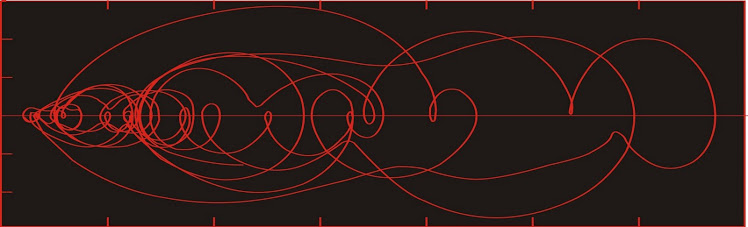
Two dimensional phase space reconstruction of dust flux from the Vostok core over the period 186-4 ka using the time derivative method. Dust flux on the x-axis, rate of change is on the y-axis. From Gipp (2001).

Sunday, September 2, 2018

Crises in confidence

Today we revisit the graph of US "confidence" through time, a concept formerly discussed here.


The confidence ratio is the ratio of the face value of US debt divided by the value of the US gold holdings. As always, we are assuming that the US holds all the gold it claims to. Estimated debt for 2018 comes from here, historical debt is from here, and the average gold price for 2018 up to the end of August from kitco.com. I don't have the record of original gold holdings, which actually changed in the early part of this graph, and adding such information would improve the pre-1960 portion of the graph.

The reason I call this confidence is that the higher the ratio, the more confidence is required in the country for its currency to hold value.

Even though this measure is economic, I think its value is affected strongly by non-economic factors. One obvious example is the peak of confidence observed in 2001. After that peak, the ratio declines sharply, suggesting a loss of confidence in the US. The destruction of the World Trade Centre and damage to the Pentagon (and America's irrational reactions) contributed mightily to this loss in confidence, in my view.

The earlier decline in confidence, starting in the 1960s was probably related to the closing of the gold window, but may have been exacerbated by oil shocks, the impeachment of Nixon, and the withdrawal from Viet Nam.

Jim Sinclair, of jsmineset.com, has long had a thesis that the confidence ratio graphed above will eventually return to 1:1. This would imply a much higher price for gold--about 60x the current price if you believe that US holds all that it claimes; higher if you don't. The $174,000 question is about timing--Sinclair says it is now.

What triggers are there in the geopolitical sphere like those in 1970? Apart from the usual economic difficulties, America does face the possible impeachment of its president, and to be nearing defeat in Syria; both of which are similar to political issues in the early '70s.

Once confidence is lost, it can take a long time to be restored. Plan accordingly.

Thursday, August 30, 2018

A sample of pagodas in Shijiazhuang

On my way to the kidney hospital in the spring, my train stopped at Shijiazhuang, a provincial capitol. From the window of the train I could see a large complex under construction.


I had thought someone might be building a new Orthodox cathedral, but it's probably a mall.

Twenty minutes of my life wasted walking to it.

Next step was to find a bus (or a series of buses) to get to Zhengding County, which I had identified as a principal tourism objective. As it was an important religious site for over a thousand years, there are numerous temples and pagodas in the area.


Handy reference map


The area appears to be surrounded by a wall with ramparts. The bus passes through a gate on the south wall, where I disembarked . . .


. . . directly across the street from the Hua Pagoda. My immediate impression was that this tower, built during the Tang Dynasty, was inspired by Hindu temples, although the repeated motifs on the pagoda wall were definitely Chinese.

Leaving the pagoda grounds, the next pagoda appears about 300 m to the north, surrounded by temple buildings.


According to Wikipedia, this is the Chengling Pagoda, in the Linji temple. There was no English documentation anywhere on site, but there was a large photoboard commemorating the 1150th anniversary of the pagoda's construction (apparently last year).


As this was the site of the founding of one of the birthplaces of Chan Buddhism, it is a popular site for pilgrims.

Further north, you enter a town, which is disappointingly ordinary. Then, in the middle of town, there is this recently constructed gate.


A little to the north and west is the Xumi Pagoda, which reminds me somewhat of the Big Wild Goose Pagoda in Xi'an.


At one time the site also boasted a bell tower and large halls. Recently, some of the supports for the original hall were recovered onsite, and these have been erected to give you  a sense of its size. Additionally, a large earth dragon was found nearby and brought to the site--this probably at one time carried a stone tablet that would have been several metres tall.


Solar observatory on Xumi Pagoda grounds

The last pagoda that I reached was near the centre of town, and is called the Lingxiao pagoda. It was originally built in the Tang Dynasty but was remodeled extensively during the Song Dynasty


Pagoda grounds across a public square

Saturday, August 25, 2018

Something big is brewing

I have used the product of the gold price and the US dollar index as a metric for the profitability of (most) gold companies. I divide the product by 100 to end up with a convenient number.

Conventional thinking would have it that gold goes up when the US dollar goes down. If that were the case, this graph would consist of a straight horizontal line. Increases in this product represent times when non-US gold miners make more money. If the US dollar rises, and gold remains constant, the mining company outside the US with expenses in local currency benefits, arguably more than they would by a rise in the gold price, which is often accompanied by special windfall taxes.

As seen in other posts, the long-term trend over the past ten years has been a rise in both the gold price and the US dollar. But there is a lot of noise.

Today's chart is a simple look at the level of gold price x USDX since the beginning of 2012.


It looks to me like a setup for a big move, perhaps up by 400 points, which would bring the index close to 1600. For the record, the previous all-time high was 1448.

Saturday, June 16, 2018

Changping District of Beijing

The Ming tombs in the Changping region all look alike. They have a similar layout and are characterized by the same general motifs and colour schemes.


Drain pipe on the Changling tomb grounds


Soul tower at Changling

If there's a tomb, there must be treasure. And there was, rather a lot of it, piled up and buried in a mound, now covered with trees.


Gold ingots


Gold cufflinks. The swastika has been an important symbol in 
eastern religions for thousands of years.


Endpieces for pillows

A short ways up the road (to me, this is out of town, but the city buses still run out this far), there is another tomb. I'm too lazy to look up its name now. It was closed to the public, but there were some workmen on the site, so maybe it is being prepared for public exposure.


The town closest to the hospital has a tomb of its own--the Qingling tomb. It is not open to the public, but many of its features are quite close to the main road.


Approach to the Qingling tomb


Qingling tomb and its soul tower

Just past the Qingling tomb on the way to the hospital is a small walled town. Didn't look too busy or touristy.


Mealtimes in the hospital are on a rigid schedule, and I could see I was going to miss lunch. It wasn't a bad thing really--it seemed that the only spice the cooks in the kitchen knew was salt. So I ate lunch in the village--but the food wasn't any better.


I may have mentioned there were a lot of foreigners in the hospital. When I returned, they were in the midst of a mini-exercise session, similar to the mass tai chi sessions that take place in workplaces all over China. As I went to the elevator, I met a foreigner. I said hello, he responded, "Salaam Alaikum". I know this, I thought, but I had to think really hard to remember something that was at least close to the expected reply. He asked if I were a Muslim. I told him I was not. And then he didn't want to talk any more.

Monday, May 21, 2018

Changping District kidney specialist hospital

Late last month I checked in to a specialist hospital in the Changping District of Beijing, to see if I would be able to undergo treatment later this year.

To say it was a challenge finding the hospital would be an understatement. I had been given Chinese-language instructions on how to reach the hospital so that I could direct a taxi once I reached the Changping District, which is more than 50 kim from the city centre. Fortunately, the area is easily reached by subway (although it is a long trip with a number of transfers), and the trip took no more than about an hour.

Unfortunately, the taxi driver could not understand the directions. I think it is because the directions take you a long way out of town. I had underestimated how much farther I had to travel once I reached Changping, not realizing that it was a good twenty minute drive if there was no traffic, heading up the highway through the Ming tombs (which go on for 20 km or so). We had not even reached the first of the tombs when the driver was ready to give up, apparently alarmed at driving out of the city (or at least into an area where there might not be any return fares). It took some cajoling on the part of the hospital to convince him to drive on--a location share on wechat helped as well. And so I arrived.


It is a large facility in a very nice setting. Or in the middle of nowhere. Which wasn't too much of a problem for me, because at least I have ways of getting around. But this hospital has a large contingent of foreign patients, most of whom had that wild-eyed look that comes of too long a period in captivity. I found them hard to talk to. As far as I could tell, none of them ever left the compound, and most of them had been there for some weeks.

The evening I arrived, I wandered about the grounds a little bit. There was a small fountain and a few trees, where most of the patients sat when outside, and a few trails around the grounds that went up into the hills, but none of the inmates went very far. I didn't go far either, but that was mainly because my red blood cell count is so low I find climbing even modest hills and short staircases troublesome.


So when I first arrived, I had this brief, wild idea I would climb these hills. But just walking on the path around the hospital was already too much for me.

This is a private hospital, and it supplies very little. It's up to you to provide your own towels, toilet paper (luckily I had brought these), and of course meals are extra as well. And the cost of the various testing was by far the most I've spent on medical tests on China, although they were far more thorough than testing elsewhere. I did doubt whether it was all necessary.

While waiting for results, the staff advised me to stay on the hospital grounds. I asked them if I had to, to which they replied I was free to wander around outside, but it was dangerous because of the highway traffic. I decided to take my chances. I crossed the street, and was surprised when a city bus drove past on the way toward the city. I used the Chinese mapping app on my phone to find the bus route to the Ming tombs, and found that it would be rather easy to get there, although the buses didn't run all that frequently. I located the nearest bus stop on the app and walked toward it, but when I got there, there was no obvious bus stop. It was no more than 100 m from the front gate of the hospital, and I had the sneaking suspicion that the lack of markings was deliberate.

My suspicions were shortly confirmed somewhat when a local villager approached and asked me if the bus had been by. At least I think that's what he asked. I told him I didn't know, and he stood beside an unmarked utility pole waiting. I went back to the hospital shop to get water, and see how my results were going. I hadn't completely decided to go to the Ming tombs, but after about half an hour I decided I would at least go to the Ming tombs scenic area, which was about halfway to the city. I walked back out to the bus stop, and the villager was still waiting--and just then the bus came, showing me that the unmarked utility pole was the bus stop. I managed to catch the bus and luckily had a lot of change, because the fare was 4 yuan (about $0.80), by far the most I've paid for a bus fare in China.

The bus passed through a number of villages on its way into the city, and I noticed a number of other features that would be worth seeing in addition to the scenic area. We passed three or four tomb sites along the highway until we reached the scenic area, which happened to be the Changling tomb, which is actually the best-preserved tomb and one of only three open to the public.


To be continued . . .