Dust flux, Vostok ice core
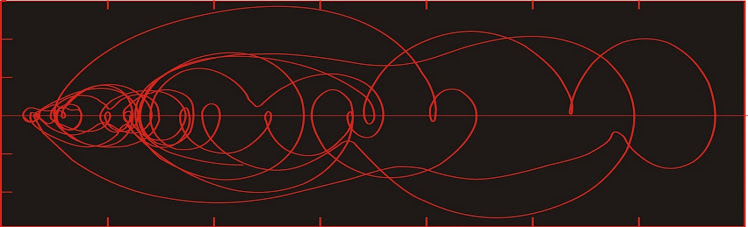
Two dimensional phase space reconstruction of dust flux from the Vostok core over the period 186-4 ka using the time derivative method. Dust flux on the x-axis, rate of change is on the y-axis. From Gipp (2001).
Saturday, July 30, 2011
Deconstructing algos, part 4: Phase space reconstructions of CNTY busted trades suggests high speed gang-bangs in the market
This summary is not available. Please
click here to view the post.


Thursday, July 28, 2011
Similarities between paleoclimate transfer function determination and statistical arbitrage
Paleoclimate transfer functions
Back in the day I was given the task of converting a set of programs from FORTRAN 66 to something that could be run on a PC. These programs were designed to use a wide variety of paleoclimatic indicator sets--in this case the relative abundances of 30 species of foraminifera, and known distributions of summer and winter temperature and salinities at the ocean surface over thousands of surface samples, and convert them into a transfer function which related the desired environmental parameters to the foraminiferal abundance data.

The basic idea is this: Summertime surface temperature (Ts) will be a function of the foraminiferal species abundance. If the abundances measured at a particular point were represented by the probability series p1, p2, p3, . . . , p30 (where Σp = 1), then an expression might be found as follows:
Ts = a1p1 + a2p2 + a3p3 + . . . + a30p30 + a31p1p1 + a32 p1p2 + . . . for a whole lot of terms. Assuming we used all first and second-order terms, we would have to develop 496 parameters in the above equation. That is rather a lot, particularly for the computers we were using when FORTRAN 66 was in vogue (well, okay, it was obsolete then--we were really using FORTRAN 77).
So instead of using all of the foraminiferal species abundance data, we would use factor analysis to simplify the data. Factor analysis is a bit of statistical wizardry which groups species which behave in a similar fashion together into a single factor. We would use the minimum number of factors to represent an acceptable amount of variance--in the case of transfer functions for the North Atlantic we reduced our thirty species to six factors. Our expression for temperature then becomes:
Ts = a1f1 + a2f2 + a3f3 + . . . + a6f6 + a7f1f1 + a8f1f2 + . . . +a27f6f6 + a28. Values for a1 to a28 were found by multiple regression. The PCs of the late 80's were capable of running such programs in a reasonable length of time.
Once all of the surface samples were run for the present day, you could look at the foraminifera found at different levels of a dated core. Let's say you have a sample from a level in a core known to be 100,000 years old. You count the numbers of the different species of foramifera, convert your observations into the factors determined above, and apply the factor loading scores to the transfer function, and you calculate the sea surface temperature at the site of your core 100,000 years ago.
As you might expect, there are a lot of things that can go wrong. The environmental preferences of one or more species might change on geological timescales. Different species might bloom during different times of the year, and this may also change due to evolutionary pressures or some confounding effect like iron seeding in coastal seas oceans due to variability in surface runoff. Nevertheless, the technique has been a mainstay of paleoclimatologists for about forty years.
Approaches to statistical arbitrage
The idea of statistical arbitrage is that there is a particular stock (or commodity or bond or what-have-you) which is mispriced relative to a model based on observations. This model would have the form of a transfer function as described above, but instead of using species abundance data, we use observed values of related financial data, including such things as the price of one or more indices, perhaps the unemployment rate, the inflation rate, the price of gold (or other commodities), and so on. Like in the transfer functions described above, having accurate financial data is critical (as opposed to manipulated "official" data sets).
There are at least two principal approaches to statistical arbitrage--1) concerning individual stocks (or commodities or bonds or whatever and 2) involves matched long-short trades between any number of stocks.
Instead of creating a transfer function between your observations and a particular stock price, you might find the ratio between the prices of two stocks. If the modeled ratio differs from the observed ratio, there may be an arbitrageable opportunity by going long the underpriced stock and short the overpriced one. Your assumption is that the dynamics of the ratio between the two prices has not changed so you plan to take advantage of the reversion to the mean. You don't know whether mean reversion will occur by the overpriced stock falling or the underpriced one rising, but the paired trade should work provided the relationship between the stocks does return to the mean.
Speed comes into play because it is an advantage to be the first market participant to recognize the arbitrage opportunity. As the world is now filled with algorithms seeking these opportunities they tend not to be available for long. One recent exception was in Canadian banks a few years ago, when two of the major banks were thought to be in trouble (and their dividend yields rose quite sharply as share prices fell)--there was a great trade in going long the high-yielding stocks and short the low-yielding stocks (on the assumption that in Canada there will not be a bank failure).
Many institutions calculate highly involved stat-arb positions involving matched long and short positions over large numbers of stocks. It can be difficult for a human to see how all the matches work. For human traders, stat arb probably works best in paired stocks, or a stock vs. an index.
For the record, I don't have any problem with algos pursuing stat arb. It seems to me to be an inherently fair process, and potentially it does improve liquidity if the under/overvaluation is driven by some sort of investor frenzy. I would have a problem if part of the strategy of the algo is to interfere with the access to information of market competitors by creating latency.
Back in the day I was given the task of converting a set of programs from FORTRAN 66 to something that could be run on a PC. These programs were designed to use a wide variety of paleoclimatic indicator sets--in this case the relative abundances of 30 species of foraminifera, and known distributions of summer and winter temperature and salinities at the ocean surface over thousands of surface samples, and convert them into a transfer function which related the desired environmental parameters to the foraminiferal abundance data.

This really brings back memories.
The basic idea is this: Summertime surface temperature (Ts) will be a function of the foraminiferal species abundance. If the abundances measured at a particular point were represented by the probability series p1, p2, p3, . . . , p30 (where Σp = 1), then an expression might be found as follows:
Ts = a1p1 + a2p2 + a3p3 + . . . + a30p30 + a31p1p1 + a32 p1p2 + . . . for a whole lot of terms. Assuming we used all first and second-order terms, we would have to develop 496 parameters in the above equation. That is rather a lot, particularly for the computers we were using when FORTRAN 66 was in vogue (well, okay, it was obsolete then--we were really using FORTRAN 77).
So instead of using all of the foraminiferal species abundance data, we would use factor analysis to simplify the data. Factor analysis is a bit of statistical wizardry which groups species which behave in a similar fashion together into a single factor. We would use the minimum number of factors to represent an acceptable amount of variance--in the case of transfer functions for the North Atlantic we reduced our thirty species to six factors. Our expression for temperature then becomes:
Ts = a1f1 + a2f2 + a3f3 + . . . + a6f6 + a7f1f1 + a8f1f2 + . . . +a27f6f6 + a28. Values for a1 to a28 were found by multiple regression. The PCs of the late 80's were capable of running such programs in a reasonable length of time.
Once all of the surface samples were run for the present day, you could look at the foraminifera found at different levels of a dated core. Let's say you have a sample from a level in a core known to be 100,000 years old. You count the numbers of the different species of foramifera, convert your observations into the factors determined above, and apply the factor loading scores to the transfer function, and you calculate the sea surface temperature at the site of your core 100,000 years ago.
As you might expect, there are a lot of things that can go wrong. The environmental preferences of one or more species might change on geological timescales. Different species might bloom during different times of the year, and this may also change due to evolutionary pressures or some confounding effect like iron seeding in coastal seas oceans due to variability in surface runoff. Nevertheless, the technique has been a mainstay of paleoclimatologists for about forty years.
Approaches to statistical arbitrage
The idea of statistical arbitrage is that there is a particular stock (or commodity or bond or what-have-you) which is mispriced relative to a model based on observations. This model would have the form of a transfer function as described above, but instead of using species abundance data, we use observed values of related financial data, including such things as the price of one or more indices, perhaps the unemployment rate, the inflation rate, the price of gold (or other commodities), and so on. Like in the transfer functions described above, having accurate financial data is critical (as opposed to manipulated "official" data sets).
There are at least two principal approaches to statistical arbitrage--1) concerning individual stocks (or commodities or bonds or whatever and 2) involves matched long-short trades between any number of stocks.
Instead of creating a transfer function between your observations and a particular stock price, you might find the ratio between the prices of two stocks. If the modeled ratio differs from the observed ratio, there may be an arbitrageable opportunity by going long the underpriced stock and short the overpriced one. Your assumption is that the dynamics of the ratio between the two prices has not changed so you plan to take advantage of the reversion to the mean. You don't know whether mean reversion will occur by the overpriced stock falling or the underpriced one rising, but the paired trade should work provided the relationship between the stocks does return to the mean.
Speed comes into play because it is an advantage to be the first market participant to recognize the arbitrage opportunity. As the world is now filled with algorithms seeking these opportunities they tend not to be available for long. One recent exception was in Canadian banks a few years ago, when two of the major banks were thought to be in trouble (and their dividend yields rose quite sharply as share prices fell)--there was a great trade in going long the high-yielding stocks and short the low-yielding stocks (on the assumption that in Canada there will not be a bank failure).
Many institutions calculate highly involved stat-arb positions involving matched long and short positions over large numbers of stocks. It can be difficult for a human to see how all the matches work. For human traders, stat arb probably works best in paired stocks, or a stock vs. an index.
For the record, I don't have any problem with algos pursuing stat arb. It seems to me to be an inherently fair process, and potentially it does improve liquidity if the under/overvaluation is driven by some sort of investor frenzy. I would have a problem if part of the strategy of the algo is to interfere with the access to information of market competitors by creating latency.
Tuesday, July 26, 2011
Feces-throwing primates rule the world!
As humans have a primate origin, sometimes we can gain valuable insight into human behaviour by studying primates. For instance, primates are known for throwing shit at things when we are angry.
It is true we don't literally do this anymore. Well, not often. But it is still embedded within our psychology. In our language--we might say, "my boss just shit all over me after presentation," or perhaps, "I'm tired of all your crap", or even, "let's go over there and beat the shit out of them!".
I find it terribly amusing and a little frightening to consider that psychologically we do not much differ from those little monkeys up in the trees throwing shit at each other.
Only we have rockets and nuclear weapons.
In fact we can view the history of warfare as the development of better and better means of throwing shit. The relentless march of technological progress in warfare has been driven by the need to improve three parameters--1) range; 2) accuracy; 3) explosive yield.
Over the years we have progressed from the invention of the catapult to the ultimate dream of primate-kind--brave American technicians sitting in bunkers in Nevada hurling shit at unsuspecting Afghan villagers by remote control. Intercontinental shit-throwing!
We've even managed to hurl some of our shit right out of the solar system!
The war policy of the western powers ever since WWII has been predicated around throwing large volumes of shit from aircraft. Victory through air power!
Viewing some of our modern political problems through the prism of our primate past may provide an interesting perspective.
There is currently considerable consternation over the Iranian regime developing the ability to hurl shit 2,000 km. Why a country that can hurl shit right out of the solar system feels this is a problem is unclear.
There is a lot of noise coming from Israel, which is close enough to be struck by the Iranian shit-flinging devices. But they have tremendous retaliatory capacity--enough to completely bury Iran. Nevertheless they endlessly lobby the US to ensure that American shit will be added to Israeli shit in an attack on Iran.
Meanwhile, the shit-throwing continues in Libya.

Over the years we have progressed from the invention of the catapult to the ultimate dream of primate-kind--brave American technicians sitting in bunkers in Nevada hurling shit at unsuspecting Afghan villagers by remote control. Intercontinental shit-throwing!
We've even managed to hurl some of our shit right out of the solar system!
The war policy of the western powers ever since WWII has been predicated around throwing large volumes of shit from aircraft. Victory through air power!
Viewing some of our modern political problems through the prism of our primate past may provide an interesting perspective.
There is currently considerable consternation over the Iranian regime developing the ability to hurl shit 2,000 km. Why a country that can hurl shit right out of the solar system feels this is a problem is unclear.
There is a lot of noise coming from Israel, which is close enough to be struck by the Iranian shit-flinging devices. But they have tremendous retaliatory capacity--enough to completely bury Iran. Nevertheless they endlessly lobby the US to ensure that American shit will be added to Israeli shit in an attack on Iran.
Meanwhile, the shit-throwing continues in Libya.

"As of March 20, Royal Canadian Armed Forces have been ordered to begin
flinging poo at forces loyal to Colonel Qadaffi."
Thursday, July 21, 2011
The World Complex welcomes new readers
This article has attracted a little attention from somebody taking a break from the debt-ceiling debate.

Edit: Perhaps they're just looking for a place to invest their hard-earned cash.
Monday, July 18, 2011
HFT hits the housing market
The short-sale fraud in housing looks a lot like HFT only on a longer timeframe. It makes use of the same phenomenon--the asymmetry in available information.
The way it works is simplicity itself.
For those who say this is all fair--and that anyone is capable of acquiring the software and hardware (or alternatively, that anyone who has gone to all that expense deserves the profit), please note that similar behaviour in the housing market (where it is banks who suffer) is fraud, so therefore . . .

The way it works is simplicity itself.
The scam artists, usually real estate agents, will secure a legitimate bid on a home, one where the borrower owes far more on the mortgage than the home is worth. Then they arrange for an accomplice investor to make a lower offer on the home.
The agent then presents the lower bid to the lender and asks them to forgive any remaining balance owed -- without disclosing that there was a higher bid made on the home. Once the short sale is approved, the scammer then sells the home to the higher bidder, often on the same day.At heart this is what latency arbitrage is all about. Delay price quotes and get your counterparty a poor price while you know better ones are available.
For those who say this is all fair--and that anyone is capable of acquiring the software and hardware (or alternatively, that anyone who has gone to all that expense deserves the profit), please note that similar behaviour in the housing market (where it is banks who suffer) is fraud, so therefore . . .

Subscribe to:
Posts (Atom)