Dust flux, Vostok ice core

Dust flux, Vostok ice core
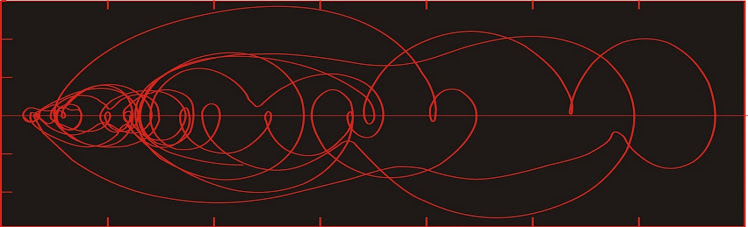
Two dimensional phase space reconstruction of dust flux from the Vostok core over the period 186-4 ka using the time derivative method. Dust flux on the x-axis, rate of change is on the y-axis. From Gipp (2001).

Sunday, January 26, 2014

Operation Oblivion airs tonight

Promo video below, more information here.


Thirteen Chinese Canadians volunteered to go behind enemy lines to organize Chinese resistance against Japanese occupation. Although their principal mission was cancelled due to political infighting, their actions were instrumental in acquiring the rights of citizenship for Chinese Canadians.

My great uncle is the last surviving member.

Saturday, January 25, 2014

The recent stability of silver

It's been a few months since my last posting on silver in phase space--let's see what's new.

As before we have reconstructed a phase space portrait from weekly closing prices of silver, using a lag of six weeks. Such a graph as we have indicated before is topologically equivalent to a plot of the silver price against its rate of change.


The three white circles show the areas of attraction that were identified prior to the middle of 2013. The yellow circle near the centre represents the totality of the system states since June of 2013.

I should point out here that I have reversed the axes with respect to the earlier silver plots. I am trying to make this consistent with other plots I have done with the principal axis being vertical rather than horizontal.

There is nothing special about the dates listed in blue--it is just difficult otherwise to label points that are not at the extremes of the function.

When silver broke down from the highest area of attraction (in the $30 range), I had forecast it to fall to the middle area of attraction (<$20). As we saw last time, it just missed, and since then has been filling in a zone of attraction which looks to be centered at just over $20.

The current work of filling in a basin of attraction is similar to the notion of gap-filling in standard TA, which seems to be the obvious interpretation. If the silver market as a whole is probably smarter than a lot of individual investors, then there may be another interpretation. The yellow area and the middle white one are the same attractor, but appear separate because of inflation.

The last time the system occupied the middle white attractor (centered at $18) was mid-2010. We entered the yellow attractor (centered at $22) in mid-2013, three years later. A price rise from $18 to $22 is an increase of 22%, which over three years compounded is a whisker under 7%.

Is 7% a good estimate of annual inflation (that is in the commonly accepted definition of a rise in prices, not the correct definition of increase in money supply)? It feels truer than the official pronouncements, but I have seen both higher and lower estimates.

Going forward--my gut feeling is that we haven't finished filling in this area of attraction yet. We could easily spend another six months here, although hopefully in the higher part of the range (up to about $24). Afterwards, the higher white area of attraction comes back into play. Will we see another adjustment for inflation at that time?

There is still an obvious looking gap between our present state and the higher area of attraction beyond, and it wouldn't be surprising to see the silver price state fill that gap before moving higher.

Friday, January 24, 2014

Contrasting notions of risk in the developing and undeveloping world

Today's topic is risk. Not financial risk. Personal risk.

Last year I and our financial adviser had a meeting at the Canadian offices of an international engineering firm to discuss a project in Africa. We were a few minutes early for the meeting, but to my surprise, we were informed we would not be allowed to go into the conference room until we watched a safety video. The safety video represented about thirty minutes of my life I will never get back. Worse, it implies that other, similar, losses are likely in my future.

The film advised us that if we saw anyone fall, we had to report it, even if there were no injuries. All injuries, even paper cuts, also had to accompanied by a sheaf of reports to the appropriate authority.

The excess regulation of risk is a defining characteristic of a country that has passed the developing stage and is entering the undeveloping stage. It is mirrored by a changing time-preferences of money from leading a society from civilization to decivilization.

Now in Africa, on the other hand, I once had to find local operators and a local fishing vessel (dugout canoe) to run a small sidescan sonar survey. So I hit the local fishing harbour, found a crew that had been operating daily for more than two years, hired them, and started work.

One of our company executives was an engineer, and he was horrified by my quick decision--hiring these local fishermen to do the job (unless they first had appropriate safety training, which appeared to involve a lot of lifeboat and man-overboard drills). Besides, he asked, how do you know these guys can operate the boat safely? My answer was that they have been going out to sea every day for two years and are still alive. In any event, we completed a series of missions over the next two months without mishap.

About fifteen years ago, I was tasked with finding some local Ghanaians to be trained as commercial divers. We brought a diving instructor from Canada, and I advertised for people who could swim. There were many applicants. I went into town on some errands and left the diving instructor and his assistant to vet the applicants at a local hotel swimming pool. When I returned that evening they were exhausted--they had spent all day rescuing applicants. When told to swim across the pool, they jumped in without fear and sank straight to the bottom.

At length we found some good swimmers, and they completed their training. But at the end of their training, the instructor in good conscience could not pass them--for without exception, they refused to believe in the "bends". I think it was because they were all experienced free-divers, and in free-diving there are no consequences to a rapid rise. During the pool practice dives, they would always ascend by inflating their BCDs, sending them rocketing to the surface. No amount of explanation could convince them to do otherwise.

At around the same time, we rented a vessel and hired our first ocean-going crew. Our first gift to them were life jackets. Every day we arrived at the village, they would put on their life jackets, as they brought all the equipment to the boat. Then as we set sail--their life jackets were gone. Where were they? One of them told me that they didn't want to risk anything happening to them while at sea, so they left them at home.

When they were hired, they had assured me that they had abundant experience at sea. Unfortunately, their experiences were limited to hauling in fishing nets. They had never been to sea on their own before. We had a few exciting adventures in the first couple of weeks getting the vessel through the surf zone (especially landing), but after that they got the hang of it, and we completed the project without issue.

The view of personal risk in the developing world is clearly different than back here.
Monday, January 20, 2014

Significance of the $1000 isoquant in gold

When last I mentioned isoquants, I suggested that the 1000-isoquant would be an important level for the next few months. A common thread of the commentary (after the etch-a-sketch comments) on ZH today was the difficulty of following the chart. So today I present two short segments involving the 1000-isoquant level to show why I think it has some importance.


The last year has consisted of a dizzying drop in the price of gold, a bounce in mid-summer and a lot of hard work in the last six months. The rapid fall in early 2013 bounced from the 1000 isoquant. There was a second small bounce in October, followed by a slight penetration of the 1000 isoquant last month. Friday's close is just above the 1000 isoquant.


The last time the gold x USDX was near the 1000 isoquant was in 2010, when it stayed there for nearly six months. Note that even though gold x USDX was nearly constant for that time, the gold price itself varied from less than $1200 to over $1350. This is the way we normally expect the price of gold to act--as the anti-dollar.

Over the last six years, sustained improvements in gold x USDX require the gains be digested for a time. Usually we see six or so months at one isoquant, before a move to a new one 100-150 points higher, which then needs six months or so before another move is sustainable. When gold spiked to $1800 in 2011, gold x USDX moved from just over 1100 to just over 1400 in too short a time--the result was the collapse we have just lived through back to the 1000 isoquant.

The significance of the isoquant is that changes in the price of gold that are offset by changes in the US dollar do not change the marginal economics of gold mine operations (that is costs in the country of operation, provided it is not the US). They do influence the ability of the company to repay debt, which is normally denominated in US dollars--however, many (I don't know if it is all) loan covenants include a gold-hedging component which in theory reduces the dollar risk to the producer. The company then only has to worry about producing x hundred thousand ounces of gold each year (if they can't deliver on their promises, well, that's another problem).

Friday, January 17, 2014

Video for upcoming PDAC

PDAC has a new video for the upcoming meeting.

I particularly like the tour of all the empty booths.


PDAC 2014 Convention Video – A Guided Tour from The PDAC on Vimeo.