If memory serves, this is exactly how it looked.
Dust flux, Vostok ice core
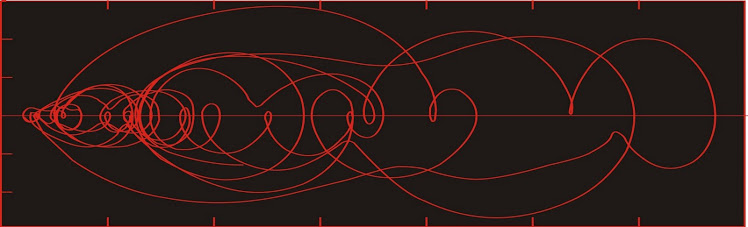
Two dimensional phase space reconstruction of dust flux from the Vostok core over the period 186-4 ka using the time derivative method. Dust flux on the x-axis, rate of change is on the y-axis. From Gipp (2001).
Friday, February 28, 2014


Saturday, February 22, 2014
A professional regret
I was asked to send a copy of the 2001 Paleoceanography paper to somebody recently and I noticed this one figure that I wish I could do over again.

The dashed curve in the upper graph should really have been reproduced in the lower one. Unfortunately I was hidebound by my recent discovery that insolation (that is the amount of sunlight received at certain latitudes on earth) drove the rate of change of global ice volume, rather than the ice volume itself, as was commonly supposed. So I likewise compared insolation to the rate of change of temperature in Antarctica, as deduced from the Vostok ice core temperature series.
Here is what it would have looked like had I compared insolation to Antarctic temperatures

It looks like a reasonable comparison, in that geological arm-waving way. It is a bit curious that the Antarctic temperature responds to northern-hemisphere insolation, but that's part of the wonder of the world.
As an aside--just before publication, the journal editor questioned me very closely about the title. He presumably thought it was some kind of joke, and this was a serious journal that published serious science, and titles were definitely no joking matter. I managed to convince him that it was not a joke. But it was!
The dashed curve in the upper graph should really have been reproduced in the lower one. Unfortunately I was hidebound by my recent discovery that insolation (that is the amount of sunlight received at certain latitudes on earth) drove the rate of change of global ice volume, rather than the ice volume itself, as was commonly supposed. So I likewise compared insolation to the rate of change of temperature in Antarctica, as deduced from the Vostok ice core temperature series.
Here is what it would have looked like had I compared insolation to Antarctic temperatures
It looks like a reasonable comparison, in that geological arm-waving way. It is a bit curious that the Antarctic temperature responds to northern-hemisphere insolation, but that's part of the wonder of the world.
As an aside--just before publication, the journal editor questioned me very closely about the title. He presumably thought it was some kind of joke, and this was a serious journal that published serious science, and titles were definitely no joking matter. I managed to convince him that it was not a joke. But it was!
Tuesday, February 18, 2014
A nugget of info
. . . from the World Gold Council report (Gold Demand Trends for 2013) issued early this morning.
Hidden away in the middle of the report was an interesting observation--that Germany was the only European country in which investment demand for gold increased over 2012. I suppose all the other Europeans are happy with their euros.
I wonder if it is coincidental that the Bundesbank is the only European central bank to ask for its gold back from the US?
Hidden away in the middle of the report was an interesting observation--that Germany was the only European country in which investment demand for gold increased over 2012. I suppose all the other Europeans are happy with their euros.
I wonder if it is coincidental that the Bundesbank is the only European central bank to ask for its gold back from the US?
Monday, February 17, 2014
The village hammer
In response to the higher than usual amount of spam being sent to the World Complex, here's a little story. (BTW, thank you for your story about trying to get a loan from a god-fearing man, Mrs. Monica Roland. But the last time I was in Singapore, the unit of currency was not the pound).
We were about to run a small survey from a fishing vessel out of a small village in the western region. The geophysical gear had to be towed from the side, so I prepared to nail a beam to the boat, so we could tow the gear from a fixed point about 2 m off the side of the vessel. Unfortunately, my hammer had gone missing sometime during the trip--but one of our local employees told me he had one in his house just around the corner, so off he goes to get the hammer.
So we wait. And wait. And wait. A few hours pass, and then he returns with the hammer. I asked him what took so long. "Someone else was using it." Two minutes of hammering and we were done. Out to sea.

Not sure how clear this is to you, but this is a bit of raw seafloor acoustic imagery, with no navigational corrections (we wobble a bit and our speed changes due to wave action). The width of the image is about 90 m, and the length is a little over 500 m. The prominent light coloured bodies with the ripple marks are sand bodies with dunes; the darker material is soft sediment (silt), and the light blotches are bedrock outcrop.
Update: The image upload isn't that good. Bloody google.
We were about to run a small survey from a fishing vessel out of a small village in the western region. The geophysical gear had to be towed from the side, so I prepared to nail a beam to the boat, so we could tow the gear from a fixed point about 2 m off the side of the vessel. Unfortunately, my hammer had gone missing sometime during the trip--but one of our local employees told me he had one in his house just around the corner, so off he goes to get the hammer.
So we wait. And wait. And wait. A few hours pass, and then he returns with the hammer. I asked him what took so long. "Someone else was using it." Two minutes of hammering and we were done. Out to sea.
Not sure how clear this is to you, but this is a bit of raw seafloor acoustic imagery, with no navigational corrections (we wobble a bit and our speed changes due to wave action). The width of the image is about 90 m, and the length is a little over 500 m. The prominent light coloured bodies with the ripple marks are sand bodies with dunes; the darker material is soft sediment (silt), and the light blotches are bedrock outcrop.
Update: The image upload isn't that good. Bloody google.
Friday, February 14, 2014
The "Garlic Ballads" award goes to . . .
. . . the government of Thailand. Congratulations on your rice-purchasing scheme, which threatens to conjure a famine out of plenty.
The Garlic Ballads, a semi-fictional novel by Mo Yan is about just the same topic--the peasants of a Paradise County are encouraged to focus all their efforts on growing garlic, as the government offered to pay a good price for every stalk they could produce. Things went swimmingly until one year, the region produces the bumper crop to end all bumper crops. The farmers see they are going to produce more garlic than ever before; excitedly calculate their forthcoming profits; and plan their spending. Their excitement is piqued as the first farmers to market sell their entire crop, reaping more money than they've ever seen. But before long the warehouses are full, and the government simply announces they won't be purchasing any more garlic, precipitating a riot.
Horrors follow. The county only grew garlic, so those who were unable to sell theirs are forced to try to survive on nothing but their crop of garlic--and the grass, and the bark from the trees--surrounded by the overpowering stench of garlic rotting in the fields and from every room in every house. Famine in the midst of plenty.
There's no misfortune quite like centrally planned misfortune.
The Garlic Ballads, a semi-fictional novel by Mo Yan is about just the same topic--the peasants of a Paradise County are encouraged to focus all their efforts on growing garlic, as the government offered to pay a good price for every stalk they could produce. Things went swimmingly until one year, the region produces the bumper crop to end all bumper crops. The farmers see they are going to produce more garlic than ever before; excitedly calculate their forthcoming profits; and plan their spending. Their excitement is piqued as the first farmers to market sell their entire crop, reaping more money than they've ever seen. But before long the warehouses are full, and the government simply announces they won't be purchasing any more garlic, precipitating a riot.
Horrors follow. The county only grew garlic, so those who were unable to sell theirs are forced to try to survive on nothing but their crop of garlic--and the grass, and the bark from the trees--surrounded by the overpowering stench of garlic rotting in the fields and from every room in every house. Famine in the midst of plenty.
There's no misfortune quite like centrally planned misfortune.
Subscribe to:
Posts (Atom)