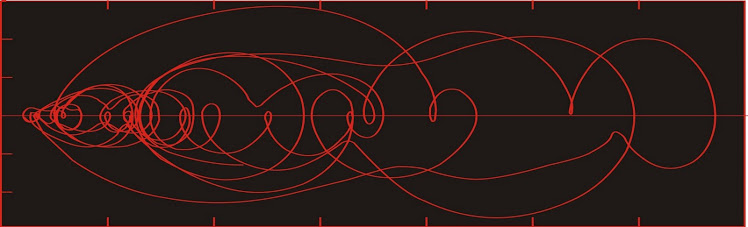
Dust flux, Vostok ice core

Dust flux, Vostok ice core
Two dimensional phase space reconstruction of dust flux from the Vostok core over the period 186-4 ka using the time derivative method. Dust flux on the x-axis, rate of change is on the y-axis. From Gipp (2001).
Showing posts with label Keynsian rules of inference. Show all posts

Tuesday, October 4, 2011

You must remember what Keynesians forgot

One characteristic of time series that we have been able to study through reconstructed phase spaces is the concept of long memory. In principle, the future evolution of the state of a complex system is dependent on the entire past history of the system.

The prescriptions of Keynesianism in modern economics ignores the long memory of the system. Keynesians believe that application of policy A brings about response B. In a system with long memory, the response is also dependent on the previous history of the system--hence lowering interest rates in 2011 does not bring about the same response as lowering them in 2001--because the history prior to 2011 differs from history prior to 2001.


Monday, September 19, 2011

Brilliant discovery in economics: A review of Johansen and Simonsen (2011)

This paper shows the kind of brilliant research that gets done now that economic commentary is only pursued by Ph.D.s.

In this paper, Johansen and Simonsen (2011) come to the surprising conclusion that (spoiler alert!) the US economy operates on Keynesian principles; which differs significantly from its official policy of creating credit whenever a problem appears.

The principal evidence offered in support of the author's conclusions is the following chart, showing that both the value of the Dow Jones Industrial Average (DJIA) and the amount of public debt have increased logarithmically since the late 18th century. And since correlation implies causation, the rise of the DJIA must be due to the increasing public debt.

Correlation between DJIA and U.S. public debt. From Johansen and Simonsen (2011).

Now that we understand how the economy works, it becomes clear how we move forward. Raise public debt. Boost the DJIA! The trickle down effects on the economy shall enrich us all.

Notice how public debt jumps at particular intervals--especially around 1812, 1860, 1914, 1940, and steadily after about 1965. These increases in debt relate to wars, proving the Keynesian adage that war is good for the economy.

Of course there might be a few other variables that increased over the same time, which might also contribute to that rising DJIA.

Population increased, as did infrastructure construction and economic activity. Might these factors have influenced the DJIA? Most of that economic activity had nothing to do with wars, but did have a lot do with increasing the American standard of living.

Probably the most important factor is the increased availability of cheap energy.

Looking at the chart again, I worry a bit about that last increase in the DJIA just before the end of the chart. Looks like it's about 5x more expensive than the historical trend. Quick! Somebody borrow more money!

Reference:

Johansen, A., and Simonsen, I., 2011. Keynesian Economics After All. Submitted (but they don't admit where).

Tuesday, August 10, 2010

Volcker-Bernanke puzzle no puzzle

In a recent article in the Asian Times, Hossein Askari and Noureddine Krichene, who I can only assume pass for economists, talk about the effects of interest rates on unemployment. They propose the existence of the "Volcker-Bernanke puzzle", which I will leave to them to describe. . .


"Assuming Fed chairman Ben Bernanke succeeds in reverting the US economy to full employment and rapid growth, then economic historians will be facing a difficult puzzle that could be coined the Volcker-Bernanke puzzle. Paul Volcker, Fed chairman from August 1979 to August 1987, got the US economy out of 11-12% unemployment by pushing money market rates to 19%. Bernanke pushed unemployment from 4% to 10% through aggressive monetary policy with near-zero interest rates, massive monetary injection, and buying all toxic bank loans; however, Bernanke, if he does succeed by his indicated path, will have pulled the US out of 10% unemployment by even more monetary stimulation."

Well, that certainly is a conundrum! But wait a minute. . . isn't that first assumption a little presumptuous?


"Somehow, either extreme, very tight or very loose monetary, could be followed by policymakers to solve the unemployment problem and propel the economy back to prosperity. It makes no difference which extreme is adopted!"


Amazing! No matter what we do, the economy will recover! Of course that doesn't explain how we got into trouble in the first place.


Maybe our problem was that after the fall of Volcker and before the rise of Bernanke, our interest rates were too moderate. They should have been either much higher or much lower! Now who was the guy in charge of setting interest rates back then?

I'm still not getting the puzzle though. On one hand, raising interest rates ultimately resulted in lower unemployment. On the other, lowering interest rates "pushed unemployment from 4% to 10%".

I still don't see a problem. One method produces lower unemployment, and the other produces high unemployment. Logically, you simply choose the method which produces the desired outcome. Given all the Ph.D. economists working on this, we can only assume that that indeed is what is happening.

So what is the puzzle? Our favourite economists again . . .

"Assuming Fed chairman Ben Bernanke succeeds in reverting the US economy to full employment and rapid growth, then economic historians will be facing a difficult puzzle that could be coined the Volcker-Bernanke puzzle."

Well always assuming that of course. We might also add  . . .

Assuming leprechauns exist, Obama's new economic plan wherein Federal agents are to be tasked with chasing rainbows in order to seize pots of gold at their ends will balance the Budget by 2012 at the latest.

It's hard to know on what basis this assumption is being made (the Askari-Krichene assumption, that is*). I hereby formally name this assumption after them with the sincere hope that it leads to their lasting fame.

Formally the Askari-Krichene assumption goes as follows:

"Assuming Fed chairman Ben Bernanke succeeds in reverting the US economy to full employment and rapid growth (which is precisely the opposite of what we are empirically observing), then economic historians will be facing a difficult puzzle that could be coined the Volcker-Bernanke puzzle."

We could add to their fame by creating an entire genre of logical statements that could be referred to as Askari-Krichene logical positions as follows . . .


If A is observed, then assume not A.

Which can be reduced to the Askari-Krichne Rule of Inference for Keynesian Economics:

If A then not A.


*The assumption about leprechauns follows from careful empirical observations.