Dust flux, Vostok ice core

Dust flux, Vostok ice core
Two dimensional phase space reconstruction of dust flux from the Vostok core over the period 186-4 ka using the time derivative method. Dust flux on the x-axis, rate of change is on the y-axis. From Gipp (2001).
Showing posts with label Wealth. Show all posts

Saturday, March 8, 2014

The changing dynamics of generational wealth transfer in the bubble economy

About fifteen years ago I started travelling around various local church sales, buying silver--mostly jewellry, but also spoons, candlesticks, cutlery, whatever could be found. At the time, the stuff was dirt cheap, and there was no competition. That all changed in the following years, and it has been a few years since I last went looking for the stuff.

An acquaintance of mine pointed out that that was the traditional way to accumulate wealth--the young take advantage of the old, buying the things they no longer wanted. It sounds distasteful, but there is a kind of logic to it.

The classic, of course, was property. The archetypical scenario, with the young fellow cajoling the elderly pensioner to sell his house. "Come on, grandpa. You don't really want to keep going to the trouble of maintaining this place, do you? I'll give you a good price for it."

In older times, I don't think we thought of our homes as having value--other than the value of a place to live. With this mindset, the value of a house changes constantly throughout your life--having greater value when you are young, as its value becomes the net present value of all your future years living in it minus the costs of maintaining it. As you age, that value declines. So if the owner is elderly, we have a situation where the value of the house is much higher to the (presumably young) interested buyer than it does to the seller.

That discrepancy in value creates the opportunity for a really good deal for both sides. The pensioner can receive a sum of money much greater than the house is worth to him, while the buyer pays less than his perception of the house's value.

Since the fall in interest rates that began in 1980, house prices rose so much, creating a "wealth effect" that enriched the majority of homeowners, and changed their perception of the value of a house. Now the value of a house is "objectively" determined by other sales in the area--and not by an individual's life circumstances. It's no longer a purely personal decision either--a homeowner's choice to sell at a lower price will affect the prices of other houses in the neighbourhood, and would be looked upon as a betrayal by the seller's former neighbours.

The new perception of a house as objectively definable wealth now seems to be ubiquitous, but is a recent state of the human condition. The old dynamic, a form of inter-generational wealth transfer, has disappeared in the depersonalization of financial affairs.

Tuesday, December 10, 2013

The rise of the virtual economy, part 2--retail consumption indicators

I recently received some publications from Dr. Ray Huffaker, who studies reconstructed phase space portraits from agricultural cycles. There are some interesting data sets presented in these papers which echo some of the themes I've argued in earlier postings.


The above figure shows retail beef consumption per capita. Data comes from the USDA, the figure is snipped from McCullough et al. (2012). Notice the large decline in the late 1970s. Perhaps you think that decline was due to changing preferences in meat--perhaps more Americans chose to eat pork instead.


Data and figure as above--notice there is also a decline in per capita pork consumption at the same time. Not as marked as the decline in beef, but still present.


Comparison of metal usage to global GDP. Chart from 
Handselbanken Capital Markets.

As posted before, something appears to have happened to the economy in the late 1970s, which puts the lie to the reported GDP growth figures. Would the government exaggerate these numbers? Perhaps to tell you that the economy is doing fine, and if you happen to be experiencing a drop in your standard of living, well, you just need to work harder. Or go buy something with no money down and no payments for three years.

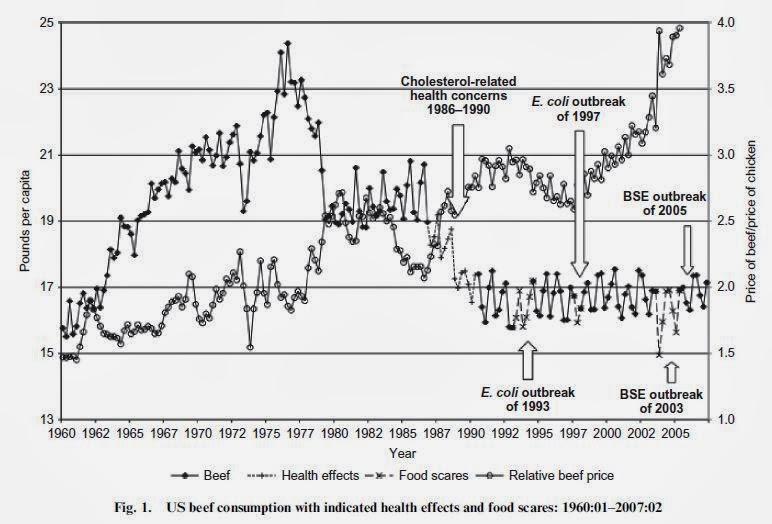
One last figure. Perhaps the decline in beef consumption was due to the "cholesterol scare".


In this figure from McCullough et al. (2013), we see that the cholesterol scare happened after the major decline in beef consumption. Furthermore, the major declines in beef consumption both correlate to increases in the relative price of beef (the beef/chicken ratio on the right axis).

Some comments on previous articles suggested that the decline in copper and zinc production was due to replacement with plastics or aluminum. My counter to that was that copper cannot be replaced in most of its applications, and the decline in copper consumption speaks to a real decline in economic activity--one which was not reflected in reported GDP numbers. The simultaneous per-capita decline in beef and pork consumption supports this conclusion.

References:

McCullough, M. P., Huffaker, R., and Marsh, T. L., 2012. Endogenously determined cycles: Empirical evidence from livestock industries. Nonlinear Dynamics, Psychology, and Life Sciences, 16: 205-231.

McCullough, M. P., Marsh, T. L., and Huffaker, R., 2013. Reconstructing market reactions to consumption harms. Applied Economics Letters, 20: 173-179. doi: 10.1080/13504851.2012.687091.

Saturday, November 23, 2013

Interpretation of scaling laws for US income

It has been remarked that if one tells an economist that inequality has increased, the doctrinaire response is "So what?"
                                          - Oxford Handbook of Inequality

h/t Bruce Krasting

Social Security online has published a full report on income distribution in America.

Two years ago we looked at the distribution of wealth in America. Today we are looking at income.


There were a total of about 153 million wage earners in the US in 2012, which is why the graph suddenly terminates there.

As we have discussed before, in self-organizing systems, we expect the observations, when plotted on logarithmic axes, to lie on a straight line. Casual observation of the above graph shows a slight curve, which gives us some room for interpretation.

I have drawn two possible "ideal states"--the yellow line and the green line. Those who feel the yellow line best represents the "correct" wealth distribution in the US would argue that the discrepancy at the lower income (below about $100k per year) represents government redistribution of wealth from the pockets of the ultra-rich to those less deserving. Followers of the green line would argue the opposite--that the ultra-wealthy are earning roughly double what they should be based on the earnings at the lower end.

Which is it? Looking at the graph you can't tell. But suppose we look at the numbers. Adherents of the yellow line would say that roughly 130 million people are getting more than they should. The largest amount is about 40%, so if we assume that on average these 130 million folks are drawing 20% more than they should (thanks to enslavement of  the ultra-wealthy), we find that these excess drawings total in excess of $1 trillion. Thanks Pluto!

The trouble with this analysis is that the combined earnings of the ultra-wealthy--the top 100,000--earned a total of about $400 billion. They simply aren't rich enough to have provided the middle class with all that money.

Now let's consider the green line. Here we are suggesting that the ultra-wealthy are earning about twice as much as they should be, and let's hypothesize that this extra income is somehow transferred from the middle and lower classes.

As above, the total income of the ultra-rich is about $400 billion. If half of this has been skimmed from the aforementioned 130 million, they would each have to contribute about $1500.

I expect a heavier weight has fallen on those at the upper end of the middle-class spectrum; but even so, $1500 per wage earner does seem doable. Of the two interpretations, the green line looks to be at least plausible, and we are forced to conclude that those who believe the ultra-wealthy are drawing a good portion of their salaries from everyone else have a point.

But isn't $1500 per year a small price to pay to create a really wealthy super-class?

Paper on causes of income inequality full of economic axiomatic gibberish here (pdf).

Wednesday, July 17, 2013

How financialization began in the western world

only debts grew exponentially, year after year, and they do so inexorably, even when–indeed, especially when–the economy slows down and its companies and people fall below break-even levels. As their debts grow, they siphon off the economic surplus for debt service (...) The problem is that the financial sector’s receipts are not turned into fixed capital formation to increase output. They build up increasingly on the opposite side of the balance sheet, as new loans, that is, debts and new claims on society’s output and income.
                                                          - Michael Hudson (2003)
A couple of years ago I questioned the reality of reported GDP, as it seemed to conflict with the rate of usage of real resources. One figure I used is reproduced below.

Source: Handselbanken Capital

When I think of the 50s and 60s (okay, I'm too young to remember much about the latter), I think of rapidly rising standard of living--at least in North America. The reduction in growth of usage of metals in the 70's I attributed largely to the energy crisis--and a slowing in the real economy. The manufactured GDP numbers kept on growing.

One recurring theme in describing the past few decades is the notion of financialization--which I view as using financial products to wring out profits for banking interests at the expense of producers.
[Companies] are not able to invest in new physical capital equipment or buildings because they are obliged to use their operating revenue to pay their bankers and bondholders, as well as junk-bond holders. This is what I mean when I say that the economy is becoming financialized. Its aim is not to provide tangible capital formation or rising living standards, but to generate interest, financial fees for underwriting mergers and acquisitions, and capital gains that accrue mainly to insiders, headed by upper management and large financial institutions. . . . Instead of labor earning more, hourly earnings have declined in real terms. There has been a drop in net disposable income after paying taxes and withholding "forced saving" for social Security and medical insurance, pension-fund contributions and–most serious of all–debt service on credit cards, bank loans, mortgage loans, student loans, auto loans, home insurance premiums, life insurance, private medical insurance and other FIRE-sector charges.
                                                                               - Michael Hudson (via)

There was a time when all you had to worry about was whether you could provide a service at a profit--even if you bought raw materials from one country, assembled them in a second, and sold the product in a third. Now you need to have a hedging program in place for currency fluctuations and another to manage your exposure to commodity price fluctuations--but there are costs to such programs, both in terms of money and intellectual effort which detract from the core business.

In recent years we have found whenever we send large wires to Ghana for operations, the money is held in transit until there is a sudden swing in exchange rates (not in our favour)--only then does the wire clear, and an unexpectedly smaller amount of money shows up at the bank in Ghana. Each time this happens, it represents a roughly 5% tax on money transferred--in addition to the normal costs of wire transfer.

Between regulation and financialization, the life is being strangled out of the producers. But we are supposed to be the richest people in history.

How did the process get started? The answer might be here.


Via (my annotations).

Creating paper to drive down the price of commodities makes you richer in the short term, but poorer in the long term, as lower prices encourage producers to make less. But if real wealth is copper, zinc, gold, oil, food--products, that is--then having more dollars but less things is a recipe for impoverishment.

For mining companies, lower prices tell them to reduce production and reduce exploration. And that is what the above chart shows. Gold prices began to rise in the 1970s, attracting capital. But what commodities improve your life more? Are you rich stockpiling gold when there isn't enough copper to make a functioning electrical grid or sewer system?

In an earlier posting (based on data sets that ran back to the mid-90s) I showed that gold attracted about 50% of all exploration finance (excluding mineral fuels). Clearly, this is not the normal historical situation, and we have to ask how the system arose.

It looks like in addition to the sudden loss of control of energy, capital was deployed into the commodity that was rising markedly in price. Gold was rising because it had suddenly been cut loose from the US dollar. And the emphasis in mining exploration ever since has been gold.

I think this was the precursor to the financialization of the past few decades--that money should be diverted to creating more money, instead of wealth.

At the World Complex we love gold. But at the same time we recognize that putting all of your effort into mining it doesn't necessarily raise your standard of living.

Thursday, January 24, 2013

The temple builders

So many of us in life start out building temples: temples of character, temples of justice, temples of peace. And so often we don’t finish them. Because life is like Schubert’s "Unfinished Symphony." At so many points we start, we try, we set out to build our various temples. And I guess one of the great agonies of life is that we are constantly trying to finish that which is unfinishable.
                             - Martin Luther King, 3 March 1968

One fact of life is that we can't fulfill all of our dreams. We have only limited time and resources. But modern life has a major additional obstacle which makes building temples more difficult than it needs to be--government. In particular, government's confiscation of resources which you might choose to use for your own benefit.

 - - - - - - - - - - - - - - - - - - - - - - - - - -

Bali is full of temples. Not only are there large public temples and town temples, but every home has a temple as well.


Temple in a lake. Too tired to look up its name.

The family temples start off simple, using blocks cut and fabricated on a mass scale from sandstone or lava. The temples are nevertheless ornate as the blocs are combined in an exceptionally creative manner, and decorated with intricate finials. As the family becomes wealthier, they will add more finials to the gate, and the temples themselves, as well as add more (pagodas), decorate them with finials of stone or metal. It is clear that a significant portion of the family's capital and time have gone into them. Temples are key focal points for the family, and the village.


One shrine within a homeowner's temple

Lest you feel superior for not succumbing to superstition, I should remind you (as a North American or European) also devote a large portion of your income to the building of temples. However, these temples are not in your backyard, nor do you have much input into them. Instead, your income is diverted, often before you see it, towards temples built supposedly on your behalf by your elected representatives. Examples follow:

 Source: mindfrieze
Here's a Canadian one. Source: Jcart1534

Did you ask for these? Did you want them built? Would you have built a different temple with your resources had they not been taken from you? Did building them fill you with serenity?

Have you seen the upkeep on them (especially the first two examples)? At least when you build a temple in your backyard, if you can't afford the maintenance, you can let it fall apart. What happens next is between you and God. But you aren't given the choice to let the Pentagon fall apart.

It's already hard to build the temples you want to build. Building a bunch of temples you don't want makes it harder.

Friday, April 13, 2012

Celebrating the debasement of our coinage (once again)

. . . with full-page colour ads in major newspapers.

The Toronto Star today had a two-page spread right in the centre of the news section. The Royal Canadian Mint is boldly announcing that the loonie ($1 coin) and toonie ($2 coin) will now be made of glorious steel ("multi-ply plated steel"), as opposed to nickel, as has been the case until now.

I always thought debasing the coinage was something governments did surreptitiously. One can't imagine Septimus Severus boasting about wonderful new plating technology covering coins manufactured by Rome's greatest leadsmiths. Of course in those days people actually thought about money.

Sunday, December 18, 2011

Self-organization and wealth distribution

The question of wealth inequality has been making headlines, in everything from the Occupy Wall Street movement and their decrying the wealth of the 1%, to discussion in the Republican Presidential-Candidate Popularity Contest currently ongoing in the US.

There have always been voices clamouring for equal wealth for everyone, but the real world doesn't work like that. Wealth inequality doesn't seem particularly unfair given the inequalities in natural abilities and access to capital or resources. Intuitively, it seems that the distribution of wealth in society will follow a power-law distribution. A power-law distribution is one in which the observations show a 1/f distribution, as described in this article.

Recent modeling studies suggest a 1/f distribution over most of the population, but wealth distribution becomes exponential near the tails. The model distribution is described as Pareto-like, with a relatively few super-wealthy floating over an ever-changing middle class.

So wealth inequality should be expected in any society, no matter how even the playing field. The skills necessary to navigate through the economy are not evenly distributed. Some individuals play better than others. Therefore, some individuals will be wealthier than others. Let's take a look through some public data and see if we can recognize a power-law distribution.

According to Wolff (2010), the breakdown of wealth among different quintiles (and finer groups) is:

Fraction of                        Fraction of 
population                         wealth

Lowest 40%                      0.2%
40 - 60%                            4.0%
60 - 80%                          10.9%
80 - 90%                          12.0%
90 - 95%                          11.2%
95 - 99%                          27.1%
99 - 100%                        34.6%

Given that the wealth of Americans in 2007 was reported by the Fed to be $79.482 trillion, and the population of the US at that time was 299,398,400 (roughly), we can plot a logarithmic graph of individual wealth vs population to check for self-organization in wealth distribution.

In order to do this, I have estimated that the wealth of the individual in the middle of each group to have the average wealth of the group. Based on past experience, this estimate will tend to be biased--however given the number of orders of magnitudes on the resulting graph, the errors are so small as to be unnoticed.


To interpret this graph, consider the first two points--they suggest that roughly 80 million people have less than about $2,500, and about 130 million people have less than about $75,000. Most of the data appear to lie along a line of fit, but there are a few exceptionally rich individuals, including some on the Forbes 400 list, who plot far above the line. 

Also note that "the 99%" includes people that have about $8 million in assets.

The observed distribution agrees somewhat with the models described above--a few super-wealthy lording it over the rest. However, there is a significant difference between our observed slope and the slope of the models--the models suggest a slope for the straight-line of about 2. On our graph, the slope of the straight line is over 4 (meaning four orders of magnitude in wealth over one order of magnitude of population).

On our graph, roughly 290,000,000 people have less than $1 million, and 29,000,000 have less than $100. Seems a tad steep. With a slope of 2, the 29,000,000 would have less than $10,000.

If the wealth of the entire population were described by a 1/f distribution, then the richest American would have a wealth of only about $1.5 million. We here at the World Complex think it would be difficult to manage that summer home in the Hamptons with such a paltry sum.

The Ebert and Paul (2009) paper linked to above attempts to explain the semi-permanent nature of the super-rich. The super-rich have benefited from leverage in the system, and remain at the top due to the ongoing access to greater leverage than is possible for the average citizen. 

A poor geologist like me can only wonder--what happens when leverage becomes wealth-destroying rather than wealth-enhancing? Unfortunately, the answer we are seeing is that the super-rich get bailed out of their losing positions by everyone else.

And here we come to the question of fairness in the system. A fair system with an even playing-field will always result in inequalities--but even extreme inequalities will be tolerated to the extent that the system is perceived as being fair. In the past, during times when the system was fair(er), people tended to respect that someone had earned money and was able to enjoy the fruits of success. Under the present system, there is a widespread and growing skepticism that unusually wealth individuals have obtained their wealth not through production of wealth but through gaming the system and even stealing wealth from those lower down the socio-economic ladder.


Lastly we see the same plot as above, but with the estimated and "ideal" wealth distributions as determined from a series of nationwide interviews with over 5500 respondents reported in Norton and Ariely (2010).

Clearly most Americans thought the system was more equitable that was actually the case, and interestingly, they seemed to wish the system were more equitable still. I would like to point out that the "ideal" distribution is actually mathematically impossible (the third and fourth quintiles had equal wealth), which seems fitting. 

In an ideal world, according to the survey, only 10 million Americans would have less than $100,000 in assets, and no one would have as much as a million.

Unfortunately the survey neglected to ask respondents what they felt the wealth of Mssrs Gates and Snyder (no. 1 and 400 on the Forbes 400 list) should be in an ideal world, which might have been very interesting.

Sunday, October 24, 2010

What has made you rich has made you poor

Electricity has been at a premium since a fantastic lightning storm here in Accra ten nights ago damaged the local power grid. We have had electricity over only about 24 hours in the first five days. It's been better since.

 Blogging by battery. Unfortunately I blew up the inverter last night.

Such things get me thinking about scarcity in general. The prices of many commodities have soared over the past two decades, particularly in the last ten years. What’s behind it?


Some have argued for “peak everything”.

Much has been written on the concept of peak oil. The idea here is that once we reach the point where we have produced about one-half of all oil in existence, oil production will decline. Some might argue we can keep production up awhile longer, but the idea is that as the amount remaining declines, eventually production must decline.

Hubbert said “We cannot produce what we have not discovered.”

The Earth is large, and for the most part we have barely scratched the surface. If the world were the size of a billiard ball, the depth to which we have plunged in search of resources would not even be visible. From my perspective as a geologist whose prime interest is in metals, we are nowhere near the peak ability to produce metals.

A paper published some years ago proposed the existence of a sphere of uranium (and other heavy metals) at the centre of the Earth, and some preliminary evidence that this sphere would have a radius of up to 6 km. Quite a lot of uranium, but I don’t care to hazard a guess as to the cost of its extraction*. 

Oil, however, is a different matter. Given what we know of its formation, there cannot be substantial and increasing pools of accessible hydrocarbon at successively greater depths within the Earth beyond some level fairly close to the surface. Alternative theories of deep hot biospheres or primary hydrocarbon have extremely limited evidence in their favour, and in any case, the few molecules of hydrocarbon which may have been demonstrated to have drifted up through the basement geology from the deep Earth are but a small drop in the ocean of world demand. Oil is definitely a commodity which could be at or near its peak of production.

Having said that, I think we would find that at a price of about $1000/bbl (in constant 2010 dollars—no fair printing your way to this price!) we would still find a lot of oil at depth. But for geological reasons, this oil will be extremely expensive to discover and produce (hence the need for $1000/bbl).

The deeper the rocks are, the more tectonic episodes they have experienced. An oil reservoir is very simply the volume contained within a fold in the rocks. The deeper you go, the more complex the folding, and the smaller the individual volumes. You have two technical challenges, leading to greatly increased costs—first, the targets are small, so they are difficult to “image” using geophysical techniques, and difficult to hit with a drill; and second, the reservoir is small, so there is not much economic benefit to offset the much higher costs (except by a much higher price).


Beyond this depth, you don’t have much chance of finding anything at all, as the temperature is too high to preserve the most valuable hydrocarbons.

Most of the data we have collected to date in the search for oil (and there are reams of it—I once heard that a major oil company was prepared to donate its entire collection of eastern Canada seismic data to the Geological Survey—just the tapes alone would fill a small building) are useless for looking for these deeper, smaller structures. It hurts to admit it, but there it is.

There is a small problem called spatial aliasing. You have a complex curve as in the figure. But your sampling is limited. How you sample is called CDP stacking. A series of shots are set off and the results recorded on geophones, and simply, all the reflections occur off one common point at depth, which is the sampled point. Then the entire array is dragged along some distance and repeated. But the smallest target that can be resolved is a function of your sampling interval. In particular, you need two samples to define a bend in the rocks (defining it accurately requires more).

If exploration geophysicists had unlimited budgets and placed no value on time, I have no doubt they would sample more frequently. But budgets are limited, and so geophysicists collect the minimum amount of data necessary to define their targets of interest, which over the past couple of decades have been that second layer of hydrocarbons in my cartoon of oil distribution. This data is not nearly dense enough to resolve the smaller targets on the third layer above.

What happens when you try to interpret geology without adequate data?

Oh yeah--you have to click on this figure for it to do anything.

Holy crap! Those hundred-million dollar holes that were supposed to be into a fat juicy anticline went into nothing! Not only are you fired and blacklisted from the industry, but you and your extended family are hereby sold into slavery.

So let’s leave aside oil for a moment.

What about metals? If we are nowhere near their peak production, why have their prices risen so sharply?

One reason may be inflation. More dollars chasing the metals.

There could be another—and that has to do with the fall of the price of metals (and most commodities) that began in the early 1970s. This fall had more to do with the rise of commodity futures trading than it did a sudden per capita increase in metals production. Many charts showed a drop in per capita production of basic commodities.

 Global copper production in tonnes per thousand population. Data compiled from
USGS and UN 2004 projections, digitized at five year intervals.

The per capita production of copper has risen through the 20th century, but four declines are apparent--WWI, the Depression, WWII, and the period from 1975 to 1985 or 90. Other commodity graphs appear similar. Was there an economic implosion equal to a Great Depression or a World War in that period?

When I was teaching early in the last decade, it was fashionable to look at such graphs and wonder if production for many of these metals was peaking.

The real reason for the drop in per capita production has to do with the fall in price. For producers, price is a signal. A rising price tells you to increase production. A falling price tells you to reduce production.

The problem comes from the paper pushers. If you have a certain amount of wealth, it seems intuitively obvious that if the price of what you have to buy falls, then you become wealthier. But this is only true if price falls due to an increase in supply.

If the price has fallen because of the ability of large corporate and banking interests to control the price downwards through the issuance of paper, then your wealth is not actually increasing.

After all, what is wealth? Isn’t wealth actually stuff—gold, oil, copper, grain, meat? If you drive the price down, but at the same time you have less stuff, then you have become poorer—for wealth is an abundance of oil, of gold, of food; but not of paper (or its electronic equivalents).

Creating all this paper has not made us richer! It has made us poorer!

Notice how per capita production of copper has increased over the past fifteen years. Do you feel richer? You should . . . except that much of that extra copper has gone to China, so unless you have been Chinese over that interval, you are not much wealthier (much like how the rapid growth from 1950 to 1975 was mainly experienced in North America).

We are a long way from the peak of everything (oil being the probable exception). We are currently in the process of revaluing real commodities in terms of paper. This revaluation is the equivalent of a complex system leaping from one metastable state to another. Huge volatility lies in our future, as corporate and banking interests, backed by huge government bailouts, double and redouble their efforts to regain control of commodity prices.


*The cheapest way to extract it may be to blow up the Earth. But there is an easy way to protect yourself. You simply buy land futures and take delivery after the Earth is destroyed!

Wednesday, July 14, 2010

Beginning

I want to write this here so I don’t have to keep repeating it.

1. You are wealthy at birth. By wealth, I am referring to the net present value of your life’s earnings, discounted at a reasonable rate—or at least what was a reasonable rate before our current inflationary economic system.

2. There are those who believe it is unfair that you should be wealthy by right of birth. These people are frequently (but not always born wealthy by virtue of wealth within the family). This wealth is necessary because many of them would not earn any wealth during the course of their life otherwise.

3. The goal of the system in which you are embedded is to strip of you of that (in their eyes) “undeserved” wealth. After all, any fool can be born. Why should they be wealthy?

4. The means of stripping you of your natural wealth is by inflationary means, which increases the discount rate so much that the net present value of your future labours becomes zero (you can learn how to perform NPV calculations here ).

5. The role of government in all of this is to deliver you into this system. To this end, you are educated to be passive, docile, and ignorant of financial matters. You are blinded from this reality by a succession of atrocities and entertainments.

6. Government must handle your education so that you will cooperate with the system. Among the first things you learn is that government and its agents are your friends. Consequently, in early primary school you were introduced to firemen (your friends), the police (your friends), the principal (spelt ‘pal’ because he is your pal).

7. Any group that does not recognize the primacy of government must be eliminated. Hence, the Branch Davidians, the home schoolers, the FLDS (see here, for instance), and even the Muslims are demonized. The differences between ‘us’ and ‘them’ are emphasized and expressed as a reason for their demonization.

8. We must be educated to be divided, for if we were to unite, there could be unpleasant consequences for the architects of the system into which we have been born. We are divided by age into cohorts, and any social mixing of these cohorts is discouraged. Similarly we are divided in school by grade (A, B, C, D, and F, although those are not given much any more) similar to the alphas, betas, gammas, deltas, and epsilons of Huxley’s Brave New World.

9. The coming goal is to place controls on all forms of economic activity so that the flow of money can be tracked from your employer or business to your pocket to your local merchants.

10. The plan requires top-down control of all activities.

11. All transactions could be taxed. But what if we bartered. Or what if we used something outside of the system as money. Like the stone wheels of Yap, if we trusted each other, the commodity used might not change hands, merely ownership. Consider two individuals. One has money in Canada. One has money in Singapore. They wish to exchange, in order to move the money. But the money doesn’t move, only the ownership changes. In a system based on trust, no money crosses the borders. And the powers that be cannot trace the ownership, for it is purely conceptual. But this can only work if we trust one another and have respect for rights of ownership.

12. Our respect for the right of ownership has been degraded by the politics of democracy. Each of us is a participant in a scheme by which the majority expropriates property of some minority for some purpose. Actually, the expropriation is ordered by a majority of politicians each of which can claim they were voted in by the population of a particular area (not always a majority). We may or may not agree with the expropriation, but have little ability to change it.

13. The remedy is trust. Trust and faith in ourselves, and in each other. And distrust in authoritarianism.