Dust flux, Vostok ice core

Dust flux, Vostok ice core
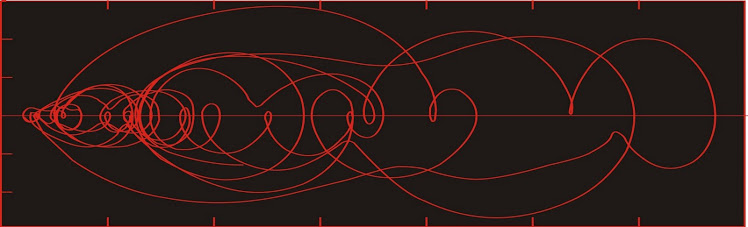
Two dimensional phase space reconstruction of dust flux from the Vostok core over the period 186-4 ka using the time derivative method. Dust flux on the x-axis, rate of change is on the y-axis. From Gipp (2001).

Friday, March 25, 2011

Increasing margin requirements for silver will only hasten the end

Once again, COMEX margin requirements were raised on a big up-day for silver.

The higher the margin requirements go, the easier it is to call for delivery at the end of the month.

After all, if you have to put in full cash value for all ounces under contract, you don't have to come up with any money at all when you call for delivery.

As the calls for delivery are what will eventually blow up the system, the increasing margin requirements will ultimately have an effect opposite to what is desired.

Sunday, March 20, 2011

In order to save civilians, we have to slaughter them

So the UN has authorized the use of force against some Libyans in order to save others.

The coalition partners in this operation include France, the UK, the US, and possibly some Arab states. Canada is tagging along too. The Harper Government has asked rhetorically whether we believe in freedom or merely say we do.  Their reply is to join the UN in violating Article 2 of the UN charter in which the sovereignty of each of its members is assured. The UN is only intended to intervene in conflicts between or among states, but internal affairs of a state are specifically off limits.


Article 2 finishes thusly: "Nothing in the present Charter shall authorize the United Nations to intervene in matters which are essentially within the domestic jurisdiction of any state..." 


So the UN doesn't like the Libya's form of government? They are not permitted to intervene.


The Harper Government's (no longer the Canadian government) response is problematic. As a democracy, Canadians are accustomed to the idea that if those that form Canadian policy make a mess of things, the voters have the opportunity to vote them out of power. But now Canada is bound to join a war chosen by foreign bureaucrats. How are we to express our disapproval? 


Now I'm no fan of Gaddafi, but it seems to me that there are many places around the world where civilians either are or were being slaughtered by their governments (whether fairly elected or not), and the UN has not seen fit to act.


Perhaps I could be convinced if our particular method of lending assistance to civilians were not so devastating. But unfortunately, since the beginning of WWII, the preferred method of military intervention by the Anglo-American powers has been the mass bombing attack--the one method which has been field-tested and which is conclusively proven to have the highest ratio of civilian deaths to military targets destroyed.


And much of this field testing took place in an era when military targets were obvious targets--you had airbases, certain types of manufacturing, certain types of radars, armored formations and troop concentrations--but the military scenarios in the middle east involve small groups of fighters hidden among civilian populations. Attempting to destroy such targets by air strikes leads to the common Afghan problem--large numbers of civilians killed for each demonstrated insurgent.


The UN plan to save civilians will involve the murder of many others. It seems a little imperious to be deciding which Libyan civilians should live and which should die.


The air strikes have already attracted buyer's remorse from some Arab States (who had earlier called for a no-fly zone). 


"What has happened in Libya differs from the goal of imposing a no-fly zone and what we want is the protection of civilians and not bombing other civilians," Arab League secretary general Amr Mussa told reporters.


Even the Taliban, it appears, understand the UN Charter better than the UN.

Friday, March 18, 2011

What's wrong with our financial system.

A story posted by Harvey Organ.

As many know there are a group of ex Morgan traders who decided to take on Blythe Masters and JPMorgan by standing for delivery but then asking for a huge fiat premium.  We have now heard from one trader who also is a reader of my blog. The name given to the ex traders is "Wynter_Benton:


Here is what is posted by Louis Cypher:

"Wynter_Benton update on their recent raid
With permission, I can update the results of our raid. It was successful beyond imagination but that "success" has spawned even more questions about the price of paper silver going forward. It was reported by SGS that he heard that on Friday Blythe was offering 30-50 percent premium and that at least 4500 hundred contracts will stand for delivery. I am here to give you a more accurate update (and a first hand account of what happened on Friday Feb 25). Our group was detemined to stand for delivery going into Monday because we were not going to take a 30 percent premium on a price of $33.50. It was reported that Blythe offered 50 percent premium. That was not even close in our case. We got over 80 percent premium. That's right. Over $50 per contract on the condition that our group sell all our contracts. Our counterparty even threatened us with the ghost of Herstatt. They openly admitted that they could not deliver even 20 million ounces to us but that if we stood for delivery they would be sure that they make delivery to everyone else before they defaulted on us which would make us 'unsecured creditors'. They told us directly that they could not allow even 5000 contracts to stand for delivery because they could not deliver a mere 20 million ounces. Like Vito Corleone said, "I'm gonna make him an offer he can't refuse." And indeed we did not refuse as this was our intention all along.

These sets of facts from our traders lead us to believe that the paper price of silver may have a difficult time surpassing $36 because if the counterparty at the Comex is so willing to pay north of $50 to dissuade people from standing for delivery yet the paper price of silver is still under $35, then we suspect that losses triggered by derivatives is the main reason for the price suppression of silver. We can see no reason why they would not allow the paper price to go up yet are so glad to pay off the comex contracts to show the world that so few are standing for delivery. In our mind, Comex could default with if as little as 4,000 contracts stood for delivery. We are very curious to see how high the paper price of silver actually trades during this run.

Posted by Louis Cypher"

 The problem with our financial system is that this story is even plausible.

If we had a "real" system with proper checks and balances; where wrong-doing was investigated, punished, and publicized; where it was impossible to sell something you couldn't deliver; where there was no improper collusion amongst what should be competing interests--in such a system you would laugh out loud at such a story, and your only wonder would be that I believed it. Instead, most people I've told this to have all mused aloud, "I wonder if that's true?"


One reason why the story might be doubted is that if true, it would suggest there is riskless profit for everybody who can go long any number of silver contracts. Supposedly, there is no such thing as riskless profit, except where market subversion is involved.

Tuesday, March 15, 2011

Nuclear power and geologic hazards 2--southwestern Ontario

Since the problems in the Japanese nuclear reactors have been publicized, the safety of nuclear power plants comes into question everywhere.

How are North American reactors in terms of earthquake safety?

Are nuclear reactors in Southern Ontario at risk of earthquake damage.

The Toronto Star has published its answer. No, they say. The basis of their argument is that southwestern Ontario (particularly the Lake Ontario and Lake Huron basins) are not known for large earthquakes.

It is well known that the western margin of North America is seismically active. Less well known is the potential for seismic activity in eastern North America.

Here is the seismicity map for eastern North America from the USGS. Sourced from this document.

Right away we see four hot areas--in South Carolina; in Missouri; near the mouth of the Gulf of St. Lawrence; and along the Ottawa River. These areas represent the locations of sizable earthquakes in the past 200 years.

Four significant shocks (magnitude 7-8) occurred in the New Madrid area between December 1811 and February 1812.

A major earthquake occurred in South Carolina in 1886.

The Charlevoix seismic zone is the most active in eastern Canada.

Significant earthquakes have occurred along the Ottawa River from Montreal to Temsicaming.

The map is entirely dependent on the past record of earthquakes. Prior to 1811, it is unlikely that central Missouri was considered a seismic hazard area. The next major earthquake, wherever it occurs, will generate its own spot on the map.

To evaluate seismic risk, we need to evaluate structures. In eastern North America, a major plane of weakness intersects the earth's surface along the St. Lawrence River, and passes through Lake Ontario and Lake Erie. It passes southward, and follows the trace of the Mississippi River to the Gulf of Mexico. A failed rift arm extends through Lake Huron and Lake Superior (these structures go a long way towards explaining why these features are where they are).

The main structural feature passing through Lakes Ontario and Erie and up through the St. Lawrence is the same structure on which the near magnitude 8 events occurred in 1811-12. We therefore must recognize that there is potential for events of similar magnitude in southwestern Ontario. The reason why this is largely unrecognized is because such an event has not occurred in recorded history.

One of the charming things about earthquakes is that they demonstrate scale invariance. In particular, the size distribution of earthquakes in any given area shows a 1/f distribution. This relationship has long been observed in seismic studies--the famed Gutenberg-Richter law is an example of an empirical law which has been shown to have predictive value.

If you have an area where historical records are short, and you have only observed small earthquakes, it is still possible to make use of the scale-invariant nature of earthquakes to predict the recurrence interval of earthquakes larger than noted in the historical record. Using this technique, Arsalan Mohajer calculated that the recurrence interval of a magnitude 6.5 earthquake in western Lake Ontario was 1000 years. (see figure 2).

Figure 2 of Mohajer, 1993.

True, he doesn't actually state the numbers in the report, but the extrapolation of the data in the figure above gives us a recurrence interval for a magnitude 6.5 earthquake to be 1000 years.

Assuming that the power plants are to last 50 years, there is a 1 in 20 chance of an earthquake of this magnitude affecting them. The hazard assessment for earthquakes in Ontario is based more on the official data, which notes the lack of any such events in the past 250 years.

Reference

Mohajer, A. A., 1993. Seismicity and seismotectonics of the western Lake Ontario region. Geographie physique et Quaternaire, 47:353-362.
Al Jazeera explains problems at Japanese nuke plants


Problems look worse than originally announced.