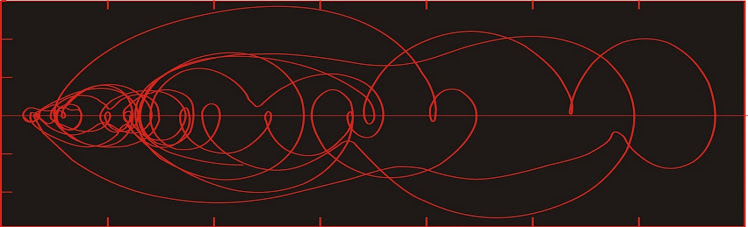
Dust flux, Vostok ice core

Dust flux, Vostok ice core
Two dimensional phase space reconstruction of dust flux from the Vostok core over the period 186-4 ka using the time derivative method. Dust flux on the x-axis, rate of change is on the y-axis. From Gipp (2001).

Thursday, April 7, 2011

Ivoirans escaping by sea to Ghana

When I came out to Axim, western Ghana a few days ago, I expected to see many refugees from Cote d'Ivoire fleeing along the highway. But the road was completely dead--the border had been closed last week and nobody was getting through (although three weeks ago there was a steady stream of vehicles loaded with people and cocoa heading into Ghana).

The refugees are escaping by sea.


These fishing vessels have been cruising past the hotel every few minutes. The hotel staff tell us that this has been going on for weeks. The vessels are actually from fishing towns in Ghana, particularly Busua, Dixcove, Cape Coast, and points even farther to the east. The fishing in those areas has lately been poor, and the fisherman have found a new source of income.

They motor to Abidjan, or other coastal towns, pick up paying customers, and bring them back to their home port. The refugees are primarily Twi-speaking groups from the south of the country, who are culturally similar to the southern Ghanaians. They will also have been Gbagbo supporters.


I have to admit that it isn't as crowded as I would have thought it would be, but it is a long journey, and the boats are known to break in half. When fishing they are usually farther offshore.

Update April 12

According to today's Daily Graphic (a Ghanaian newspaper), the escaping refugees were not Ivoirans, but Ghanaians (more than a million of whom live in Cote d'Ivoire in the area surrounding Abidjan). They have been trapped there since the border was closed last week. There were harrowing descriptions of life for these Ghanaians (food cut off, people starving, dead children in the streets). As some of the fishing boats decided to return to Sekondi, many of these Ghanaians bought passage.

You can lead a horse to water . . .

A brief recap:

Damage to the economic system is causing leverage to fail. The prices of heavily leveraged assets (including house prices and the stock market are in danger of collapsing.

In order to stave off this collapse, central banks are using the usual techniques as well as some brand new ones to create more money in order to prop up these asset values and convince you and me that we are still well-off.

Unfortunately, large amounts of this money are being used to buy commodities, which is forcing their prices up. This makes you and me feel we are not so well-off, and this is bad from the central banks' perspective. The central bankers would like us to all buy bigger houses and invest in the stock market.

Notice that it is appearances that matters.

There has been much whining from central bankers about our complaints about food and energy prices (typical response--"shut up and buy and iPad2".)

All of this proves the old saying: You can lead a horse to water but you can't stop him from pissing in the pond."

Tuesday, April 5, 2011

A plague on all their houses--Ghanaian perspectives on the Ivoiran crisis

Recent news has the UN carrying out air strikes in Abidjan. But the idiots are bombing the forces that are defending the city from an invading force. Killings continue.

In this article I will present the prevailing understanding that lives on the street in Ghana (particularly western Ghana). I cannot verify the truth of these statements, and acknowledge the possibility that there are many misconceptions. However I believe their stories may add a different perspective than may be presented in western news media.

Many Ghanaians feel that both Ouattara and Gbagbo are unfit to preside over their country. They have both disqualified themselves by resorting to violence. Even in the case of Gbagbo (whom most Ghanaians believe is the wronged party in the dispute--see below), Ghanaians feel that once it became clear that his resistance would lead to bloodshed, he should have become a great statesman, yielded power, and waited for the next election.

Ouattara is from the north of Ivory Coast. He is Ivoiran, but of Burkinese descent, as are many of the Mosi-speaking peoples of Ivory Coast. In the last election, Ouattara benefitted tremendously from miraculous voting patterns, in which villages of 500 delivered thousands of votes (unsubstantiated statement, probably from Ghanaian news article). Allegations of voter fraud were not investigated. He has won the election, but that does not give him the right to massacre those who voted against him. (If it does, then I pray Harper doesn't win next month in Canada).

On his last visit to the African Union, the Nigerians offered to arm him. The Ghanaians were not in favour of him, so the arms were shipped by a northerly route, through Burkina Faso (unsubstantiated statements).

Gbagbo is from the south, representing peoples who generally originated in Ivory Coast. In a sense, he is following a tradition, in that when he first won an election, the former President also resisted leaving office, and both sides resorted to violence. Gbagbo reduced French involvement in Ivory Coast, leading to a resurgence of formerly suppressed Ivoirian culture. Under the French, the only culture in Ivory Coast was French.

The perception of Ghanaians is that Ouattara will return Ivory Coast to France. Hence the arrival of French troops to defend "French interests" including the airport.

The Americans have promoted Ghana as the gateway to West Africa. A part of this is the development of a highway system through Ghana from the coast to the interior. The French have their own ideas--that Ivory Coast will be the gateway to the interior.

Although cocoa has been much discussed in the media, there has been much less dicussion about the offshore oil, which has been the subject of exploration and exploitation for much longer than the recently discovered oil off Ghana.

The attack on Abidjan was remarkably well coordinated, with simultaneous strikes on key facilities, such as the Presidential palace, the radio and TV stations, and arms depots. Compare this to the mob-like efforts of the Libyan rebels. There was a three-day period in which Ouattara forces massed outside of Abidjan, as supplies and ammunition were brought to the front, and plans were made. Once again, this is a suspiciously well-disciplined mob.

A helpful summary

Ouattara--bad
Gbagbo--bad
The French--bad
The UN--bad

A plague on all their houses!

A note about stepping back for the good of the country. When elections were held in Ghana in November of 1996, I recall being amazed at the distribution of votes. All through the thinly populated northern regions there were enormous numbers of votes for Rawlings' party (the NDC). Furthermore, the votes in the north were unanimously in favour of the NDC (e.g., 65,912 to 2). Kuffour's party (the NPP) decided not to contest the results. I remember the tension leading up to that announcement and the tremendous relief afterwards. The NPP were rewarded by winning the next election four years later.

Saturday, April 2, 2011

Massacres in West Africa: where are the airstrikes?

The situation in Cote d'Ivoire is deteriorating rapidly. A major massacre is reported at Duekoue, in the western part of the country. I don't know what news you are receiving, but what is being reported here (in Ghana) as the slaughter of Gbagbo supporters (who by all accounts lost the election) by Outtara supporters.

In Libya, Gaddhafi had only promised to massacre civilians. Here, actual massacres are already taking place.

Will there be any action on the part of the UN or other interested parties, or do they only protect civilians on the right side?

I am expecting to travel to Nzemaland, near the border between Ghana and Cote d'Ivoire early next week and will try to look in on the refugee situation.

In the heart of Agbogbloshie market

Aargh! The bandwidth! This post has taken five days to put together.

Power has been out in Kokrobitie for a couple of days. The official story is that they are working on the high-tension lines, so all power needs to be shut down. Rumours are that this will go on for seven weeks.

What you need for midnight blogging in the black-out. 
Laptop with internet stick, 12-V battery and power inverter, 
wind-up lantern, beer. The pizza arrived about ten minutes later.

Our photos today are from the heart of Agbogbloshie market, which as we have seen before is packed with more onions than the mind can comfortably conceive.


The place is loud. And the moment you arrive you are besieged by people determined to sell you onions.


What do you feel like? Dark red, high antioxidant onions? Sweeter white onions? Holland onions?


There really is a lot of food here. It just happens that a lot of it is onions.


It isn't all onions. Garlic in Ghana is really pungent. Not sure if it is the selenium.

I'll post more photos if bandwidth improves.