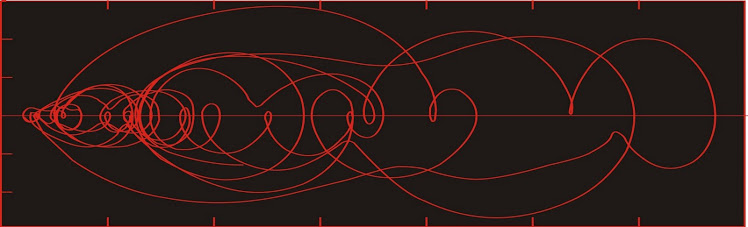
All over the world, the same message is relentlessly hammered home--conventional economics has failed. Policy makers did not foresee the 2008 crisis--and their attempts at remediation of the unemployment situation have had effects opposite to what was intended.
Why is this? Does economics in the real world differ so much from the theoretical? And if so, why?
Let us consider how complex behaviour arises in some natural systems.
Multistability in natural systems
The global climate system is a nonlinear, nonequilibrium system involving internal time-varying mechanisms, feedbacks, and external forcing. Systems with feedbacks are commonly multistable, prone to bifurcations, and hysteresis—even when those systems are driven by invariant driving functions.
In previous posts we have seen that the phase space projections of numerous climate functions show multistability--that is they tend to evolve not to a single equilibrium, but oscillate among any number of equilibria. The reason that multiple equilibria arise is because the dynamics of the climate system include both negative and positive feedbacks.


Soros goes on to describe the inflation and bursting of a bubble in terms of the interaction between positive and negative feedbacks.


The recognition of multiple equilibria in economic systems does not go far enough, in Soros's view, because the collapse of bubbles can trigger policy responses which greatly alter the workings of the system. In other words, politics can become a potent driving force, with both secular components (such as the progressive concentration of wealth and power into fewer hands over the last forty years) and singular spectacular events (such as declaration of wage and price controls, short-duration spikes in interest rates; or even irreversible decisions like detaching the dollar from gold).
The addition of the political drivers adds a dimension which has no analog in nature. It also forces us to recognize that the future evolution of the economy will be not only a function of the feedbacks and forces we consider above, but also the entire history of the economy as well. For instance, Soros argues that the present European crisis is as much a function of history as of excessive government debt . . .
Why is this? Does economics in the real world differ so much from the theoretical? And if so, why?
Let us consider how complex behaviour arises in some natural systems.
Multistability in natural systems
The global climate system is a nonlinear, nonequilibrium system involving internal time-varying mechanisms, feedbacks, and external forcing. Systems with feedbacks are commonly multistable, prone to bifurcations, and hysteresis—even when those systems are driven by invariant driving functions.
In previous posts we have seen that the phase space projections of numerous climate functions show multistability--that is they tend to evolve not to a single equilibrium, but oscillate among any number of equilibria. The reason that multiple equilibria arise is because the dynamics of the climate system include both negative and positive feedbacks.

Different forms of stability. For asymptotic stability, given a limited range of initial
conditions, the system evolves towards a fixed point. For Lyapunov stability, once the system
reaches a limited region of phase space (b), the system tends to remain there.
Where negative feedbacks dominate, the system tends to be stable. In the diagram above, there are different forms of stability, but the two most important are asymptotic stability (also called a point attractor) and Lyapunov stability. It will normally not be possible to distinguish between these on the basis of observation of some system.
Positive feedbacks tend to enhance the effects of external forcing, multiplying the magnitude of the stresses brought on by forcing. The presence of both negative and positive feedbacks supports a system with multiple disjoint regions of equilibria, bounded by separatrices.

Time evolution of a system with multiple equilibria. In actuality, the separatrices
are likely to show fractal interfingering.
I have commented on applications of this idea to unemployment, but have not discussed the origins of the necessary feedbacks required to generate multistability. Some comments by George Soros (below) seem to shed some light on this topic.
Soros' remarks on global economy
George Soros recently spoke at the Festival of Economics in Trento, Italy. What made his remarks interesting to me were his allusions to nonlinear dynamics in the evolution of the economic system, and their effects on policy. Soros begins by remarking on the lack of success policy makers have had in predicting economic outcomes in the past few years. The reasons for these failures . . .
go back to the foundations of economic theory. Economics tried to model itself on Newtonian physics. It sought to establish universally and timelessly valid laws governing reality. But economics is a social science and there is a fundamental difference between the natural and social sciences. Social phenomena have thinking participants who base their decisions on imperfect knowledge.
Anyone reading about Austrian Economics will be familiar with the argument. Market participants will try to act in a way that maximizes benefits to themselves, but what constitutes maximum benefit may vary from one to another. A highly technical treatment of this topic can be found here (probably not of interest to most of you, except for the part about aggressive participants with a strategy of investing in risky assets increasing the likelihood of a market crash for everyone).
The market participants do not perceive the true nature of the system in which they are operating, and so many will choose suboptimal strategies. However, as they act, they also change the nature of the system, so that what would have been an optimal strategy had all participants been "rational" may become suboptimal in the real world. Likewise, strategies which would be suboptimal in a purely rational world may become optimal.
I found a two-way connection between the participants’ thinking and the situations in which they participate. On the one hand people seek to understand the situation; that is the cognitive function. On the other, they seek to make an impact on the situation; I call that the causative or manipulative function. The two functions connect the thinking agents and the situations in which they participate in opposite directions. In the cognitive function the situation is supposed to determine the participants’ views; in the causative function the participants’ views are supposed to determine the outcome. When both functions are at work at the same time they interfere with each other. The two functions form a circular relationship or feedback loop.For instance, under normal circumstances it would not be advantageous to rush to the bank and withdraw all of your money. However, the economic system could be altered to the point where that might turn out to be the optimal strategy after all.
Soros goes on to describe the inflation and bursting of a bubble in terms of the interaction between positive and negative feedbacks.
I developed a model of a boom-bust process or bubble which is endogenous to financial markets, not the result of external shocks. According to my theory, financial bubbles are not a purely psychological phenomenon. They have two components: a trend that prevails in reality and a misinterpretation of that trend. A bubble can develop when the feedback is initially positive in the sense that both the trend and its biased interpretation are mutually reinforced. Eventually the gap between the trend and its biased interpretation grows so wide that it becomes unsustainable. After a twilight period both the bias and the trend are reversed and reinforce each other in the opposite direction. Bubbles are usually asymmetric in shape: booms develop slowly but the bust tends to be sudden and devastating . . .
At any moment of time there are myriads of feedback loops at work, some of which are positive, others negative. They interact with each other, producing the irregular price patterns that prevail most of the time; but on the rare occasions that bubbles develop to their full potential they tend to overshadow all other influences.What does the phase space of a system with myriads of feedback loops look like?


The recognition of multiple equilibria in economic systems does not go far enough, in Soros's view, because the collapse of bubbles can trigger policy responses which greatly alter the workings of the system. In other words, politics can become a potent driving force, with both secular components (such as the progressive concentration of wealth and power into fewer hands over the last forty years) and singular spectacular events (such as declaration of wage and price controls, short-duration spikes in interest rates; or even irreversible decisions like detaching the dollar from gold).
The addition of the political drivers adds a dimension which has no analog in nature. It also forces us to recognize that the future evolution of the economy will be not only a function of the feedbacks and forces we consider above, but also the entire history of the economy as well. For instance, Soros argues that the present European crisis is as much a function of history as of excessive government debt . . .
because the financial problems were reinforced by a process of political disintegration. While the European Union was being created, the leadership was in the forefront of further integration; but after the outbreak of the financial crisis the authorities became wedded to preserving the status quo. This has forced all those who consider the status quo unsustainable or intolerable into an anti-European posture. That is the political dynamic that makes the disintegration of the European Union just as self-reinforcing as its creation has been.Unfortunately the non-linearities in the system make prediction hazardous. But given the preliminary indicators of bank runs in Europe, South America, and Africa, as well as Oanda's recent announcement . . . errm, yes, excuse me, but I have some preparations to see to.


