Dust flux, Vostok ice core

Dust flux, Vostok ice core
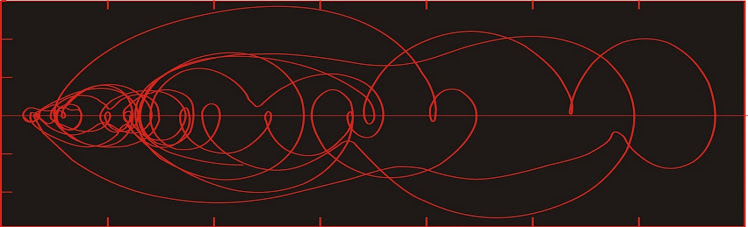
Two dimensional phase space reconstruction of dust flux from the Vostok core over the period 186-4 ka using the time derivative method. Dust flux on the x-axis, rate of change is on the y-axis. From Gipp (2001).

Friday, December 7, 2012

Election day

One of my last days here, so I'll make a few observations.

People here are still enthusiastic about elections. They are passionate about their parties. Earlier this week on our way to the Minerals Commission we were held up by traffic going to political rallies. They still hope that government will make their lives better--at the same time, until now, the government's ability to interfere with their lives is still limited as the institutions of total control are undeveloped. But the signs are that they are coming.

People began lining up last night so they could vote today. Accusations of electoral fraud and warnings of ballot box snatchers are the talk of today's news.

One item really caught my eye as it went across the bottom of the TV. "Religious leaders warn politicians not to be too desperate for power as it will incite violence." I wish we saw such warnings at home.

Tuesday, December 4, 2012

Electricity and the election in Ghana


Once again the national electrical authority has promised that the load-shedding practice (which you might call rolling blackouts or power-sharing) will be suspended before the election--although the starting date has been rolled back to Wednesday.

The election is Friday.

Tonight there was breathless reporting on a major conspiracy to plunge all of Ghana into darkness during the election and vote-counting, so that unnamed nefarious powers could gain some unspecified advantage. Our staff have advised us that this sort of thing is announced before every election.

If they can avoid power-sharing for a few days, why can't they do it all the time?

According to interviews on Joy News, the required additional supply is coming from three sources. An extra 100 MW has been purchased from Cote d'Ivoire, 30 MW is coming from (or rather not being exported) to Togo and Benin, and interestingly, 30 MW is coming from an 80 MW power station built by a consortium of four mining companies. It was not clear whether they meant that the mining companies were generating this power and selling it to the network, or whether it represented power normally supplied by the grid that would be diverted elsewhere.

In case you are wondering why your mining stocks in Ghanaian jurisdictions have been performing poorly lately, there is this.

Sunday, November 18, 2012

Another exciting day

Saw something I hadn't seen before (but knew was theoretically possible).

The power went out early this morning. But it wasn't completely out--my computer reported it was still charging, and the lightbulbs in the kitchen were flickering dimly. So I got out the multimeter and measured the  voltage coming out of the wall. It came in at a grand 18 V, less than one-tenth normal. But there were little transient flickers of higher voltage, so I unplugged the computer.

The power came back--sort of. Some things started to run, although the lights seemed unusually bright and the fans were spinning much faster than normal.

When I measured the voltage in one of the kitchen outlets, I measured about 370 V. Again, with transient flickers of much higher voltages. But there were other outlets only producing about 20 V.

Theoretically I knew such a thing was possible. The power coming into the building was three-phase, and many electricians here have hands-on experience without any theoretical knowledge of what they are doing, so after we had the building wired and connected to the grid, the first thing I did was to check the voltage output everywhere possible.

For three-phase power you have a ground and three active terminals. In Ghana, the voltage between the ground and any active terminal is 230-240 V (ideally--although on most days it is considerably less). The voltage across two active terminals will be around 370 V. If the house is wired properly, one-third of the outlets will run off each one of the active terminals and a ground. If the house is wired improperly, it is possible that one-third of the outlets will be run off two active terminals, giving you a voltage at that outlet of 370 V.

In our case I knew the house was wired properly. So the only explanation was that after the first power outage, the electrical workers must have connected their wiring improperly, crossing the ground with an active terminal, blowing up appliances from Bortianor to Kokrobitie.

You'd like to think that electrical utility workers would be better than that. Yes, you'd like to think that.

Tuesday, November 13, 2012

Argentina sues Ghana over the Libertad


The story of Ghana's seizure of the ARA Libertad caught my eye while on my way to Accra last month. It seems that when Argentina's currency peg collapsed about a decade ago, some private creditors refused to accept the government's repudiation of its sovereign debt. In this case, an investment fund called Elliot Management (with court rulings in its favour) has asked Ghana to sieze Argentinean property--in this case, a tall ship.

What has tongues wagging here in Ghana is the announcement that Argentina will now sue Ghana of this seizure.

Elliot claims to be owed $1.6 billion, so without a highly favourable valuation, the Libertad represents only a drop in the bucket.

It seemed odd to me for Argentineans to be hiring Kwesi and Kwabinah as hired muscle. Ghanaians are too happy-go-lucky to make convincing enforcers. Even in the event that a Ghanaian court agrees that the Libertad is fair game for seizure, history here favours a suboptimal outcome for Elliot &c.


"I'm here for the money you owe my boss! But if you don't have it, that's okay too."

On my first trip here (in 1996), there were highwaymen along the main road, with a noted concentration near Liberian and Leonian refugee camps. Other highwaymen could be encountered on roads all over Ghana, and a common trick was to pound nails through sandals which would be left on the road. When the vehicles stopped to repair tire damage, the thieves would strike.

The encounters went something like this:

"Hand over all your money!"
"Here."
The villains move off.
"Wait! You can't just leave me out here in the middle of the forest with flat tires".
The villains return. They help the victim repair his tires. The villains start to leave.
"Wait! I don't have enough petrol to return home!"
The villains return. They give the victim money for fuel. The villains start to leave.
"Wait! I don't have any money for food on the road!"
The villains return. They give the victim money for food. The villains start to leave.
"Wait! I am going to need a drink with my meal to calm my nerves after this robbery!"
The villains return. They give the victim money so he can buy a beer (or alternatively, apeteshie).
The villains leave, possibly with less money than they started with.

In Ghana it is not uncommon for a Ghanaian to find that he owes the government some heavy sum. But the difference between the stated debt and what is finally paid can be immense--and usually in favour of the Ghanaian. That is because the government here--or, rather, its agens--recognize that they can't destroy someone's livelihood just to collect an arbitrary debt. So debt repayment becomes a negotiation--sometimes a very long one--with a lot of compromise on both sides.

That probably seems incredible to someone in North America or Europe, but it is the reality here where the government's ability to pursue its "creditors" is extremely limited.

The Ghanaian court is apt to look at this whole scenario, and rule that due to the trouble this ship represents, Elliot (or its sub, NML) upon taking delivery of the ship will be paid in full. Of course, they can only take delivery after paying the docking fee and the storage fee at Tema. Then they will have to pay a fee for the security provided by the government of Ghana while the ship was in storage. Then there will be the release fee, the exit fee, the immunization fee for whatever crew are brought in to take the ship back to New York . . .
Sunday, November 11, 2012

Gold-silver five-year four-step

It's a dance.


Four steps over the last five years (since the beginning of 2008). Date annotations are mmyy. As before, I have used a one-year lag and a three-point moving average for the gold-silver ratio.

Last time we were here things didn't go so pleasantly.