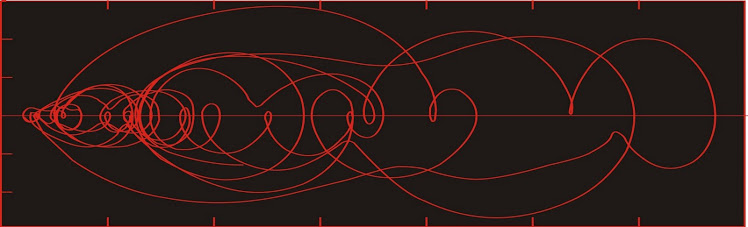
Dust flux, Vostok ice core

Dust flux, Vostok ice core
Two dimensional phase space reconstruction of dust flux from the Vostok core over the period 186-4 ka using the time derivative method. Dust flux on the x-axis, rate of change is on the y-axis. From Gipp (2001).

Thursday, June 20, 2013

The body piezoelectric

Piezoelectricity is all around you, from the clocking chips in computers and watches, to the transducers in certain sonars, to many of the tissues in your body. Piezoelectricity is a phenomenon in which a crystal which is subject to stress develops an electric field. It is reversible, so that applying an electric field across a piezoelectric crystal causes it to distort.

We are accustomed to thinking of piezoelectricity as being restricted to crystals and ceramics. But tissues in the body are piezolelectric as well. The initial discovery (though long suspected - pdf) of piezoelectric behaviour in bone was followed up by its discovery in neurons, intestinal tissue, cartilage, tendons, and ligaments.

The piezoelectric effect may play a role in crystal growth, as when pressure is applied to the crystal, the maximum potential differences will tend to be at the ends of the crystal, so that ions are more likely to report there rather than the middle.

It has long been recognized that the piezoelectric effect is responsible for bone remodeling which is why you should make an effort to stand up straight and don't slouch!

- - - - - - - - - - - -

This story about cellphone towers prompted today's topic. I have long been sympathetic towards the notion of non-heating damage from non-ionizing radiation. Piezoelectricity is a possible mechanism for harm, although there is no study of which I am aware that shows this. The possible mechanism for harm is difficult to elaborate, because the role of electric fields in these various tissues is uncertain. Piezoelectric materials may undergo a distortion when they are subject to external electric fields, which may contribute to vascoconstriction. It's also possible that the external electric fields may also interfere with the growth of these structures.

Tuesday, June 18, 2013

Multistability in the gold-copper ratio

The gold copper ratio is commonly used to illustrate the state of the economy. Note that we usually take the ratio of the gold price per troy ounce and the copper price per pound. A recent graph of this ratio can be found here.

In past articles I have looked at how to study dynamic systems using reconstructed phase space portraits.


Here we see the reconstructed phase space of the gold-copper ratio over the past eight years, using a time-derivative method--plotting the value of the ratio against the average rate of change over six months. My convention is to plot the rate of change against the midpoint of the time window--for example, the last such calculation measures the change in the ratio from November 2012 to May 2013, and is plotted against the month-end price of February. This is why the graph ends at February even though we have month-end pricing to May.

There are three areas of stability in the above graph. In 2006 and 2007, the copper price rose dramatically, and the Au-Cu ratio fell, until there was a sudden pop in the economy in mid-2008, which is recorded in the figure above as a tremendous gyration lasting a year. The Au-Cu ratio settled for several months near the 350 level, before leaping to the 450 area, where it has remained for the past 18 months.

It could be that the economy as a whole was overheating in the middle of the last decade, what with all the demand for copper from China and the US housing boom. Then I suppose we returned to sanity.

Except the current economy doesn't feel sane to me.

The highs for copper in 2006 are not out of the ordinary. By inspection we can find numerous periods where the ratio was 200 or lower. In the late 1920s, Au/Cu fell to about 140, but when the depression hit, the ratio rose to over 400. In the wake of the post-war rebuilding, Au/Cu fell well below 100 and was still at that level when Nixon closed the gold window, although the pegging of the gold price and the military actions of the US both supported this low ratio.

More recently, we have the following . . .


. . . in which our hot, inflationary late '70s economy suddenly slowed. It helped that in the '80s the US wasn't involved in any wars of consequence (just little actions in Iran, the Sinai, El Salvador, Libya, Lebanon, Egypt,  Grenada, Honduras, Chad, the Persian Gulf, Italy, Libya again, Bolivia, the Persian Gulf again, Honduras again, Panama, Colombia, Bolivia, Peru, the Philippines, and Panama again).

Just after where I have ended the graph, the system returned to the area of stability at around 300, during the housing bubble at the end of the '80s. For a look at how terrifyingly huge it was, see below. ;)


So to my non-economically trained mind, the Au-Cu ratio only seems to fall below about 300 during credit-fuelled booms (and maybe during major postwar rebuilding phases). Presumably when it is higher than some level, we could say it indicates we are in a depression--but I haven't figured out what that level is yet. Early in the Depression, the ratio was at 400--but that was in the days of the gold peg at $20.

My gut feeling is that the present ratio is not far from depression levels.

Friday, June 14, 2013

Singapore faces worst dengue fever outbreak in its history (updated)

On our last trip to Singapore, my wife insisted that the mosquitoes there were not a concern. This is no longer the case. Singapore is in the throes of its worst outbreak of dengue fever ever. No explanation has been offered for the size of the outbreak, although there have been comments that the virus has a greater resistance to treatment than normal.

I'm not convinced--in my experience with tropical disease outbreaks in Africa and other places, it is almost always caused by higher than normal rainfall. In Singapore it may be compounded by the large number of construction projects underway.

Dengue is caused by a virus which is spread by mosquitoes. There is no vaccine, so you avoid dengue by avoiding mosquito bites.

Last year Singapore experienced a little over 4,500 cases of dengue fever (which seems like an awful lot to me). That would be less than one case per thousand population. This year, the number is already over 10,000, with over 800 new cases this week alone. They have not yet reached the time of year where the number of cases normally peaks. There have been two deaths.


Dengue cases this year. From here.

It's hard to make sense of the distribution of cases. The Paisir Ris cluster is an area of apartment blocks, but there is a lot of green space between the buildings and a fairly large series of connected parks.


Downtown shots, not Pasir Ris. Couldn't find any good shots of Pasir Ris except inside the apartment.

Updated June 26


Numbers still growing, with the peak still likely a few weeks away. Graphics source.

Friday OT

The Friday O.T.

For as long as I remember.


Love the girls playing violin on the rooftop in Havana.

Wednesday, June 12, 2013

About the Bay of Pigs . . .

Given the ongoing furor over the NSA's Prism surveillance program, it is useful to remember that ridicule is one method of resisting authoritarian initiatives. With this in mind, I call to your attention the 2000 film Company Man, which purports to explain the Bay of Pigs and presents us with a retelling of the CIA's attempts to discredit Castro via a series of bizarre plots including beard-defoliation, drugs, and poisoned cigars. The opening line of the movie advises "based on some true events".

Even Operation Mongoose gets a mention in the movie ("There's a mongoose in my shorts!").

The movie generated poor reviews. It is not a great film, and John Tarturro brings the film to a screeching halt with some brutally bad acting--but there was some good political humor overall. Woody Allen was a great, albeit hopelessly inept, CIA section chief.

Again, mocking the secret intelligence services is a good thing.

Spoiler alert - the various assassination attempts fail, and the Bay of Pigs invasion is repulsed. At the end of the film, Kennedy compliments the "hero" for his dedication in attempting to kill Castro, and notes that although the invasion failed, it did highlight the need for an increase in the CIA's budget.

Considering what happened to Kennedy later, that line is the real stinker in the movie.

Theme song below.