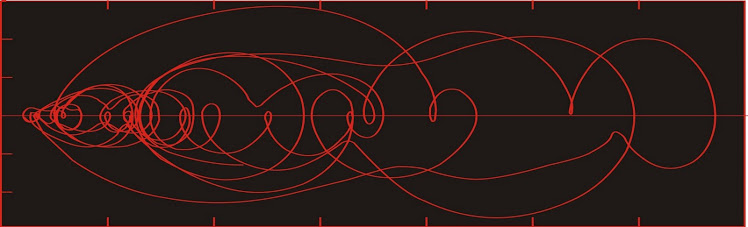
Dust flux, Vostok ice core

Dust flux, Vostok ice core
Two dimensional phase space reconstruction of dust flux from the Vostok core over the period 186-4 ka using the time derivative method. Dust flux on the x-axis, rate of change is on the y-axis. From Gipp (2001).

Monday, January 19, 2015

Grottoes and hobbit holes of Luo Yang

Driving around over the Great Loess Plain of China, you eventually come to Luo Yang, home of the peony festival. Not too many peonies around this time of year, but the city is famous for other reasons, including the Longmen Grottoes, a UNESCO World heritage site.


The grottoes are small caves that have been carved out of a limestone cliff. They are decorated with sculptures representing buddha, boddhisatvas, guardians, and pagodas. The sculptures were all created between the late fifth century (C.E.) and the early 12th century.


View from Xiangshan temple


There are about 1400 caves and over 100,000 carvings (including some very small ones).


Progressive details in Leigutaizhongdong Cave.


Large sculptures of Feng Xian Si (the large grotto in the top two images).

A small reflection of the grottoes is found in the loess cliffs along the highway near Luo Yang. I call these hobbit holes, even though they aren't dwellings. Some of them are brick-lined, but most appear to be for manufacture.


Loess is quite cohesive, and there are regions in China where people live in the stuff. It is pretty stable until there is an earthquake, at which point the casualties can be horrific.


Big hobbit hole.

Saturday, January 17, 2015

Gold x USDX since "decision time"

IWNATTOS has been crowing about gold breaking out for some small period of time now. Central to his thesis is that the price of gold has been rising ex-USD.

My approach is slightly different, although the implications are the same. Instead of looking at just the gold price, I have been looking at the product of the gold price in US dollars and the US dollar index. For most gold mining companies (outside the USA), this product has a strong impact on the economics of their mining operations.

If the gold price remains constant while the US dollar index rises, a mining company in Ghana may get the same number of dollars per ounce, but the purchasing power of those dollars rises. The result is higher profit. In fact, rising US dollar (with near constant gold price) is politically more favourable for producing miners--I have never seen a government slap a 'windfall tax' on a mine because of the rising dollar. Such things tend to only occur when the gold price rises.

On a scatterplot of gold vs US dollar index, the loci of constant gold x USDX values were hyperbolae called isoquants.

A couple of months ago, I was looking for a breakout of gold x USDX. We certainly have one now. The size of the current breakout is revealed on the chart of the gold x USDX below.


Gold x USDX has leaped up towards the 1200 level. The last time this product was higher than its present value was on May 10, 2013, when gold was $1426/oz and the US dollar index was a little over 84.


The current move we are looking at does look out of place in comparison to the last 20 months or so. The chart above suggests that there is a long way to go to get back to the good times of 2011. At some point, however, the rate of ascent has to decline or we'll face another collapse.

More about gold on a later post. 

Monday, January 12, 2015

Zhengzhou Museum

This is a much smaller museum than the better-known Henan museum, where I went last fall.


Nice day, very pale blue sky.

There are only a few galleries, dealing with Neolithic artifacts (bone and stone tools), pottery from early dynastic times, bronze from slightly more recent dynastic times, and carved stone (generally of boddhisatvas).

A lot of my interest is in magic, money, mysticism, and music, so we'll start with those.


Oracle bones, used in divination.


Cowrie shells, used here as money too.


Sculpture of a boddhisatva.


Stone coffin


It wouldn't be music in China without bronze bells.

The museum mainly focused on artifacts found in the vicinity of Zhengzhou, which is an area that was settled in very early times. The exhibits are quite limited in comparison with the Henan museum--no gold, no jade--but on the other hand, there are no crowds.


Friday, January 9, 2015

What hath QE wrought?

First off, let's see how our deflation indicator is playing out.


The latest trend of rising gold and USDX is in its third month.

The last time we had a similar trend was in 2009. That ended with a massive blowout of QE. But a funny thing happened on the way to the bank. After four-and-a-half years, we wound up back where we started.


The ineluctable march of deflation.

And for context, a look at the bigger picture.


One lesson of all this is that if the system needs to deflate, the bankers and politicians who think they are in control can delay it, but not stop it. A little over four years later, we have picked up where we left off.

I would expect the central bankers of the world will try for another inflationary push at some point in the future. Maybe they will let deflation to run for a time to ratchet up the pain enough for the public to scream for more stimulus. I can't help but think that they decided to let deflation run for a bit just to chase out some of the 99.9% who were perhaps betting on continued inflation.

Deflation's the same in a relative way, but you're older;
Shorter of breath, and four years closer to death.

Thursday, January 8, 2015

Reach for the sky

Today's chart is a reconstructed state space diagram of the gold-silver ratio (monthly) over the past eleven years.


It's been awhile since we last looked at this chart. At that time, in March, we were close to the middle of this graph, near where I thought economic crisis beckoned. History, it seems, doesn't repeat, but perhaps it does rhyme. For what it is worth, we have bypassed that spot, but the trajectory is similar to what we saw in late 2008--we are seeing a rapid rise in the gold-silver ratio. At the same time, the oil price is cratering, which fits into the idea of deflation I have been proposing.

I can't comment on the feel on the street, as I am in China rather than North America this time. Certainly here in China, everyone still feels confident. They all believe that all they have to do is buy property and everything will be fine, and they find my interest in gold curious, but for all they know, perhaps all foreigners are so strange.

Even so, someone in China is buying a lot of gold. If the numbers here are correct, then gold is being bought at a rate of over 2000 t per year, which amounts to something about 1.5 g per person in China.  However, you do not find gold offered in such paltry amounts. The smallest bar I have been able to find is 20 g, and it is more common for people to buy 50 or 100 g at a time.

Gold is easy to find here--you can buy it at any branch of any bank (or so I am told--I have only tried it at my local branch of my bank). So perhaps it is just all the banks that have bought it--and for now, they are making it available to anyone with a few yuan to spare.