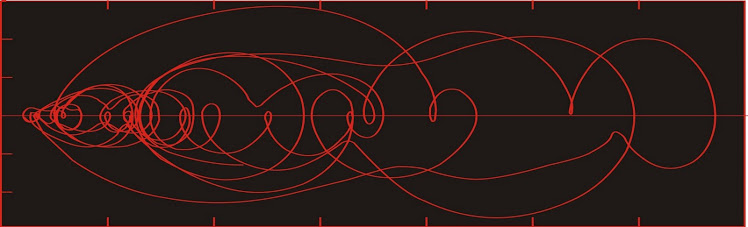
Dust flux, Vostok ice core

Dust flux, Vostok ice core
Two dimensional phase space reconstruction of dust flux from the Vostok core over the period 186-4 ka using the time derivative method. Dust flux on the x-axis, rate of change is on the y-axis. From Gipp (2001).

Tuesday, September 17, 2013

Dissection of the Malian crisis

An detailed summary of the crisis in Mali from inception to the present has been recently released by the Institute for the Study of Islamic Thought, and is presented here. (pdf)

What I found striking is that prior to the turmoil, Mali had passed through about 20 peaceful years, including five elections and three peaceful transitions of power. The speed with which the collapse occurred was surprising, and may be an object lesson in the stability of African democracies. 

Thursday, September 12, 2013

Game theory and the road to ruin

There's a nice restaurant on a certain beach in Africa, which, according to local lore, was started by a former mafioso who retired to a sunny spot for, shall we say, the good of his health. Of course, it's best to pay no mind to local lore; more likely he was a baker who wanted a nice spot on the beach.


Great lobster, too.

The world is full of criminals--in government, in finance, in journalism, in industry, and even in sports. And lately it seems that the criminality is increasing exponentially.

When pondering the mathematics of criminality, one issue is the nature of interaction between criminals. And here is where game theory has a say. One particular famous story is the prisoner's dilemma, a scenario in which that two criminals have been caught, and are being held separately. If both keep silent, they will only be convicted on lesser charges and face a short prison term. Each is offered a chance to testify against his partner, in exchange for being released (the partner will get a very long prison term). However, if both testify, they will both get long prison terms. There is a chance of improving one's position by testifying; however if both testify, then both will be worse off than if they had remained silent.

The above is a classic problem of game theory. Game theory is a study of human interaction. There is the potential of mathematical treatment, but the decisions are human, and there is no computable best choice that works under all situations. The possibility of strategy arises in any situation where there are interests at cross-purposes. In classical game theory, each player has some control over the situation, but there remain factors which are controlled by the other player(s), and there may be some factors under the control of none of the players.

In the prisoner's dilemma, neither player knows what the other will do. They can only control their own choice. The player's cannot influence the results of their respective choices (the payoff matrix). They don't know what the other is going to do. Moreover, larger society may influence the choices. If both prisoners are members of an organization that has a strict rule of omerta, which greatly increases the cost of testifying against their partner, they may keep silence.

Some problems in game theory involve an optimum choice among strategies. In some games, each player may find a pure strategy to use (meaning always do the same thing). In some games, either player may have to seek a mixed strategy (varying strategies).

Many interactions in society are similar to the prisoner's dilemma--interactions in which if both choose to cooperate, both get a greater gain than is the case if both defect. Since our interactions with our neighbours are ongoing--day after day, we remember how our neighbours acted in the past, and take that into consideration in future interactions. Given repeated interactions, it is overwhelmingly better to cooperate.

In life, we can choose to cooperate, by doing productive work within the context of the law, trading freely with our neighbours; or we may defect, by becoming a criminal, or perhaps a lobbyist, or something less productive and more coercive. Individually, we might benefit, but when the entire society heads down the path of criminal activity, then we are all worse off. To a large extent, society acts as does the criminal organization mentioned above--it is social norms that keep most people on the straight-and-narrow, not the fear of arrest by police.

But what happens if society no longer expects cooperation?

We are seeing the answer all around us.

Consider journalism--at one time one could count on news organizations to report on government with skepticism. More recently, we see the press acting as cheerleaders for the latest government outrage. Here is an example(may require free registration to read). We can see why it happens--newspapers that support the government get improved access: those that continue to treat government statements with skepticism lose accessibility and risk irrelevance.

Consider banking. A few decades ago, the bank made its money by lending responsibly. If you wanted a loan to expand your business, the bank manager would go to your location, and either check the books, or would visit surreptitiously, counting customers and estimating cash flow. Only when satisfied that your business was sound and your expansion likely to succeed would he lend you money. But since that time, the banks have become joined at the hip to government, and live off rent, or by packaging loans and selling them to trusting buyers, while charging heavy fees to customers for the privilege of keeping their money in the bank.

In many of these games--perhaps in all of them--each member of society maximizes his own benefit by defecting rather than cooperating. Tragically, the end result of everyone attempting to maximize his benefit is a society in which everyone is poorer. The mark of a civilized society is one in which the social pressures drive individuals to cooperate.

All this fits in to part of our greater theme of multistability. We can see two areas of stability for a civilization--one in which virtually everybody is engaged in productive enterprise, government is small; and one in which government is large, criminality and the rentier mindset are dominant, but everyone is poorer.

We are witnessing a form of decivilization, in where social weight favours defecting. The only way to return is through revolution--not necessarily violent, but revolution in social expectations. The criminality will only end when society expects and demands change.
Sunday, September 8, 2013

The endless crisis in silver

In 1999 I was in dire straits. A company I had done a lot of work for had collapsed, owing me a lot of money. I was in the throes of a life-altering illness. It would be a few years before I could walk again without considerable pain, which is a tough condition for a field geologist. I was desperately broke. And I was reading articles by fellows like Ted Butler about an impending apocalypse in silver, which threw me into a panic. How to get silver before this impending crisis that was due to explode any day now.

There was a coin shop not far from where I lived, and they sold Canadian silver coins--at that time the half-dollars were going for $3. I had no idea how much silver was in them, so I looked it up on the internet, and found that it was probably the cheapest way to buy silver when you only had $20 or so to spare, so I started buying them--them and the silver dollars. Twenty or thirty dollars worth, maybe once or twice a month.

Eventually, health improved, and I did some teaching, and began to buy a little more--but still probably no more than $100 a month. I went to church sales in Leaside, and bought lots of spoons, old-lady jewelry (to this day one of my wife's favourite pairs or earrings I bought at a church sale for $2), and the occasional salt shaker. Within a couple of years these sales became overrun by professional buyers, but when I started I had the field to myself.

In about 2006, the owner of my neighbourhood coin shop congratulated me for my strategy. He saw a lot of people rush into it in 2004, who then rushed out of it when the price suddenly collapsed. One of the clerks in the shop tried to get me interested in some elaborate currency-trading program (probably yen carry-trade, but I didn't look into it). He assured me that with this program I would make money exponentially and be able to retire in only two years. I asked him what was wrong with coming in every time I got paid and buying a little bit of silver, and he just rolled his eyes.

About a year later the coin shop suddenly melted down. I don't know what happened--the owners suddenly had to leave the country with a lot of unpaid debts. I suspected the currency-trading scheme. There were rumours of customers who had put up money for silver or gold that was never delivered, which made me glad everything I had bought was cash-and-carry. The store sat empty for several months before new owners arrived--but it wasn't the same. I started buying elsewhere.

So here we are, nearly fifteen years after I started buying silver. In the past two years I have sold rather than bought. There has been no silver apocalypse, although writers like Ted Butler are still writing about it. To be fair, Butler does state that you should not worry about an impending crisis, just buy silver a bit at a time and put it away. But the underlying message seems to be designed to create an undercurrent of panic. I know, because that's what I felt in 1999.

I like silver. I really do. I'm glad I have some. But I'm even more glad that I bought it a little at a time, and didn't get sucked into the hype about a civilization-altering spike in its price. The argument of impending silver shortages has been out there for decades now. Perhaps it will happen someday. I think the argument is harmful, especially to folks who are just starting out, because it can induce the kind of panic that encourages them to take risks in acquiring silver--risks that are especially harmful in the event of sudden collapses in price (of which there have been several). And if the price spikes don't happen quickly, they are likely to lose confidence.

Wednesday, September 4, 2013

Tuesday, September 3, 2013

Macro photography: digital or film?

I'm starting to prep for a field program in Sierra Leone again and have come to the thorny problem of photography.

Earlier in my career I used to drag around a Nikkormat, with one wide-angle lens, one 50 mm macro, and a telephoto lens.


Why, there it is, freshly exhumed from the closet where it spent the last ten years or so. Yes, lately I have been using digital.

The trouble is, on the next trip, the macro capabilities are going to be important. And unfortunately, the digital cameras I have offer nothing in comparison to the macro capabilities of above camera, which (with the appropriate lens) can produces an image on the film which is larger than the original object (examples follow).


All of the above were captured on slide film, and then scanned in at home. The coin used for scale is the now-extinct Canadian penny. Scale in the bottom photo is a lens cap. From top to bottom: 1) crinoid ossicle in Silurian dolostone; 2) branching bryozoan (and base of crinoid or blastoid calyx beside penny) in Ordovician shales of the Middle Trenton, Canada Cement quarry; 3) a variety of fossils from the Middle Trenton shales; 4) pyrite replacement on brachiopods, St. Mary's Cement quarry; 5) graphic intergrowth from somewhere in Finland; 6) Precambrian broken algal mat, Rae River, NWT; 7) Gold grain under worker's fingernail, coastal Ghana. All taken more than 15 years ago (scanned much more recently).

Meanwhile, with my present camera, the best I have been able to manage are pictures like these:


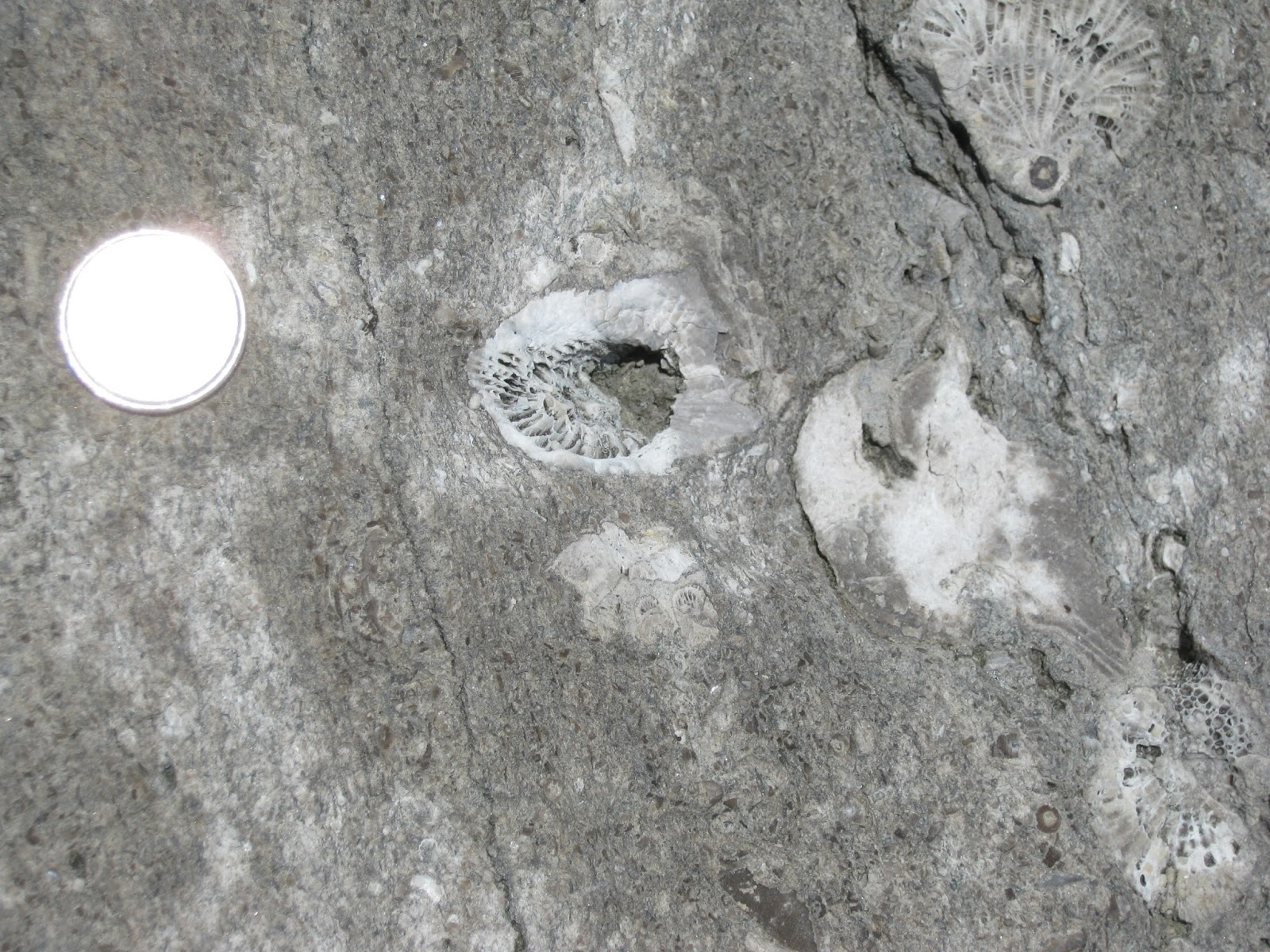
Canadian nickel used for a scale. From top to bottom: 1) corals in Silurian dolostone; 2) calcite crystals in a a vug; 3) shells screened off of marine sands, coastal Ghana (mesh size 4 mm, I think).

For the quality of the image, the film camera is better than anything I can afford in the digital realm--but it is bulky, and film processing isn't as easy to come by as it used to be. Especially for slide film, because prints would never have turned out as well. And in SL. 

The great advantage of digital is that at least you know whether or not the picture turns out before you leave the field locality.

At this point I am looking at options. I can borrow a camera that is much better than what I have now, but still not as good for macro. I can buy a newer model, but not a DSLR.