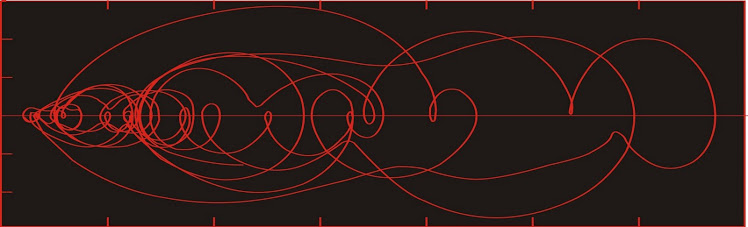
Dust flux, Vostok ice core

Dust flux, Vostok ice core
Two dimensional phase space reconstruction of dust flux from the Vostok core over the period 186-4 ka using the time derivative method. Dust flux on the x-axis, rate of change is on the y-axis. From Gipp (2001).
Showing posts with label Canadian politics. Show all posts

Monday, February 24, 2020

I read the news today, oh boy

Things are happening quickly, but I've been tied up with various health maintenance issues and have not been able to keep up. It would help if I could sleep, but that has been beyond my reach for most of the past week. Since multistability is in the purview of this blog, we may consider consciousness to have several metastable equilibrium states, some of which lie in the realm of sleep, and some of which lie in the realm of wakefulness. I am stuck in the one best characterized as "tired and wired". To go to sleep I have to leave one metastable equilibrium and migrate to one in the sleep portion of state space. Unfortunately, it is as if I have forgotten how.

Two stories that are of interest to me and (I think) are somewhat related are the decision by Teck Resources to withdraw its application for development of its proposed Frontier Mine oilsands project.
The company cites the inability of government (Canada) to square the circle with its stated objectives of mitigating climate change and supporting resource development.

The government had been preparing to announce a decision about the project shortly. Now it seems they no longer need to.

Coincidentally, this morning police moved in to disperse protesters around the rail blockade in Tyendinaga. The RCMP also moved in on Unist'ot'en territory in northern BC, presumably to disperse protestors there as well. I haven't seen statements by the protestors and their allies about the reason for this move, but I suspect it has to do with the Canadian government's inability to square the circle with its stated objective of native reconciliation and a (subtly) unstated objective of ensuring corporate profitability.

This move, to me, looks like it was to signal the government's intention to approve the project. Until Teck decided to discontinue the project

The Teck decision, I think, is based on rather more than has been stated. Years ago I owned a pile of shares in an entity called Fording Coal, which in its brief life made a respectable amount of money, no doubt leading Teck to buy out Fording's stake in the Elk Valley project. In reflecting on Teck's assets--a lot of coal, oil, and oilsands projects--and I couldn't help wondering whether somebody in management might be thinking about a need to scale back on carbon-intensive energy products. That perhaps someone in management might be thinking that it is better to sell off these components of the company, because their value may shortly begin to fall, and the longer they wait, the less they will get for them. I think this viewpoint must still be a minority viewpoint within the company, but it is there nonetheless.

From an economic standpoint, the rise of e-cars (much of which is going to be legislated), means lower sales of oil products going forward. Is now the time to be developing large oil sands mines--especially given the political uncertainty around developing pipelines to take the stuff to market?

Wednesday, August 16, 2017

Emergency storage for Canada's gold

The Diefenbunker--a cold-war-era bunker built to house the Canadian government in case of a nuclear attack by the Soviet Union--has a deep vault which was intended to house Canada's gold reserves during just such an emergency. The bunker is in Carp, a small town on the rail line just west of Ottawa.

The vault is about 25 metres below the surface, and looks like it would make a pretty good discotheque. Obviously, there is no gold there now.


Behold! Canada's gold reserves.

The vault was to be guarded by an impressive vault door.


Changes in pressure could make it impossible to open the vault door, so they had a smaller door that could be opened in order to equalize pressure between the vault and the entry hall.


They also created a narrow passageway completely around the vault, so it was less likely to be damaged in an earthquake. The vault would have been guarded, but rather than walk around the vault, each corner had a mirror in it, so that the guard could see all around the vault from one place.


Welcome to the underground

The plan was to move the gold somewhere where it couldn't be irradiated. Maybe the thinking was that radioactive gold wouldn't be suitable as a monetary base. I'm not sure I agree. The velocity of money idea suggests that the faster money circulates, the better off the economy is, and if all the gold had been minted into coinage and pumped into circulation, I think the radioactive coins would have really circulated.

Anyway, I took a close look for Canada's gold reserves, but didn't find any.

Tuesday, May 17, 2016

Bamboo slips in Changsha

What shows us the most about ancient civilizations?

We learn the most from mundane records. Bills of sale. Tax receipts. Water charges. Land registries. Most of these things would go unremarked in our civilization—we always imagine that people in the future will know of us through high literature, or the bible, or something. But the boring records of land taxes and the like, which are piling up in all the offices of governments everywhere, will give the most vivid picture of our society.

It may seem disappointing that one day archaeologists will be studying Hansard and interpreting the ins and outs of Canadian fuddle-duddling from the words therein. As opposed to reading Robertson Davies or Atwood, or maybe Mowat. Of course, it could be worse. Perhaps the only documents you might find would be the minutes of the meeting in which the Reform Party was founded.

One fairly recent discovery of this type is on display at the Bamboo Slips Museum in Changsha.  The bamboo slips are thins rods of bamboo, on which were written the detailed administrative records of an ancient city in China. Tax records, land transfers, sales—all recorded on more than 100,000 wooden strips, some of which are seen below.


The museum itself is a modern-looking building, festooned with bamboo trees. Unfortunately, like many Chinese museums, there is a lot of wasted space inside. 


Different forms of slips include narrow bamboo slips, and wider tiles. Don’t ask me to interpret what is on them.


Given today's preference for digital records, it is entirely possible that we will leave nothing readable behind. That is a slightly different problem than not leaving behind anything worth reading, which is another distinct possibility.


Treestump peacock sculpture (edit: actually a phoenix).

Tuesday, February 24, 2015

Multistability in the political world

In this blog I have tried to show that economic systems behave very like complex natural systems, which are often characterized by multistability. These demonstrations have been easy because of the data available from economic systems.

Political systems may similarly exhibit multistability. But this is not so easy to demonstrate in phase space.

Rosie Dimanno has a recent opinion in the Toronto Star about the ongoing horror in Afghanistan. Unfortunately, she draws the wrong conclusions, stating that the internecine warfare amongst groups of Muslims is occurring because "we" are withdrawing our troops. According to Rosie, all would be well if only the West would continue its benevolent humanitarian interventions in Afghanistan and other places around the world.

She doesn't pause to consider--why all this violence? Were all these countries this violent before the foreign interventions? How was Afghanistan before all the western intervention--which goes all the way back to the Russian invasion (if not earlier)? The pictures in the above links suggest it was a pretty nice place.

The current state of Afghanistan is completely different from the above earlier version of the country. What changes a peaceful place into one wracked by war, kidnappings, and all forms of extremism?

I believe we are looking at a state change much like we observe in complex natural and economic systems. Most systems find themselves in some stable state (which one is a function of the entire past history of the system). External forcing mechanisms (often in conjunction with internal mechanisms) may drive the system from its zone of stability.


Once the system leaves an area of stability, it tends to behave chaotically until it settles in another region of stability (or perhaps the same one).

What may have happened in Afghanistan is that western intervention drove the social system from its former stability and into a chaotic regime. Ordinarily, we would expect the system to evolve to some other stable state, but perhaps the ongoing interventions have kept this from happening.

It isn't clear if the social state in Afghanistan has switched to a new and very undesirable stable state, or whether it is winging through the realm of chaos. Trying to drive the system to a particular realm of stability is difficult--we have no theoretical framework for success. For this reason, it is typically better not to intervene in the first place.

Tuesday, February 17, 2015

Harper looks serious

. . . in the photo on his Facebook page.

Very serious, very leader-like, as he condemns ISIS for beheading 21 Coptic Christians.

Does he consider his own role in the debacle? Perhaps if he hadn't been so gung-ho to murder in favour of progressivist "R2P" bullshit, he wouldn't have broken Libya, and there'd be a whole lot less killing going on.

But of course, in his mind, there is no connection between his past actions and the present consequences, which shall go on and on.

Monday, December 8, 2014

Hewers of gold; drawers of oil

Two charts here about Canada's mining industry.

First up gold mining, both by weight and dollar value, from 1998 to 2012. The chart has been touched up, but originally is found here (pdf).


Gold production has fallen off, but this has more than been made up for by rising prices. Canada has been pretty lucky, although I wonder how 2013 would look on this chart.

The source material includes graphs of mining production and value for several other metals, and in most cases actual production has fallen while the value has increased. God bless inflation!

Secondly, Canada's balance of trade in the mining sector up to 2012.


And we see that while Canada is doing well in mineral extraction and primary manufacturing (ingots and rolled products), we need to import ever greater values of fabricated products. This is somewhat alarming, as the last country that got wealthy doing this was . . . well, I can't think of one just now.

One thing going for us is that with the recent higher prices for metals of the past several years, the overall balance of trade has increased. But seeing as the increase in value is not due to increased production, but increased price, and as production in many commodities has fallen over the last fifteen years, our only real hope may be deindustrialization.

It is tempting to blame all this on the Conservatives, but the trend was set in motion long before the beginning of the above data set.

Thursday, October 23, 2014

The killing will continue until the morals improve

Sad news has come from Canada over the past few days--two separate attacks have killed two Canadian soldiers.

The Harper government has been quick to condemn the attacks as ISIL-inspired terrorism. Unfortunately I am unaware of any investigation that has evidence to support this assertion. It seems likely that the attacks may be characterized as terrorism, but making a definitive statement linking them to a particular foreign group seems likely to skew the result of any investigation. Will the RCMP feel obligated to present conclusions that support the Prime Minister's assertions?

Like all Canadians, I too am saddened by these attacks. But it is important that we learn the truth behind the attacks, and act in a way to reduce their future likelihood. This will probably not mean that we should deport all Muslims; or that we should make Islam illegal; both of which are suggestions I have already heard from other Canadians.

We should not be afraid to investigate the possible role of recent Canadian foreign policy in these attacks. This means that we should ignore all the cries about "blaming the victims". The victims of these attacks are named Nathan Cirillo and Patrice Vincent. Neither the Canadian government nor the Department of Foreign Affairs are victims of this attack--investigating the connection between their actions and the recent appearance of acts of terror (both planned and realized) is not blaming the victim.

We are hearing claims of "radicalization" at the hands of Islamic clerics--but this has not been demonstrated. Nowhere do we hear of the possibility of "radicalization" due to the feelings of hopelessness and despair over injustices committed in our names in the Middle East.

There are many Canadians who are angry at the evolution of Canadian foreign policy, from "honest broker" to whatever it is that we are now. The vast majority of them will never raise their hand in anger against another. Their frustration has mounted, as their voices have gone unheard, and ever-greater acts of aggression are committed overseas in their name.

All over the world, I have seen the same thing. As long as there remains the possibility of peaceful change, peace will reign. But if the system is so heavily skewed that there is no possibility that your opinions will be heard, people eventually turn to violence.

Canada is about to embark on another mission overseas. Canadian soldiers will be placed in harm's way yet again. Some of them may become victims of attacks either here or overseas. The radicalization, one by one, of previously peaceful Canadians at home will also continue.

The killing will continue until the morals improve.

Friday, June 27, 2014

As Russia had its East Germany, so the United States has its Canada

In the bad old days of NATO and the Soviet bloc, East Germany was the snarling dog of the Communist world.

It was East Germany that had the Stasi, and the tightest control over the thoughts and actions of its people. East German athletes went the farthest in terms of steroid usage in order to bring glory to the country through athletic accomplishment.

Today, Canada is moving into that role for the United States. Where even the US is talking about engaging with Iran to formulate a response to ISIS in Iraq, and Britain is set to reopen its embassy, Canada remains opposed to talking with Iran. Canada's position with respect to Israel is now so far to the right as to be indistinguishable from the Likud.

The role of the snarling dog is to appear so unhinged as to make its "master" seem reasonable.

Friday, February 14, 2014

Setting up a people for hyperinflation--the Canadian example

The World Complex is not a fan of Stephen Harper and His Government (see here, for instance). But I am forced to conclude that he may be a cannier economist than I originally gave him credit for.

When a country destroys its debts by inflation, it ruins its creditors. The proper progressive approach is to ruin them all equally--thus it is imperative that there be no avenue by which creditors might protect themselves. At the same time, the government wishes no doubt to have its citizens continue to honour its currency, worthless though it might be.

During the Wiemar hyperinflation, despite the frenzied printing, the sum total of foreign currency that could be purchased by all the marks in circulation fell precipitously. There is a Keynesian argument to be made that the Germans didn't print quickly enough! Of course, having Germans individually destroying the currency in great amounts by putting it to such uses as cigarette rolling papers and firewood didn't help either.


It's not always nice to have money to burn.


And consider this--using the currency in lieu of hard-to-locate toilet paper may clog pipes.

Canada recently unveiled polymer bills. Just the perfect cross between plastic and paper money. And the brilliant part is, they are perfect in a hyperinflationary environment.

Plastic. Not really suitable for use as cigarette wrappers or firewood. You wouldn't want to be burning it indoors, anyway.

And as far as toilet paper--although it is a little uncomfortable, the microtexture on the bills does seem to be helpful for cleaning up the really tough spots. And although the bills have not been field-tested for flushability, the beauty of the polymer bills is that you can just wash them and reuse! Or spend, if you prefer.

The only problem the beta testers have reported is that the bills are a little small to be used comfortably.

Friday, October 4, 2013

Should Canada and the US merge . . . (updated)

. . . like Diane Francis asks?

No.

Sure, I could use the money. But I think in her calculations she has neglected to consider the extra costs to Canadians, like having to roughly double our per capita medical expenditures. Not to mention we might have to start pulling our weight in military adventurism around the globe. We might have to close our embassy in Cuba.

There's an old song I remember hearing from way back. The words used to be on the internet years ago, but I can't find them now. Unfortunately, on my copy the first line is garbled, so I'm not sure of the wording.

There's a fine country called America don't you know,
Just take a look at your atlas, it's the one that's down below.
There's fifty states in the union and something should be done,
To forget the war of 1812 and make it fifty-one.

There'll be colour television,
Social security,
Racial segregation and the Birch Society;
You can take the fifth amendment,
You can vote for LBJ,
You can even burn your draft card when we're Canada, USA.

Now some folks think we're English, which isn't true at all;
And some t'ink we're a colony that's run by Charles de Gaulle;
But we're looking up to greater things upon the glorious day,
When the capitol of our little state is Ottawa, CA.

There'll be colour television,
Social security,
Racial segregation and the Birch Society;
You can cheer for Jimmy Hoffa,
You can join the Klan today;
You can even be a Commie when we're Canada USA.

There's a bunch of stripes and fifty stars upon the Yankee flag,
There's gonna have to be fifty one when Canada's in the bag,
But when we see the flag unfurl, we'll know we've won the fight,
We'll be just before Connecticut in the third row from the right.

There'll be colour television,
Social security,
Racial segregation and the Birch Society;
You can take the fifth amendment,
You can vote for LBJ,
You can even burn your draft card when we're Canada, USA.

We'll all be much more affluent in the Great Society,
Their buck is worth $1.10 in Canadian currency,
The economy's going to get a boost for it's very evident,
That it costs us more to feed a Queen than pay a President.

There'll be colour television,
Social security,
Racial segregation and the Birch Society;
You can cheer for Jimmy Hoffa,
You can join the Klan today;
You can even be a Commie when we're Canada USA.

There'll be no more selling prairie wheat to all the commie crew,
There'll be no more Cuban sugar--that's very naughty too,
But think of all the benefits that surely have to come
When we're citizens of a country that's got the atom bomb!

There'll be colour television,
Social security,
Racial segregation and the Birch Society;
You can take the fifth amendment,
You can vote for LBJ,
You can even burn your draft card when we're Canada, USA.

Update: Just need to update that last chorus a bit:

There'll be welfare cheques and foodstamps,
Homeland Security,
The NSA on Google
And the end of privacy,
You can take the fifth amendment,
Get Obamacare today,
You can even shoot Iraqis when we're Canada, USA!

Tuesday, July 9, 2013

Will flood mud stick to the Harper government?

Past decisions have a way of coming back to haunt you. Just ask Stephen Harper.

The past several weeks have seen a series of events which, while not his fault, can be used by critics to attack his policies.

The first event was the Senate expense scandal, in which several Harper appointees were caught with their fingers in the till making inappropriate expense claims. The scandal is evolving, with one member of the Prime Minister's Office stepping down after it was revealed that he advanced one of the offending senators a cheque to cover his expense repayment. Although the senior aide in question resigned, and claimed that the PM had no knowledge of this event, Harper's history of micromanagement makes this claim rather dubious.

The second event was the massive flooding in Calgary. Though Harper was born in Toronto, this inconvenient fact is often glossed over in his appeals to his power base in Alberta. Especially Calgary.


Downtown Calgary showing the Stampede Grounds in foreground. Via

The event was driven by record intense thunderstorms across southern Alberta. Some areas received about half their average annual rainfall in less than two days. Many were quick to jump to the conclusion that this was a form of natural payback for Harper's push to develop the oil sands at the expense of any reduction in greenhouse gas emissions; however, Canada's muzzled environmental scientists were not among the critics.

(As an aside, it is impossible to ascribe a single event to global warming--although one can acknowledge the rising probability of such an event).

Before the floodwaters subsided, a near-crisis occurred--a train carrying petroleum distillates across a bridge derailed as the swiftly flowing Bow River scoured around the bridge foundations. It was mere foreshadowing for a major event.

Then came the apocalyptic train accident at Lac Megantic, which happened early Saturday morning. As is by now well known, a train hauling cars of oil for refining out east somehow slipped out of park and derailed and exploded in the centre of town, with what looks to be great loss of life.

Again, this is not Harper's fault--but critics are commenting on the tremendous increase in oil shipped by train in just the past four years. The amount of oil shipped by train has increased 28,000% in that time. I don't ever recall having a debate about the advisability of such an increase.

Perhaps this is not something that Harper has directed. But it has happened on his watch.

This brings us back to Toronto, Harper's real hometown. There was a surprising burst of rain, leading to a surprising amount of flooding. Unusual amounts of rain fell in a short time (about a month's worth in 6 hours). Not as bad as Calgary, and the results weren't as bad either. But notable.


This is my route to work. Via.

We were blacked out for about five hours. Some had it worse, with blackouts in Toronto ongoing today. Once again, there were critics blaming the flooding on Harper's energy/greenhouse-gas policies. Once again--this particular event can't be tied to it (although the probability of such events may well increase).

There is a lot of mud flying around. Eventually some of this mud may stick.

- - - - - - - - - - - - - -

Without any electronics, the kids were desperately bored. I shut down the laptops and unplugged them--we lost one due to a lightning strike last year. I finally engaged Jacob in a game of Shogi--he can play Chess and Chinese chess too (although he has a hard time finding credible opponents because I keep getting the pieces mixed up).

Tuesday, September 11, 2012

Why the Canadian political situation seems so familiar, part 2

Just to update the recent developments in Canadian politics since last time.

Today newspapers across Canada were abuzz with the news that Justin Trudeau, son of former PM Pierre Trudeau, has thrown his hat into the ring (no pun intended).


Justin Trudeau tries to take the majority government of Doom from Frodo. 
But Frodo won't surrender it, leading to tragedy.

As many feared, Stephen Harper managed to acquire the dreaded Majority Government of Doom.


Victory is mine! Two thumbs . . . err, one eye up!

And Michael Ignatieff suffered a devastating fall from grace.


Michael Ignatieff after the last election.

- - - - - - - - - - - - - - - - - - - - - - - - - - - - - - - - - - - - - - - - - - - - - - - -

I have been running this blog for a little over two years. When I started it, my focus was intended to be on methods of approaching interpretations of geological (primarily climatological) data. Somewhere along the line, the blog became more about economics/politics.

I have begun publishing the political/economic material on www.floatingpath.com, but will continue with the geological/mining/ industry/heavy mathematics here.

I have signed up for twitter and once I figure out how to link everything together, can keep anyone who wishes apprised of postings on either site.

If your interest has only been economic/political commentary, thanks for reading and I'll see you on the floating path. For everyone else, I'll see you over here or over there.

Thursday, February 16, 2012

That you have nothing to hide doesn't mean you have nothing to fear

The "Harper Government's" new online privacy bill, which requires that telecom companies hand over subscriber information to police without a warrant, had already generated a great deal of excitement--but when Public Safety Minister Vic Toews accused any opposition to the bill as supporting child pornographers, the online chatter went stratospheric.

Toews argument is yet another iteration of the old saw that you have nothing to fear if you have nothing to hide.

I, and many others, beg to disagree.

The reason I disagree is my long experience with authority figures and a certain creeping inevitability to the abuses that power entails. Once you are put in a position where you are to investigate crime, you begin to colour innocuous events with your own suspicions.

For instance, for years I have collected nickels. I would go to the bank, buy a number of rolls, pick out the ones I wanted, and returned the rest. There is nothing wrong with doing this, apart from whatever annoyance it might cause the tellers at the bank. But now I have these strings of petty cash transactions at the bank--20 dollars out, 18 dollars in, 40 dollars out, 35 dollars in, etc., each one separated by a day or two. I feel I have nothing to hide, but what might a CRA agent or some other suspicious member of the law think of this? How might they interpret all of this moving cash in and out of the account? Who knows.

A few years ago my bank offered me a free financial consultation, so I could talk to an "investment professional" about my progress towards my retirement goals. As per usual I told him that I was a significant shareholder and an insider of a reporting issuer--this is information that they are supposed to know in the event that I trade any securities of a company at which I am an insider. As he looked over my portfolio, he commented on how risky many of holdings were--there were a lot of junior miners there. I told him that I work in the industry, which helps me interpret the press releases and the geology of the various projects, some of which I have visited in the past. He threw off a light comment, "Well, I guess it's easy to make money when you trade on insider information."

Excuse me? Are you accusing me of something? This is a very dangerous accusation to hear from your banker, as he is required by Canadian law to report such suspicions through Fintrac. The guy knows nothing about me, but one look at my portfolio and he's sure I'm trading on insider info. This is the mindset of those who seek to use this information. You are a criminal; they just need to find the right information to prove it.

Suppose you have a favourite niece (or grandchild) going to university near your home. So you go to visit her every couple of weeks, bringing her a small bit of spending cash that you take from your bank on your way to visit her. Perhaps you email her before these visits. Now, suppose that this niece has been caught once with a small amount of some recreational drug (shocking, I know, but not unheard of at university). How might the police look at your pattern of small cash withdrawals from the bank followed by visits to this known drug offender?

Perhaps you are a Muslim youth struggling to keep to a moral path in what might appear to be an amoral world. For support you write your cleric with your questions about your struggle (perhaps you use the word jihad in this context). Might the police look at this discussion as a coded cover for something more ominous? Remember, that's their job.

Saturday, February 4, 2012

Can oil and agricultural land really replace gold?

Last time we discussed the ratio of government debt to gold holdings for select countries (primarily the PIIGS, but also the US and Canada). The article appeared on Zerohedge, and among the comments was this one:

Gold is just one asset class among many. TO divide debt by a single asset puts in play the grand assumption that gold is the only thing of value in the country that any creditor would want. I would argue that, while gold has its place, barring the breakdown of the financial system there are many other assets that are fungible with credit and paper money.
Re Canada: Canada has many fungible assets. How about dividing debt by oil reserves?  Or  fecund and cultivatable land? or other minerals and metals. 
The comment was made in response to the graph I had showing that Canada's debt was about 4000 x greater than its gold holdings.

There are points here worth addressing--some of which crossed my mind in an earlier article about gold mining and exploration. Ask geologists why they spend so much time looking for gold (at least 50%, by exploration expenditure) and your answers will probably be something along the lines of that is what pays the bills. But why should there be so much effort to finding gold, as opposed to, say, copper, nickel, aluminum, and zinc--all of which we use in much greater quantities than gold?

The answer is that gold, unlike any of the other metals listed above, is money. As money, it is irreplaceable, for reasons posited by Aristotle. In exploring for other metals, like lead or zinc, there is always a chance, however unlikely, that the industrial demand will fall dramatically due to technological advancement. Such risk affects every decision made from exploration to mine development for the different metals in different ways.

While it is true that gold is just one asset class among many, it is the only one that extinguishes debt. Credit and paper money merely transfer the debt from one debtor to another. Neither speak to the ability of the debtor to make good the debt.

What about other physical goods like oil or land? One problem is that, as I understand it, the oil and most agricultural land are private property and not something the government can properly use to pay down debt. But even if these things were public, rather than private property, they are not as good as gold for repaying debt. For one thing, the livelihood of Canadians depends on the present (and future output) of agricultural lands and oil fields. Selling them to repay debt would be like a carpenter selling his tools to repay his debts.

To tax the output of our mining, oil extraction, and agricultural fields to repay debt is to subject ourselves to a lower standard of living--which is the result in any case of incurring debts with no counterbalancing assets. Gold, as a non-productive asset, could have been sold without lowering our standard of living (were there any).

There is a lot of Crown Land which might be sold--although at what price is unknown. The only way to find out is to put it on the market. 

Tuesday, November 1, 2011

Canadian Mint launches new gold "ETR"

This was actually announced on Friday but only hit the papers today. The Royal Canadian Mint is proposing to sell a fraudulent product they call an "Exchange Traded Receipt" (ETR), each one of which represents a fixed amount of gold. The initial proposed price is $20 per unit, and the amount of gold represented by each receipt will be determined by the gold price on the Closing Date (not stated if this is the closing price, maximum price, London PM fix?).

The objective is to sell $250 million worth of units, through the usual culprits. The Closing Date is expected to be in late November.

You should note that this is not a good method for holding gold in the long term, as there is a management fee of 35 basis points per year, which is deducted daily from the gold represented by each receipt. So it's a little like buying a bag of gold with a very small hole--each day, a little will leak out.

According to the Mint's announcement, there will be a procedure for taking delivery of the gold represented by each certificate. No word yet on how onerous or time-consuming this procedure will be.

And if by chance the gold represented by your receipt goes missing at the Mint for whatever reason, there is this:
ETR holders will have no recourse to the Mint or the Government of Canada for any loss on their investment.
Of course if you never try to take delivery, you never have to find out if there is any gold backing this instrument.

Congrats to the Toronto Star for spicing up the otherwise bland coverage of this momentous achievement with the following quote from Dr. Moshe Milevsky, a professor at the Schulich School of Business:
“What I worry about is if people somehow think the government is somehow telling them gold is a good investment,” said Milevsky. 
 Oh no, we'd never want people to think that! 

Wednesday, October 12, 2011

Take the test: See what kind of terrorist you are (Canadian edition) - updated

Fintrac puroports to protect us all.

Test is available here.* Sorry if you love animals or trees. A partial screenshot appears below.


We're not distrustful of the government on this blog, nosiree!

*Update: Strangely enough, the site seems to have been taken down or had its address changed. If I can find it (if it still exists) I will post a new link.

Update 2. The missing page has not reappeared. But there is this.

Sunday, September 18, 2011

Poor Gordon Brown . . .

. . . he got such a bad rap for selling over half of the UK's gold at the price bottom.

But he is an investment genius compared to the government of Canada.

From 1997 to 2003 (in the low), they sold off over 96% of Canada's gold reserves, once again into a generational bottom. Although, according to this article, the last of these sales was into a "sizzling market".

And prior to that, from 1984 to 1993, when Mulroney (Conservative) was in power, Canada sold 70% of its gold into a falling market. Because selling into a falling market is how you make money.

The Chretien government (Liberal) sold off half of what was left by 1997, meaning Canada sold 85% of its gold prior to 1997. Then in next six years they sold 96% of what was left.

The glorious chart follows.


We have little to compensate for the sale of 99.5% of our gold. Except this. The prevailing global opinion of the strength of the Canadian economy is favourable.

As before, we next compare Canadian government debt to the value of its gold holdings.


The confidence of the ruined! The results are so spectacular that they need to be viewed on a logarithmic axis.


On paper, the picture isn't really this devastating--much of our gold was converted into foreign currencies including the US dollar, pound sterling, euros, Swiss francs, Japanese yen, Berzerkistan trffls, and other similarly combustible currencies; all of which are convertible into gold. For the moment.

In retrospect I had some rude things to say about this index for the US and Japan. Sorry about that.

Tuesday, May 3, 2011

Odds and ends

The news cycle is slow here in Ghana, especially when travelling. We had a gruelling all-day trip yesterday in which the truck suffered some sort of significant, yet hidden injury, requiring us to dump in a couple of litres of oil   every 20 km or so. As we approached one of the few bright spots on the bleak road from Mankessim Circle to Winneba Circle, my adventurous driver decided he wanted to see if the oil on hand would be enough to reach Winneba. I convinced him otherwise, arguing that the expense of a few litres of oil was cheap compared to the costs of blowing up the engine on a long, deserted stretch of highway in the middle of the night.

So I make it back to the office and what do I find? The TV has been fixed in my absence! And what's this? Osama Bin Laden is dead?!? And what's this? Harper wins a majority government, while the Liberals retreat to Isengard to lick their wounds? Perhaps Saruman will be thrown from the tower.

My last observation was in driving through Buduburam, a small town about 40 km west of Accra. The UN High Commission on Refugees (UNHCR) has a very snazzy building that has just gone up in this town, in acute counterpoint to the grinding poverty around it. Pretty blue banners wave in the breeze. The building has something to do with the Ivoiran refugees in Ghana, have no doubt, but does look a little too nice for actually housing them. I suspect it is for storing bureaucrats.


Saturday, March 26, 2011

Job openings in the Canadian government

The Harper government has fallen and is being held in contempt of parliament (or so it appears from over here in Ghana--I don't know how accurate this position is).

I'm not a fan of Mr. Harper but I have to admire anyone who brings dishonour to government.

Thursday, February 10, 2011

Fear of Democracy

Israel has long boasted of being the only democracy in the Middle East. Now they have come out and spoken about their opposition to democracy in other Middle Eastern countries.

From the referenced article:

'Deputy Premier Silvan Shalom said attempts at promotion of democracy in Egypt could strengthen what he called radical elements in the country, said Israeli website The Marker, a subdivision of the Ha'aretz newspaper.

'He asserted, “We know that, recently in the Middle East, democratic elections have caused the accession to power of radicals like Hamas in the Gaza Strip and Hezbollah in Lebanon.”

'The resistance movements, who owe their presence in the defense and political arenas to popular consensus, have invariably defended the Palestinians and Lebanese against deadly Israeli invasions.

'“Think of what would happen if the radicals become dominant over Egypt and decide to close the Suez Canal,” he said.'


That's the problem with democracy.

Think of what would happen if radicals became dominant over Israel. They might invade Lebanon or Gaza.

Wait--that already happened.

- - - - - - - - - - - - - - - -

Meanwhile in Canada, Stephen Harper seems a little reluctant to push for Mubarak's retirement.

But then he knows a thing or two about clinging to power.


Harper keeps a close eye on events in Egypt. He doesn't like seeing the hobbits in revolt.