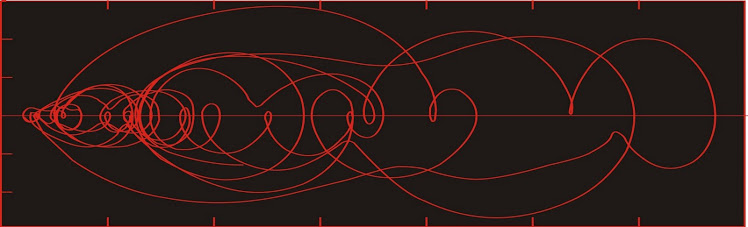
Dust flux, Vostok ice core

Dust flux, Vostok ice core
Two dimensional phase space reconstruction of dust flux from the Vostok core over the period 186-4 ka using the time derivative method. Dust flux on the x-axis, rate of change is on the y-axis. From Gipp (2001).
Showing posts with label deflation. Show all posts

Wednesday, August 5, 2020

The inflationary hyperloop and other tales from the near future

Last time we looked at the recent transition from deflation to inflation as revealed in the USDX vs gold chart. This time I would like to put this into a somewhat larger perspective.


This chart compares the US dollar index with the gold price over the last 12+ years. The overall effect has been one of deflation (both gold and the dollar index have risen over that period), but the effect has not been steady. Much of the deflationary "progress" has been made through cycles of inflation and disinflation, although there have been substantial periods of "pure" deflation, mainly in early 2010, late 2014 to early 2015, and the longest stretch covering nearly all of 2019 into May 2020.

The question of inflation, disinflation, deflation, etc. are not just theoretical--they potentially affect the balance sheets and investors' perception of gold and silver stocks as investments (or, perhaps, speculations). During deflation, when both the US dollar price of gold and the US dollar index are increasing, the balance sheets of non-US-based gold miners (companies with mining operations outside of the US) improve markedly. The effect is not as strong for US-based gold miners, however they do benefit from inflation. During inflation, the non-US-based gold miners don't really benefit much (from the accounting perspective), however this tends to be the time when their perception of value increases the most in the minds of investors. Since it is also likely to be a time for US operations to increase in profitability, it improves the financial conditions of the Nevada-based producers (and California, Arizona, etc.).

Also take note of the effects of deflation on silver. It isn't pretty. The switch from deflation to inflation makes puts silver in play. The important thing to remember is to leave the party when the inflation turns to disinflation or deflation, which can happen suddenly. 

In May, the situation switched from deflation to inflation. That may suggest that American-based producers and silver companies are right in the sweet spot.

One feature that stands out is the "inflationary hyperloop" highlighted in gold. It represents a fairly long period of inflation followed a similar period of disinflation, the total lasting about four years. For gold and silver investors, only the first half or so was much fun. Now that we have entered into an inflationary period, are we going to experience another such loop? It seems plausible. 

But there is at least one significant differences in the current inflationary run and the beginning of the inflationary hyperloop--and that is battle. Almost the entire way around the loop there was a real struggle between bear and bull forces. That struggle on the way up is important, as it tends to lead to resistance on the way back down. Now observe our current smooth inflationary stretch since May. Where are the struggles?

One approach is to assume that the current situation will mimic the inflationary loop. If so, we might get two years of fun and about $600 of price out of this. Some approaches suggest magnitude and time increase due to [central bank-fueled liquidity; higher price levels; Mars is in conjunction with Apollo; your reason here]. But the reality is that this is a dynamical system, and in state space, once the system breaks out of a mode of stability, it can move rapidly to another. The new area of stability may be nearby, or it may be far afield, but in either case, without any previous observations of its existence, its location in phase space is unknowable. This is just a roundabout way of saying we can't know how high the gold price will go (or how low the gold-silver ratio will fall) during this period of inflation.

I just thought of this. Youtube here

Wednesday, March 11, 2020

The possible coexistence of inflation and deflation

One comment came up a lot in the recent posting. Well, the comments were all on Zerohedge. Which was to dispute my conclusion of a switch to an inflationary setting.

In the biggest picture, we have had deflation for at least the past twelve years.


Sorry, haven't updated this one in the past few months. But on this scale, very little has changed. The long-term trend of rising gold price and rising USDX index that has been active for the past twelve years would still look the same as in this graph.

I remember Richard Russel, long before 2008, advocated for deflation, saying that the way to play it was 50% gold, 50% US dollar. So the deflation isn't really a surprise--it's a reflection of the excess levels of debt, and will remain until the debts disappear.

Yet on a year-by-year basis, we don't have continuous deflation at all. There have been year+ long cycles of inflation and disinflation which have resulted in deflation (the first year or so,  2011 to 2013, and 2016-2018). For this reason, it can be difficult to remain invested for deflation for the whole last twelve (and more) years.

The inflationary impulse that we may have embarked on (it will be safer to call this in a few weeks, assuming it continues) could be another event like we witnessed in 2011, which saw gold fall just short of $1900, with the US dollar falling sharply. And this was followed by the 2013-2013 period which saw sharp drops in the price of gold. 

Going forward, I think the next decade will be dominated by deflation (a rise to the upper right in the graph). But in the next year, we may see inflation (falling down and to the right in the graph) before disinflation (rising to the left) possibly ending up a little higher and to the right of our current position.

What's a prudent investor to do? Well, I'm not offering any advice. We may be starting an inflationary cycle. But then, I've thought that, and been wrong, before.

Friday, February 14, 2020

The Gold-Silver Ratio

For Valentine's Day, a little something for you who love silver.

Or gold

A couple of weeks ago, Wheaton Precious Metals released a very useful study on the gold-silver ratio. Today I would like to take a look at some of its implications.

The most important implication is one that everyone needs a little time to absorb. That is that there is no characteristic value for the gold-silver ratio.

That means that there is no "true north", or no mythic value (16, for instance) to which it is attracted, and to which it would return if only the world stopped manipulating its price.

The Wheaton conclusions are quite definite. The gold-silver rises during deflationary periods and disinflationary periods (we'll look at this distinction shortly). The gold-silver ratio falls during inflationary periods.


What is unclear is whether a rising GSR causes deflation, or deflation causes a rising GSR. I know which one I believe.

Let's test this against some measures I've used for deflation/inflation. I'll use the weekly chart of USDX vs gold price, weekly, going back to the beginning of 2008.


It is a busy visual, but what we want to do is look at longer-scale variations. Intervals when both the USDX index and the gold price rise are considered deflationary. If gold rises and the US dollar index falls, we have inflation (hence inflation and deflation are not opposites). Gold falling and the dollar rising will be disinflation, and I suppose that if both gold and the US dollar fall, we must have disdeflation, although I have never seen that word anywhere. It's a little hard to say, so it might be best to leave it nameless, and remember that if it ever happens, you should be shorting gold stocks.

Through most of 2008, the graph above suggests we were experiencing disinflation, and over that interval, GSR rises from 55.7 to 77.1

Much of 2009 was characterized by inflation, and the GSR fell from 77.1 to 63.3.

Until the middle of 2010, we had disinflation, and the GSR rose slightly.

The big inflationary pulse into late 2011 saw the GSR falling to 40.8. The final blow-off in the gold price did not see any movement in the US dollar index, so it technically lies between inflation and deflation, but I don't know what to call it. The GSR actually rose during that interval, which makes some sense as the gold price rose over $200 in that time.

The following disinflationary episode that lasted through 2013 saw the GSR rise to 65.9.

Since then, the dominant trend has been deflationary, although realistically there have only been two deflationary pulses--through early 2015 (GSR 74.5) and over the past 18 months (GSR at 88.6). Most of the time has been consumed by short inflation-disinflation cycles, with slight rises and falls of the GSR without significant trend.

Over the entire chart (twelve years) the big picture is deflation, but most of that has been accommodated through cycles of inflation and disinflation.

So long as deflationary conditions persist, the GSR may rise without limit. As long as debts are created beyond any ability to repay them, deflationary conditions will rule. Under such conditions, despite the GSR being pretty much the highest in history, gold remains a better investment than silver.

However, as much of the actual deflationary effect is brought about by cycles of inflation and disinflation, there are  brief intervals where silver makes a better investment than gold. But rather than using the level of the GSR as your selection criterion, you need to look closely at monetary policy instead.

Wednesday, December 11, 2019

A year of deflation was pretty good for gold miners

I have been showing the long-term graph of US dollar index vs gold for some time, arguing that the last twelve years have, on average, been deflationary.


Since early 2008, the gold price has risen from ~900USD per oz to nearly 1500 USD/oz, whereas the US dollar index has risen from about 72 to nearly 98. Richard Russell seems to have been right, with his bet of 50% gold and 50% US dollars.

Now, here's a thought. If the graph trending upward and to the right is deflation, how does inflation plot?

Down and to the right (rising gold, falling dollar). Deflation and inflation are not opposites . . . they are perpendicular.

In the above graph, even though the trend has been deflationary, there are inflationary and disinflationary intervals as well.


From about mid September last year until the end of August, we had pretty steady deflation. But on much shorter timescales, individual actions are on the inflation-disinflation axis. (I have not decided what to call the opposite of deflation - perhaps #$!?@!?).

My thesis of the past several years is that deflation is good for the price of gold companies. So let's see how one did.


Franco Nevada is a royalty streaming company with about 80% of its revenues coming from precious metals production. This company is a good one to test the hypothesis as it is more likely to be affected by economic factors such as the price of gold and less affected by company-specific factors as would be the case for a mid-tier producer.

From late September 2018 to about the end of August of this year, Franco Nevada embarked on a powerful price advance from about $80/share to $130/share--a 62% gain. This gain corresponded with the period of deflation, where both gold and the US dollar index were rising.

Similarly, a quick look at other companies including SSR Mining, Wheaton Precious Metals, Wesdome, Semafo, and even a small exploration company like Bravada showed strong gains over the same period.

Friday, August 9, 2019

Human ingenuity and gold

I saw the figure below on this website, and felt compelled to comment.


No attribution was given, so I will assume it was put together by the site operator.

At first glance, it tells a simple (if somewhat horrifying) story of currency destruction. But I think there is another story it tells, which is a little more hopeful.

The picture as presented is a little misleading because it shows what an ounce of gold will buy now. (Gold was $20/oz in 1932, but there was a little less than an ounce of gold in the double eagle. But let's pretend it is an ounce of gold and look at what that $20 coin would buy you in 1932.

According to this site, a gallon of gas cost $0.18 in 1932. Accordingly, your $20 coin would buy you 111 gallons of gas.

According to this site, a gallon of milk cost $0.26 in 1930 and $0.47 in 1935. The reason for the price rise was due to the government introducing programs to help farmers during the Depression. Not knowing when exactly the program started, it's a little difficult to be sure what the price was in 1932. So let's go with $0.33, meaning $20 would get you 60 gallons.

According to this site, a dozen eggs cost $0.36 in 1937. I'll estimate $0.33 for the price in 1932, netting us 60 dozen eggs for $20.

This old New York Times article tells us that a first-class postage stamp in the US cost $0.03 in 1932. Your $20 coin would allow you to mail 666 letters and have 2 cents left to put in them.

All of which is a lot more than $20 buys you now. But notably, it is much less than an ounce of gold will buy you now.

Gas: 111 gallons vs 482 gallons
Milk: 60 gallons vs 427 gallons
Eggs: 60 dozen vs 675 dozen
Stamps: 666 vs 2700

These increases are the result of capital investment and human ingenuity, and are a reflection of real increases in productivity.

So let's not overlook the happy side of the story. A big hand for human ingenuity!

Monday, July 22, 2019

The changing face of deflation

As noted previously, the shared global economic system has been dominated by deflation for the past eleven years. Evidence for this can be seen in the chart of US dollar index vs gold price since 2008 (below).


Since 2008, the US dollar has risen about 35%, whereas the gold price (in US dollars) has risen over 50%. At the current level, where goldxUSDX approaches the 1400 isoquant, non-US gold mining companies are getting more for their gold than they were in August 2011, when the gold price was $1848/oz. This speaks of deflation. But if you look at shorter timescales, you mostly see the expected inverse relationship between gold and the dollar.

Do you hear of deflation? Most people worry about inflation--it's the banks that worry about deflation. And it's not hard to see why. In a deflation, people seek to hold real money--which for most people nowadays means cash. But the graph shows that two things are viewed--nearly equally--as cash: gold and the US dollar. They have been rising for ten years because of an undercurrent of urgent purchases. Banks don't like people removing cash from the system because it impedes their ability to lend. Removing cash from the banking system and hoarding it (or using it to buy gold) short circuits the "wealth-creating engine" of the past few decades, which has been responsible for the growing wealth inequality since the 1980s.

But if we look at the relationship between the US dollar index and the gold price over the last year, we see a change--perhaps an important one--in the style of deflation we are experiencing.


In the past year, gold has risen about 20% in price (in US dollars), whereas the US dollar has only increased about 2% over the same timeframe. My interpretation is that this suggests a shift in deflation protection from purchasing a mix of gold and US dollars to just gold. After all, President Trump is signalling he wants to drive the US dollar down in price, and we all know that governments have many tools they can use to destroy their own currency!

Sunday, June 23, 2019

USDX vs gold in new territory

Again.


The last deflationary move has carried the system out of the immense head that has been building for the past four-and-a-half years. We are in new territory, with the possibility of continuation along the deflationary trend that as been operating for over ten years, or a switch to an inflationary trend, which could potentially result in another big runaway reaction as begain in 2011.

The isoquants in the above figure are lines of constant product of the gold price and the USDX. They represent the apparent gold price to a company that is mining gold outside of the US, and are the theoretical trajectory that the system would show if the only factor affecting gold price was the US dollar.


If we just look at the last 14 months, we see three distinct behaviours in the system. From April until mid June 2018, the system followed the 1200 isoquant, showing an almost perfect inverse relationship between the gold price and USDX.  From mid-June to late September, there was a sharp fall in the gold price with a nearly constant value for the USDX index. This phase was bad for gold companies. Since September, we have seen both rising gold and rising USDX, which this space interprets as a deflationary indicator. This is the sweet spot for mining companies, especially those outside the US, who get more dollars per ounce produced, and also see the value of the dollars rise. This improvement in fundamentals is well reflected in the GDX index, as seen below.


Friday, July 8, 2016

Third phase of deflation coming

But it's good news for gold miners--profits will rise.

The long-term plot of USDX index vs. the gold price shows that the US dollar gold price and the dollar index are inversely correlated much, but not all of the time. Empirically, money-making opportunities have arisen when both gold and the US dollar are rising together, as is happening now.


The blue trend line represents deflation--times when the US dollar gold price and the dollar index rose together. This trend enhances the profitability of most gold companies, as they are receiving a higher price for their product at the same time as the value of the dollars receiving is rising. The most important stretch where this was happening was in late 2009 to about mid-2010--a time when there were a lot of big moves in mining companies, especially those with production stories.

When the graph moves to successively higher isoquants the business of gold mining becomes more profitable. This happens during the deflationary segments, but can also happen if the gold price rises faster than the US dollar falls, as it did in early 2011, when the gold price rose quickly to over $1800 per ounce, bringing us to about the 1450 isoquant.

The segment of the blue line between the 1000 isoquant and the 1150 isoquant occurred in late 2014 to early 2015. Our current deflationary action started just after the Brexit vote. If it lasts as long as either of the last two episodes, we should have an excellent window for making good money in the gold stocks in the next six months to a year. If the dollar continues to be strong, a gold price of $1450 may bring us to the 1450 isoquant.

Sunday, March 27, 2016

Counting down to another deflationary impulse

First the bad news.


That pop-up I talked about last month in the phase space portrait of gold x USDX has gone the same way as last year's. Back into the increasingly significant area of Lyapunov stability near the centre of the above plot.

- - - - - - - - - - - - - - - - - - - -

The plot of USDX index vs gold price over the past decade has shown extreme variability in the specific relationship between gold price and the US dollar index. Conventionally, one might assume that gold and the US dollar strength are inversely related. If so, on the graph below, the plot would trace out a single hyperbola. Instead, we see that while there is a general inverse relationship between the two variables most of the time, the relationship is not simple. Furthermore, there are intervals when both rise together.


This impossible trend represents the increasing demand/value of real money, and is interpreted as an indicator of deflation. From September '09 until June '10 and from October '14 to late January '15, we saw a deflationary reaction in USDX vs gold. Interestingly one such trend began at the endpoint of the previous reaction.


Of course, it helped that major bond purchases by the Fed supposedly ended in October 2014.

For the last year, USDX vs gold has been confined to a relatively small area of phase space, with most of the action showing an inverse relationship between the two variables. In the last four months, however, the state of the plot has shifted from the upper left to the upper right of the following plot, bringing us very close to the endpoint of the last deflationary impulse.


Presently, with other deflationary indicators perking up (Au/Cu), we see the system evolving to the end of the last deflationary impulse. In conjunction with the breaking of the world, buckle up for another deflationary move. We just need a policy trigger. End to NIRP, anybody?

Monday, October 21, 2013

Why we face ruin

A nice compendium of UK economic data has recently appeared (h/t NESS). You are encouraged to download data sets for your own nefarious purposes.

As an example, I have decided to plot UK unemployment rate against the measure of confidence I proposed on these pages a couple of years ago. To recap, the confidence ratio is the ratio of outstanding public debt (in dollars) to the dollar value of the country's gold holdings. I chose "confidence" as presumably this ratio can only be high for a country in which investors have great confidence. For those of a different mindset, it can be viewed as a measure of a country's ruin (although it would be better to include other foreign currency reserves).


UK unemployment data from the site mentioned above. UK debt came from google public data. UK gold holdings came from the data sets available from the World Gold Council. To find the dollar value of gold holdings, I used averaged annual prices available at Kitco. Average conversion rate of GBP to USD available here (although I don't remember where I got it for the original posting, which was up to 2011).

That is a good-looking example of negative correlation. It tells us that the unemployment falls when the confidence ratio is high. Now, there are three ways for a government to increase that confidence ratio:

1) increase debt
2) sell off gold
3) pray for the price of gold to fall (obviously in a non-manipulative manner that doesn't direct profits to favoured entities).

The fall in confidence that we observed in the latter half of the last decade was entirely due to the rising price of gold. Look at what that did to the unemployment rate! Clearly the fault of gold-bugs and conspiracy theorists. The rising price of gold completely overrode the excellent work of the British Parliament in driving up the country's debt. As for Gordon Brown, he was a hero! His only flaw was in not going far enough. If he had sold all the UK's gold, imagine how low unemployment would be today!

This wouldn't be a post on the World Complex if we didn't do some kind of state space portrait, so here it is: unemployment rate vs. confidence ratio.


Policy decisions of British Parliament and their impact on unemployment can be followed from the above chart. Clearly the government in the 1970s laboured under the delusion that reducing debts would benefit the economy(1). They were rewarded for their imprudence by spiking unemployment in the early 1980s.

By the mid-1990s, they had discovered the golden ticket. With the rising confidence ratio, the UK was rewarded with a falling unemployment rate. Then came Gordon Brown's heroics--by aggressively selling gold he caused the confidence ratio to rise and the UK was showered with new jobs!

There was a small crisis in the latter part of the last decade. But since then--clearly back on track. If the forward evolution of the system follows a similar catenary to the period 1993-2005, then a mere quadrupling of the confidence ratio will restore the unemployment rate to about 6%. The most prudent way to achieve this would be to immediately sell off 75% of Britain's remaining gold (2).

I find this approach to finances inspiring, and am willing to give it a try. Here at The World Complex, the unemployment rate is unusually high (technically I am welcome to go to the office, but the treasury is empty). Looking at my finances, I see the problem--I have very little debt and high savings (although much lower than they were two years ago, thanks to the ongoing turmoil in the junior mining market). To rectify this oversight, I will be issuing bonds. For reasons of fiscal prudence, I will try to keep my confidence ratio below 100, and will begin an auction for $25 million in debt next Thursday (3). No cheap google ad payouts here!

Notes:

(1) the rising price of gold may have had something to do with this. But this proves my point! Rising gold price = rising unemployment, you naughty gold bugs.

(2) in my opinion it would be too difficult to drive the gold price back down to $300/oz.

(3) securities officers and other sarcastically challenged individuals take note--this is intended as sarcasm. Your participation is welcome.

Monday, September 5, 2011

Confidence or recklessness: The onset of inflationary deflation in the Anglo-American economies

Today we apply the same methodology that we previously used to study the rise and fall of confidence in the American economy to the UK. The chart below is the historical plot of the ratio of the UK public debt (in pounds sterling) to the value of the UK Central Bank gold holdings (similarly in pounds). A low ratio generally suggests economic soundness, and the ratio tends to increase with increased debt load. The ratio can fall due to increased holdings of gold, but for the UK and the US since WWII, the ratio falls due to a rising price of gold.

Gold reserve data to 1998 comes from the World Gold Council website (you need to create an account and sign in to download files).


Information concerning the UK gold holdings is a little sparse before 1950, but it appears that the confidence ratio shot up during WWI, as public debt rose ten-fold and gold holdings tripled. Gold holdings increased through the 1930s, no doubt escaping the continent.

The fluctuations in the 1950s were due to fluctuations in gold holdings, as were the spikes in the late 1960s and about 1970. By the mid-70s, debt was increasing rapidly, but was more than matched by the rising gold price, resulting in a fall in the confidence ratio.

The famed Brown gold sales beginning in 1999 led to the last enormous spike (perhaps this should be the recklessness ratio instead of confidence ratio). This ratio peaked in 2005, and its subsequent decline is entirely due to the rising price of gold.

In fact, the UK public debt has more than doubled since 2005. And even though the UK gold holdings have declined further since then (albeit by only about 0.5 tonnes), their value has more than tripled since then.

Here, once again, is the graph of US confidence.


If we consider gold to be a currency, then what we are looking at (for both the US and UK) is a situation where the government is inflating but the market is deflating. The number of dollars (or pounds) has increased, but the total purchasing power of all of these pounds or dollars (in terms of gold) has declined. The rate at which this is occurring is perhaps low enough we may call this inflationary deflation, but one wonders which line do we cross before we recognize this situation as hyperinflationary deflation.

Of course the interesting question then becomes--can Helicopter Ben really print faster than the market can destroy? We may soon find out.