Dust flux, Vostok ice core

Dust flux, Vostok ice core
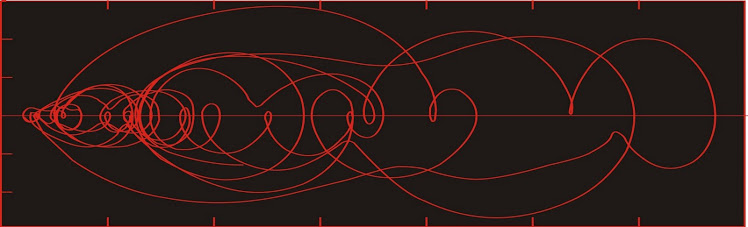
Two dimensional phase space reconstruction of dust flux from the Vostok core over the period 186-4 ka using the time derivative method. Dust flux on the x-axis, rate of change is on the y-axis. From Gipp (2001).
Showing posts with label Nevada. Show all posts

Sunday, March 30, 2014

Scale invariance in the changing economics of resource extraction

Some simple discussions today that follow from our last exciting episode.


First issue - there is a limit to the size of deposits (given our current state of understanding). For gold, you can't have a hydrothermal flow system with a radius of hundreds of km--the crust is too thin. Also the crust has too many heterogeneities, which can each trap some amount of the gold in a circulating system. So at some point, the probability density for the right tail has to drop off a cliff, instead of declining steadily forever.

There are some interesting ideas about the Witwatersrand invoking means of forming gold deposits which are no longer active that could have formed deposits over scales of hundreds of km.


As an example, I have plotted the size distribution of reported deposits in Nevada (pdf here). It is a graph which should mimic the white hyperbola in the first figure. It might look better if we had a lot more deposits to work from. The smallest deposits on this chart were only about 2,000 ounces--and one of them had already been mined out. I would naturally expect far more accumulations of gold in that size range in Nevada--but for economic reasons, only two have had enough work done on them to define a resource.

Second point is that size isn't everything. There are quality issues to consider as well. For instance, conventional thinking suggests there is little appetite for financing mining operations on gold deposits smaller than 2 million ounces. Anecdotally, however, there is increasing interest in financing small, near-surface oxide deposits because their capex and operating costs are both low, recovery rates are high, and their long-term environmental legacy costs are likely to be low. Similarly, grade affects the economics in a more complex manner than we can capture in the above figures. What might work would be to classify the deposits by grade or type, and create the same type of plot--but that is a project for another day.

Third issue--obviously, the economics of the extraction business don't stay constant. There are technological breakthroughs, making extraction cheaper. Or the commodity price rises. These change the location of the left limb of our hyperbola, making a whole new group of deposits (generally among the smaller of them) economically attractive. But some large, hitherto uneconomic, deposits may become economic as well (I'm not going to name any names).


Wednesday, January 11, 2012

Scale invariance and the scaling laws of Zipf and Benford

Scaling laws have been empirically observed in the size-distributions of parameters of complex systems, including (but not limited to): 1) incomes; 2) personal wealth; 3) cities (both population and area); 4) earthquakes, both locally and globally; 5) avalanches; 6) forest fires; 7) mineral deposits; and 8) market returns. Several years ago one of my students showed that various measures for the magnitude of terrorist attacks also observed scaling laws.

The general prevalence of scale invariance in geological phenomena is the reason for one of the first rules taught to all geology students--every picture must have a scale. The reason for this is that there is no characteristic scale for many geological phenomena--so one cannot tell without some sort of visual cue whether that photo of folded rocks is a satellite photo or one taken through a microscope--whereas one can make such a distinction about a picture of, say, a moose.

Numerous empirical laws (by which I mean equations) have been developed to describe the size-distribution of scale invariant phenomena. Most of these empirical laws were developed before the idea of scale invariance was well understood. One famous example is the Gutenberg-Richter law describing the size distribution of earthquakes.

Another statistical law, Zipf's Law, describes the relationship between size and rank. For cities, for instance, the largest city in a country will tend to have twice the population of the second-largest city and three times the population of the third. More formally, the relationship is stated as follows:


for a distribution where C is the magnitude of the largest individual in the population, y is the magnitude of an individual with rank r, and k is a constant which characterizes the system--but is commonly about 1.

If we plot rank vs size on a log-log plot, the graph should approximate a straight line with a slope of -1/k.

For instance, a plot of city size vs rank for US cities appears as follows:


Data sourced here.

From the same data source we find a similar relationship when city size is determined from area rather than population:


In the first plot we obtain a value for k very close to 1. The plot where cities are ranked by area is not as clear, but this may be due to the arbitrary nature of city limits. To characterize either of the above plots by Zipf's law is fairly straightforward--draw the straight line from the top-ranked city that best follows the line of observations.

A recent article published in Economic Geology argues that mines in Australia follow Zipf's Law. In summary, not only do the known deposits in Australian greenstone belts follow Zipf's law fairly closesly, but the early estimates of as yet undiscovered gold projected from early Zipf's law characterizations compared favourably with the amount of gold eventually discovered.

The weakness that I see with this approach is that it is all rather strongly dependent on the estimates of the size of the largest deposit. In any given area, it will be true that the largest known deposit will be well studied, but history has shown us that mines can be "mined out" only to be rejuvenated by a new geological or mining idea.

I am unable to reconcile the size-distribution data from the Nevada mineral properties presented recently with Zipf's Law, although they do seem to follow some sort of power law.


Using the straightforward approach to a Zipf Law characterization gives us the red line, which appears to show that there have been far too many gold deposits of > 1/2 million ounces for the largest mine. To reconcile the known gold discoveries with Zipf's Law (green line), someone would need to find a 100-million-ounce deposit (if that doesn't get explorers interested in Nevada, I don't know what will)!

I, however, would prefer to use the interpretation of the above data developed in our last installment--that there is a power-law relationship between size and rank, but this relationship breaks down for the largest deposits because there is some sort of limit to the size of gold deposits (at least near the Earth's surface), although I do not know what the limiting factor(s) would be.

Another scaling law is Benford's Law, which is an empirical observation that the first digits of measurements of many kinds of phenomena are not random. In particular, the first digit is a '1' approximately 30% of the time; '2' 18% of the time, '3' 12% of the time and so on, with the probability descending as the number increases.

First       Probability of
digit        occurrence

1            0.30103
2            0.176091
3            0.124939
4            0.09691
5            0.0791812
6            0.0669468
7            0.0579919
8            0.0511525
9            0.0457575


So if you had a table of the lengths of every river in the world, for instance, you would find that approximately 30% of the first digits were '1'--rivers with lengths of 1 904 km, or 161, or 11 km would fall into this category.

Furthermore, it doesn't matter what units you used--if you had measured the river lengths inches, you would observe the same relationship. The reason for this is that if you were to double a number which begins with '1', you end up with a number which either begins with '2' or '3'. Hence, the probability that the first digit is either '2' or '3' must be the same as the probability of it being '1'. In the table above, we see this is the case.

It isn't only natural phenomena that are characterized by Benford's Law. It has also been used as a tool to identify fraud in forensic accounting.

The deposit-size data from Nevada seem to conform to Benford's Law.


And if I convert the deposit size from ounces to metric tonnes . . .


So although Zipf's Law doesn't describe Nevada gold deposits well (at least at present), Benford's Law does.

Saturday, January 7, 2012

Gold, part 2: Is there a maximum size for gold deposits?

In our last installment, I presented a graph showing the size distribution for global gold deposits of greater than one million ounces. In it I tried to estimate the slope of the relationship between the size of deposits and their ranking, in terms of size,  in the hopes that the slope had some predictive power for the deposits that are yet to be found.


Two suggested scaling laws for the size-distribution of gold deposits (global).

Once again, the interpretation of these graphs is the rank, (in size, less one) of any deposit is the abscissa, and size is the ordinate. The reason for subtracting one from the rank number is that the largest deposit shown on the graph is actually the second-largest deposit in the state--and there is one deposit larger.

In our last installment, we assumed that the blue line was the better representation of the scaling law for gold deposits. Today we explain why the yellow line may be the correct answer, and that it does not mean we can expect to find multi-billion ounce deposits of gold (at least nowhere near the Earth's surface).

- - - - - - - -

The Earth system consists of myriads of local interacting subsystems. Intuitively, we might not expect the overall effects of these to merge into a background of white noise, we find instead that highly ordered structure arises on a variety of scales ranging up to that of the globe.

A simple scaling law for the size-distribution of gold is an example of red noise (or pink noise, depending on the slope). The observed power-law is a characteristic of a system at a state of self-organized criticality (SOC), as is nicely outlined here. In essence, the scaling law we observe in the size-distribution of gold deposits due to self-organization in the geological processes which control the reservoir size of crustal fluids which contained the gold, and possibly also the fracturing process which preceded the emplacement of the gold in the rocks.

Today we look at the size-distribution of gold deposits in Nevada.


The above graph was plotted using the data from the Nevada Bureau of Mines and Geology review of its mineral industry for 2009. There were 191 (unambiguous) significant deposits of precious metals for which I have combined the most recent mineral resources (all categories) plus any pre-existing historical production. I only counted gold ounces--and freely acknowledge that some of the mines in the above chart were probably better described as copper or silver mines--and treated all categories (proven and probable reserves, measured and indicated resources, and inferred resources) equally. If you feel the methodology is flawed you are invited to use your own.

We can compare the current size-distribution of gold deposits to the size-distribution of gold deposits in the Carlin Trend in 1989 (Rendu and Guzman, 1991).


Remarkably, both sets of data appear to be described by a straight line of constant slope, at least between for deposits between about 100,000 ounces and 10 million ounces in size.


During Nevada's "maturation" as a gold province, the scaling law describing the size-distribution of gold deposits remained constant over two orders of magnitude in size. The slope of these lines is about 1.5, placing the scaling law exponent between pink noise and red noise.

When we look at the figure on the top of the page, the blue line has a slope < 1, whereas the yellow line has a slope of about 1.5. For this reason, I propose the yellow line to be a better representation of the scaling law for the global deposits. The reason I first leaned towards the blue line was due to insufficiency of observations.

For comparison, if I only looked at deposits in Nevada greater than 1 million ounces, I would not be as confident describing the size-distribution with the yellow line.

SOC theory would seem to tell us the entire distribution should be characterized by a power law. Why not gold deposits?

In nature, there are limits. Infinity is not an option. Earthquakes are recognized as SOC processes, yet they have a maximum size, as the capacity for earth materials to store and transmit strain is finite. Similarly, we would expect there to be an upper limit for the size of crustal reservoirs of gold-bearing fluids. The result is that the largest gold deposit we find is much less than we would predict on the basis of our observed power law.

This explanation does not explain why there also appears to be a deficit in small deposits. For this the reason is economic. Under the current reporting regime (NI 43-101), gold in the ground cannot be considered a "deposit" unless it is reasonable to expect it to be exploited profitably. The requirement for economic exploitability will exclude many small--well, since they are not deposits, let's call them "collections"--of gold. Additionally, many company geologists will ignore such collections as soon as it becomes clear they are unlikely to become a deposit.


So it's up to these guys! (sorry about the quality--this is a point-and-shoot photo scanned way back in the '90s). He's using a rubber cut-out from an inner tube as a pan. This site is a thrilling walk north of Asanta village, western Ghana, on land almost certainly on a concession held by Endeavour.

References:

Hronsky, J. M. A., 2011. Self-organized critical systems and ore formation: The key to spatial targeting? SEG Newsletter, 84, 3p.

Nevada Bureau of Mines, 2010. The Nevada Mineral Industry 2009. Special Publication MI-2009. http://www.nbmg.unr.edu/dox/mi/09.pdf, accessed today.

Rendu, J. M. and Guzman, J., 1991. Study of the size distribution of the Carlin Trend gold deposits. Mining Engineering, 43: 139-140.