Dust flux, Vostok ice core

Dust flux, Vostok ice core
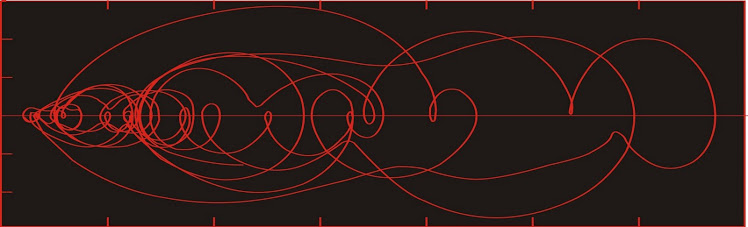
Two dimensional phase space reconstruction of dust flux from the Vostok core over the period 186-4 ka using the time derivative method. Dust flux on the x-axis, rate of change is on the y-axis. From Gipp (2001).
Showing posts with label unemployment. Show all posts

Sunday, December 7, 2014

National suicide and the nation state

The topic of national suicide seems an appropriate topic for the anniversary of the Japanese attack on Pearl Harbour. The Japanese people bore very little animosity to America. No doubt many of them remembered the aid that came to Japan after the big earthquake in 1923. Sadly, like in all other countries, the Japanese people were not in control of their country.

Like all wars, this war was sold to the people as a matter of national survival. But it was to be a survival in which Japanese people were destroyed in vast numbers to "save the nation." By the end of the war, soldiers were being outright sacrificed in order to achieve limited tactical successes.

The movie For Those We Love*, the pilots are preparing to leave on their final mission. The father, brother, and sister of one of the pilots have arrived to see him off. As he is about to enter his plane, his father pleads for him to come back to talk to him one last time (it's at about 2:35 of the following video). Unfortunately, his last words for his son are a lame cliche ("Do your best. We are all counting on you." And so on). My thought was that if that were my son about to fly off to die, I would have told him, "See that tent over there? That's where your commanding officers will all go as you leave. So after you take off, come back and strafe the hell out of it."


Now I read in this article that at least one pilot did attack his commanding officers. The article argued that the Kamikaze phenomenon in the latter part of the Pacific War was a particularly noxious brew of statism and Zen Buddhism.

I don't believe the Zen Buddhism part to have been necessary. The kamikaze pilots were not driven to suicide out of a philosophical concept of nothingness. They were ordered to, or perhaps pressured ("Come on, you don't want Japan to lose the war because of you, do you?"). The desire for death came down from the top, mostly from people who did not have the grace to kill themselves afterward.

The noxious mix came from a government that equated "the country" with themselves rather than with the people. As a consequence, the government was willing to sacrifice as many of its own people as was necessary to ensure its own survival. The lesson here applies not only to the hapless wartime Japanese, but to everyone in the world from the United States and Japan, to the Ukraine, and even non-state actors such as ISIL. The most obvious antecedents are in the suicide bombers that have struck targets around the world.

Today most of the developed countries of the world are pursuing economic policies "to save the nation". Unfortunately, they are predicated on arguments that the elderly will bankrupt the state: thus the state must strike back through low interest rates and understating inflation.

In fact, President Barack Obama’s budget wouldn’t take a dime from anyone’s current Social Security check. It would merely reduce the growth of future benefits by changing the way the government calculates inflation.
What the president has done is to endorse the notion that our current Consumer Price Index overstates inflation, because it doesn’t account for people’s ability to switch to lower-cost goods. If the price of beef goes up, people eat more chicken.

I like that choice of words: "merely reduce the growth of future benefits". Those future benefits were to compensate for rising prices which are themselves a function of the activities of the state. The remedy, that the elderly can eat chicken when the price of beef goes up; then cat food when the price of chicken rises, is a recipe for poverty. Unfortunately, starving the elderly is necessary to save the "nation".

I have argued that the low-interest-rate policy has harmed employment by reducing the costs of losses in financial speculation relative to productive investment. Thus, starving white and blue-collar workers of all ages is also necessary to save the "nation".

The massive size of the debts accumulated across the developed world will be borne by our children, encouraging a lower standard of living for them. Thus, starving children is also necessary to "save the nation".

In WW2, Japan sent its young men off to die trying to sink American ships. Now governments all around the world are casting off their citizens, stealing their lives a bit at a time to push the day of their own reckoning a little further into the distance. The only difference is they are not yet ordering us to die.


* I have to advise you that this is not a very good film.

Thursday, November 27, 2014

False confidence rising in the US

A recent article argues that the increasing demand for consumer credit is an indicator of increasing consumer confidence. The argument seems reasonable due to the way it is presented--there is an entirely different conclusion one would draw were the argument presented differently.

If you had a very low income, and few assets, yet people kept lending you money--money that greatly exceeded your assets--would that not suggest that these lenders had confidence in you? It may be that this confidence is unjustified--but we can infer its existence by the continued willingness of others to lend you money despite the fact that you appear to be ruined.

In just the same manner, we can infer the confidence that lenders have in a country by computing the ratio of a nation's debt to its actual holdings of real money. A high ratio suggests great confidence--even though it could just as easily be a measure of ruin. In the case of the US, we have used the ratio of its official debt to its official gold holdings. For other countries, we would have to include foreign currency holdings as "wealth".


Confidence in the US hit an all-time high in September 2001. Then something happened, and confidence in the US fell steadily until the end of 2012. The falling confidence level occurrred because the value of the US gold holdings rose faster than its debt (which itself was increasing at the greatest rate ever). In other words, the US dollar was losing value (relative to gold) faster than the US gov't could spend it.

Confidence increased in 2013, as the gold price fell while debt continued to increase. But is this real confidence?

The ratio of debt to gold can only be considered a measure of confidence if foreign entities are willfully buying the debt. If, on the other hand, the government simply monetizes the debt itself, or orders its vassal states to purchase the debt, then it wouldn't be correct to look at this ratio to be a measure of confidence. It is a measure of ruin--and faked confidence.

We have also seen that higher confidence correlates to periods of lower unemployment. The correlation appears to have continued into 2013, but with all the shenanigans involved in reporting unemployment, I have to caution that I have no confidence in the reported unemployment rate. However, it appears that goosing confidence may be a fore-runner to improved employment, and reiterate that there are only three ways governments and central banks can bring about such a result--increase debt (without the gold price falling); sell gold; or pray for the gold price to fall. Pray hard. Very, very hard.


The second chart really shows faked confidence compared to faked unemployment numbers (particularly the last couple of years). But at least it shows that things are getting "better" in the US.

Wednesday, October 23, 2013

Economic policy and the price of gold

Then the rumour circulated that at night the Fed Governors neglected their sacrifices and prayers. A great depression seized everyone. One day the President said to the Fed Chief, "When will we celebrate the return of normal unemployment rates? I would like to make a journey and return in time for the feast. How long is it until the day of the feast?" The Fed Chief was embarrassed. It had been several days since she had looked at the moon and the stars. She had learned nothing more about their courses. The Fed Chief said, "Wait one more day and I will tell you." The President said, "Thank you. Tomorrow I will come to see you again."
The Fed Chief gathered the Fed Governors together and asked, "Which of you lately has observed the course of the stars?" None of Fed Governors answered, because they had all stayed to listen to the stories of Fiat-do-lar. The Fed Chief asked again, "Hasn't even one of you observed the course of the stars and the position of the moon?"
                                                 -- modified from The Ruin of Kasch

Economics isn't a science. It is a mistake to think it would be so. Science does not have schools. Only philosophies have schools.

The difference between a science and a philosophy is the difference between seeking truth while honestly admitting you don't know it and declaring that truth is something you define.

Ideally science is described by working hypotheses, which are constantly tested, and if falsified, replaced (unless pride is involved or money). In philosophy, you begin with axioms, which are untestable statements that are defined as being true. Each school of economics has its own set of axioms. From axioms, you apply rules of inference (logic) in order to generate new statements, which are also true. These generated statements are called theorems. Thus all theorems are true (within the school of philosophy) but not necessarily applicable to the real world!

In the early days of geology, there were competing schools: the Neptunists and the Plutonists being two that come to mind immediately. The Neptunists believed that all rocks formed in the sea, either as sediments, or by crystallization as salts (this was their central axiom). The Plutonists believed that all rocks formed from magma (as their central axiom). Debates between adherents of the two schools were rowdy, fruitless affairs, because the nature of philosophy is that it cannot be overturned by mere observations.

The distinction between science and philosophy with respect to economics is important because economists have an annoying ability to set policy--policy that affects the quality of your lives. It probably doesn't matter much to you whether some geologists can't decide among themselves whether a particular rock formed in the sea or on a volcano (or even on a volcano in the sea). But it does make a difference if some Fed official acts on her belief that bankrupting the elderly eliminating interest on savings is a cure for unemployment.

Application of economic policy follows the axiomatic approach. Some high priest of an obscure caste decides on a cure for economic woes. Perhaps he dances around like a medicine man. The evil spirits are expunged, so that unemployment levels will finally fall. Maybe.

Recently, The World Complex presented the inverse correlation between the unemployment rate in the UK and its "confidence ratio" (dollar value of public debt divided by the dollar value of gold holdings). The idea was that a high ratio could only be supported if bondholders had high confidence that the debt would be properly serviced (forget about repayment). The flip side is that a high ratio could be interpreted as a measure of a country's ruin.

In the article I had suggested that government economists might cheer a decline in the price of gold.

So today, we look at the same relationship for the United States.


Once again we see a strong inverse relationship between confidence ratio and unemployment.

One of the goals set out for the Federal Reserve is to manage the unemployment rate. Looking at this chart, the answer is clear--to reduce unemployment, increase the confidence. Confidence (as defined above) can be increased in three ways: 1) raise debt, 2) sell gold, 3) lower the gold price.

Of course we all know that correlation does not imply causation. But it doesn't have to in order to impact on Fed policy. That's the beauty of politics--reality and truth don't really matter when there are elections to be won.

There was a comment that perhaps I have too much time on my hands. I'm not sure if the intent was to say that only someone with a lot of time on his hands would notice this relationship. The economists at the Fed have far more PhD's and time on their hands than does this corner of webspace. So I'm sure they have already seen this.

So the question becomes--even if no causation can be established, can it be used to set policy? And what policies will be followed?

Raising debt is the old standby--but as we see in the clarified chart below, it doesn't seem to be working anymore.


Since the 2001 peak (on September 10, perhaps?), the increasing debt has been more than compensated by the rising price of gold. Don't be fooled into thinking the US is sinking into solvency--it is creating debt faster than any time in history. But the price of gold has been rising faster still (although we shall see about 2013).

It appears that policy #2, the sale of gold, is politically untenable. Officially at least. Selling gold is for lesser countries. So that leaves option #3--hope the price of gold falls. Perhaps they do more than hope.

. . . at first the story of Fiat-do-lar was like hashish when it makes wakefulness happy. Then the story was like hashish when it makes dreams delirious. Toward morning, Fiat-do-lar raised his voice. As the Nile rises in the hearts of men, so his words swelled. To some, his words brought serenity; to others, they were as terrifying as the appearance of Azrael, the angel of death. Happiness filled the spirits of some, horror the hearts of others. The closer morning came, the mightier that voice grew and the more it resounded within the people. The hearts of men rose up against one another like clouds in the sky on a stormy night. Flashes of wrath met thunderbolts of fury. When the sun rose, the tale of Fiat-do-lar reached its end. Ineffable wonder filled the confused minds of the people. For when the living looked around, their gaze fell upon the Fed Chief and Governors. They were stretched out on the ground, dead.
                                        -- modified from The Ruin of Kasch 

Monday, October 21, 2013

Why we face ruin

A nice compendium of UK economic data has recently appeared (h/t NESS). You are encouraged to download data sets for your own nefarious purposes.

As an example, I have decided to plot UK unemployment rate against the measure of confidence I proposed on these pages a couple of years ago. To recap, the confidence ratio is the ratio of outstanding public debt (in dollars) to the dollar value of the country's gold holdings. I chose "confidence" as presumably this ratio can only be high for a country in which investors have great confidence. For those of a different mindset, it can be viewed as a measure of a country's ruin (although it would be better to include other foreign currency reserves).


UK unemployment data from the site mentioned above. UK debt came from google public data. UK gold holdings came from the data sets available from the World Gold Council. To find the dollar value of gold holdings, I used averaged annual prices available at Kitco. Average conversion rate of GBP to USD available here (although I don't remember where I got it for the original posting, which was up to 2011).

That is a good-looking example of negative correlation. It tells us that the unemployment falls when the confidence ratio is high. Now, there are three ways for a government to increase that confidence ratio:

1) increase debt
2) sell off gold
3) pray for the price of gold to fall (obviously in a non-manipulative manner that doesn't direct profits to favoured entities).

The fall in confidence that we observed in the latter half of the last decade was entirely due to the rising price of gold. Look at what that did to the unemployment rate! Clearly the fault of gold-bugs and conspiracy theorists. The rising price of gold completely overrode the excellent work of the British Parliament in driving up the country's debt. As for Gordon Brown, he was a hero! His only flaw was in not going far enough. If he had sold all the UK's gold, imagine how low unemployment would be today!

This wouldn't be a post on the World Complex if we didn't do some kind of state space portrait, so here it is: unemployment rate vs. confidence ratio.


Policy decisions of British Parliament and their impact on unemployment can be followed from the above chart. Clearly the government in the 1970s laboured under the delusion that reducing debts would benefit the economy(1). They were rewarded for their imprudence by spiking unemployment in the early 1980s.

By the mid-1990s, they had discovered the golden ticket. With the rising confidence ratio, the UK was rewarded with a falling unemployment rate. Then came Gordon Brown's heroics--by aggressively selling gold he caused the confidence ratio to rise and the UK was showered with new jobs!

There was a small crisis in the latter part of the last decade. But since then--clearly back on track. If the forward evolution of the system follows a similar catenary to the period 1993-2005, then a mere quadrupling of the confidence ratio will restore the unemployment rate to about 6%. The most prudent way to achieve this would be to immediately sell off 75% of Britain's remaining gold (2).

I find this approach to finances inspiring, and am willing to give it a try. Here at The World Complex, the unemployment rate is unusually high (technically I am welcome to go to the office, but the treasury is empty). Looking at my finances, I see the problem--I have very little debt and high savings (although much lower than they were two years ago, thanks to the ongoing turmoil in the junior mining market). To rectify this oversight, I will be issuing bonds. For reasons of fiscal prudence, I will try to keep my confidence ratio below 100, and will begin an auction for $25 million in debt next Thursday (3). No cheap google ad payouts here!

Notes:

(1) the rising price of gold may have had something to do with this. But this proves my point! Rising gold price = rising unemployment, you naughty gold bugs.

(2) in my opinion it would be too difficult to drive the gold price back down to $300/oz.

(3) securities officers and other sarcastically challenged individuals take note--this is intended as sarcasm. Your participation is welcome.

Wednesday, September 25, 2013

The tipping point of 2008

As before, I have compiled this graph from official figures released by BLS and the US Fed.


Scatterplot of unemployment rate vs real interest rate (3-mo. treauries - inflation).

As some commentators have noted, the fall in unemployment rate is not supported by the fall in labor force participation, and it is likely that unemployment is understated because of the large number of individuals who have become discouraged.

In any event, we see a major change happened in late 2008, accompanied by a short-lived spike in real interest rate (mainly due to falling prices). Since then, interest rates have been slammed to real lows, but the unemployment rate has not significantly changed.

The transition from the lower area of concentration to the higher one is an example of a state change in a complex system. The system has switched from one mode of operation to another.

What are the two modes of operation? We can assume that one of them is an ideal economy in which most of the players are involved in some sort of productive enterprise. It is this economy which behaves more-or-less as predicted by economists--a drop in interest rates tends to cause a marginal increase in productive investment.

The trouble is that over the past couple of decades, an increasingly large proportion of economic activity was based on non-productive, or rent-seeking, activities--such as speculation, carry trades, and increased fees for normal financial activity. When the financial crisis hit in 2008, guess which sector received the majority of aid from central banking authorities. It wasn't the productive sector--it was the speculative sector. When you consistently reward an activity, you get more of it. At the same time, the productive sector suffered real damage, and contracted to the point where the US economy is now dominated by rent-seeking behaviour.

In an economy of speculation, lowering interest rates does nothing but reward further speculation (near bottom). If you can borrow ever-increasing amounts of money at near-zero interest, and make progressively larger bets on the global casino until it pays out, then why would you do something risky like build a factory to make refrigerators?

Since the lower interest rates aren't creating employment, the BLS has no choice but to keep removing discouraged workers from the list. It's the only way to reduce unemployment.

Well, keep pushing boys--eventually you'll get that unemployment "rate" down to 6% and you can claim mission accomplished--no matter what the real state of the economy.

Thursday, August 29, 2013

The magic ends, part 2:

In part 1 we looked at some examples of what happens when the audience can no longer suspend its disbelief in a currency.

What was the magic? The magic was the magnificent illusion that money printing increased wealth. It certainly looked that way, despite all the common-sense interpretation that would have you believe that it doesn't. But that's the beauty of a wonderfully performed magic trick. Something impossible seems to happen. You know it can't happen, but it looks like it did, and what's the harm in letting yourself believe?

The latest round of the great trick really began in the late 1950s. Spending by the US government increased the demand for labour by the millions, which allowed women to enter the workforce in large numbers.


Data source: Bureau of Labor Statistics (BLS)

The main uptick in the labour force participation rate began in the early '60s, but the real bottom (on this graph) was in the mid '50s. One obvious source of stimulus in the 1960s would have been the Vietnam War, on which the US gov't spent the equivalent of $738 billion, in 2011 dollars (pdf). That kind of money created a lot of jobs--mainly in the military industries, but also for lobbyists.

At the same time, the "Great Society" was in full swing. Lots of public works projects. The same thing happened up here in Canada, with a huge increase in universities, highways, and transit systems. All this spending created a lot of jobs. Nobody asked whether these jobs were really necessary. Would the public works projects pay off?

Certainly they appeared to make society more prosperous. But was it real prosperity or just a magic trick? Was it an illusion, or something more sinister . . .
A thief and a magician enter a convenience store. The thief says to the magician, "Watch this", and promptly places three chocolate bars into his pocket so smoothly that nobody else notices. He is just about to leave when the magician calls him back and says, "I've got a better trick." The magician approaches the shopkeeper, and asks if he'd like to see a trick. "I can make three chocolate bars disappear and reappear." He unwraps three chocolate bars and eats them. When the shopkeeper asks to see them reappear, the magician points to the thief and says, "They are in my friend's pocket."
In the earliest part of my education I recall, we were fed the belief that it was right for women to enter the workforce, and it followed that once women wanted to work, all these jobs opened up for them. Millions of them.

Why can't it happen now?

Look at the unemployed--the real unemployed. Their numbers are reflected in a massive increase in duration of unemployment not to mention the increase in the reported unemployment rate.


I thought the unemployment rate was supposed to drop when interest 
rates were low. Data from BLS.

Don't the unemployed want jobs? Why don't jobs magically appear for them like they did in the 60s?


Impressive job creation from the 1960s until about 2000. 
It stalled briefly during the Volcker high-interest-rate period
of the early 80s. Data from BLS.

The trouble is similar to what our magician friend in the story above might face if the shopkeeper suddenly demanded a repeat performance, this time with meat pies. The magician can only perform a trick like that so many times. Perhaps he becomes too engorged with chocolate bars and meat pies. Perhaps there aren't any that can "appear" in his friend's pocket. Or maybe the shopkeeper simply won't be fooled any more.


That's funny. All that money of yours that disappeared was 
supposed to reappear in my hand. Errrm, sorry?

At least is isn't as bad as Siegfried and Roy's last trick with the tiger.

What does the rest of the world think?


Too lazy to update this. Sorry. To mid 2011. But I doubt it's gotten better.

It looks like the rest of the world started to lose faith in the US dollar in the '90s. Remember the Strong Dollar Policy under Clinton? Looks like somebody thought it was a selling opportunity.

But the problems with the money-creating approach became apparent by 1970. Nixon kept the system going a bit longer with his trick of taking the dollar off the gold standard, so the US would not have to exhaust its stored gold redeeming green coupons. The system ran out of gas again at the end of the 70s, but Volcker's trick of raising interest rates gave the US 20+ years of slowly falling interest rates, which allowed the audience to keep believing the illusion.

But even then, it should have been clear that something was up. GDP as it was defined at the time was climbing, but some of its ancillaries were not keeping up.


Data from Handselbanken Capital Markets.

It is difficult to imagine just how the economy grows without similar increases in the use of copper and zinc, both of which are tough to replace. One comment wondered if we replaced copper and zinc with plastics. Some piping maybe. But not much wiring.

As I proposed earlier, what really happened in the late 1970s was a contraction in the economy, which was hidden by fudging reported GDP. If real GDP is tied to demand for copper and zinc, then I would say that (from the above chart) world GDP was overstated by approximately 80% as of 2005. It's hard to imagine that that number has gotten smaller subsequently. Either that, or the "value" of lawyers bills, lobby groups, US medical expenses, overspending on military wonder weapons, financial charges and skimming, and other less than productive enterprises now constitutes just under 50% of the world "economy". I hope it makes you feel rich.

With lower demand came lower exploration expenditures--at least for base metals.


Source here (pdf)

I think this graph shows the change in mindset from the past to the present. Don't mine base metals; mine money (gold). And this established the precedent for today's industrial ideal: don't make products, make money. And so the business model changed: from producing real products, which improved lives and increased the wealth of everyone; to making money through methods including outsourcing and speculation, which improved the lives and wealth of only a few.

Back to jobs.


After the little scare in 1980, we had 20 years of lower interest rates, during which the US labour force participation rate increased to its highest level in history. After the internet bubble popped, the US Fed shoved interest rates down, igniting a nice housing bubble, which created a lot of construction, real estate, and retail jobs. Unfortunately, these only matched the losses of manufacturing jobs--until about 2007. More recently, the number of full-time jobs is falling.

The magician has pulled all the rabbits there are out of the hat.

If money printing can't create jobs anymore, the pain that is to come will dwarf the pain already felt. The labour force participation rate will fall to the level of the 1950s unless there is another rabbit in there somewhere.

Too bad they'll all be low-paying jobs.

Wednesday, July 3, 2013

Kage Ginko-ka (The Shadow Banker)

This recent remake of a classic Kurosawa film investigates themes of identity, and sublimation of the self. A common man of the streets must pretend to be the head of US Fed in order to maintain market stability. But what is the price he must pay?

It opens with a notorious central banker (Ben Bernanke) discovering a double exact duplicate of himself.


"He's an exact duplicate of me. He could be very useful. He's the worst sort of 
scoundrel-a drunkard, a gambler, a thief. As I say, an exact duplicate of me!"

Fearing unspecified plots against his life, he plans to use this doppelganger as a Kage Ginko-ka--a shadow banker. This shadow can take his place in public appearances, reducing the risk of unexpected economic events.

Arduous training follows--how to make verbose, meaningless statements about the economy; how to compose himself before the cameras during congressional hearings; how to conduct FOMC meetings; and the importance of low interest rates as a means of combating undesirable economic outcomes..

Ironically, despite his preparations, Bernanke succumbs to a mysterious ailment (possibly ink poisoning) compounded by numerous paper cuts.


Bernanke informs Fed Governors that he may die, and tells them to maintain low 
interest rates and keep his death a secret for at least three years to avoid market turmoil.


"I can see gold under $300/oz! Fly my banners!"

Rumours swirl of Bernanke's death, so to calm the markets, the Fed Governors trot out the Shadow Banker.


The Shadow Banker is introduced. The Fed Governors decide to use
him to convince the market Bernanke is still in control.

His first public appearances go very well. Many commentators note he seems more life-like than usual.


"Innovation, almost by definition, involves ideas that no one has yet had, 
which means that forecasts of future technological change can be, and 
often are, wildly wrong. A safe prediction, I think, is that human innovation
 and creativity will continue; it is part of our very nature." (May 18, 2013).

The human element is a major element in a tragedy. In this case, Bernanke's replacement, Tim Geithner, is distressed that he is being passed over for the position in favour of a common man from the streets.


Geithner (at right): "That should be me up there--not that fraud!"

Geithner schemes to expose the charlatan so that he can take over as Fed Chair. As an FOMC meeting approaches, the other Fed Governors prepare the shadow banker to sit quietly, listen to everyone's advice, then thank everyone for their input and close the meeting with an announcement the policy decisions will follow in the morning--said policies to be drafted by the other Fed governors.

But Geithner tries to sabotage the proceedings, by pointing out apparent overheating in some sectors of the economy and asking him to raise rates. Ignoring the others, Geithner demands the shadow banker make a policy decision on the spot.


The Shadow Banker rises to the challenge. "The interest rate shall not move."

Although the other Fed governors are impressed with his ability to think on his feet, they are disquieted by the disrespect shown by this common man from the streets. Some of them also fear that someone so clever might be tempted to "slip the leash".

Their fears are later confirmed when he releases a statement unilaterally raising the target rate for unemployment rate from 6.5% to 7%. Sensing the need to act, they dismiss him, admit the real Bernanke is dead, and appoint Geithner.

Determined to put his stamp on the Fed after his long period of frustration, Geithner embarks on a series of market interventions that end in disaster.


Bailed-in depositors lie on the field of battle.

Desperate to help, the shadow banker buys all the bonds he can, but it is too little, too late.


"I can't replace QE, but every bit helps!"

Killed by sharply rising interest rates, he is swept away by the river of fate.

Sunday, May 5, 2013

Break in generational employment trend

It's been awhile since we last revisited unemployment. I have largely abandoned its study because of the distortions that have been built into its present calculation. These distortions become clear in looking at the labor force participation rate, which is the proportion of the adult population engaged in full time employment, and which is readily available at the Bureau of Labor Statistics.

The website gives you monthly data going back to 1948.


Available data are monthly, but I have only used the year-end numbers in the above graph.

The profile of employment across the United States was no doubt greatly different in 1948 than at present. In 1948 it was a lot less common to see both parents fully employed than was the case in 2000. Assuming that all families have at least one parent working full time, the peak value of about 67% in the late 1990s would  suggest that 34% of families had two full-time working parents. Part-time workers are not counted in this statistic, and no doubt they were many.

The increase in participation from the early 1960s to the late 1990s reflects a major change in the structure of employment over the past two generations, with more married women entering the workforce.


In the lagged phase space we see two areas of attraction--the first in the 59% participation, and the second more recently, around 67%. We also note that the system has recently moved out of the higher area of attraction. The relative number of fully employed people is falling. How low can it go?

Below we see a topologically equivalent phase space constructed using the time-derivative method--plotting the participation rate against its rate of change, averaged over four years.


The same two areas of attraction appear, with what might be a third at around 64%. The current trajectory looks like it is heading there--so it doesn't appear that labor force participation will shrink much going forward.

Labor force participation increased during the period of falling interest rates after Volcker raised them so high in 1980. Their subsequent drop ignited a stock market bubble, which finally popped in the year 2000. The participation rate appeared to be heading lower--but intervention in interest rates inflated a bubble in real estate prices, "creating" lots of jobs in sales and construction--until it, too popped.

Based on the above graph, it looks as though most of the damage to employment of the bubble popping is over . . . unless . . .

Unless there is another bubble which we haven't considered. One that has been inflating since the early 1960s. One built on expansion of credit which has funded wars and expanded the economy to accommodate influxes of workers from family farms and young women wanting to take control of their own affairs.

Is this really logical? Did millions of jobs suddenly appear because there was this generation of young women who wanted to work?

One of the key features of a bubble is a story--a story that justifies the expansion, and which tells you that this time the expansion is not the inflation of a bubble. It looks to me that the happy story of women entering the workforce may be such a story--and there are still many millions more to leave the full-time labor force.

Sunday, August 26, 2012

Autoritärenerdammerung!

A recent article discusses an old document (the "Report from Iron Mountain") supposedly written by a committee of academics, explaining why war was necessary as an organizing principle of society. Supposedly these academics decided that if warfare didn't exist it would either have to be invented, or some replacement found. Numerous suggestions are made (the report can be found here).

The report finds difficulties in worldwide disarmament. The problem reiterates an old economic fallacy, which I am certain has been exploded by Bastiat previously. The pamphlet assumes that if there is no longer demand for weapons, missile systems, and the like, then all the poor employees of the companies that make such products will have to be retrained and put to work in some other (centrally planned enterprise) - suggestions included (but were not restricted to): 1) a worldwide program to improve human welfare; 2) endless space exploration; 3) a minutely detailed program of disarmament with forced inspections; 4) the creation of an omniscient, omnipotent global police force; 5) a desperate program to reverse global environmental catastrophe. Other options were offered as well.

I can see why this document is viewed as a hoax. Why replace our economic model of endless warfare with these alternates when we can have the endless war and the alternates?

The real problem with this document (and what gives it the whiff of truth in my opinion) is that it assumes an authoritarian framework. This premise is never stated, but it permeates the entire work. The document never considers that people might be able to make decisions on their own. Instead, the document would have us believe that war is a force gives us meaning.

Is it natural that war be a central organizing force, or is this a conclusion that has been forced upon us by our "betters"?

The trouble with authoritarians is that they believe that they can make any part of our human or cultural systems reflect the "reality" that they create. For instance--as covered in this blog before--Keynesian economics suggests that low interest rates automatically lower the unemployment rate. Empirical observations indicate that such is not the case, yet the Keynesians continue to set economic policy in accordance with their flawed assumptions. Such pig-headedness is akin to a physicist claiming that gravity could be made to fall off with the cube of the distance, given sufficient funding, and that the benefits of the new result would more than justify the costs.

In a free society, capital which was no longer being used to build complex weapon systems would be used for other purposes, as directed and desired by customers. I don't know, and probably can't imagine how the capital would be used, but that isn't actually necessary as it is better for the economy if I don't try to direct it. That is the key point missed by the authors. The capital would be used. It isn't necessary to direct it.

I frequently get a sense of frustration from the writings of some of these economists when they fret about the suboptimal strategy of, say, handmaking furniture as opposed to churning out by the container load out of some factory. The argument is about efficiency, and survival of the fittest. However, one of the things that we observe from nature is that all sorts of critters pursue what appear to our eyes to be suboptimal strategies--but here they are. They have persisted to the present day because their survival strategies are optimal when the environment is different than it is today.

Nature thrives from diversity. Diversity is what gives nature strength and ecosystems their resilience. Despite numerous attempts, we have not succeeded in creating a stable biosphere. Our limited understanding suggests that a functioning biosphere needs a lot of different types of plants and animals, and the more different types, the more stable it is likely to be.

Part of the stability is due to the presence of the suboptimal organisms, some of which really shine when climate suddenly changes, or lots of volcanoes erupt and make the sea acidic.

If autonomous political systems were organized along the same lines as natural systems, there would be a range of sizes from very small to very large. The organization on a global scale is not natural--it is shaped by a historical reality that large political entities have a military advantage over smaller ones--France and Spain vs Italian city-states, for example. The authoritarian vision appears to be to create a larger political union still.

But the end is coming for them. We have entered the twilight of their vision. It is the same fear that motivates the Report from Iron Mountain. The system is too complex to be controlled. Back then the authorities said they feared chaos breaking out over the necessary changes to the economy that would follow from a transition to perpetual peace. In reality they feared the loss of control.

The potential for the loss of control is magnified by the aspirations of billions of people, who can now contact one another directly free of authoritarian oversight. The authoritarians cannot control the future.

Instead they must accept there is nothing to do but watch it unfold.

Like this . . .


Monday, May 14, 2012

The futility of scientific secrecy

"We are, I rather assume, going to have a whole series of crises as a result of increasing scientific knowledge that is adaptable to blowing the hell out of the world."  -- David Lilienthal, chairman of AEC, September 1945.
So why do government actions tend to spawn the opposite result of what was intended? We have already seen how forcing down interest rates may have raised unemployment (rather than lowering it), just as raising interest rates three decades ago had the counter-intuitive effect of reducing unemployment.

We now find that banning texting while driving results in a slight increase in accident rates, probably because texting drivers have to hold the their device below normal sightlines and scan for police, in addition to the task of driving.

The international community (by and large) seems determined to keep Iran from developing the technology required to build a nuclear weapon. At first glance this seems a laudable task. But how effective can it be? Not long ago Shimon Peres gave a speech on the futility of restricting scientific advancement. Knowledge can be disseminated by too many routes.

In 1945 American scientists faced a very similar situation. America had successfully tested and then used nuclear weapons against Japan, and while the scientists involved in the Manhattan Project were not permitted to disseminate the knowledge of what they had done to the world, they recognized that muzzling free scientific communication was doomed to failure.

This story is conveyed very nicely in the May 2012 edition of Physics Today, in this article, which is available free of charge.

A group of scientists, who had not been involved in the atomic bomb project, set themselves about duplicating the procedure, and by 1946, had basically succeeded. They attempted to publish their findings in a book. And that's when the trouble began. Among the things the scientists had done is conjectured possible methods of triggering nuclear detonation--which was the idea the AEC most urgently wished to keep secret. The AEC wanted to censor the book--but there was a problem. If they pointed out what they wanted removed, that would send a clear signal to the authors that their conjectures were probably correct. Furthermore, since these scientists had already given a series of public lectures, anyone who had attended the lectures could read the book and deduce which information the AEC viewed as most sensitive. So there really was no way to prevent the most sensitive information on nuclear weapons from being disseminated.

Eventually the AEC did force some material to be censored (the censored material has thoughtfully been made available here as a pdf).

(As an aside, here is my solution--let's say there are 40 ideas in the book, and six of them are sensitive. Toss a coin, or use some other random method to censor, say ten of the ideas, and allow the rest to pass, even if they turn out to be sensitive material.)

Nevertheless, every so often some physics graduate student would read the material that had been published, and from that deduce how to build a nuclear bomb. Assuming that Iranian scientists are at least as smart as American graduate students, they must already have the knowledge to build a bomb. Assassinating nuclear scientists is futile, and merely establishes a precedent for assassinating scientists engaged in scientific endeavours that might be inconvenient to your country. When American (or, perhaps, Israeli) scientists start dying mysteriously we will know that some form of international parity has been realized.

Wednesday, April 18, 2012

US real interest rates falling--unemployment too. Is Bernanke right?

Nah.

First the graph.


This graph of unemployment rate against real interest rate should not exist in this form, according to generally accepted Keynesian theory, which tells us that at low interest rates, there is one equilibrium state for unemployment--and that is low.

Unfortunately reality seems to be painting a different picture--that of multistability. Many natural systems have more than one equilibrium point, and one's ability to choose which equilibrium is manifested in a complex system is limited. Which equilibrium appears is a function of the entire history of the system, so that simply hammering it with low interest rates won't necessarily give you the desired result, Ben.

In the last couple of months, real interest rates have swung sharply negative, in response to rising inflation (as reported on the BLS website). In my graph above I have used the annualized rate of the CPI for all urban consumers, calculated monthly. I have used a three-point moving average for the real interest rate to reduce the volatility.

Unemployment has fallen, but not because a lot of people are finding work. Instead BLS has eliminated a lot of "discouraged workers" from the work force.

If you can't force reality to conform to your economic models, at least you can fudge the data.

Friday, February 17, 2012

An economy explodes--unemployment in Ireland 1985 to 2011

Today we look at the historical unemployment rate for Ireland. No word yet on whether they have different definitions for "unemployed" and "out of work." This data I found at this site, which allows you to telescope the record to obtain monthly data from 1984 to the end of 2011 (for Ireland--the range of data differs for other countries).


Through the '80s and early '90s the unemployment rate was pretty high (by our standards). It fell during the tech boom of the late 90s, staying low until early 2008 when the rate very rapidly returned to the levels of the late 80s.

In earlier articles we have used the phase space reconstruction as a tool for interpreting the dynamics of the system. For ease of presentation, we limit our reconstructions to two dimensions even though we recognize that two dimensions is not sufficient for a true reconstruction. Below we see such a plot using the time delay method, with a lag of twelve months.


I'm not sure whether I would characterize the high unemployment as an area of stability, but you could make a pretty good argument for the highlighted area in the low unemployment section of the curve. The unemployment state occupied that tiny region of phase space for nearly six years.

One observation that favours a high-unemployment area of Lyapunov stability is the return to late-1980s levels of unemployment once the economic "miracle" collapsed.

Enlarging the lower part of the graph shows just how compressed the reconstructed phase space is for six years during the real estate bubble.


I'm not sure how much massaging the unemployment numbers have undergone over the past few decades--it's possible the picture is even worse for Ireland that it appears.

When sorrows come, they come not single spies, but in battalions.

Saturday, February 11, 2012

Updated reconstructed phase space for US unemployment rate

It has been some time since I updated the graph of US unemployment against real interest rates. Data for the chart have been compiled from the Bureau of Labour Statistics website and our friends at the Fed.


Some interesting changes appear, assuming we can believe the data. As this graph suggests two metastable equilibria for unemployment rate given low interest rates--one low, the other high. It may be that we are beginning to leave the higher "attractor" by way of a rising real interest rate. Of course, it is easy to reduce the unemployment rate if you redefine unemployment.

The reason we appear to have a rising real interest rate is because of the rapid rate of decline in CPI as delineated in the BLS data. I don't know about you, but I haven't noticed prices falling. Of course this is Canada and not the US--also I pretty much only buy food, and tea. Creating the appearance of falling prices might help sell more of those negative interest rate bonds. Sell enough of those and your budget is balanced!

Friday, February 10, 2012

Greek unemployment in phase space

Today's chart is a reconstructed phase space plot in two dimensions of the reported Greek unemployment numbers. The methodology is the same as that used to reconstruct the recent plots of US unemployment, with data available here and here.

First up is the time series of unemployment rate since 1998. The data is quarterly except for the last eight months, which is monthly.


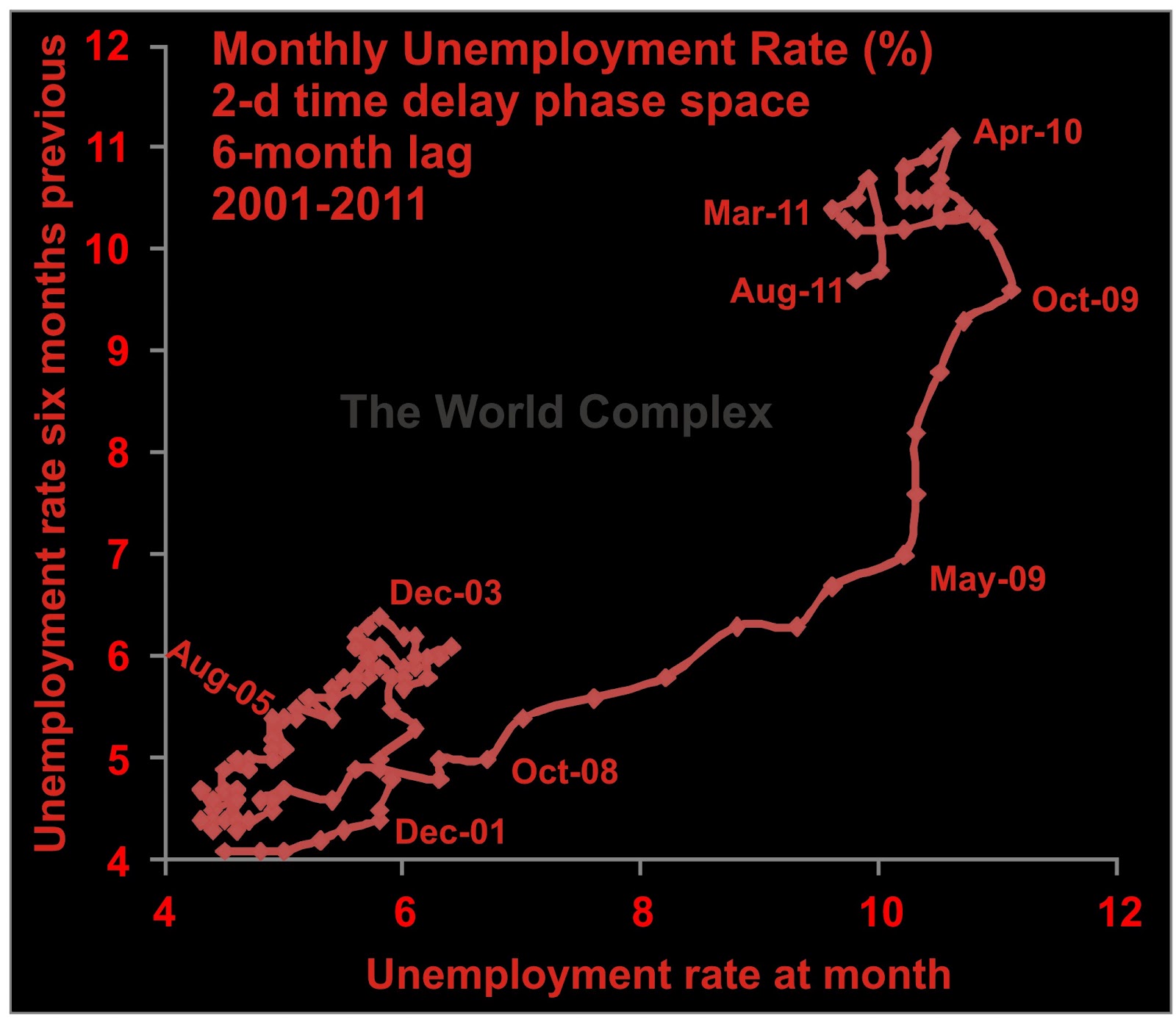
And here is the two-dimensional phase space of Greek unemployment plotted with a six-month lag. Recall that we create these plots by making a scatterplot of the data against a lagged copy of itself. In this case, the lag is six months.

The points are quarterly, with the exception of the last two, which are monthly. Note how rapidly the system has evolved into the region of phase space characterized by high unemployment. This rapid excursion was preceded by a steady drop in the unemployment rate from 2004 until about mid-2008. The effect is reminiscent of a tightening spring which is suddenly released.

Ordinarily, after such a large excursion, we would expect to see these numbers stabilize. Stability in this region of phase space would suggest we have reached a long-term state of very high unemployment in Greece.

We see the same thing in the US unemployment rate phase space reconstruction below, with data from BLS.


Unemployment was relatively high in December of '03, and fell until early in 2008, before a sudden move to a much higher rate. Was the earlier decline in unemployment a precondition of the later increase? I think it was a reflection of the gaming of the economy due to low interest rate and the ensuing mortgage-market free-for-all. A lot of jobs were created in real estate sales and renovations--jobs which did not turn out to be based on a sustainable model.

The recent reported decline in unemployment rate appears to be forming some sort of excursion from the more recent area of Lyapunov stability, near the top right of the plot. If this were a natural system, we would look to see if it evolves towards the LSA at the bottom left of the plot. Systems which cycle slowly through two (or more) metastable equilibria are not uncommon in nature. Unfortunately, I still have some residual doubt that the decline in unemployment is not real, but a statistical fabrication.

Systems with more than one equilibrium state are very difficult to control, because their reaction to forcing (think policy) is dependent not only on the mathematical "laws" of the system, but also its past history. Arguably, each moment in history is unique--so the response of the system to the same policy will be different at each point in history. A Keynesian fixation on creating credit in response to all problems cannot be a viable solution at all times. Sometimes it will work. Sometimes new and unexpected behaviours will result, causing central bankers to apologize for their failures.

Wednesday, February 8, 2012

Unemployment

I have previously discussed methods of reconstructing phase space portraits to study the dynamics of complex systems, including economic systems. An earlier application of this approach applied to the state space of real interest rates and unemployment rate suggested that the economic system has more than one equilibrium state, which is at odds with conventional (Keynesian) economic thought.


Naturally, in performing this sort of analysis, we are assuming that the methodology by which our data are collected remains constant. Any changes (or manipulation) in the data and we begin to have problems. Unfortunately, there is reason to doubt the reported rate of unemployment. Many people who have been out of work for a long time are dropped from the workforce and no longer count as unemployed, as discussed by our resident experts, Drs. Abbott and Costello below (dialogue by CIGA Lew, originally here)


COSTELLO: I want to talk about the unemployment rate in America.
ABBOTT: Good Subject. Terrible Times. It’s 8.3%.
COSTELLO: That many people are out of work?
ABBOTT: No, that’s 16%.
COSTELLO: You just said 8.3%.
ABBOTT: 8.3% Unemployed.
COSTELLO: Right 8.3% out of work.
ABBOTT: No, that’s 16%.
COSTELLO: Okay, so it’s 16% unemployed.
ABBOTT: No, that’s 8.3%…
COSTELLO: WAIT A MINUTE. Is it 8.3% or 16%?
ABBOTT: 8.3% are unemployed. 16% are out of work.
COSTELLO: IF you are out of work you are unemployed.
ABBOTT: No, you can’t count the "Out of Work" as the unemployed. You have to look for work to be unemployed.
COSTELLO: BUT THEY ARE OUT OF WORK!!!
ABBOTT: No, you miss my point.
COSTELLO: What point?
ABBOTT: Someone who doesn’t look for work, can’t be counted with those who look for work. It wouldn’t be fair.
COSTELLO: To who?
ABBOTT: The unemployed.
COSTELLO: But they are ALL out of work.
ABBOTT: No, the unemployed are actively looking for work… Those who are out of work stopped looking. They gave up and if you give up, you are no longer in the ranks of the unemployed.
COSTELLO: So if you’re off the unemployment rolls, that would count as less unemployment?
ABBOTT: Unemployment would go down. Absolutely!
COSTELLO: The unemployment just goes down because you don’t look for work?
ABBOTT: Absolutely it goes down. That’s how you get to 8.3%. Otherwise it would be 16%. You don’t want to read about 16% unemployment do ya?
COSTELLO: That would be frightening.
ABBOTT: Absolutely.
COSTELLO: Wait, I got a question for you. That means there are two ways to bring down the unemployment number?
ABBOTT: Two ways is correct.
COSTELLO: Unemployment can go down if someone gets a job?
ABBOTT: Correct.
COSTELLO: And unemployment can also go down if you stop looking for a job?
ABBOTT: Bingo.
COSTELLO: So there are two ways to bring unemployment down, and the easier of the two is to just stop looking for work.
ABBOTT: Now you’re thinking like an economist.
COSTELLO: I don’t even know what the hell I just said!

If you're out of work, and you can help the economy improve so you can find a job--stop looking for work!

Wednesday, November 2, 2011

Inference of dynamics for complex systems: Examples, part 1

This article continues from the theoretical discussions here, here, and here.

Today we begin looking at some reconstructed phase space portraits (in two dimensions). These are all figures that have been shown here.

All three of today's examples show multistable behaviour. As discussed last time, the implication of multistability is that there are two (or more) equilibrium states in the system, as opposed to just one (the most common assumption).

Stability arises from negative feedback. The instability results from positive feedback. Complex adaptive systems with many participants commonly exhibit both and are thus prone to multistability.


The Case-Shiller index is an inflation-adjusted measure of house prices (for houses of constant quality) in the United States. The reconstructed phase space (above) shows two areas of Lyapunov stability.

The tick marks on the trajectory mark the states at one-year intervals. As the lag is four years, the first point on the graph is the plot of the 1890 value against the 1894 value. The point is labelled as representing the state in 1894--consequently the 1894 state is the first one that can be plotted despite available observations going back to 1890.

The larger of the two areas of stability is occupied over two long stretches totalling nearly 70 years. The smaller of the two areas is occupied for 30 years. Thus of the 116 states (at one-year intervals), 100 of them occur in one of these two areas of stability. There are two short transitions, in about 1915, where inflation-adjusted housing prices suddenly fell, and again at about 1945, when they rose.

The principal era of instability began in the year 2000, whereupon the system embarked on an impressive excursion through phase space. Had this excursion wound up in another area of stability (this may yet be the hope of Greenspan, Bernanke, et al.) we would not be discussing a housing bubble now, but rather a new paradigm of high house prices. Unfortunately, there is no evidence of any stability--and for topological reasons, it is impossible for the current position in phase space to be an area of stability.

If housing prices were to remain at today's levels (adjusted for inflation), the trajectory of the curve would evolve directly towards a point just to the NE of the tip of the large area of stability--at about (130, 130). It would arrive there in four years.

If prices continue to fall, then the trajectory may fall into either the larger area of stability, or perhaps even the smaller one. Either outcome is more likely than developing a new area of stability at prices equal to or higher than today's prices. (FYI this does not constitute real-estate investment advice).

As for the drop in housing prices after 1915--there are a few possible explanations for that, but the easy one might be the introduction of income tax (about the same time as the Federal Reserve), which would have reduced the money most people had available for such a purpose. Our normal expectation when less money is available for discretionary purchases is that prices will fall. There followed a long period where for various reasons there just wasn't much money--the Depression, and WWII.

Interestingly, one reason there wasn't a lot of money available for buying houses despite scads of it being printed and distributed during WWII was the sale of War Bonds, which helped to draw excess money out of the economy and so prevent inflation. Curtailing this program at the end of WWII allowed inflation of house prices after 1945.


Two areas of stability over the past ten years--one of low unemployment, and more recently, a stable area of high unemployment.


The plot of unemployment vs interest rate also shows two distinct areas of stability in phase space. The existence of (at least) two areas of stability points to (at least) two equilibria in the system of unemployment and interest rates. This is at odds with the assumption of single equilibrium in the system which has informed the Central Bank's policy of lowering interest rates in order to stimulate employment.

A major problem with the relationship between interest rates and unemployment--like economic theory in general, this relationship is simply asserted. A great amount of effort has gone into justifying these assertions--and to be fair, the assertion doesn't seem unreasonable. However economic theory seems to assume that the preferences of the various participants in the system will never change in a way that has not been foreseen by an economist.

For instance, suppose that interest rates are high, around 10%. At such high rates, you had better be borrowing money for some productive purpose or the interest will kill you. Such high rates will make it difficult for a business founded on debt to succeed as interest on the entire debt has to be paid out of the profits. It is easy to see here that any marginal decline in interest rates will increase the likelihood of success of any business. More successful businesses mean more jobs. So lower those rates!

But economists don't consider that if interest rates fall below some level, some participants will see that is easier to try to make a living on speculation rather than productive industry. If real interest rates fall to zero, and you have an unlimited ability to borrow, then why not speculate on, say, the stock market. You just keep borrowing and gambling until you win big, and as interest rates are so low you can easily carry the debt until you win. It's a lot easier than building a factory to make refrigerators. The lower the interest rate falls, the greater the impetus to speculate rather than produce, as the costs of carrying the debt are minimal.

In this scenario, lowering interest rates no longer creates employment, as it simply encourages more speculation. No doubt, there will be a few hardy fools out there trying to start a business, but they are a distinct minority.

The empirical evidence suggests the policy of lowering interest rates to stimulate employment has failed. Unfortunately, because our observations are at odds with classical economic theory, it is unlikely we will see any change in Central Bank policy.

I think the only option is higher interest rates, but this will only be possible after the debt that is currently choking the system is somehow purged.