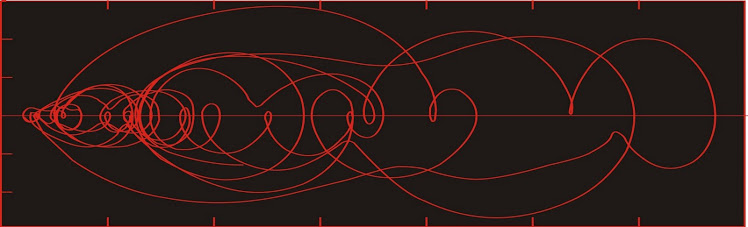
Dust flux, Vostok ice core

Dust flux, Vostok ice core
Two dimensional phase space reconstruction of dust flux from the Vostok core over the period 186-4 ka using the time derivative method. Dust flux on the x-axis, rate of change is on the y-axis. From Gipp (2001).
Showing posts with label China. Show all posts

Monday, March 16, 2020

Journal of the Plague Year - part 1: Chinese ex-girlfriend oracle says "Situation cloudy"

Here I am, watching myself for Covid-19 symptoms, having braved the crowds of PDAC earlier in the month. I only went on the Sunday, but there were plenty of opportunities for mingling with crowds, particularly during the reception at the Peruvian exhibit, the Argentinian exhibit, the Chilean exhibit, and the Brasilien exhibit (not to mention repeatedly visiting their coffee machine, which was on the fritz). The crowds at those events were quite close.

News of course came a few days later that someone who had been at the convention later showed symptoms--and a Kinross exec claims to have gotten the virus there. Seeing as there were over 20,000 people there, I'm sure that won't be the end of it.

- - - - - - - - - - - - - - - - - - - - - -


Roadblock in one of Jiaozuo's many villages

I contacted a couple of ex-gfs in China to ask about the progress of covid-19. It isn't easy to get accurate information otherwise, as I never know whether or not to believe news about China that is reported here, but I also don't completely believe Xinhua news or equivalents. Somewhere in there, there may be some truth.

And last night, a third ex-gf contacted me to ask how the virus was proceeding in Canada. She even asked if I had masks! I told her no, we don't believe in those here.

Anyway: Ex#1 is originally from the Wuhan area, and is currently working in Zhengzhou, the capital of Henan province. She had been in her village last month, but it never seemed to be completely isolated from the rest of Hubei province. She tells me she is back at work in Zhengzhou now, and when I asked about activity in businesses around her, she told me that as far as she can tell, businesses and institutions are nearly back to normal.


There she is - at left, on her bicycle in Wuhan about three years ago - at right, how the government sees her.

All the stories floating around over here, about hundreds of thousands of people left to die in Wuhan apartments; massive numbers of corpses burned in crematoria around the country; even the story about the disease either originating in a Chinese bioweapon lab or an American lab and inflicted on the Chinese--should all be rejected as fake. In her case, if there were huge numbers of deaths in Wuhan, she would probably know it through relatives and relatives of friends. As for the combustion signals, remember that the Chinese have had to destroy nearly a hundred million pigs due to pig ebola

The other two exes are having different experiences. They are both from a city near Zhengzhou called Jiaozuo--but are both from different villages. Both of them are still trapped in their respective villages. One of them is from the village with all the roadblocks that I posted on twitter last month. She manages a restaurant in Zhengzhou, where I imagine business isn't too good. She did remind me that I should drop in at the restaurant upon my return to Zhengzhou. Then she immediately posted our conversation on social media and boasted about her English. The second one tells me she doesn't know what is happening. There is a rumour that there are still two people in her village with the virus, and the whole place is locked down. She doesn't know when she will return to Zhengzhou.

So, depending on where you are in China, things are close to normal, or not.

PS - I just checked, and the top picture I posted on Feb. 5. So poor Pan Pan has been trapped in her village for six weeks! I would add that her village is not the most interesting village in China

Thursday, August 30, 2018

A sample of pagodas in Shijiazhuang

On my way to the kidney hospital in the spring, my train stopped at Shijiazhuang, a provincial capitol. From the window of the train I could see a large complex under construction.


I had thought someone might be building a new Orthodox cathedral, but it's probably a mall.

Twenty minutes of my life wasted walking to it.

Next step was to find a bus (or a series of buses) to get to Zhengding County, which I had identified as a principal tourism objective. As it was an important religious site for over a thousand years, there are numerous temples and pagodas in the area.


Handy reference map


The area appears to be surrounded by a wall with ramparts. The bus passes through a gate on the south wall, where I disembarked . . .


. . . directly across the street from the Hua Pagoda. My immediate impression was that this tower, built during the Tang Dynasty, was inspired by Hindu temples, although the repeated motifs on the pagoda wall were definitely Chinese.

Leaving the pagoda grounds, the next pagoda appears about 300 m to the north, surrounded by temple buildings.


According to Wikipedia, this is the Chengling Pagoda, in the Linji temple. There was no English documentation anywhere on site, but there was a large photoboard commemorating the 1150th anniversary of the pagoda's construction (apparently last year).


As this was the site of the founding of one of the birthplaces of Chan Buddhism, it is a popular site for pilgrims.

Further north, you enter a town, which is disappointingly ordinary. Then, in the middle of town, there is this recently constructed gate.


A little to the north and west is the Xumi Pagoda, which reminds me somewhat of the Big Wild Goose Pagoda in Xi'an.


At one time the site also boasted a bell tower and large halls. Recently, some of the supports for the original hall were recovered onsite, and these have been erected to give you  a sense of its size. Additionally, a large earth dragon was found nearby and brought to the site--this probably at one time carried a stone tablet that would have been several metres tall.


Solar observatory on Xumi Pagoda grounds

The last pagoda that I reached was near the centre of town, and is called the Lingxiao pagoda. It was originally built in the Tang Dynasty but was remodeled extensively during the Song Dynasty


Pagoda grounds across a public square

Saturday, June 16, 2018

Changping District of Beijing

The Ming tombs in the Changping region all look alike. They have a similar layout and are characterized by the same general motifs and colour schemes.


Drain pipe on the Changling tomb grounds


Soul tower at Changling

If there's a tomb, there must be treasure. And there was, rather a lot of it, piled up and buried in a mound, now covered with trees.


Gold ingots


Gold cufflinks. The swastika has been an important symbol in 
eastern religions for thousands of years.


Endpieces for pillows

A short ways up the road (to me, this is out of town, but the city buses still run out this far), there is another tomb. I'm too lazy to look up its name now. It was closed to the public, but there were some workmen on the site, so maybe it is being prepared for public exposure.


The town closest to the hospital has a tomb of its own--the Qingling tomb. It is not open to the public, but many of its features are quite close to the main road.


Approach to the Qingling tomb


Qingling tomb and its soul tower

Just past the Qingling tomb on the way to the hospital is a small walled town. Didn't look too busy or touristy.


Mealtimes in the hospital are on a rigid schedule, and I could see I was going to miss lunch. It wasn't a bad thing really--it seemed that the only spice the cooks in the kitchen knew was salt. So I ate lunch in the village--but the food wasn't any better.


I may have mentioned there were a lot of foreigners in the hospital. When I returned, they were in the midst of a mini-exercise session, similar to the mass tai chi sessions that take place in workplaces all over China. As I went to the elevator, I met a foreigner. I said hello, he responded, "Salaam Alaikum". I know this, I thought, but I had to think really hard to remember something that was at least close to the expected reply. He asked if I were a Muslim. I told him I was not. And then he didn't want to talk any more.

Monday, May 21, 2018

Changping District kidney specialist hospital

Late last month I checked in to a specialist hospital in the Changping District of Beijing, to see if I would be able to undergo treatment later this year.

To say it was a challenge finding the hospital would be an understatement. I had been given Chinese-language instructions on how to reach the hospital so that I could direct a taxi once I reached the Changping District, which is more than 50 kim from the city centre. Fortunately, the area is easily reached by subway (although it is a long trip with a number of transfers), and the trip took no more than about an hour.

Unfortunately, the taxi driver could not understand the directions. I think it is because the directions take you a long way out of town. I had underestimated how much farther I had to travel once I reached Changping, not realizing that it was a good twenty minute drive if there was no traffic, heading up the highway through the Ming tombs (which go on for 20 km or so). We had not even reached the first of the tombs when the driver was ready to give up, apparently alarmed at driving out of the city (or at least into an area where there might not be any return fares). It took some cajoling on the part of the hospital to convince him to drive on--a location share on wechat helped as well. And so I arrived.


It is a large facility in a very nice setting. Or in the middle of nowhere. Which wasn't too much of a problem for me, because at least I have ways of getting around. But this hospital has a large contingent of foreign patients, most of whom had that wild-eyed look that comes of too long a period in captivity. I found them hard to talk to. As far as I could tell, none of them ever left the compound, and most of them had been there for some weeks.

The evening I arrived, I wandered about the grounds a little bit. There was a small fountain and a few trees, where most of the patients sat when outside, and a few trails around the grounds that went up into the hills, but none of the inmates went very far. I didn't go far either, but that was mainly because my red blood cell count is so low I find climbing even modest hills and short staircases troublesome.


So when I first arrived, I had this brief, wild idea I would climb these hills. But just walking on the path around the hospital was already too much for me.

This is a private hospital, and it supplies very little. It's up to you to provide your own towels, toilet paper (luckily I had brought these), and of course meals are extra as well. And the cost of the various testing was by far the most I've spent on medical tests on China, although they were far more thorough than testing elsewhere. I did doubt whether it was all necessary.

While waiting for results, the staff advised me to stay on the hospital grounds. I asked them if I had to, to which they replied I was free to wander around outside, but it was dangerous because of the highway traffic. I decided to take my chances. I crossed the street, and was surprised when a city bus drove past on the way toward the city. I used the Chinese mapping app on my phone to find the bus route to the Ming tombs, and found that it would be rather easy to get there, although the buses didn't run all that frequently. I located the nearest bus stop on the app and walked toward it, but when I got there, there was no obvious bus stop. It was no more than 100 m from the front gate of the hospital, and I had the sneaking suspicion that the lack of markings was deliberate.

My suspicions were shortly confirmed somewhat when a local villager approached and asked me if the bus had been by. At least I think that's what he asked. I told him I didn't know, and he stood beside an unmarked utility pole waiting. I went back to the hospital shop to get water, and see how my results were going. I hadn't completely decided to go to the Ming tombs, but after about half an hour I decided I would at least go to the Ming tombs scenic area, which was about halfway to the city. I walked back out to the bus stop, and the villager was still waiting--and just then the bus came, showing me that the unmarked utility pole was the bus stop. I managed to catch the bus and luckily had a lot of change, because the fare was 4 yuan (about $0.80), by far the most I've paid for a bus fare in China.

The bus passed through a number of villages on its way into the city, and I noticed a number of other features that would be worth seeing in addition to the scenic area. We passed three or four tomb sites along the highway until we reached the scenic area, which happened to be the Changling tomb, which is actually the best-preserved tomb and one of only three open to the public.


To be continued . . .

Sunday, February 25, 2018

Forbidden City gold and silver, part 1

All those years in China, and I only went to Beijing for part of two days. One day was spent on the Great Wall, at Jinshanling. The other was spent fighting my way through the crowds at the Forbidden City.

It was a fight. Within minutes of entering, I was separated from my travelling companions, by the surging crowd, and only found one of them about an hour later by chance as I was deciding where to look next. We played WeChat tag, and managed to get together at the exit.

The Forbidden City was a palace that expanded greatly during the Qing Dynasty. The wealth of the place was truly amazing, even after the KMT sacked the place before retreating to Taiwan with the spoils. What they left behind is still impressive.


One of the thrones

The entire complex has been converted into a series of museums organized by topic. Like most Chinese tourist spots, there are ample opportunities to get dressed up in period costume and pose at different spots in the palace complex. 

The two best museums to see are the treasures museum and the clock museum. Bandwidth here in Ghana is a little limited, so I'll only show pictures of some chintzy stuff today, and save the good stuff for later.


Silver candlesticks


Chamberpot with silver and gold inlay


Various articles with gold or silver inlay


Silver axle endpiece for chariot


Wine vessel with gold and silver inlay

Most of these artifacts are older pieces, dating from the Han Dynasty and the Warring States period. None of these are in the main treasure museum, but are scattered in some of the others, along with a lot of bronze pieces and weapons (so many weapons).

Tuesday, February 6, 2018

Goodbye China

This is my last day here.

I liked it here. It was comfortable. Perhaps too comfortable. I would have stayed here forever. It was an ideal retirement.

Oh well, back to the Ghanaian project, assuming the current market turmoil hasn't derailed the financing.

Saturday, February 3, 2018

Stone by stone


One of the things I like about China is the way the Chinese use stone, even in modern-day life. Most bollards, for instance, a carved from stone. I suspect this is only possible due to the low value of labour.

Of course, there is a long history of using stone in China.


The Great Wall, seen from the air.

The Great Wall of China cannot be seen from the moon. It can be seen from commercial flights if you care to look.


It snakes across hills, built on what looks like the most difficult path possible, cresting hills and ridges in the parklands north of Beijing.

The most famous tourist sites have been extensively rebuilt. Some of them are wide enough for twelve men to march abreast. Many other places are falling apart, or have only been partially refurbished. I think these are more interesting.


Jinshanling is a less-visited section of the wall. Of course, travelling there in late fall also helps. In any case, there were few visitors other than the dozen or so on our day trip.

The terrain is rugged, with many steep climbs. Still, it must have been worse actually carrying the blocks of stone used to build the wall up to the construction site.


The Mongol side of the wall. Those are not solifluction terraces.


The wall was a barrier as well as a road. An army could move along the wall, easily keeping pace with an enemy army on the outside trying to outflank it.


As we walk along the wall, we start to reach places where repairs have not kept up with time.


The watchtower in the distance was the goal of our hike.


Along this stretch the climb was so steep it was tempting to go on all fours. Here was also where I really pondered the difficulty of carrying the stones while the wall was being built. I have been assured that they used donkeys.


At lunch I sat at a table with several others on the tour, who happened to be from Singapore. We were telling each other about ourselves, when one of them stopped me and told me I had a nice voice, and should go back with her to Singapore where she would get me a radio show. I told her that Singapore had too many of my ex-wife's relatives.