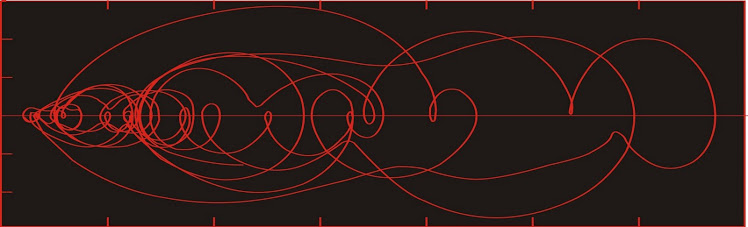
Dust flux, Vostok ice core

Dust flux, Vostok ice core
Two dimensional phase space reconstruction of dust flux from the Vostok core over the period 186-4 ka using the time derivative method. Dust flux on the x-axis, rate of change is on the y-axis. From Gipp (2001).
Showing posts with label silver. Show all posts

Wednesday, August 5, 2020

The inflationary hyperloop and other tales from the near future

Last time we looked at the recent transition from deflation to inflation as revealed in the USDX vs gold chart. This time I would like to put this into a somewhat larger perspective.


This chart compares the US dollar index with the gold price over the last 12+ years. The overall effect has been one of deflation (both gold and the dollar index have risen over that period), but the effect has not been steady. Much of the deflationary "progress" has been made through cycles of inflation and disinflation, although there have been substantial periods of "pure" deflation, mainly in early 2010, late 2014 to early 2015, and the longest stretch covering nearly all of 2019 into May 2020.

The question of inflation, disinflation, deflation, etc. are not just theoretical--they potentially affect the balance sheets and investors' perception of gold and silver stocks as investments (or, perhaps, speculations). During deflation, when both the US dollar price of gold and the US dollar index are increasing, the balance sheets of non-US-based gold miners (companies with mining operations outside of the US) improve markedly. The effect is not as strong for US-based gold miners, however they do benefit from inflation. During inflation, the non-US-based gold miners don't really benefit much (from the accounting perspective), however this tends to be the time when their perception of value increases the most in the minds of investors. Since it is also likely to be a time for US operations to increase in profitability, it improves the financial conditions of the Nevada-based producers (and California, Arizona, etc.).

Also take note of the effects of deflation on silver. It isn't pretty. The switch from deflation to inflation makes puts silver in play. The important thing to remember is to leave the party when the inflation turns to disinflation or deflation, which can happen suddenly. 

In May, the situation switched from deflation to inflation. That may suggest that American-based producers and silver companies are right in the sweet spot.

One feature that stands out is the "inflationary hyperloop" highlighted in gold. It represents a fairly long period of inflation followed a similar period of disinflation, the total lasting about four years. For gold and silver investors, only the first half or so was much fun. Now that we have entered into an inflationary period, are we going to experience another such loop? It seems plausible. 

But there is at least one significant differences in the current inflationary run and the beginning of the inflationary hyperloop--and that is battle. Almost the entire way around the loop there was a real struggle between bear and bull forces. That struggle on the way up is important, as it tends to lead to resistance on the way back down. Now observe our current smooth inflationary stretch since May. Where are the struggles?

One approach is to assume that the current situation will mimic the inflationary loop. If so, we might get two years of fun and about $600 of price out of this. Some approaches suggest magnitude and time increase due to [central bank-fueled liquidity; higher price levels; Mars is in conjunction with Apollo; your reason here]. But the reality is that this is a dynamical system, and in state space, once the system breaks out of a mode of stability, it can move rapidly to another. The new area of stability may be nearby, or it may be far afield, but in either case, without any previous observations of its existence, its location in phase space is unknowable. This is just a roundabout way of saying we can't know how high the gold price will go (or how low the gold-silver ratio will fall) during this period of inflation.

I just thought of this. Youtube here

Saturday, March 7, 2020

Brace for impact

What a week we just had in the precious metals market.

From a huge drop last Friday--which in the past would have presaged further declines the following week--to a significant rebound in the gold price, coupled this time with a major drop in the US dollar--which I will argue may be the signal for a switch to inflationary conditions.

First the chart


We see the nice deflationary trend of the past 18 months looks to have been decisively broken by last week's action. Although it will be a few weeks before we can be absolutely sure, last week suggests that we are about to embark on another bout of inflation, no doubt as carefully calibrated by the Masters of the Universe as they can fill a shot-glass of whiskey from a pool of liquidity the size of a football field. Either, like a small child pouring very carefully, they have poured only too much, or they have sloshed out enough whiskey to fill a large swimming pool, and we are about to see what happens when it all lands in a shot glass.

Now, why the need for some liquidity?

Another chart:


This graph plots the gold-copper ratio against its rate of change. I typically interpret this ratio as an indicator of the real world preference between bricks and mortar and financials. When the ratio is low, it's a sign that people would rather make refrigerators than chase derivatives. Rate of change is the vertical axis. Near the top of the chart means that the plot is shifting towards the right at high speed. Currently, the system is moving toward the right (ratio is increasing) at the fastest rate in the last couple of years. To me, this means the real economy is degrading very quickly.

Thus the Fed may feel pressured to pump out some liquidity.

If we are moving into an inflationary cycle, then one consequence, according to this recent post, is a decrease in the gold-silver ratio. Given that moves tend to get larger as liquidity sloshes around the system, the gold-silver ratio could hit a significant low, implying a new all-time high for the silver price (in fiat terms).

Normally I would wait a few weeks to have greater certainty, but if there is a swimming pool full of whiskey heading for a shot glass I want to get as close to ground zero as possible with a bucket.

Friday, February 14, 2020

The Gold-Silver Ratio

For Valentine's Day, a little something for you who love silver.

Or gold

A couple of weeks ago, Wheaton Precious Metals released a very useful study on the gold-silver ratio. Today I would like to take a look at some of its implications.

The most important implication is one that everyone needs a little time to absorb. That is that there is no characteristic value for the gold-silver ratio.

That means that there is no "true north", or no mythic value (16, for instance) to which it is attracted, and to which it would return if only the world stopped manipulating its price.

The Wheaton conclusions are quite definite. The gold-silver rises during deflationary periods and disinflationary periods (we'll look at this distinction shortly). The gold-silver ratio falls during inflationary periods.


What is unclear is whether a rising GSR causes deflation, or deflation causes a rising GSR. I know which one I believe.

Let's test this against some measures I've used for deflation/inflation. I'll use the weekly chart of USDX vs gold price, weekly, going back to the beginning of 2008.


It is a busy visual, but what we want to do is look at longer-scale variations. Intervals when both the USDX index and the gold price rise are considered deflationary. If gold rises and the US dollar index falls, we have inflation (hence inflation and deflation are not opposites). Gold falling and the dollar rising will be disinflation, and I suppose that if both gold and the US dollar fall, we must have disdeflation, although I have never seen that word anywhere. It's a little hard to say, so it might be best to leave it nameless, and remember that if it ever happens, you should be shorting gold stocks.

Through most of 2008, the graph above suggests we were experiencing disinflation, and over that interval, GSR rises from 55.7 to 77.1

Much of 2009 was characterized by inflation, and the GSR fell from 77.1 to 63.3.

Until the middle of 2010, we had disinflation, and the GSR rose slightly.

The big inflationary pulse into late 2011 saw the GSR falling to 40.8. The final blow-off in the gold price did not see any movement in the US dollar index, so it technically lies between inflation and deflation, but I don't know what to call it. The GSR actually rose during that interval, which makes some sense as the gold price rose over $200 in that time.

The following disinflationary episode that lasted through 2013 saw the GSR rise to 65.9.

Since then, the dominant trend has been deflationary, although realistically there have only been two deflationary pulses--through early 2015 (GSR 74.5) and over the past 18 months (GSR at 88.6). Most of the time has been consumed by short inflation-disinflation cycles, with slight rises and falls of the GSR without significant trend.

Over the entire chart (twelve years) the big picture is deflation, but most of that has been accommodated through cycles of inflation and disinflation.

So long as deflationary conditions persist, the GSR may rise without limit. As long as debts are created beyond any ability to repay them, deflationary conditions will rule. Under such conditions, despite the GSR being pretty much the highest in history, gold remains a better investment than silver.

However, as much of the actual deflationary effect is brought about by cycles of inflation and disinflation, there are  brief intervals where silver makes a better investment than gold. But rather than using the level of the GSR as your selection criterion, you need to look closely at monetary policy instead.

Friday, October 18, 2019

The church-sale indicator tells me that silver is at a significant low

Every spring and fall the neighbourhood church has a rummage sale. Parishioners donate used goods, which are sold to benefit the church (although this year, the beneficiary seems to be a separate charity). In past years I have bought books and games for the kids, books for me, and once some jigsaw puzzles when my wife's aunt came for a long visit from Singapore.

About twenty years ago, I had started to buy silver. At that time, there was a lot of silver jewellery available at the church sale. Nobody was interested in it. I bought a really fascinating piece from the opium era in China for probably about $5. I remember getting a pair of art deco silver earrings for $2, that my wife wore a lot and said were her favourite pair (at that time). And lots of other things--generally jewellery and utensils.

The price of silver rose, and the clientele abruptly changed. Gangs of young men would show up, line up early, and buy up all the silver within minutes of the doors opening. It was very difficult to get anything unless you too were willing to line up for a few hours in advance. As a result, I stopped looking for silver there, choosing to shop for books and music instead.

This year I arrived at the sale quite late, and the crowd was already thinning out. After picking up some books, I thought of taking a look at the jewellery, since that section wasn't jammed with people. Surprisingly, there was quite a bit of silver jewellery available, and numerous sterling spoons (more plate, too, of course). I bought a few sterling silver teaspoons for my collection.

This points to a lack of interest in silver among not only the general public, but among the type that research the topic and buy accordingly. This suggests to me that the silver price is at an important low.

Sunday, October 21, 2018

Silver is really unpopular

So says my anecdotal evidence.

In China, where silver sells for about four times the world price, it is no surprise that it is unpopular. I tried to give silver jewellery to a girlfriend there--she didn't want it. There was more acceptance of the charming notion of providing a silver spoon as a gift for a baby, as the Chinese do believe that silver draws the toxins out of foods.

I became interested in silver in about 1998, and originally bought it from a local coin shop. Looking for other sources, I found the local United Church held sales in the spring and fall, and jewellery was one of the main topics. Back in those days, nobody was interested in silver, and I bought a lot of old jewellery and the occasional silver spoon, and even a few candlesticks, all at good prices. Some of the jewellery I bought there were listed among my wife's favourite pieces, including an antique piece from Republican times in China, which included a secret pocket for secreting opium.

By around 2004, it began to get more difficult to buy used silver. Groups of young men began to show up at the church sales, aggressively buying up all the silver (and occasionally berating the bemused old ladies administering the sale for not lowering prices when the silver price began to fall). So by about 2006, I had stopped looking for silver at the church sale, and just bought used CDs, games for the kids, and baked goods.

I had been in China for the past few years, but was around for the church sale last week. I decided to see if anything was available in the jewellery section. And there were very few people there, mainly old women, and nobody was interested in the silver. I ended up buying something for my daughter. So this is a more anecdotal evidence of a general lack of interest in silver.

Sunday, February 25, 2018

Forbidden City gold and silver, part 1

All those years in China, and I only went to Beijing for part of two days. One day was spent on the Great Wall, at Jinshanling. The other was spent fighting my way through the crowds at the Forbidden City.

It was a fight. Within minutes of entering, I was separated from my travelling companions, by the surging crowd, and only found one of them about an hour later by chance as I was deciding where to look next. We played WeChat tag, and managed to get together at the exit.

The Forbidden City was a palace that expanded greatly during the Qing Dynasty. The wealth of the place was truly amazing, even after the KMT sacked the place before retreating to Taiwan with the spoils. What they left behind is still impressive.


One of the thrones

The entire complex has been converted into a series of museums organized by topic. Like most Chinese tourist spots, there are ample opportunities to get dressed up in period costume and pose at different spots in the palace complex. 

The two best museums to see are the treasures museum and the clock museum. Bandwidth here in Ghana is a little limited, so I'll only show pictures of some chintzy stuff today, and save the good stuff for later.


Silver candlesticks


Chamberpot with silver and gold inlay


Various articles with gold or silver inlay


Silver axle endpiece for chariot


Wine vessel with gold and silver inlay

Most of these artifacts are older pieces, dating from the Han Dynasty and the Warring States period. None of these are in the main treasure museum, but are scattered in some of the others, along with a lot of bronze pieces and weapons (so many weapons).

Tuesday, September 19, 2017

Those rich monks at Baoen temple

The Bao'en temple in Nanjing once boasted a pagoda 80 m tall that was entirely clad in decorative porcelain. Built during the fifteenth century, it was described by the first European explorers who viewed it as one of the seven wonders of the world. Unfortunately, it was destroyed in a series of unfortunate events during the 19th century, beginning with a lightning strike, and culminating in the chaos of the Taiping Rebellion.


The pagoda is being rebuilt, and it is presently made of glass, rather than porcelain. But the tower's base is porcelain.


The tower must have been quite a spectacle when built. Apart from the glittering white porcelain, the Chinese had many techniques for colouring porcelain, which were still unknown in the west, and had used these to cover the tower with Buddhist imagery.


Original tower arch (on display at provincial museum)


The tower today

Climbing it is a bit like climbing up a staircase in a greenhouse, especially near the top. But most of the lower layers are open and give clear views of the surrounding terrain.


Looking past the city wall into the old city.


Within the rebuilt temple is a display of the artifacts of the old temple, as well as some newer displays. I will gloss over most of these and focus on one thing--precious metals. These monks were rich. They have a lot of gold and silver items on display, although most of these are small..


Gold crown with cloud motif.


Gilded silver boxes (for incense)?


Gilded silver incense burner


A gold coffin, which may have contained holy relics of Sakyamuni, founder of Buddhism

Probably the most significant piece was discovered in the ruins of the old temple a little less than ten years ago. It was a tall (1.1 m) pagoda-shaped shrine, called an Asoka Pagoda. It contained the coffin depicted above, and, according to an accompanying stele, part of the skull of Sakyamuni, in a separate metal case


The King Asoka pagoda that bore the relics


Gilded silver king Asoka pagoda


A gilded stamp


Various bits of jewellry


A gilded silver spoon


Glass bowl with a silver rim


Silver and glass bottles, with gilding


Meditation

Updated Sept. 22. I've had some labels translated, and it seems that at least some of the jewellery above came from rich people's tombs, so they aren't all artifacts from the temple.

Sunday, August 20, 2017

Metals (updated)

Some gold and silver on display at Ottawa's Museum of Nature.


I've always like dendritic gold


Wiry native silver


Native copper

Had some problems with my SD card reader, and found a few more:


Another dendritic gold


Looks like a euhedral gold grain suffering from some wear.


Nice nugget

Saturday, January 21, 2017

Shiny things

For the new year, Bank of China is selling a variety of gold and silver products, in various sizes up to 500 g (not depicted). Here is the 1 g gold bar (coloured, this year)


And they have a 2 g silver bar. Man, this thing can't possibly be worth making.


Once again, they pressed.