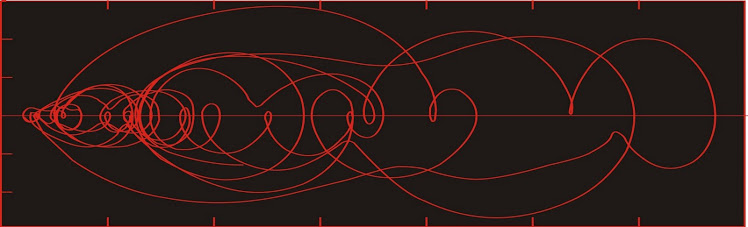
Dust flux, Vostok ice core

Dust flux, Vostok ice core
Two dimensional phase space reconstruction of dust flux from the Vostok core over the period 186-4 ka using the time derivative method. Dust flux on the x-axis, rate of change is on the y-axis. From Gipp (2001).
Showing posts with label S&P 500. Show all posts

Thursday, November 6, 2014

S&P 500 and oil follow-up

This could be another Hallowe'en special.


The monthly chart shows a noticeable break, caused by the breakdown in oil price. How far it will fall is anyone's guess. Probably it will take the S&P 500 down with it at some point--maybe through losses in all those oil companies that are heavily dependent on fracking and a high oil price.

Once we reach bottom though, we ought to have a pretty nice bull run in both oil and the broader market.

I can hear your objections. Someone will point out that those waves of "growth" over the past ten+ years are just the result of Fed inflation. Furthermore, that someone will say that the Fed has shot all of its bolts and they will never be able to engineer inflation again. These statements will be amplified with opinions about Fed incompetence. It's a story I've heard a lot over the last ten (and more) years. I've even voiced similar opinions myself. I've come to realize that they are competent--the reason they seem incompetent is because what they are really doing is different from what they say they are doing.

Wednesday, July 2, 2014

The changing correlation between the S&P 500 and oil

Today we investigate the relationship between oil and the broad US market, using the S&P 500 index as a proxy.

A common thought is that the two functions are inversely correlated, with the US market in danger whenever oil rises too high.


The relationship has been a complex one over the past 11 years, but the correlation is positive most of the time.

In particular, we see from 2003 until late 2007, both oil and the market rose in tandem. The only time the two records show an inverse correlation was during the windup to the financial crisis--from late 2007 to July 2008.

The collapse in both market index and oil price through the second half of 2008 shows up quite clearly. The two prices rise in tandem from early 2009 to the end of 2012.

It doesn't seem logical that the S&P should be positively correlated to oil prices--so it is more likely that both records are correlated to the same thing--inflation. But what to make of the last 18 months, in which we see an almost vertical rise in the stock market without an increase in the oil price? Is an American renaissance in the works, powered by increased American oil production? Or is it due to the much rumoured mass purchase of securities by financial institutions, powered by monetary creation? Is it being done to prevent another period of negative correlation, which might foretell another economic crisis? Stay tuned . . . 

Monday, March 3, 2014

More about bubbles

Today we revisit a ratio I last looked at late last year--a simple comparison of the S&P500 vs gold, based on monthly closing prices, going back to the late '70s. In keeping with the theme of this blog, it has been presented in phase space. One way of studying complex systems is to attempt to illustrate the space of vectors that drive its evolution through time by observing the trajectory traced out in phase space. The time-delay phase space plot is one approach.


The S&P500-gold function is obtained by subtracting the gold price from the S&P 500 index price and dividing the result by the lesser of the gold price and the S&P 500 index. I did it in order to balance the size of the two bubblicious lobes that appear in the diagram.

The present value of the function is plotted on the vertical axis; whereas the 18-month lagged value plots on the horizontal axis. As the trajectory is placed out by the succession of points on the graph, when the trajectory is rising, the S&P 500 is outperforming gold; and when falling, gold is outperforming the S&P 500.

The downward bubble represents the rise and fall of the gold price in the late '70s to the early '80s, and lasted eight years. The upward bubble traces the rise and fall of the S&P 500 through the late '90s until 2009, and represents about 14 years. Together, the two bubbles constitute 22 years, which is more than half of the time represented by the plot.

Much of the time is spent close to the origin, meaning much of the time, gold and the S&P 500 index don't blow up with respect to one another. They still represent differences in performance of a few percentage points, and totalled over the 40 years of the graph, such differences will still be material. You might also notice that August 2011 plots just below and to the right of the origin, while December 2013 plots just above and to the left of the origin. Although not far apart on this graph, that did represent a pretty painful time for goldbugs.

Once a generation there appears to be a tremendous opportunity to make money. But the money is only made if you are able to keep it. It isn't enough to ride the bubble to the top--you need to take profits near the peak and there are opportunities during its deflation.

As we are again near the origin, there is no sign of a bubble in either of these parameters with respect to one another. If there is to be another vast bubble, we can't yet see which one is going to be inflated. But if we're taking turns, then it's gold's turn.

Friday, September 20, 2013

What's in a bubble?

Bubbles are on a lot of minds lately. Bonds. Housing. Stocks. Are any of these in a bubble? How do we decide? A bubble is usually defined as a situation in which the value of an asset exceeds its true worth. What does that mean? How are we to know that the true worth of something differs from its price? It sounds like something St. Thomas Aquinas would think up.


Here is a reconstructed phase space of what is generally agreed to be a popping bubble--the Case-Shiller index. It's not always clear when the popping takes place. Is it the moment it falls from a high to which it never returns (or at least not for a considerable time)? That's first quarter, 2006 in the above figure. Is it when it becomes clear that no area of stability is going to form in the upper registers of phase space? That would be about the second quarter of 2008 in the above figure. Or is it only when the system returns to the area of stability that characterized it? That hasn't happened yet, but it looks imminent.

For today's discussion, consider the S&P 500 and the price of gold.


"Oy'm winning," sez S&P. Data here and here.

Starting from a remarkably similar starting point, they have reached pretty similar levels. But although the S&P 500 may be slightly ahead over our 20+ year chart, it hasn't always been so. In fact it is painfully obvious in hindsight that switching from stocks to gold in early 2000 would have been especially sweet.

One approach I have been working on is based on the notion of stability. It looks good for the Case-Shiller index at top, but that index has been adjusted for inflation--the gold price and the S&P 500 are not. We may be able to assess stability by reconstructing state spaces from the original time series.


Apart from the run-up in price over the past 20 years, the main feature on this graph is that the plot does not stray far from the green dashed line, which is the only part of the graph where areas of stability can appear. Apart from the cluster at about $300, there aren't any areas of stability. I'm not alarmed by this, and don't expect the $300 area to come into play again. This is a reminder of the importance of adjusting for inflation.


Even though this graph is also not corrected for inflation, it does not behave as the gold chart does, but cycles twice around the yellow dashed circle. In terms of a deviation from the regions of stability, it did get about as stretched as did the housing market, both in January 1998 and November 1999. It's current position is not stable but it is not nearly as extreme as it has been in the past.

Some have suggested that gold price is a proxy for inflation. So let's look at the S&P 500 with respect to gold. The comparison will be as follows: the difference between the S&P and the gold price, divided by the gold price.


Here we see a tremendous peak in early 2000. The current level of the index, however, does not seem out of line with respect to gold. If the S&P 500 is in a bubble, then so is gold.

Both the stock market and the dollar price of gold are influenced by monetary creation. As long as money continues to be created, we should expect both to increase in price. There have been times in the past when the money blew up the stock market much more rapidly than gold, and if that were to happen again, there may be an arbitrage opportunity. Such does not appear to be the case today. I find it hard to imagine that we will see the extremes of early 2000 again.

In a time of monetary or credit creation, there are opportunities to preserve wealth through investments in productive enterprises as well as gold. Unfortunately, it is difficult to distinguish between enterprises that are truly productive and those which merely look productive as long as the credits keep flowing.