This is the third in a series of unfortunate events.
I had a friend who used to have a broker he called the Great White Shark. This broker was so unreliable that he was actually reliable, provided you always did the opposite of what he suggested. Whenever he advised you to sell a stock, it soon went up; whenever he advised you to buy a stock, it soon went down.
What was going on? Basically, the broker was working for his firm's interests as opposed to his clients'. When the firm needed to push some crap financing out the door, they advised their clients to pick up the shares, and if the firm knew something good was coming down the pipe, they took the shares off their clients' hands.
Last year, I received a communication from a broker about a small account which had not been active for some time. In it I held a few shares of a company called Volta Resources Inc. (VTR-T) which had been in the account for some years. The value of the shares at the time of the notice was not very much, as the shares were trading in the $0.15 range. [disclosure-- long position, but not as long as it could have been].
The communication stated that as I had not been active in this account for sometime, and as its total value was rather low, they gave me a choice of either selling the shares and closing the account or keeping the shares and the account open, but paying a monthly fee (I think it was about $20).
Neither choice seemed appealing, as the broker's commission was normally in the $60 range. But they said they would waive the commission in this one particular case if it would help me decide to sell my shares. What swell guys!
So I sold them at $0.19. About a week later the shares popped up and have continued popping up ever since (see below).
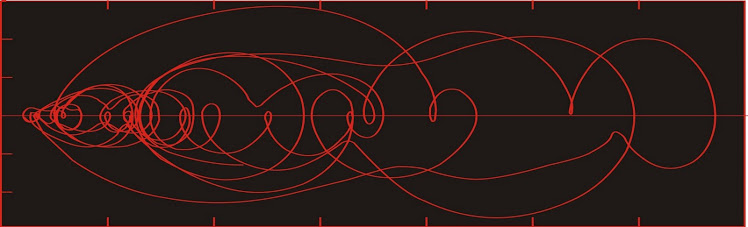
Dust flux, Vostok ice core
Two dimensional phase space reconstruction of dust flux from the Vostok core over the period 186-4 ka using the time derivative method. Dust flux on the x-axis, rate of change is on the y-axis. From Gipp (2001).
Showing posts with label stock trading. Show all posts
Tuesday, August 24, 2010
Wednesday, August 18, 2010
How the game is played, part 1: Beware of stop losses
If money were stable and real interest rates were greater than zero, we would all keep our money in the bank. We might, once in awhile, invest a little money in the stock market, and the form of that investment would probably be a dividend-paying stock.
Unfortunately, none of the above are true, so we are forced to gamble with our life savings in the grand casino we call the stock market--our only alternative (unless you buy gold) is to watch the value of our money evaporate at the same rate irrespective of whether it sits in the bank or is stuffed under the mattress. And, like any other properly run casino, the game is rigged--or at least the rules are defined in such a way as to swing the odds heavily in favour of the House.
Today we will discuss one mechanism by which the House wins at the expense of its clients. In future entries we will look at least two others (more if I can find suitable examples).
Go to the TSX website. Get a quote on VTR (Volta Resources Inc.). In the interests of disclosure, I am long this stock, but otherwise have no involvement with them (but my long position is not as long as it should be for reasons that will be discussed in part 2).
Now click on the tab marked "Price History". You will see the price history of this stock for the last month. Scroll down below the table and you will see a little box labelled "History snapshot for Volta Resources Inc." Beneath it is a box. Enter the following date: 09/24/2009 and click the Get Quote button.
Here is what you should see:
Thursday, September 24, 2009
Closing Price: 0.405
Open: 0.450
High: 0.460
Low: 0.265
Volume: 3,142,884
Split Adjusted Price: No splits
Adjustment Factor: No splits
If you look at the previous two days you see that this stock underwent a tremendous move from $0.17 to about $0.45 in two days under heavy volume (about double the volume above). This was in response to an excellent news release.
Compared to the days before, and the days after, the trading on September 24, 2009 was really unusual. Both of the two previous days, the stock opened at or very close to the low of the day, rose through the day, and closed at or near the high. On the 25th, the stock traded within a small range as it fell from $0.42 to $0.39, trading only as low as $0.36.
But on the 24th, the stock opened at $0.45, rose to $0.46 until late morning when the price suddenly collapsed to $0.265. The collapse was on a relatively few trades with low volume, and there was a sudden cascade of 200,000 shares at $0.265 or $0.27, and then the stock rose rapidly on large volume back to $0.40.
Somebody was taught an expensive lesson.
What happened was this. Someone bought a lot of shares, probably at around $0.40 the day before, and they put a stop-loss on those shares, set at, say, $0.27. Now you and I cannot see that position, but there are people who can. There is usually a flurry of trading early in the morning, so the stalker waits until the activity grows quiet before making its move.
The stalker might place a bid just below the stop-loss (say $0.265). Then the stalker readies his computer, and fills all the existing bids down to the bid just below the stop-loss. That last transaction triggers the stop-loss, and the stalker is right on it picking up the stop-loss shares. Because VTR was thinly traded, the entire affair was stretched out over a couple of hours, but I can remember on several occasions in 2003 seeing the same thing happen with Couer d'Alene (CDE-N), and it was clear that all the bids were hit and the stop-loss triggered in less than a minute (Disclosure--no current position in CDE-N, long or short, although I was long in 2003). It would then take about fifteen minutes for the stock to return to (or near) the price before the quick takedown.
This is an example of how sophisticated money takes advantage of unsophisticated money.
In the medium to long term, seeing this type of activity is a bullish sign for the stock in question, as it means that sophisticated investors are picking the pockets of the unsophisticated in order to accumulate the stock cheaply. It is, however, a mark of the unfairness of the market (or at least the imbalance of information available to certain players at the expense of you and me).
There are a couple of lessons we can learn from this:
1) don't actually post your stop-losses. Keep them in your mind only (actually this isn't likely to be a problem until you are wealthy enough to buy positions large enough for this sort of character to take an interest) as Jim Sinclair has suggested;
2) It can be very useful to keep stink bids in 15-20% below the going price of a stock, especially a strong one. Your bid will get filled in the course of the takedown. Part of my current long position in VTR was obtained during a similar takedown (albeit at a higher price).
Unfortunately, none of the above are true, so we are forced to gamble with our life savings in the grand casino we call the stock market--our only alternative (unless you buy gold) is to watch the value of our money evaporate at the same rate irrespective of whether it sits in the bank or is stuffed under the mattress. And, like any other properly run casino, the game is rigged--or at least the rules are defined in such a way as to swing the odds heavily in favour of the House.
Today we will discuss one mechanism by which the House wins at the expense of its clients. In future entries we will look at least two others (more if I can find suitable examples).
Go to the TSX website. Get a quote on VTR (Volta Resources Inc.). In the interests of disclosure, I am long this stock, but otherwise have no involvement with them (but my long position is not as long as it should be for reasons that will be discussed in part 2).
Now click on the tab marked "Price History". You will see the price history of this stock for the last month. Scroll down below the table and you will see a little box labelled "History snapshot for Volta Resources Inc." Beneath it is a box. Enter the following date: 09/24/2009 and click the Get Quote button.
Here is what you should see:
Thursday, September 24, 2009
Closing Price: 0.405
Open: 0.450
High: 0.460
Low: 0.265
Volume: 3,142,884
Split Adjusted Price: No splits
Adjustment Factor: No splits
If you look at the previous two days you see that this stock underwent a tremendous move from $0.17 to about $0.45 in two days under heavy volume (about double the volume above). This was in response to an excellent news release.
Compared to the days before, and the days after, the trading on September 24, 2009 was really unusual. Both of the two previous days, the stock opened at or very close to the low of the day, rose through the day, and closed at or near the high. On the 25th, the stock traded within a small range as it fell from $0.42 to $0.39, trading only as low as $0.36.
But on the 24th, the stock opened at $0.45, rose to $0.46 until late morning when the price suddenly collapsed to $0.265. The collapse was on a relatively few trades with low volume, and there was a sudden cascade of 200,000 shares at $0.265 or $0.27, and then the stock rose rapidly on large volume back to $0.40.
Somebody was taught an expensive lesson.
What happened was this. Someone bought a lot of shares, probably at around $0.40 the day before, and they put a stop-loss on those shares, set at, say, $0.27. Now you and I cannot see that position, but there are people who can. There is usually a flurry of trading early in the morning, so the stalker waits until the activity grows quiet before making its move.
The stalker might place a bid just below the stop-loss (say $0.265). Then the stalker readies his computer, and fills all the existing bids down to the bid just below the stop-loss. That last transaction triggers the stop-loss, and the stalker is right on it picking up the stop-loss shares. Because VTR was thinly traded, the entire affair was stretched out over a couple of hours, but I can remember on several occasions in 2003 seeing the same thing happen with Couer d'Alene (CDE-N), and it was clear that all the bids were hit and the stop-loss triggered in less than a minute (Disclosure--no current position in CDE-N, long or short, although I was long in 2003). It would then take about fifteen minutes for the stock to return to (or near) the price before the quick takedown.
This is an example of how sophisticated money takes advantage of unsophisticated money.
In the medium to long term, seeing this type of activity is a bullish sign for the stock in question, as it means that sophisticated investors are picking the pockets of the unsophisticated in order to accumulate the stock cheaply. It is, however, a mark of the unfairness of the market (or at least the imbalance of information available to certain players at the expense of you and me).
There are a couple of lessons we can learn from this:
1) don't actually post your stop-losses. Keep them in your mind only (actually this isn't likely to be a problem until you are wealthy enough to buy positions large enough for this sort of character to take an interest) as Jim Sinclair has suggested;
2) It can be very useful to keep stink bids in 15-20% below the going price of a stock, especially a strong one. Your bid will get filled in the course of the takedown. Part of my current long position in VTR was obtained during a similar takedown (albeit at a higher price).
Subscribe to:
Posts (Atom)
