The Aga Khan is the head of a small, but wealthy, subset of Shia Islam.
He is known for charitable works around the world. Today's topic is about one of these, the Aga Khan Museum in Toronto. I had decided to visit late last year when I became aware of an exhibit based on trade in West Africa during the Medieval Era. I had been interested in this topic since the company I worked for at the time drew on the history of gold caravans in West Africa for promotional reasons back when it first began working in the area. During field work in different parts of Ghana, we discovered traces of the historical economic development of the region, some of which has been described previously.
I also took a tour of the museum, which detailed many of the architectural details which might otherwise go unappreciated. For instance, the theme of the museum was light, and the dominant colour for the exterior walls was to be white. Normally this would mean marble, but it was rejected because a study had shown that marble broke down too quickly for a building which is meant to last for hundreds of years. Instead, a white granite was located from a quarry in South America

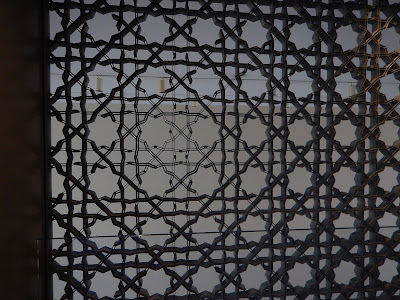

Symbology is important in the museum. Apart from the above symbol for nothingess (as everything was created out of nothing, there must be a little bit of "nothing" in everything), there are hexagonal and more complex repeating motifs in the windows and vents, and even the drain in the centre of the courtyard.
Blue seems to be another common theme in the museum. Especially lapis.




He is known for charitable works around the world. Today's topic is about one of these, the Aga Khan Museum in Toronto. I had decided to visit late last year when I became aware of an exhibit based on trade in West Africa during the Medieval Era. I had been interested in this topic since the company I worked for at the time drew on the history of gold caravans in West Africa for promotional reasons back when it first began working in the area. During field work in different parts of Ghana, we discovered traces of the historical economic development of the region, some of which has been described previously.
I also took a tour of the museum, which detailed many of the architectural details which might otherwise go unappreciated. For instance, the theme of the museum was light, and the dominant colour for the exterior walls was to be white. Normally this would mean marble, but it was rejected because a study had shown that marble broke down too quickly for a building which is meant to last for hundreds of years. Instead, a white granite was located from a quarry in South America

White granite exterior walls, guaranteed to last
In keeping with the theme of light, most of the interior of the museum is bathed in light from various windows. Elaborate patterned shutters on the windows throw an ever-changing series of patterned shadows across the interior walls of the building as the day proceeds.

Pattern on most of the windows. Material is cast zinc

A Persian symbol for nothingness
Symbology is important in the museum. Apart from the above symbol for nothingess (as everything was created out of nothing, there must be a little bit of "nothing" in everything), there are hexagonal and more complex repeating motifs in the windows and vents, and even the drain in the centre of the courtyard.
Blue seems to be another common theme in the museum. Especially lapis.

The Dancer. A mosaic of lapis

Hexagonal staircase to the auditorium. Terrazzo from Italy

Looking straight up the centre of the spiral stair


Bar made from matching slabs of lapis

The auditorium. It's actually bluer than this

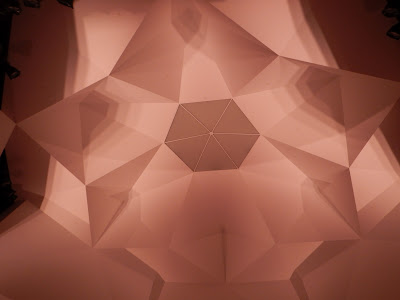
The dome of the auditorium

Shutter for the Bellerive Room in the museum
The principal symmetry element for the interior is a 1 m x 1 m square. All of the major features in the building line up with the edge of the squares, or else with 2 m x 2 m squares. All of the double doorways are 2 m across, and the edge of the doorway lines up with the edges of the floor tiles (which are 1 m x 1 m). Even the tiling in the courtyard lines up with the outer edges of 2 m x 2 m squares (the straight segments in the tiles below)


Stone floor of the central courtyard, composed of the same white
granite as the exterior walls, pink limestone from France, and
blue lapis

A look at the surrounding grounds (the dark squares are reflecting
pools in the summer) and the Ismaili Centre.

Nearby, the Toronto skyline says "Hello"


