Dust flux, Vostok ice core

Dust flux, Vostok ice core
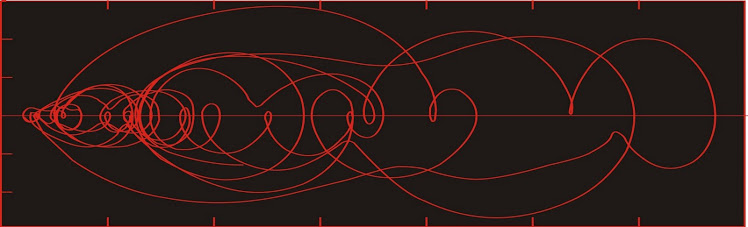
Two dimensional phase space reconstruction of dust flux from the Vostok core over the period 186-4 ka using the time derivative method. Dust flux on the x-axis, rate of change is on the y-axis. From Gipp (2001).
Showing posts with label Economics is hard. Show all posts

Friday, August 9, 2019

Human ingenuity and gold

I saw the figure below on this website, and felt compelled to comment.


No attribution was given, so I will assume it was put together by the site operator.

At first glance, it tells a simple (if somewhat horrifying) story of currency destruction. But I think there is another story it tells, which is a little more hopeful.

The picture as presented is a little misleading because it shows what an ounce of gold will buy now. (Gold was $20/oz in 1932, but there was a little less than an ounce of gold in the double eagle. But let's pretend it is an ounce of gold and look at what that $20 coin would buy you in 1932.

According to this site, a gallon of gas cost $0.18 in 1932. Accordingly, your $20 coin would buy you 111 gallons of gas.

According to this site, a gallon of milk cost $0.26 in 1930 and $0.47 in 1935. The reason for the price rise was due to the government introducing programs to help farmers during the Depression. Not knowing when exactly the program started, it's a little difficult to be sure what the price was in 1932. So let's go with $0.33, meaning $20 would get you 60 gallons.

According to this site, a dozen eggs cost $0.36 in 1937. I'll estimate $0.33 for the price in 1932, netting us 60 dozen eggs for $20.

This old New York Times article tells us that a first-class postage stamp in the US cost $0.03 in 1932. Your $20 coin would allow you to mail 666 letters and have 2 cents left to put in them.

All of which is a lot more than $20 buys you now. But notably, it is much less than an ounce of gold will buy you now.

Gas: 111 gallons vs 482 gallons
Milk: 60 gallons vs 427 gallons
Eggs: 60 dozen vs 675 dozen
Stamps: 666 vs 2700

These increases are the result of capital investment and human ingenuity, and are a reflection of real increases in productivity.

So let's not overlook the happy side of the story. A big hand for human ingenuity!

Sunday, September 2, 2018

Crises in confidence

Today we revisit the graph of US "confidence" through time, a concept formerly discussed here.


The confidence ratio is the ratio of the face value of US debt divided by the value of the US gold holdings. As always, we are assuming that the US holds all the gold it claims to. Estimated debt for 2018 comes from here, historical debt is from here, and the average gold price for 2018 up to the end of August from kitco.com. I don't have the record of original gold holdings, which actually changed in the early part of this graph, and adding such information would improve the pre-1960 portion of the graph.

The reason I call this confidence is that the higher the ratio, the more confidence is required in the country for its currency to hold value.

Even though this measure is economic, I think its value is affected strongly by non-economic factors. One obvious example is the peak of confidence observed in 2001. After that peak, the ratio declines sharply, suggesting a loss of confidence in the US. The destruction of the World Trade Centre and damage to the Pentagon (and America's irrational reactions) contributed mightily to this loss in confidence, in my view.

The earlier decline in confidence, starting in the 1960s was probably related to the closing of the gold window, but may have been exacerbated by oil shocks, the impeachment of Nixon, and the withdrawal from Viet Nam.

Jim Sinclair, of jsmineset.com, has long had a thesis that the confidence ratio graphed above will eventually return to 1:1. This would imply a much higher price for gold--about 60x the current price if you believe that US holds all that it claimes; higher if you don't. The $174,000 question is about timing--Sinclair says it is now.

What triggers are there in the geopolitical sphere like those in 1970? Apart from the usual economic difficulties, America does face the possible impeachment of its president, and to be nearing defeat in Syria; both of which are similar to political issues in the early '70s.

Once confidence is lost, it can take a long time to be restored. Plan accordingly.

Saturday, June 11, 2016

Train (station) in vain

Zhengzhou is a rail hub in central China. It sits at the intersection of two of the busiest high-speed train networks in the country. The train has become such a mainstay of life here, that people don't think much of commuting a couple of hundred km--and many take day trips of over a thousand km.

But it may be that the high-speed rail system is overbuilt. Recently (last Tuesday), I took a short trip to Xuchang. I left at high rush hour. Last year, the station would have been pretty busy at this time of day. This year, not so much.


Looking towards the main entrance.


The departures level viewed from the food concourse.

Technically, the system works wonderfully well. But I can't help wonder if maybe too much of it has been built.

Sunday, February 8, 2015

How QE helped Main Street, Example 2: Maserati dealerships

I haven't written on this topic in a long time, but it is time once again to look at the magnificent benefits that have accrued to main street businesses as a result of bailing out bad bets of banks. Today I have selected another typical main street business--the car dealership. I have randomly selected the Maserati brand as the subject of today's investigation.

Sales data for Maserati sold in North America are available here.


Annual sales of the Maserati brand (in number of cars sold) ranged from less than a thousand per year in 2002 to nearly 13,000 in 2014, thanks to the benevolent leadership of the Fed.

This is a chart that truly screams "Recovery!" In fact, it is quite clear that things are far better now than they have ever been before. If your life seems to be at odds with the obvious economic reality, you are clearly not working hard enough (or perhaps not at all).

All the propaganda to the effect that the goal of quantitative easing was to make the richer even richer still is thoroughly debunked. We can see that small, struggling family businesses like high-end diamond retailers and Maserati dealerships have indeed benefited from quantitative easing.

Wednesday, January 28, 2015

House prices seek stability of long-term relationship

. . . somewhere in phase space.

I have often used the the index of home prices in the United States (the Case Shiller index) as an example of a complex system showing multistability. The data are updated monthly here.

The multistable nature of such systems is demonstrated in reconstructed phase space portraits, which can be generated by two principal methods--the time-delay approach and the time-derivative approach.


For nearly 40 years, the system remained confined to the area of the yellow circle. In fact, house prices were confined to this small area for much longer than that--for the longer term chart I've presented previously shows that this yellow area has been occupied for a total of about 70 years.

It looks like there was some kind of redefinition or recalculation of the time series on the Shiller website sometime in the last year or so, as the current time series available on the site (from which the above chart is drawn) differs from the previous time series available (from which my older graphs are drawn). For instance, in my older figure, the house price appears to have been above 100 over the last 60 years--this does not appear to be the case in the graphs I have produced in previous years.

The overall story has not changed--after 50 years of relative stability (the bubble of 1989-90 looks benign in the above figure), the system broke out of its area of Lyapunov stability, and has been meandering through phase space ever since. Two years ago, it seemed to be on a trajectory to return to the yellow area of stability. In the last two years the system trajectory veered away from that target, and is now headed . . . where?

Normally we expect it to migrate to an area which has previously acted as an area of stability--but both such areas are at much lower prices than is currently the case.

It is possible for the system to carve out a new area of stability. For reasons of geometry, stable areas must be located on the y = x line. Since we are close to that line now, it implies that perhaps Yellen can engineer a soft landing for housing at close to the current price range. Unfortunately, the future level of the trajectory in state space is partially determined by the past trajectory--and in 2013, the housing index was in the low 130s (on the horizontal axis). In two years, therefore, the trajectory will dip to the same level on the vertical axis. If house prices remain where they are now, the trajectory will be far enough from the y = x line to be unstable, and a further decline in house prices would be indicated.

If house prices rise again, we will find ourselves in a bubble destined for collapse, just as we were in about 2004. If the yellin' wants to bring housing to stability, the thing to do would be to engineer a slight decline in house prices over the next two years. Unfortunately, I don't think she wants to do that.

Friday, January 9, 2015

What hath QE wrought?

First off, let's see how our deflation indicator is playing out.


The latest trend of rising gold and USDX is in its third month.

The last time we had a similar trend was in 2009. That ended with a massive blowout of QE. But a funny thing happened on the way to the bank. After four-and-a-half years, we wound up back where we started.


The ineluctable march of deflation.

And for context, a look at the bigger picture.


One lesson of all this is that if the system needs to deflate, the bankers and politicians who think they are in control can delay it, but not stop it. A little over four years later, we have picked up where we left off.

I would expect the central bankers of the world will try for another inflationary push at some point in the future. Maybe they will let deflation to run for a time to ratchet up the pain enough for the public to scream for more stimulus. I can't help but think that they decided to let deflation run for a bit just to chase out some of the 99.9% who were perhaps betting on continued inflation.

Deflation's the same in a relative way, but you're older;
Shorter of breath, and four years closer to death.

Tuesday, December 30, 2014

Tacking after Christmas

Haven't had a lot to say lately. A bit too much holiday cheer perhaps. And duck. Lots of duck.

How do you sail a boat against the wind? You tack.


How do you get gold and the US dollar to rise together? Same thing. There's a lot of zigging and zagging, but the overall trend goes in a direction that seems impossible.

In the figure above, I used the last London fix, which was actually on Tuesday. This is the methodology I have been using all along. If I had used Friday's price, the last point would have been farther to the right.

If I'm right that this trend is signalling deflation, then we just have to wait and see what the Fed does in the New Year. Until then, champagne all around!

Sunday, December 7, 2014

National suicide and the nation state

The topic of national suicide seems an appropriate topic for the anniversary of the Japanese attack on Pearl Harbour. The Japanese people bore very little animosity to America. No doubt many of them remembered the aid that came to Japan after the big earthquake in 1923. Sadly, like in all other countries, the Japanese people were not in control of their country.

Like all wars, this war was sold to the people as a matter of national survival. But it was to be a survival in which Japanese people were destroyed in vast numbers to "save the nation." By the end of the war, soldiers were being outright sacrificed in order to achieve limited tactical successes.

The movie For Those We Love*, the pilots are preparing to leave on their final mission. The father, brother, and sister of one of the pilots have arrived to see him off. As he is about to enter his plane, his father pleads for him to come back to talk to him one last time (it's at about 2:35 of the following video). Unfortunately, his last words for his son are a lame cliche ("Do your best. We are all counting on you." And so on). My thought was that if that were my son about to fly off to die, I would have told him, "See that tent over there? That's where your commanding officers will all go as you leave. So after you take off, come back and strafe the hell out of it."


Now I read in this article that at least one pilot did attack his commanding officers. The article argued that the Kamikaze phenomenon in the latter part of the Pacific War was a particularly noxious brew of statism and Zen Buddhism.

I don't believe the Zen Buddhism part to have been necessary. The kamikaze pilots were not driven to suicide out of a philosophical concept of nothingness. They were ordered to, or perhaps pressured ("Come on, you don't want Japan to lose the war because of you, do you?"). The desire for death came down from the top, mostly from people who did not have the grace to kill themselves afterward.

The noxious mix came from a government that equated "the country" with themselves rather than with the people. As a consequence, the government was willing to sacrifice as many of its own people as was necessary to ensure its own survival. The lesson here applies not only to the hapless wartime Japanese, but to everyone in the world from the United States and Japan, to the Ukraine, and even non-state actors such as ISIL. The most obvious antecedents are in the suicide bombers that have struck targets around the world.

Today most of the developed countries of the world are pursuing economic policies "to save the nation". Unfortunately, they are predicated on arguments that the elderly will bankrupt the state: thus the state must strike back through low interest rates and understating inflation.

In fact, President Barack Obama’s budget wouldn’t take a dime from anyone’s current Social Security check. It would merely reduce the growth of future benefits by changing the way the government calculates inflation.
What the president has done is to endorse the notion that our current Consumer Price Index overstates inflation, because it doesn’t account for people’s ability to switch to lower-cost goods. If the price of beef goes up, people eat more chicken.

I like that choice of words: "merely reduce the growth of future benefits". Those future benefits were to compensate for rising prices which are themselves a function of the activities of the state. The remedy, that the elderly can eat chicken when the price of beef goes up; then cat food when the price of chicken rises, is a recipe for poverty. Unfortunately, starving the elderly is necessary to save the "nation".

I have argued that the low-interest-rate policy has harmed employment by reducing the costs of losses in financial speculation relative to productive investment. Thus, starving white and blue-collar workers of all ages is also necessary to save the "nation".

The massive size of the debts accumulated across the developed world will be borne by our children, encouraging a lower standard of living for them. Thus, starving children is also necessary to "save the nation".

In WW2, Japan sent its young men off to die trying to sink American ships. Now governments all around the world are casting off their citizens, stealing their lives a bit at a time to push the day of their own reckoning a little further into the distance. The only difference is they are not yet ordering us to die.


* I have to advise you that this is not a very good film.

Thursday, November 27, 2014

False confidence rising in the US

A recent article argues that the increasing demand for consumer credit is an indicator of increasing consumer confidence. The argument seems reasonable due to the way it is presented--there is an entirely different conclusion one would draw were the argument presented differently.

If you had a very low income, and few assets, yet people kept lending you money--money that greatly exceeded your assets--would that not suggest that these lenders had confidence in you? It may be that this confidence is unjustified--but we can infer its existence by the continued willingness of others to lend you money despite the fact that you appear to be ruined.

In just the same manner, we can infer the confidence that lenders have in a country by computing the ratio of a nation's debt to its actual holdings of real money. A high ratio suggests great confidence--even though it could just as easily be a measure of ruin. In the case of the US, we have used the ratio of its official debt to its official gold holdings. For other countries, we would have to include foreign currency holdings as "wealth".


Confidence in the US hit an all-time high in September 2001. Then something happened, and confidence in the US fell steadily until the end of 2012. The falling confidence level occurrred because the value of the US gold holdings rose faster than its debt (which itself was increasing at the greatest rate ever). In other words, the US dollar was losing value (relative to gold) faster than the US gov't could spend it.

Confidence increased in 2013, as the gold price fell while debt continued to increase. But is this real confidence?

The ratio of debt to gold can only be considered a measure of confidence if foreign entities are willfully buying the debt. If, on the other hand, the government simply monetizes the debt itself, or orders its vassal states to purchase the debt, then it wouldn't be correct to look at this ratio to be a measure of confidence. It is a measure of ruin--and faked confidence.

We have also seen that higher confidence correlates to periods of lower unemployment. The correlation appears to have continued into 2013, but with all the shenanigans involved in reporting unemployment, I have to caution that I have no confidence in the reported unemployment rate. However, it appears that goosing confidence may be a fore-runner to improved employment, and reiterate that there are only three ways governments and central banks can bring about such a result--increase debt (without the gold price falling); sell gold; or pray for the gold price to fall. Pray hard. Very, very hard.


The second chart really shows faked confidence compared to faked unemployment numbers (particularly the last couple of years). But at least it shows that things are getting "better" in the US.

Thursday, November 6, 2014

S&P 500 and oil follow-up

This could be another Hallowe'en special.


The monthly chart shows a noticeable break, caused by the breakdown in oil price. How far it will fall is anyone's guess. Probably it will take the S&P 500 down with it at some point--maybe through losses in all those oil companies that are heavily dependent on fracking and a high oil price.

Once we reach bottom though, we ought to have a pretty nice bull run in both oil and the broader market.

I can hear your objections. Someone will point out that those waves of "growth" over the past ten+ years are just the result of Fed inflation. Furthermore, that someone will say that the Fed has shot all of its bolts and they will never be able to engineer inflation again. These statements will be amplified with opinions about Fed incompetence. It's a story I've heard a lot over the last ten (and more) years. I've even voiced similar opinions myself. I've come to realize that they are competent--the reason they seem incompetent is because what they are really doing is different from what they say they are doing.

Friday, February 7, 2014

Gold x USDX in phase space

From time to time I drag out a geologic or economic time series and unfold it into a two-dimensional phase space to try to get some idea of the underlying dynamics of the function. In particular, these plots can allow us to define flows and attractors in our system of study.

Recently I started looking at the product of the gold price and the US dollar index, finding that in 2011 it shot to a high of over $1400, and fell last year to about $1000, bouncing off it twice, penetrating it briefly in December, but presently rests just above the $1000 level (or isoquant).

The two-dimensional phase space of the gold-USDX system appears below.


Regions of phase space with a high concentration of observations are interpreted as basins of attraction. In the above figure we see three such areas - at about the $650 area, last visited in late 2008, the $1050 area, and about the $1350 area. The system evolution is difficult to distinguish from a random-walk while in the areas of attraction, but evolves more-or-less in one direction while in the flows from basin of attraction to another.

In 2011, the system embarked on a significant excursion, which remained in the $1300 area from late 2011 until early 2013. I think this reflected a battle between the market, which needed to fall, and some people with money who were convinced that gold would only rise further. Like most such battles, it lasted until the money ran out, and the system returned to the $1050 basin of attraction, where it has remained since.

If there is to be a sustained rise in the gold price going forward, this system will break out of its current area of attraction, and likely return to the $1300 area, which would correspond to gold prices of $1700-$1900, depending on the strength of the US dollar. No signs of such a breakout have occurred yet.

Tuesday, December 10, 2013

The rise of the virtual economy, part 2--retail consumption indicators

I recently received some publications from Dr. Ray Huffaker, who studies reconstructed phase space portraits from agricultural cycles. There are some interesting data sets presented in these papers which echo some of the themes I've argued in earlier postings.


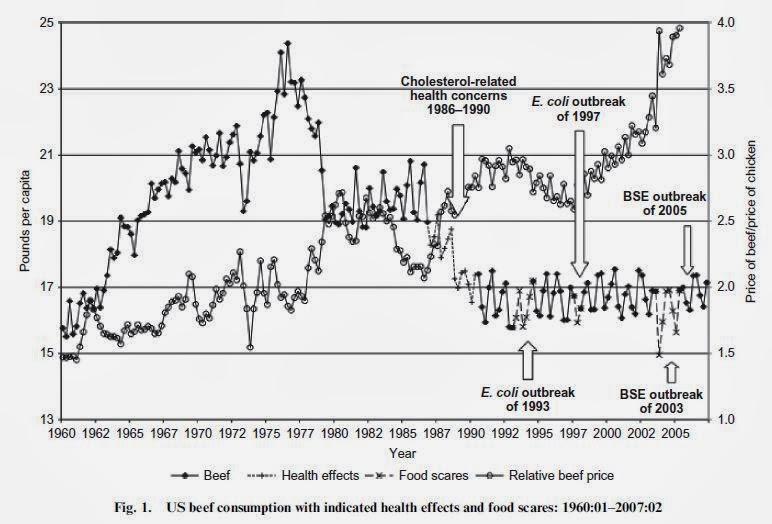
The above figure shows retail beef consumption per capita. Data comes from the USDA, the figure is snipped from McCullough et al. (2012). Notice the large decline in the late 1970s. Perhaps you think that decline was due to changing preferences in meat--perhaps more Americans chose to eat pork instead.


Data and figure as above--notice there is also a decline in per capita pork consumption at the same time. Not as marked as the decline in beef, but still present.


Comparison of metal usage to global GDP. Chart from 
Handselbanken Capital Markets.

As posted before, something appears to have happened to the economy in the late 1970s, which puts the lie to the reported GDP growth figures. Would the government exaggerate these numbers? Perhaps to tell you that the economy is doing fine, and if you happen to be experiencing a drop in your standard of living, well, you just need to work harder. Or go buy something with no money down and no payments for three years.

One last figure. Perhaps the decline in beef consumption was due to the "cholesterol scare".


In this figure from McCullough et al. (2013), we see that the cholesterol scare happened after the major decline in beef consumption. Furthermore, the major declines in beef consumption both correlate to increases in the relative price of beef (the beef/chicken ratio on the right axis).

Some comments on previous articles suggested that the decline in copper and zinc production was due to replacement with plastics or aluminum. My counter to that was that copper cannot be replaced in most of its applications, and the decline in copper consumption speaks to a real decline in economic activity--one which was not reflected in reported GDP numbers. The simultaneous per-capita decline in beef and pork consumption supports this conclusion.

References:

McCullough, M. P., Huffaker, R., and Marsh, T. L., 2012. Endogenously determined cycles: Empirical evidence from livestock industries. Nonlinear Dynamics, Psychology, and Life Sciences, 16: 205-231.

McCullough, M. P., Marsh, T. L., and Huffaker, R., 2013. Reconstructing market reactions to consumption harms. Applied Economics Letters, 20: 173-179. doi: 10.1080/13504851.2012.687091.

Monday, October 28, 2013

This chart is meaningless

I am very sorry to be picking on this article, but others have been saying much the same thing so this may be worth a brief mention.


(I did look around sharelynx a bit, but didn't find it).

The contention is that the creation of new debt in the past couple of years must bring about an increase in the gold price. This conclusion is supported by an illusion which is fostered by the purely arbitrary choice of a scale for the gold price. Unfortunately I am too lazy to go and put the data for these time series together so you will have to follow along with the plots I have below.

We compare the production of bedknobs from broomsticks with the production of broomsticks from bedknobs.


From this graph, we can see that bedknob and broomstick production grew more-or-less in tandem, until recently, when bedknob production suddenly fell. You would use this graph to support your prediction of an increase in bedknob production.


Same data, but with a slightly different scaling for bedknob production. You could use this graph to support your contention that there was a bit of a blow-off top in bedknob production in the recent past, but it is now back in line with broomstick production, in which state you expect it to continue.


Same data, different scaling. Here, not only was there a recent blow-off top in bedknob production, but it is quite clear that bedknob production still has further to fall to come back into line with broomstick production.

You can do the same with the chart at top. Whatever story you want to push--gold to rise; gold to fall; gold to stay the same--all you have to do is change the scale accordingly. Hence the title of this post.

This graph is seductive because it does seem logical that increasing the creation of debt and money should increase the gold price. But we don't know what the correct relationship is, so have no real way of stating whether gold should rise, fall, or remain neutral from these data alone.

Wednesday, October 23, 2013

Economic policy and the price of gold

Then the rumour circulated that at night the Fed Governors neglected their sacrifices and prayers. A great depression seized everyone. One day the President said to the Fed Chief, "When will we celebrate the return of normal unemployment rates? I would like to make a journey and return in time for the feast. How long is it until the day of the feast?" The Fed Chief was embarrassed. It had been several days since she had looked at the moon and the stars. She had learned nothing more about their courses. The Fed Chief said, "Wait one more day and I will tell you." The President said, "Thank you. Tomorrow I will come to see you again."
The Fed Chief gathered the Fed Governors together and asked, "Which of you lately has observed the course of the stars?" None of Fed Governors answered, because they had all stayed to listen to the stories of Fiat-do-lar. The Fed Chief asked again, "Hasn't even one of you observed the course of the stars and the position of the moon?"
                                                 -- modified from The Ruin of Kasch

Economics isn't a science. It is a mistake to think it would be so. Science does not have schools. Only philosophies have schools.

The difference between a science and a philosophy is the difference between seeking truth while honestly admitting you don't know it and declaring that truth is something you define.

Ideally science is described by working hypotheses, which are constantly tested, and if falsified, replaced (unless pride is involved or money). In philosophy, you begin with axioms, which are untestable statements that are defined as being true. Each school of economics has its own set of axioms. From axioms, you apply rules of inference (logic) in order to generate new statements, which are also true. These generated statements are called theorems. Thus all theorems are true (within the school of philosophy) but not necessarily applicable to the real world!

In the early days of geology, there were competing schools: the Neptunists and the Plutonists being two that come to mind immediately. The Neptunists believed that all rocks formed in the sea, either as sediments, or by crystallization as salts (this was their central axiom). The Plutonists believed that all rocks formed from magma (as their central axiom). Debates between adherents of the two schools were rowdy, fruitless affairs, because the nature of philosophy is that it cannot be overturned by mere observations.

The distinction between science and philosophy with respect to economics is important because economists have an annoying ability to set policy--policy that affects the quality of your lives. It probably doesn't matter much to you whether some geologists can't decide among themselves whether a particular rock formed in the sea or on a volcano (or even on a volcano in the sea). But it does make a difference if some Fed official acts on her belief that bankrupting the elderly eliminating interest on savings is a cure for unemployment.

Application of economic policy follows the axiomatic approach. Some high priest of an obscure caste decides on a cure for economic woes. Perhaps he dances around like a medicine man. The evil spirits are expunged, so that unemployment levels will finally fall. Maybe.

Recently, The World Complex presented the inverse correlation between the unemployment rate in the UK and its "confidence ratio" (dollar value of public debt divided by the dollar value of gold holdings). The idea was that a high ratio could only be supported if bondholders had high confidence that the debt would be properly serviced (forget about repayment). The flip side is that a high ratio could be interpreted as a measure of a country's ruin.

In the article I had suggested that government economists might cheer a decline in the price of gold.

So today, we look at the same relationship for the United States.


Once again we see a strong inverse relationship between confidence ratio and unemployment.

One of the goals set out for the Federal Reserve is to manage the unemployment rate. Looking at this chart, the answer is clear--to reduce unemployment, increase the confidence. Confidence (as defined above) can be increased in three ways: 1) raise debt, 2) sell gold, 3) lower the gold price.

Of course we all know that correlation does not imply causation. But it doesn't have to in order to impact on Fed policy. That's the beauty of politics--reality and truth don't really matter when there are elections to be won.

There was a comment that perhaps I have too much time on my hands. I'm not sure if the intent was to say that only someone with a lot of time on his hands would notice this relationship. The economists at the Fed have far more PhD's and time on their hands than does this corner of webspace. So I'm sure they have already seen this.

So the question becomes--even if no causation can be established, can it be used to set policy? And what policies will be followed?

Raising debt is the old standby--but as we see in the clarified chart below, it doesn't seem to be working anymore.


Since the 2001 peak (on September 10, perhaps?), the increasing debt has been more than compensated by the rising price of gold. Don't be fooled into thinking the US is sinking into solvency--it is creating debt faster than any time in history. But the price of gold has been rising faster still (although we shall see about 2013).

It appears that policy #2, the sale of gold, is politically untenable. Officially at least. Selling gold is for lesser countries. So that leaves option #3--hope the price of gold falls. Perhaps they do more than hope.

. . . at first the story of Fiat-do-lar was like hashish when it makes wakefulness happy. Then the story was like hashish when it makes dreams delirious. Toward morning, Fiat-do-lar raised his voice. As the Nile rises in the hearts of men, so his words swelled. To some, his words brought serenity; to others, they were as terrifying as the appearance of Azrael, the angel of death. Happiness filled the spirits of some, horror the hearts of others. The closer morning came, the mightier that voice grew and the more it resounded within the people. The hearts of men rose up against one another like clouds in the sky on a stormy night. Flashes of wrath met thunderbolts of fury. When the sun rose, the tale of Fiat-do-lar reached its end. Ineffable wonder filled the confused minds of the people. For when the living looked around, their gaze fell upon the Fed Chief and Governors. They were stretched out on the ground, dead.
                                        -- modified from The Ruin of Kasch 

Monday, October 21, 2013

Why we face ruin

A nice compendium of UK economic data has recently appeared (h/t NESS). You are encouraged to download data sets for your own nefarious purposes.

As an example, I have decided to plot UK unemployment rate against the measure of confidence I proposed on these pages a couple of years ago. To recap, the confidence ratio is the ratio of outstanding public debt (in dollars) to the dollar value of the country's gold holdings. I chose "confidence" as presumably this ratio can only be high for a country in which investors have great confidence. For those of a different mindset, it can be viewed as a measure of a country's ruin (although it would be better to include other foreign currency reserves).


UK unemployment data from the site mentioned above. UK debt came from google public data. UK gold holdings came from the data sets available from the World Gold Council. To find the dollar value of gold holdings, I used averaged annual prices available at Kitco. Average conversion rate of GBP to USD available here (although I don't remember where I got it for the original posting, which was up to 2011).

That is a good-looking example of negative correlation. It tells us that the unemployment falls when the confidence ratio is high. Now, there are three ways for a government to increase that confidence ratio:

1) increase debt
2) sell off gold
3) pray for the price of gold to fall (obviously in a non-manipulative manner that doesn't direct profits to favoured entities).

The fall in confidence that we observed in the latter half of the last decade was entirely due to the rising price of gold. Look at what that did to the unemployment rate! Clearly the fault of gold-bugs and conspiracy theorists. The rising price of gold completely overrode the excellent work of the British Parliament in driving up the country's debt. As for Gordon Brown, he was a hero! His only flaw was in not going far enough. If he had sold all the UK's gold, imagine how low unemployment would be today!

This wouldn't be a post on the World Complex if we didn't do some kind of state space portrait, so here it is: unemployment rate vs. confidence ratio.


Policy decisions of British Parliament and their impact on unemployment can be followed from the above chart. Clearly the government in the 1970s laboured under the delusion that reducing debts would benefit the economy(1). They were rewarded for their imprudence by spiking unemployment in the early 1980s.

By the mid-1990s, they had discovered the golden ticket. With the rising confidence ratio, the UK was rewarded with a falling unemployment rate. Then came Gordon Brown's heroics--by aggressively selling gold he caused the confidence ratio to rise and the UK was showered with new jobs!

There was a small crisis in the latter part of the last decade. But since then--clearly back on track. If the forward evolution of the system follows a similar catenary to the period 1993-2005, then a mere quadrupling of the confidence ratio will restore the unemployment rate to about 6%. The most prudent way to achieve this would be to immediately sell off 75% of Britain's remaining gold (2).

I find this approach to finances inspiring, and am willing to give it a try. Here at The World Complex, the unemployment rate is unusually high (technically I am welcome to go to the office, but the treasury is empty). Looking at my finances, I see the problem--I have very little debt and high savings (although much lower than they were two years ago, thanks to the ongoing turmoil in the junior mining market). To rectify this oversight, I will be issuing bonds. For reasons of fiscal prudence, I will try to keep my confidence ratio below 100, and will begin an auction for $25 million in debt next Thursday (3). No cheap google ad payouts here!

Notes:

(1) the rising price of gold may have had something to do with this. But this proves my point! Rising gold price = rising unemployment, you naughty gold bugs.

(2) in my opinion it would be too difficult to drive the gold price back down to $300/oz.

(3) securities officers and other sarcastically challenged individuals take note--this is intended as sarcasm. Your participation is welcome.

Friday, September 20, 2013

What's in a bubble?

Bubbles are on a lot of minds lately. Bonds. Housing. Stocks. Are any of these in a bubble? How do we decide? A bubble is usually defined as a situation in which the value of an asset exceeds its true worth. What does that mean? How are we to know that the true worth of something differs from its price? It sounds like something St. Thomas Aquinas would think up.


Here is a reconstructed phase space of what is generally agreed to be a popping bubble--the Case-Shiller index. It's not always clear when the popping takes place. Is it the moment it falls from a high to which it never returns (or at least not for a considerable time)? That's first quarter, 2006 in the above figure. Is it when it becomes clear that no area of stability is going to form in the upper registers of phase space? That would be about the second quarter of 2008 in the above figure. Or is it only when the system returns to the area of stability that characterized it? That hasn't happened yet, but it looks imminent.

For today's discussion, consider the S&P 500 and the price of gold.


"Oy'm winning," sez S&P. Data here and here.

Starting from a remarkably similar starting point, they have reached pretty similar levels. But although the S&P 500 may be slightly ahead over our 20+ year chart, it hasn't always been so. In fact it is painfully obvious in hindsight that switching from stocks to gold in early 2000 would have been especially sweet.

One approach I have been working on is based on the notion of stability. It looks good for the Case-Shiller index at top, but that index has been adjusted for inflation--the gold price and the S&P 500 are not. We may be able to assess stability by reconstructing state spaces from the original time series.


Apart from the run-up in price over the past 20 years, the main feature on this graph is that the plot does not stray far from the green dashed line, which is the only part of the graph where areas of stability can appear. Apart from the cluster at about $300, there aren't any areas of stability. I'm not alarmed by this, and don't expect the $300 area to come into play again. This is a reminder of the importance of adjusting for inflation.


Even though this graph is also not corrected for inflation, it does not behave as the gold chart does, but cycles twice around the yellow dashed circle. In terms of a deviation from the regions of stability, it did get about as stretched as did the housing market, both in January 1998 and November 1999. It's current position is not stable but it is not nearly as extreme as it has been in the past.

Some have suggested that gold price is a proxy for inflation. So let's look at the S&P 500 with respect to gold. The comparison will be as follows: the difference between the S&P and the gold price, divided by the gold price.


Here we see a tremendous peak in early 2000. The current level of the index, however, does not seem out of line with respect to gold. If the S&P 500 is in a bubble, then so is gold.

Both the stock market and the dollar price of gold are influenced by monetary creation. As long as money continues to be created, we should expect both to increase in price. There have been times in the past when the money blew up the stock market much more rapidly than gold, and if that were to happen again, there may be an arbitrage opportunity. Such does not appear to be the case today. I find it hard to imagine that we will see the extremes of early 2000 again.

In a time of monetary or credit creation, there are opportunities to preserve wealth through investments in productive enterprises as well as gold. Unfortunately, it is difficult to distinguish between enterprises that are truly productive and those which merely look productive as long as the credits keep flowing.

Thursday, August 29, 2013

The magic ends, part 2:

In part 1 we looked at some examples of what happens when the audience can no longer suspend its disbelief in a currency.

What was the magic? The magic was the magnificent illusion that money printing increased wealth. It certainly looked that way, despite all the common-sense interpretation that would have you believe that it doesn't. But that's the beauty of a wonderfully performed magic trick. Something impossible seems to happen. You know it can't happen, but it looks like it did, and what's the harm in letting yourself believe?

The latest round of the great trick really began in the late 1950s. Spending by the US government increased the demand for labour by the millions, which allowed women to enter the workforce in large numbers.


Data source: Bureau of Labor Statistics (BLS)

The main uptick in the labour force participation rate began in the early '60s, but the real bottom (on this graph) was in the mid '50s. One obvious source of stimulus in the 1960s would have been the Vietnam War, on which the US gov't spent the equivalent of $738 billion, in 2011 dollars (pdf). That kind of money created a lot of jobs--mainly in the military industries, but also for lobbyists.

At the same time, the "Great Society" was in full swing. Lots of public works projects. The same thing happened up here in Canada, with a huge increase in universities, highways, and transit systems. All this spending created a lot of jobs. Nobody asked whether these jobs were really necessary. Would the public works projects pay off?

Certainly they appeared to make society more prosperous. But was it real prosperity or just a magic trick? Was it an illusion, or something more sinister . . .
A thief and a magician enter a convenience store. The thief says to the magician, "Watch this", and promptly places three chocolate bars into his pocket so smoothly that nobody else notices. He is just about to leave when the magician calls him back and says, "I've got a better trick." The magician approaches the shopkeeper, and asks if he'd like to see a trick. "I can make three chocolate bars disappear and reappear." He unwraps three chocolate bars and eats them. When the shopkeeper asks to see them reappear, the magician points to the thief and says, "They are in my friend's pocket."
In the earliest part of my education I recall, we were fed the belief that it was right for women to enter the workforce, and it followed that once women wanted to work, all these jobs opened up for them. Millions of them.

Why can't it happen now?

Look at the unemployed--the real unemployed. Their numbers are reflected in a massive increase in duration of unemployment not to mention the increase in the reported unemployment rate.


I thought the unemployment rate was supposed to drop when interest 
rates were low. Data from BLS.

Don't the unemployed want jobs? Why don't jobs magically appear for them like they did in the 60s?


Impressive job creation from the 1960s until about 2000. 
It stalled briefly during the Volcker high-interest-rate period
of the early 80s. Data from BLS.

The trouble is similar to what our magician friend in the story above might face if the shopkeeper suddenly demanded a repeat performance, this time with meat pies. The magician can only perform a trick like that so many times. Perhaps he becomes too engorged with chocolate bars and meat pies. Perhaps there aren't any that can "appear" in his friend's pocket. Or maybe the shopkeeper simply won't be fooled any more.


That's funny. All that money of yours that disappeared was 
supposed to reappear in my hand. Errrm, sorry?

At least is isn't as bad as Siegfried and Roy's last trick with the tiger.

What does the rest of the world think?


Too lazy to update this. Sorry. To mid 2011. But I doubt it's gotten better.

It looks like the rest of the world started to lose faith in the US dollar in the '90s. Remember the Strong Dollar Policy under Clinton? Looks like somebody thought it was a selling opportunity.

But the problems with the money-creating approach became apparent by 1970. Nixon kept the system going a bit longer with his trick of taking the dollar off the gold standard, so the US would not have to exhaust its stored gold redeeming green coupons. The system ran out of gas again at the end of the 70s, but Volcker's trick of raising interest rates gave the US 20+ years of slowly falling interest rates, which allowed the audience to keep believing the illusion.

But even then, it should have been clear that something was up. GDP as it was defined at the time was climbing, but some of its ancillaries were not keeping up.


Data from Handselbanken Capital Markets.

It is difficult to imagine just how the economy grows without similar increases in the use of copper and zinc, both of which are tough to replace. One comment wondered if we replaced copper and zinc with plastics. Some piping maybe. But not much wiring.

As I proposed earlier, what really happened in the late 1970s was a contraction in the economy, which was hidden by fudging reported GDP. If real GDP is tied to demand for copper and zinc, then I would say that (from the above chart) world GDP was overstated by approximately 80% as of 2005. It's hard to imagine that that number has gotten smaller subsequently. Either that, or the "value" of lawyers bills, lobby groups, US medical expenses, overspending on military wonder weapons, financial charges and skimming, and other less than productive enterprises now constitutes just under 50% of the world "economy". I hope it makes you feel rich.

With lower demand came lower exploration expenditures--at least for base metals.


Source here (pdf)

I think this graph shows the change in mindset from the past to the present. Don't mine base metals; mine money (gold). And this established the precedent for today's industrial ideal: don't make products, make money. And so the business model changed: from producing real products, which improved lives and increased the wealth of everyone; to making money through methods including outsourcing and speculation, which improved the lives and wealth of only a few.

Back to jobs.


After the little scare in 1980, we had 20 years of lower interest rates, during which the US labour force participation rate increased to its highest level in history. After the internet bubble popped, the US Fed shoved interest rates down, igniting a nice housing bubble, which created a lot of construction, real estate, and retail jobs. Unfortunately, these only matched the losses of manufacturing jobs--until about 2007. More recently, the number of full-time jobs is falling.

The magician has pulled all the rabbits there are out of the hat.

If money printing can't create jobs anymore, the pain that is to come will dwarf the pain already felt. The labour force participation rate will fall to the level of the 1950s unless there is another rabbit in there somewhere.

Too bad they'll all be low-paying jobs.

Wednesday, July 10, 2013

Gold's changing anticorrelation to the dollar

This article posted a few days ago struck me as interesting, as it seemed so counter-intuitive that I thought it worth a look.

On the basis of weekly charts of gold and the US dollar index over the past five years, Charles Hugh Smith concludes there is no correlation. And at first glance, there seems much to support his view.

The principal argument (as I have never been a believer in peaks and troughs) is his second point--that there are at least three significant intervals where gold and the US dollar rose in tandem since late 2008.

Over the past few years I have attempted to show that most economic data are nonlinear and best studied by methods suitable for complex systems. Such systems are not easily analyzed using methods like linear regression or fourier analysis. In fact I would go so far as to say that such methods can lead you to the wrong conclusions.

The world's situation is complex and changing. Change can drive unpredictable variations in market preferences--so while it would seem logical that people's preference for US dollars and gold might normally vary inversely, perhaps there are some circumstances when the market equally seeks both.

We consider a scatter plot of USDX vs gold (weekly) from January 2007 to the end of last month.


There are a few segments suggesting correlation. From early 2007 until late 2009, the two data series appear to be negatively correlated. From late 2009 until about mid-2010, they appear positively correlated (they rise in tandem). Since mid-2010, they appear to be negatively correlated.

The gold price appears to be far more sensitive to the USDX in the second phase of negative correlation compared to the first phase; by which I mean that a small change in USDX correlates to a much larger change in gold price presently than was the case before mid-2009.

From a dynamics perspective, I would argue that the three areas of the graph represent different "states" of the (US? world?) economy. Finding the triggers for changing from one operational state to another is of key importance.

QE1 occurred during the V, from the top of the first negatively correlated segment through the positively correlated segment. QE2 occurred during the advance (lower line) in the second negatively correlated segment. QE3 occurred during the period of decline (upper line) in the second negatively correlated segment.  This all may be coincidental.

I expect we will continue to see relatively large fluctuations in the price of gold relative to changes in the USDX.

It looks like the system will have to drop down to the lower line before a steady advance in the gold price. If so, we would see a small, sharp drop in USDX without movement in the gold price, prior to a major move in gold (up) and the USDX (down).

Thursday, July 4, 2013

Confounding factors in US GDP growth--a partial criticism of Dawson and Seater (2013)

A recently published paper in Journal of Economic Growth has generated some interest over its claim that US GDP would be about 3.5 times greater than it currently is if the level of regulation had remained at 1949 levels (or a reduction in growth by an average of 2% per year).

The thesis is intuitively compelling, and has captured the interest of a few economics websites. Personally, I don't doubt that regulation does stifle growth--I have seen first-hand too many examples, not to mention the change in economic environment from the 1970s to the current day. But this is anecdotal.

The first question--how to quantify regulation? The authors use the measure of the number of pages of the Code of Federal Regulations, which is as good a measure as one can use in a reasonable amount of time.

Regulation and its growth over time. From Dawson and Seater (2013).

I admire the authors for their ability to work through the statistics in their study. Statistics is one of my least favourite topics--even though I have to do it on occasion. It's like the vegetables on your plate that your parents insist you have to eat--or in my case, journal editors and sometimes regulators. (e.g. "We're not publishing this without some statistics." "Doesn't the beauty of the calculus compel you to publish it?" "No." " . . . grumble . . .")

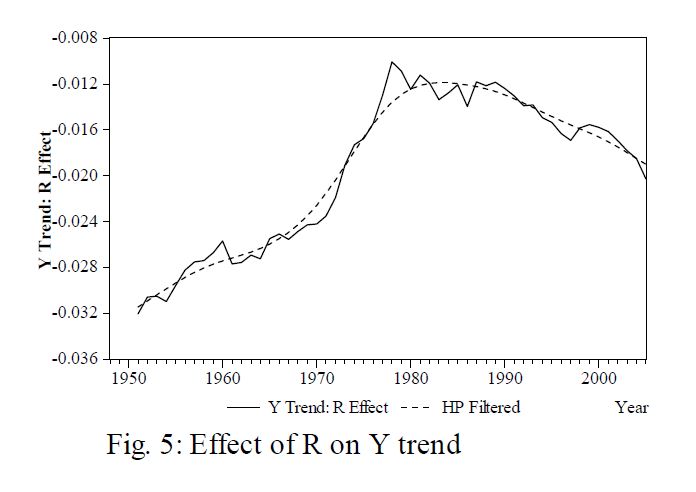
Effect of regulations on trend of total economic output. From Dawson and Seater (2013).
Effect of regulations on total factor productivity, which is like output with the 
effects of capital investment and labour removed. From Dawson and Seater (2013).

From the above graphs, the authors conclude that the effect of regulation suddenly became more pronounced in the late 1970s, despite the observation that the growth of regulation has been relatively low since 1980 (which would show better if figure 1 were on a log scale rather than linear). The authors have inferred that the response is nonlinear--as if a tipping point were suddenly reached in 1980, beyond which the economy began to contract terribly in response to the (relatively small) increases in regulation.

The trouble with this sort of statistical study is the possibility of overlooking confounding factors. In this case, there are two--energy availability/costs, and the impact of excessive credit in the system.

An article I encountered today looks at energy use in the US through its history. The major figure appears below.


Energy consumption in the US. Another graph that would be better 
displayed on a log scale. Source.

Look at the spectacular growth, especially from about 1930 to the early 1970s (the first energy crisis). Growth in energy usage has been nowhere near as great since then. Total energy use peaked in 2005. 

The main takeaway here is that the rate of growth in US energy usage after 1980 is much smaller than was the case before.

Energy is critical for a manufacturing economy. If the US economy could be viewed as a plant, the plant has three inputs--energy (sun), physical commodities (fertilizer), and credit (water). Until about 1974, there was an abundance of energy and physical inputs, so the immense credit poured into the economy resulted in spectacular growth. 

Since then, however, it's been quite cloudy, and the soil is a little depleted of nutrients. But all the government can do is water. And that's what they've been doing--and they are shocked to find that they aren't getting the same result they did in the 1960s. Instead they risk drowning the plant entirely.

There is something else, the government can do--and that is regulation. Regulation is like pruning--if done carefully, it can really benefit the plant. Unfortunately, much regulation that exists today more resembles the job done by a maniac with a machete.

I don't wish to negate the conclusions of the authors--there is no doubt in my mind that the crazed hacking perpetrated by the government has reduced the size of the economy. But the reckless overwatering given the loss of sunlight has also played an important role.


Dawson, J. W., and Seater, J. J., 2013, Federal Regulation and Aggregate Growth, Journal of Economic Growth, 18 (2), 137-177, doi: 10.1007/s10877-013-9088-y