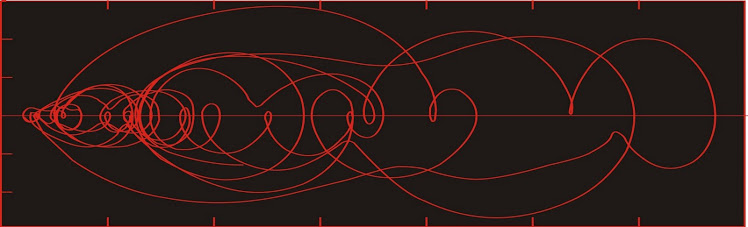
Dust flux, Vostok ice core

Dust flux, Vostok ice core
Two dimensional phase space reconstruction of dust flux from the Vostok core over the period 186-4 ka using the time derivative method. Dust flux on the x-axis, rate of change is on the y-axis. From Gipp (2001).
Showing posts with label privacy. Show all posts

Tuesday, June 11, 2013

Trust mislaid

I am greatly discouraged over poll numbers presented yesterday at the Washington Post in which the majority of Americans support the government's stance on espionage, provided that the effort is directed at finding terrorists. A large number (45%) agree that the government should go farther than it has already.

It makes feel very sorry for Edward Snowden, who has risked life-altering circumstances in order to bring this particular instance of the US government's abuse of power to light. It seems he needn't have bothered.

Americans have given this a ho-hum and gone back to Dancing with the Stars.

Americans are afraid that Google, Facebook, and various advertising agencies are spying on them. Yet at most these companies only want to sell them stuff (or sell their info to other companies that want to sell them stuff). Yet they trust the US government, which has an established precedent for drone-striking American citizens that have been deemed enemy combatants.

The only thing for which the US government needs information about you is for 1) collecting more taxes, 2) assessing your suitability as a drone target, 3) assessing your suitability as a rendition target, or 4) assessing the likelihood that they will be able to steal your house and all your assets due to drug offences. In the last dozen years there has been only one terrorist case that was not unambigously created as part of a sting operation by the FBI (there is room for doubt on the Boston bombing case).

You can opt-out of Google.


But you can't opt-out of government surveillance.

Thursday, February 16, 2012

That you have nothing to hide doesn't mean you have nothing to fear

The "Harper Government's" new online privacy bill, which requires that telecom companies hand over subscriber information to police without a warrant, had already generated a great deal of excitement--but when Public Safety Minister Vic Toews accused any opposition to the bill as supporting child pornographers, the online chatter went stratospheric.

Toews argument is yet another iteration of the old saw that you have nothing to fear if you have nothing to hide.

I, and many others, beg to disagree.

The reason I disagree is my long experience with authority figures and a certain creeping inevitability to the abuses that power entails. Once you are put in a position where you are to investigate crime, you begin to colour innocuous events with your own suspicions.

For instance, for years I have collected nickels. I would go to the bank, buy a number of rolls, pick out the ones I wanted, and returned the rest. There is nothing wrong with doing this, apart from whatever annoyance it might cause the tellers at the bank. But now I have these strings of petty cash transactions at the bank--20 dollars out, 18 dollars in, 40 dollars out, 35 dollars in, etc., each one separated by a day or two. I feel I have nothing to hide, but what might a CRA agent or some other suspicious member of the law think of this? How might they interpret all of this moving cash in and out of the account? Who knows.

A few years ago my bank offered me a free financial consultation, so I could talk to an "investment professional" about my progress towards my retirement goals. As per usual I told him that I was a significant shareholder and an insider of a reporting issuer--this is information that they are supposed to know in the event that I trade any securities of a company at which I am an insider. As he looked over my portfolio, he commented on how risky many of holdings were--there were a lot of junior miners there. I told him that I work in the industry, which helps me interpret the press releases and the geology of the various projects, some of which I have visited in the past. He threw off a light comment, "Well, I guess it's easy to make money when you trade on insider information."

Excuse me? Are you accusing me of something? This is a very dangerous accusation to hear from your banker, as he is required by Canadian law to report such suspicions through Fintrac. The guy knows nothing about me, but one look at my portfolio and he's sure I'm trading on insider info. This is the mindset of those who seek to use this information. You are a criminal; they just need to find the right information to prove it.

Suppose you have a favourite niece (or grandchild) going to university near your home. So you go to visit her every couple of weeks, bringing her a small bit of spending cash that you take from your bank on your way to visit her. Perhaps you email her before these visits. Now, suppose that this niece has been caught once with a small amount of some recreational drug (shocking, I know, but not unheard of at university). How might the police look at your pattern of small cash withdrawals from the bank followed by visits to this known drug offender?

Perhaps you are a Muslim youth struggling to keep to a moral path in what might appear to be an amoral world. For support you write your cleric with your questions about your struggle (perhaps you use the word jihad in this context). Might the police look at this discussion as a coded cover for something more ominous? Remember, that's their job.