Once upon a time I was teaching a math class, and posed a famous problem to the students that went something like this.
You are boarding a plane, which seats 500 passengers. Every passenger has been assigned a seat. All seats are booked. The first passenger boarding the plane misplaces his boarding pass, and so he chooses a random seat. Every other passenger sits in their designated seat, unless it is full, in which case they select a random (presumably unoccupied) seat. What is the probability that you, the last passenger in line, will arrive at your designated seat to find it unoccupied?
It happened to be one of those days when everyone was feeling lazy and uninspired, and nobody had any ideas on how to approach the problem, so I decided to try an experiment in crowd-sourcing. I asked each student to guess the answer, wrote them all down, and calculated the average. Surprisingly, it was very close to the correct answer (which appears at the bottom of the post).
What I found very surprising was that no guesses were particularly close to the correct answer. There were also a couple of idiots who guessed numbers larger than 1. My conclusions were that crowd-sourcing does seem to work--but requires a few idiots among the crowd to work properly.
Which brings me to the market.
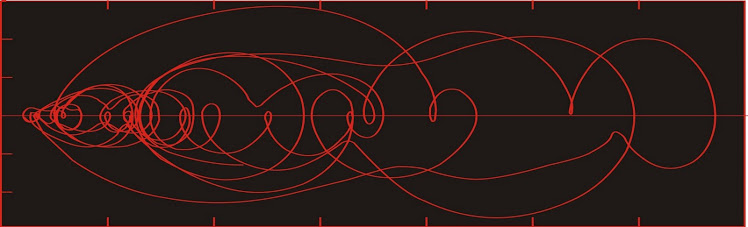
In some past articles I discussed the topological equivalence between some common methods of technical analysis and the sort of dynamical analytical techniques I have written about in numerous other postings. The reason that TA can be used at all has to do with the importance of mass psychology in setting share prices, as opposed to economic fundamentals.
An area of stability in a phase space reconstructed from a time series tells us that the system is dominated by negative feedbacks, which tend to stabilize values in the time series within a relatively narrow range of values. A crowd-sourced price for a stock could be such a value--if the majority of market participants believe that $1 is the correct price for shares in a certain company, they will tend to sell when the price is higher and buy when the price is lower.
No matter how long the game plays, the price may remains a crowd-sourced number. It can change in response to fundamentals--for instance, when Atna recently placed the Pinson mine on care-and-maintenance, the crowd decided on a dramatically lower price for a share of Atna.
As in all crowds, there are a number of idiots who influence the price so much that they can temporarily overwhelm the fundamental case, until they either suddenly realize they have made a mistake or run out of money. If the crowd-sourced price is a mean of a population, that value can be exaggerated by a few idiots greatly overestimating (or perhaps underestimating) the real value of a stock or commodity.
For example:


I tend to reject the efficient-market hypothesis. I think the market is almost always wrong, mostly because the majority of market players are missing some information. Sometimes the idiots are too high; sometimes they are too low.
- - - - - - - - - - - - - - - - - - - - - - - - -
The solution is 0.5. Explanation.
You are boarding a plane, which seats 500 passengers. Every passenger has been assigned a seat. All seats are booked. The first passenger boarding the plane misplaces his boarding pass, and so he chooses a random seat. Every other passenger sits in their designated seat, unless it is full, in which case they select a random (presumably unoccupied) seat. What is the probability that you, the last passenger in line, will arrive at your designated seat to find it unoccupied?
It happened to be one of those days when everyone was feeling lazy and uninspired, and nobody had any ideas on how to approach the problem, so I decided to try an experiment in crowd-sourcing. I asked each student to guess the answer, wrote them all down, and calculated the average. Surprisingly, it was very close to the correct answer (which appears at the bottom of the post).
What I found very surprising was that no guesses were particularly close to the correct answer. There were also a couple of idiots who guessed numbers larger than 1. My conclusions were that crowd-sourcing does seem to work--but requires a few idiots among the crowd to work properly.
Which brings me to the market.
In some past articles I discussed the topological equivalence between some common methods of technical analysis and the sort of dynamical analytical techniques I have written about in numerous other postings. The reason that TA can be used at all has to do with the importance of mass psychology in setting share prices, as opposed to economic fundamentals.
An area of stability in a phase space reconstructed from a time series tells us that the system is dominated by negative feedbacks, which tend to stabilize values in the time series within a relatively narrow range of values. A crowd-sourced price for a stock could be such a value--if the majority of market participants believe that $1 is the correct price for shares in a certain company, they will tend to sell when the price is higher and buy when the price is lower.
No matter how long the game plays, the price may remains a crowd-sourced number. It can change in response to fundamentals--for instance, when Atna recently placed the Pinson mine on care-and-maintenance, the crowd decided on a dramatically lower price for a share of Atna.
As in all crowds, there are a number of idiots who influence the price so much that they can temporarily overwhelm the fundamental case, until they either suddenly realize they have made a mistake or run out of money. If the crowd-sourced price is a mean of a population, that value can be exaggerated by a few idiots greatly overestimating (or perhaps underestimating) the real value of a stock or commodity.
For example:

Huldra Silver Inc., one year chart. I plead innocent--I never owned it.

Atna Resources Ltd., one year chart. I was one of the idiots who overvalued this one.
Both charts from TSX site.
Both charts from TSX site.
I tend to reject the efficient-market hypothesis. I think the market is almost always wrong, mostly because the majority of market players are missing some information. Sometimes the idiots are too high; sometimes they are too low.
- - - - - - - - - - - - - - - - - - - - - - - - -
The solution is 0.5. Explanation.


