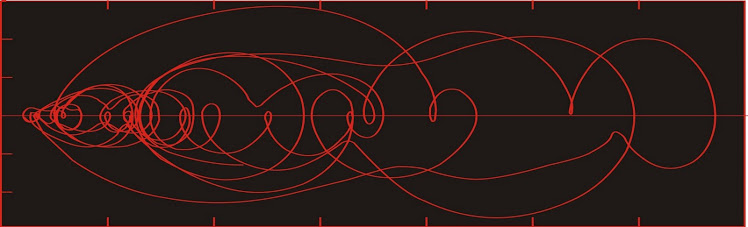
Dust flux, Vostok ice core

Dust flux, Vostok ice core
Two dimensional phase space reconstruction of dust flux from the Vostok core over the period 186-4 ka using the time derivative method. Dust flux on the x-axis, rate of change is on the y-axis. From Gipp (2001).
Showing posts with label US foreign policy. Show all posts

Sunday, September 2, 2018

Crises in confidence

Today we revisit the graph of US "confidence" through time, a concept formerly discussed here.


The confidence ratio is the ratio of the face value of US debt divided by the value of the US gold holdings. As always, we are assuming that the US holds all the gold it claims to. Estimated debt for 2018 comes from here, historical debt is from here, and the average gold price for 2018 up to the end of August from kitco.com. I don't have the record of original gold holdings, which actually changed in the early part of this graph, and adding such information would improve the pre-1960 portion of the graph.

The reason I call this confidence is that the higher the ratio, the more confidence is required in the country for its currency to hold value.

Even though this measure is economic, I think its value is affected strongly by non-economic factors. One obvious example is the peak of confidence observed in 2001. After that peak, the ratio declines sharply, suggesting a loss of confidence in the US. The destruction of the World Trade Centre and damage to the Pentagon (and America's irrational reactions) contributed mightily to this loss in confidence, in my view.

The earlier decline in confidence, starting in the 1960s was probably related to the closing of the gold window, but may have been exacerbated by oil shocks, the impeachment of Nixon, and the withdrawal from Viet Nam.

Jim Sinclair, of jsmineset.com, has long had a thesis that the confidence ratio graphed above will eventually return to 1:1. This would imply a much higher price for gold--about 60x the current price if you believe that US holds all that it claimes; higher if you don't. The $174,000 question is about timing--Sinclair says it is now.

What triggers are there in the geopolitical sphere like those in 1970? Apart from the usual economic difficulties, America does face the possible impeachment of its president, and to be nearing defeat in Syria; both of which are similar to political issues in the early '70s.

Once confidence is lost, it can take a long time to be restored. Plan accordingly.

Wednesday, April 18, 2018

Friday, January 6, 2017

Realignment in Asia

Last month, China seized an American drone operating in international waters some small distance from Subic Bay, in the Philippines. China returned the drone shortly thereafter. There was some small amount of diplomatic ranting over the incident, but these things tend not to escalate.

They have been going on for a long time. In the 1980s, Russian ships routinely stole equipment that had been deployed by Canadian research vessels in Canadian waters, most of which were only doing innocuous things like measuring salinity, temperature, and the speed of sound in the water column, much as the Americans' drone is reported to have done.

Of course, even innocuous oceanographic data can have geopolitical implications. There is a lot of speculation that the Chinese were afraid that the drone was to collect information on Chinese submarines. I'm going to go with the American story here--that it was to collect oceanographic information. That doesn't necessarily mean the data was not detrimental to Chinese interests. The question is, what are the Chinese interests?

. . . . . . . . . . . . .

On the Grand Banks, we went from station to station, lowering an instrument at each one, which would be anchored in place. When it came time to recover them, the ship would emit an acoustic signal, which would trigger a cable release and the instrument (which was buoyed) would rise to the surface for collection. On our perambulations, we noticed one or more Russian ships heading to our previous station. When the time came for collection, all the instruments were gone. The Russians had triggered the cable releases and scooped them all up. Rather, that was our interpretation--we weren't close enough to see for certain that they had done this, as the stations were kilometres apart. But no other ships were operating in the area.

We were conducting acoustic surveys as well, including sidescan sonar swaths for mapping the seafloor, as well as profilers and depth sounding. I noticed a number of submarine channels on the Banks--basically underwater fjords--and also noted that their geometry precluded them from being accurately mapped with the instruments we had. In fact there was nothing that we had in Canada that could have done it back in the day, because the issue was not a technical one--it was due to the separation between the instruments we were using and the seafloor. The limitation of standard methods for mapping steeply dipping structures was a significant part of my thesis that I wrote at the time.

In those days, instruments were towed--the umbilical was necessary for power, but towing was difficult from a surface ship through a narrow, and very deep canyon. Particularly when the cost of the instrument was high, and they tended to blow up due to the stresses upon contact with the seafloor. At one time, we had had an instrument that could be towed at a much greater depth, but (as I was told) the Russians stole the prototype in 1981 as it was being deployed, and for whatever reason, the Canadian company that made it didn't make another. (note: I have never found any independent corroboration of this story!!)

Anyway, what could be more innocent than mapping the ocean floor? Well, it turns out that our inability to map these structures properly meant that things near the bottom of the fjords were undetectable from near surface. In those days, antisubmarine detection would be via near-surface towed sonar, which would be ineffective here. Of course, there were other methods that could be used instead, but as long as we Canadians remained ignorant of the existence of these underwater fjords, we would not have the equipment ready to scan them. Does it mean the Russians were preparing an attack? (Probably not--but maybe they would simply like to be the only ones with this information, just in case). Or maybe the Russians were just short of equipment?

There can be a geopolitical element to even innocuous data collection from the seafloor. What threats might the Chinese have inferred from American drones in the South China Sea?

This article suggests the Chinese are worried about Americans tracking their subs. Possible. It's also possible that the Americans are planning for some bit of nastiness involving the Philippines, particularly after Philippine President Duterte's shift towards China. Or maybe they just want the information just in case.

Sometimes, moves like this are meant to send a message. The Americans may want the Philippines to know they are studying approaches to their coastline. The Chinese may want the Americans to know that they are willing to support their new friends.

Saturday, May 21, 2016

The US election . . ..

. . . has taken a remarkable turn. The sudden impetus of Trump has led me to a working hypothesis in which the Deep State has decided to abruptly vomit the neocons out of the political system.

Consider--the neocons supported Rubio, but they probably could have lived with just about any GOP candidate except for Donald Trump. Although Trump said a lot of alarming things, he did give the impression that he would talk to "enemies" of America, and in fact, seemed to be of the opinion that whatever deals might be made would have to benefit both sides (as they would in business). Since neocon ideology is centered on the notion that no countries other than America can have legitimate national interests that conflict with the goals of America, any reasonable agreement with Russia, or China, or Iran, etc. would be dismissed as appeasement. The neocons clearly had no future in a Trump administration. Once it became clear that Trump was likely to win the Republican nomination, noted neocons like Robert Kagan began to abandon ship and jump to the Clinton campaign.

Such is the state of politics in the US--at least to an outsider. It is so polarized that it is difficult for me to imagine that they would maintain any credibility jumping from one party to another. If Clinton does win, things will probably still work out for Kagan and crew.

But the tenor of the press seems to have changed in the last few weeks. Outside of the Washington Post, newspaper articles are starting to look at the possibility of a Trump presidency, and stories about weakness on the Clinton side are also appearing. To me it looks like Trump has come to some sort of accommodation with the Deep State, and Clinton may be on her way out. Taking the neocons with her.

This should at last finish them off. Future Democratic contenders will be far less likely to burden themselves with Kagan and company, and I wouldn't think the Republicans will take them back after their betrayal.

17 Contenders - the story of the 2016 election (stills from 14 Blades)

Our story begins as Donald Trump and sixteen other contenders vie to become the Republican presidential candidate.


No quarter is asked or given.


Trump begins to attack.

Another early favourite is Ted Cruz, whose campaign slogan "Trust Ted" seemed a little oxymoronic.


Trump dispatches most of his fellow Republicans using nothing but chicken bones and hair gel.


Jeb Bush was only slightly more trouble.


Ted Cruz finally falls before Trump's flashing blade.

Meanwhile, Hillary Clinton is the reported front-runner for the Democratic Party. Early on, it becomes clear that her main contender is Bernie Sanders.


"I can't wait 'til this is all over and I can finally stop dressing like Jack Sparrow."

She begins destroying her competition, culminating in her defeat of Sanders.


At last we reach the main event.


Electoral college members prepare to vote.


Clinton: A girl like me is fortunate indeed to run for President against someone like you.


Trump: Most of my opponents thought they were lucky. But their luck ran out . . .


Property damage ensues.


Clinton thinks she has the upper hand. But does she?

Stay tuned.

Tuesday, February 24, 2015

Multistability in the political world

In this blog I have tried to show that economic systems behave very like complex natural systems, which are often characterized by multistability. These demonstrations have been easy because of the data available from economic systems.

Political systems may similarly exhibit multistability. But this is not so easy to demonstrate in phase space.

Rosie Dimanno has a recent opinion in the Toronto Star about the ongoing horror in Afghanistan. Unfortunately, she draws the wrong conclusions, stating that the internecine warfare amongst groups of Muslims is occurring because "we" are withdrawing our troops. According to Rosie, all would be well if only the West would continue its benevolent humanitarian interventions in Afghanistan and other places around the world.

She doesn't pause to consider--why all this violence? Were all these countries this violent before the foreign interventions? How was Afghanistan before all the western intervention--which goes all the way back to the Russian invasion (if not earlier)? The pictures in the above links suggest it was a pretty nice place.

The current state of Afghanistan is completely different from the above earlier version of the country. What changes a peaceful place into one wracked by war, kidnappings, and all forms of extremism?

I believe we are looking at a state change much like we observe in complex natural and economic systems. Most systems find themselves in some stable state (which one is a function of the entire past history of the system). External forcing mechanisms (often in conjunction with internal mechanisms) may drive the system from its zone of stability.


Once the system leaves an area of stability, it tends to behave chaotically until it settles in another region of stability (or perhaps the same one).

What may have happened in Afghanistan is that western intervention drove the social system from its former stability and into a chaotic regime. Ordinarily, we would expect the system to evolve to some other stable state, but perhaps the ongoing interventions have kept this from happening.

It isn't clear if the social state in Afghanistan has switched to a new and very undesirable stable state, or whether it is winging through the realm of chaos. Trying to drive the system to a particular realm of stability is difficult--we have no theoretical framework for success. For this reason, it is typically better not to intervene in the first place.

Sunday, December 7, 2014

National suicide and the nation state

The topic of national suicide seems an appropriate topic for the anniversary of the Japanese attack on Pearl Harbour. The Japanese people bore very little animosity to America. No doubt many of them remembered the aid that came to Japan after the big earthquake in 1923. Sadly, like in all other countries, the Japanese people were not in control of their country.

Like all wars, this war was sold to the people as a matter of national survival. But it was to be a survival in which Japanese people were destroyed in vast numbers to "save the nation." By the end of the war, soldiers were being outright sacrificed in order to achieve limited tactical successes.

The movie For Those We Love*, the pilots are preparing to leave on their final mission. The father, brother, and sister of one of the pilots have arrived to see him off. As he is about to enter his plane, his father pleads for him to come back to talk to him one last time (it's at about 2:35 of the following video). Unfortunately, his last words for his son are a lame cliche ("Do your best. We are all counting on you." And so on). My thought was that if that were my son about to fly off to die, I would have told him, "See that tent over there? That's where your commanding officers will all go as you leave. So after you take off, come back and strafe the hell out of it."


Now I read in this article that at least one pilot did attack his commanding officers. The article argued that the Kamikaze phenomenon in the latter part of the Pacific War was a particularly noxious brew of statism and Zen Buddhism.

I don't believe the Zen Buddhism part to have been necessary. The kamikaze pilots were not driven to suicide out of a philosophical concept of nothingness. They were ordered to, or perhaps pressured ("Come on, you don't want Japan to lose the war because of you, do you?"). The desire for death came down from the top, mostly from people who did not have the grace to kill themselves afterward.

The noxious mix came from a government that equated "the country" with themselves rather than with the people. As a consequence, the government was willing to sacrifice as many of its own people as was necessary to ensure its own survival. The lesson here applies not only to the hapless wartime Japanese, but to everyone in the world from the United States and Japan, to the Ukraine, and even non-state actors such as ISIL. The most obvious antecedents are in the suicide bombers that have struck targets around the world.

Today most of the developed countries of the world are pursuing economic policies "to save the nation". Unfortunately, they are predicated on arguments that the elderly will bankrupt the state: thus the state must strike back through low interest rates and understating inflation.

In fact, President Barack Obama’s budget wouldn’t take a dime from anyone’s current Social Security check. It would merely reduce the growth of future benefits by changing the way the government calculates inflation.
What the president has done is to endorse the notion that our current Consumer Price Index overstates inflation, because it doesn’t account for people’s ability to switch to lower-cost goods. If the price of beef goes up, people eat more chicken.

I like that choice of words: "merely reduce the growth of future benefits". Those future benefits were to compensate for rising prices which are themselves a function of the activities of the state. The remedy, that the elderly can eat chicken when the price of beef goes up; then cat food when the price of chicken rises, is a recipe for poverty. Unfortunately, starving the elderly is necessary to save the "nation".

I have argued that the low-interest-rate policy has harmed employment by reducing the costs of losses in financial speculation relative to productive investment. Thus, starving white and blue-collar workers of all ages is also necessary to save the "nation".

The massive size of the debts accumulated across the developed world will be borne by our children, encouraging a lower standard of living for them. Thus, starving children is also necessary to "save the nation".

In WW2, Japan sent its young men off to die trying to sink American ships. Now governments all around the world are casting off their citizens, stealing their lives a bit at a time to push the day of their own reckoning a little further into the distance. The only difference is they are not yet ordering us to die.


* I have to advise you that this is not a very good film.

Friday, June 27, 2014

As Russia had its East Germany, so the United States has its Canada

In the bad old days of NATO and the Soviet bloc, East Germany was the snarling dog of the Communist world.

It was East Germany that had the Stasi, and the tightest control over the thoughts and actions of its people. East German athletes went the farthest in terms of steroid usage in order to bring glory to the country through athletic accomplishment.

Today, Canada is moving into that role for the United States. Where even the US is talking about engaging with Iran to formulate a response to ISIS in Iraq, and Britain is set to reopen its embassy, Canada remains opposed to talking with Iran. Canada's position with respect to Israel is now so far to the right as to be indistinguishable from the Likud.

The role of the snarling dog is to appear so unhinged as to make its "master" seem reasonable.

Tuesday, April 1, 2014

The wisdom of the grains - updated!

Today's posting may be the most important ever on this site. It may well be my final one if the powers I expose decide to take revenge.

There is a lot of speculation about what lies behind the headlines, but not one in a million can perceive the real forces behind not only the current global political crises, but a good deal of human history as well.

We have a hard time assessing different, even alien, forms of intelligence. We naturally believe that we are in control of our own destinies, and resist the notion that this may not be true.


We believe, for instance, that we are responsible for cultivating grains. In reality, grains have cultivated us. The grains have a plan--but this plan requires tools and technology. Imagine the difficulties of manipulating tools for a plant. Through millenia of careful thought, the grains have developed a brilliant solution--trained monkeys (that's us).

The effects of grains on the physiology of the human brain have long been noted. The blood sugar rush from eating grains is addictive, providing not only much-desired opiates, but also enlarging our brains and increasing our cognitive powers while also damaging our health. Our grain overlords are not concerned--they are satisfied as long as we develop the technology required to achieve their objectives. It is no different than a body-builder bulking up with steroids--the costs will be borne later (and in this case, by someone else).

Our social and cultural development paralleled the growth in complexity of our brains. Our addiction to the sugar rush from eating grains expanded our need to grow them. Small tribal groups, each cultivating their own strains of grains, became more complex, and either absorbed or destroyed nearby weaker groups, eliminating their strains of grains, and increasing the power and prestige of their own. The consolidation of humanity into larger and larger polities has really been the history of the conquest of much of the natural world by the grains, and the consolidation of power by the few remaining strains.

This amazing theory was developed by Dr. Reinhardt Glutenfrei, a student of Dr. Karl Haushofer, who was among the first developers of geopolitical theory. Glutenfrei's work was a natural extension of Haushofer's and concerned itself with the the clashes between and the amalgamation of human tribes as an analog for the clash of strains of differing grains as they vied for global dominance. Glutenfrei's refinement of geopolitical theory brought the role of grains as a driver of human history into the spotlight for the very first time.

The highpoint of Glutenfrei's career occurred when he was appointed a special advisor to Reichskommissar Erich Koch, during his administration of Reichskommissariat Ukraine during WW2.  He supervised aspects of the wheat harvest and began the consolidation of kolkhozes into German communal farms ("Gemeindwirtschaften") and larger state farms, following Rosenberg's "Agrarian New Order".

Ultimately, his theory was not taken seriously, and he never achieved tenure. The pressures of his failed academic career, along with the defeat of Nazi Germany, shook him to the core--though he was not considered a war criminal. Later in life he took to standing in wheat fields, where he was frequently overheard taunting the wheat. "I know what you're planning! You don't fool me!", he would shout, until, unfortunately, he was killed by a harvester. (As for Haushofer, it seems a virtual certainty that his "suicide" was arranged as retribution for his role in supervising Glutenfrei's research).

Applying Glutenfrei's theory to the current geopolitical climate allows us to understand what is really behind the situation in Ukraine. It was never about the West exposing Russian vulnerabilities! At issue is the immense cultivation of buckwheat (kasha) in the Ukraine. It must be liquidated in favour of wheat. What is at issue now is whether it is to be replaced by Russian winter wheat or European durum. Of course, the Ukrainians, Germans, Americans, Crimeans, and Russians all imagine that they are driving the drama. How little they understand!

There is no danger of an apocalyptic clash of civilizations between the rice-eaters and the wheat-eaters (although maize production is up there, maize has a much gentler "live and let live" philosophy). Such a conflict is not in the interest of the grains. The areas suitable for wheat are mostly unsuitable for rice, and vice versa. Conflicts will remain at the margin.

Consequently, I expect to see increasing conflict in South and Central America, where Rice shall vie with Wheat (via their human proxies, of course) to gain ground against Maize. Similar tensions will continue to unfold in Africa. Elsewhere, the conflicts will mainly comprise internecine strife between different strains of wheat, or different strains of rice, as they try to gain ground against one another.

What is their ultimate goal? Nothing less than galactic conquest. They shall use us, through our amped-up brain-power, to develop the technology and the ability to travel throughout the galaxy, allowing them to colonize all available planets. Once they have achieved their objective, I have no doubt we will be cast aside. Perhaps we will all be gripped by a pernicious dementia that will stupefy us to the point we will do nothing but tend to our crops. Perhaps we will be eliminated entirely as a threat. The grains are ruthless, and the subtlety and patience of their genius must not be underestimated.

- - - - -

Special update! Just out of the blue, I've been offered a job at John Deere! Something about quality control of their harvester blades and conveyer systems!

- - - - -

There's still snow on the ground, and look what's watching me from the neighbour's yard!


They'll soon have us surrounded.

- - - - - - -

Update 2 (October) Yes, I have fled to China, where the Rice has offered sanctuary . . .

Friday, October 4, 2013

Should Canada and the US merge . . . (updated)

. . . like Diane Francis asks?

No.

Sure, I could use the money. But I think in her calculations she has neglected to consider the extra costs to Canadians, like having to roughly double our per capita medical expenditures. Not to mention we might have to start pulling our weight in military adventurism around the globe. We might have to close our embassy in Cuba.

There's an old song I remember hearing from way back. The words used to be on the internet years ago, but I can't find them now. Unfortunately, on my copy the first line is garbled, so I'm not sure of the wording.

There's a fine country called America don't you know,
Just take a look at your atlas, it's the one that's down below.
There's fifty states in the union and something should be done,
To forget the war of 1812 and make it fifty-one.

There'll be colour television,
Social security,
Racial segregation and the Birch Society;
You can take the fifth amendment,
You can vote for LBJ,
You can even burn your draft card when we're Canada, USA.

Now some folks think we're English, which isn't true at all;
And some t'ink we're a colony that's run by Charles de Gaulle;
But we're looking up to greater things upon the glorious day,
When the capitol of our little state is Ottawa, CA.

There'll be colour television,
Social security,
Racial segregation and the Birch Society;
You can cheer for Jimmy Hoffa,
You can join the Klan today;
You can even be a Commie when we're Canada USA.

There's a bunch of stripes and fifty stars upon the Yankee flag,
There's gonna have to be fifty one when Canada's in the bag,
But when we see the flag unfurl, we'll know we've won the fight,
We'll be just before Connecticut in the third row from the right.

There'll be colour television,
Social security,
Racial segregation and the Birch Society;
You can take the fifth amendment,
You can vote for LBJ,
You can even burn your draft card when we're Canada, USA.

We'll all be much more affluent in the Great Society,
Their buck is worth $1.10 in Canadian currency,
The economy's going to get a boost for it's very evident,
That it costs us more to feed a Queen than pay a President.

There'll be colour television,
Social security,
Racial segregation and the Birch Society;
You can cheer for Jimmy Hoffa,
You can join the Klan today;
You can even be a Commie when we're Canada USA.

There'll be no more selling prairie wheat to all the commie crew,
There'll be no more Cuban sugar--that's very naughty too,
But think of all the benefits that surely have to come
When we're citizens of a country that's got the atom bomb!

There'll be colour television,
Social security,
Racial segregation and the Birch Society;
You can take the fifth amendment,
You can vote for LBJ,
You can even burn your draft card when we're Canada, USA.

Update: Just need to update that last chorus a bit:

There'll be welfare cheques and foodstamps,
Homeland Security,
The NSA on Google
And the end of privacy,
You can take the fifth amendment,
Get Obamacare today,
You can even shoot Iraqis when we're Canada, USA!

Tuesday, June 18, 2013

Multistability in the gold-copper ratio

The gold copper ratio is commonly used to illustrate the state of the economy. Note that we usually take the ratio of the gold price per troy ounce and the copper price per pound. A recent graph of this ratio can be found here.

In past articles I have looked at how to study dynamic systems using reconstructed phase space portraits.


Here we see the reconstructed phase space of the gold-copper ratio over the past eight years, using a time-derivative method--plotting the value of the ratio against the average rate of change over six months. My convention is to plot the rate of change against the midpoint of the time window--for example, the last such calculation measures the change in the ratio from November 2012 to May 2013, and is plotted against the month-end price of February. This is why the graph ends at February even though we have month-end pricing to May.

There are three areas of stability in the above graph. In 2006 and 2007, the copper price rose dramatically, and the Au-Cu ratio fell, until there was a sudden pop in the economy in mid-2008, which is recorded in the figure above as a tremendous gyration lasting a year. The Au-Cu ratio settled for several months near the 350 level, before leaping to the 450 area, where it has remained for the past 18 months.

It could be that the economy as a whole was overheating in the middle of the last decade, what with all the demand for copper from China and the US housing boom. Then I suppose we returned to sanity.

Except the current economy doesn't feel sane to me.

The highs for copper in 2006 are not out of the ordinary. By inspection we can find numerous periods where the ratio was 200 or lower. In the late 1920s, Au/Cu fell to about 140, but when the depression hit, the ratio rose to over 400. In the wake of the post-war rebuilding, Au/Cu fell well below 100 and was still at that level when Nixon closed the gold window, although the pegging of the gold price and the military actions of the US both supported this low ratio.

More recently, we have the following . . .


. . . in which our hot, inflationary late '70s economy suddenly slowed. It helped that in the '80s the US wasn't involved in any wars of consequence (just little actions in Iran, the Sinai, El Salvador, Libya, Lebanon, Egypt,  Grenada, Honduras, Chad, the Persian Gulf, Italy, Libya again, Bolivia, the Persian Gulf again, Honduras again, Panama, Colombia, Bolivia, Peru, the Philippines, and Panama again).

Just after where I have ended the graph, the system returned to the area of stability at around 300, during the housing bubble at the end of the '80s. For a look at how terrifyingly huge it was, see below. ;)


So to my non-economically trained mind, the Au-Cu ratio only seems to fall below about 300 during credit-fuelled booms (and maybe during major postwar rebuilding phases). Presumably when it is higher than some level, we could say it indicates we are in a depression--but I haven't figured out what that level is yet. Early in the Depression, the ratio was at 400--but that was in the days of the gold peg at $20.

My gut feeling is that the present ratio is not far from depression levels.

Wednesday, June 12, 2013

About the Bay of Pigs . . .

Given the ongoing furor over the NSA's Prism surveillance program, it is useful to remember that ridicule is one method of resisting authoritarian initiatives. With this in mind, I call to your attention the 2000 film Company Man, which purports to explain the Bay of Pigs and presents us with a retelling of the CIA's attempts to discredit Castro via a series of bizarre plots including beard-defoliation, drugs, and poisoned cigars. The opening line of the movie advises "based on some true events".

Even Operation Mongoose gets a mention in the movie ("There's a mongoose in my shorts!").

The movie generated poor reviews. It is not a great film, and John Tarturro brings the film to a screeching halt with some brutally bad acting--but there was some good political humor overall. Woody Allen was a great, albeit hopelessly inept, CIA section chief.

Again, mocking the secret intelligence services is a good thing.

Spoiler alert - the various assassination attempts fail, and the Bay of Pigs invasion is repulsed. At the end of the film, Kennedy compliments the "hero" for his dedication in attempting to kill Castro, and notes that although the invasion failed, it did highlight the need for an increase in the CIA's budget.

Considering what happened to Kennedy later, that line is the real stinker in the movie.

Theme song below.

Tuesday, June 11, 2013

Trust mislaid

I am greatly discouraged over poll numbers presented yesterday at the Washington Post in which the majority of Americans support the government's stance on espionage, provided that the effort is directed at finding terrorists. A large number (45%) agree that the government should go farther than it has already.

It makes feel very sorry for Edward Snowden, who has risked life-altering circumstances in order to bring this particular instance of the US government's abuse of power to light. It seems he needn't have bothered.

Americans have given this a ho-hum and gone back to Dancing with the Stars.

Americans are afraid that Google, Facebook, and various advertising agencies are spying on them. Yet at most these companies only want to sell them stuff (or sell their info to other companies that want to sell them stuff). Yet they trust the US government, which has an established precedent for drone-striking American citizens that have been deemed enemy combatants.

The only thing for which the US government needs information about you is for 1) collecting more taxes, 2) assessing your suitability as a drone target, 3) assessing your suitability as a rendition target, or 4) assessing the likelihood that they will be able to steal your house and all your assets due to drug offences. In the last dozen years there has been only one terrorist case that was not unambigously created as part of a sting operation by the FBI (there is room for doubt on the Boston bombing case).

You can opt-out of Google.


But you can't opt-out of government surveillance.

Monday, October 15, 2012

News from Ghana

Once again back in Ghana. The power goes off for a few hours every evening, although last night it went off and never came back.

Ghanaians like peace. They don't like war. They will argue loudly in public, but just when you think they are about to come to blows, they stop.

Ghanaians are watching the unfolding situation in Mali closely (I wrote a bit about this before).

Our housekeeper is telling us that Ghanaians are terrified the Islamists will move into Ghana once they have finished with Mali. She told us that everyone is praying that the Americans will come to intervene.

It's awfully convenient for America that two new oil-producing states are suddenly gripped with problems requiring their intervention. Especially when they were involved in the episode which led to the current unstable situation.

Tuesday, September 25, 2012

A lesson for Al-Qaeda

The Mujahadeen-e-Khalq (MEK) is a militant group which participated in the overthrow of the Shah in 1979 as well as attacks against American targets prior to 1979. Subsequently they came into opposition with the Islamic government there, and carried out attacks until 2001.

The MEK is still recognized as a terrorist group in Canada. However it has recently been announced that this designation is going to be removed in the US. At least part of the reason for this change is that MEK is now working with Mossad to kill Iranian scientists. Additionally, the MEK has lobbyists working Congress and have paid for speeches by at least one ex-state governor.

As often happens, the lesson is there is a political path off the terror list that does not necessarily include renouncing terror.


Tuesday, September 4, 2012

The gold standard according to David Olive

In this article, David Olive denigrates the Republican Party of the US (the GOP) not because of its warmongering, or its catering to Israel, or even its anti-(Mexican) immigrant bias. No, he attacks the GOP because it wants to bring back the gold standard.

The Republicans cannot be in favour of a gold standard (Ron Paul notwithstanding). The entire significant political establishment of the US is opposed to a gold standard. No politician can make a serious run at the leadership of either party and support a return to the gold standard. It can't happen. So put it out of your mind.
Ryan himself is too smart to speak of a revived gold standard, which suffers a lingering “barbaric” reputation among economists. In a recent poll cited by University of Chicago professor Richard Thayler, noted in the latest Atlantic, not one economist endorses a return to the gold standard.
The datum that "not one economist endorses a return to the gold standard" tells us much about the state of economics today. At the same time, considering the role that economists play in government finance, it is a message about the likelihood of a gold standard. There is none. For as long as the system holds.

For the rest of the article he recounts the tired old arguments against a gold standard that we have all seen before--its disastrous prevention of government intervention, its volatility, and its rarity. He tell us:
A return to the gold standard is wildly impractical. Requiring the Fed to hold gold in equal amount to currency outstanding would force it to set a fixed price at which it would exchange currency for gold. 
This is an obvious canard. As has been abundantly documented elsewhere, during the gold standard, neither the governments of the US nor Britain had anywhere near enough gold to cover all currency in circulation. Paper money was convertible, but the majority of people had no interest in such a conversion, provided they had confidence in the system.

It is much the same today. Paper money has value because people have faith in it. However, unlike a gold standard, if you suddenly lose faith in government's management of the economy, you have no real way to protect yourself. Perhaps you would exchange your national currency for some nice American currency? But then you have to have faith in the US government. Around the world, it is true, most people do. But such trust can end.

David Olive doubts that the Fed Governors would have the wisdom to set the gold price to the correct level. He writes:
Set the price too high, and monstrous inflation would result. Set it too low, and the result is the even greater catastrophe of deflation, the defining malaise of Japan’s 20-year-long economic stagnation. Just as one cannot time any financial market with precision, so it is with fixing gold at a price deemed ideal.
And yet he seems to have complete faith in the Fed's ability to set interest rates! Doesn't he wonder what happens if interest rates are set too high--or too low? If they can set interest rates, they can set a gold price--it's a political decision anyway.

As for volatility, the following chart (sourced here) shows us where price volatility really began.


Prior to about 1970 there are spikes in commodity prices related to wars and (in 1815, the "year without a summer") to natural disasters. It's true that after the WWII/Korean War spike, the price level did not decline. But since Nixon closed the gold window there has been no looking back.
Republicans in Tampa this week invoked cherished values of freedom, patriotism and self-reliance. But what they stand for is anarchism.
Well, after the last century with the murder of over 100 million people by their own or other governments, maybe it wouldn't hurt to consider something different.

Deep down I think Mr. Olive's problems with the gold standard comes from its thwarting of government's  authority. Under a gold standard, if the citizenry decided to take issue with government economic policy, they could send a strong message by converting their currency to gold.

The authoritarians intent on forcing democracy on the rest of the world want these populations captive to their governments--and a gold standard, which would give citizens power over their governments, has no role in this world. 

Monday, August 27, 2012

The True American Show

A nice movie depicting a long-running TV series starring True American as himself; written and conceived by the CFR.

True American is an everyman, living in what appears to be paradise. Here, surrounded by eternally smiling neighbours, the news is always good (except when it comes from any part of the world that isn't America). He and his neighbours' sunny reactions to news of the various American armed interventions around the world is secured by their knowledge that everything is as it should be; for they have liberal, democratic values.


"The Iraqis don't mind the constant drone attacks--they know we have their best interests at heart!"


"They only hate us for our freedoms!"

He is constantly reassured that he is living in the finest place on earth.


The rest of the world is a real hellhole!

Unknown to True American, however, his entire world is a fabrication, in a man-made bubble, sealed off from the chaos of the real world. The masterful choreographer of his world is a mysterious man (Rupert) who manages True American's perception of the world--but from time to time, little portions of the truth manage to slip past our hero's formidable defenses.


Here falling interest rates (just before they hit zero) are not accompanied by lower unemployment.


"You've got to listen to me! This isn't the real world! The rest of the world views American foreign policy as naked aggression! They don't hate us for our freedoms--they hate us for what we've done to them!" -- "Okay, let's have falafel instead of pizza then!"

True American is flabbergasted by these tiny glimpses of the truth--but each time, Rupert (through various surrogates) is able to calm him down with a reasonable explanation.


"Well, of course unemployment didn't fall. The economy in the rest of the world is too weak! If not for the European sovereign debt crisis (see newspaper headline) our economic models would work perfectly!"


"I'm sorry--she's completely crazy! A conspiracy theorist! Always going on about black helicopters, Ron Paul, and 9-11! Don't worry--it's not your fault. She's sick!"

His best friend is always ready to drop by with a six-pack of beer and reassurances.


Friends don't let friends think and drive.

Foreign policy issues are always carefully framed to include insignificant differences to create the illusion of meaningful debate.


"We should continue with our policy of sanctions on Iran, and only resort to bombing if they continue in their intrasigence." -- "I respectfully disagree. We should bomb them immediately, and if they continue resisting world opinion, follow up with continued sanctions."

Eventually the truth crashes through True American's defences.


Fox News assured me that nuclear power was safe!


Stumbling on another bit of the truth.


This time the hurried cover-up is to no avail.


Confronting the truth is painful.

But Rupert's control of reality is too strong. Facing the truth is painful--very much so. Far easier to avoid the truth. Especially when the Superbowl (or the Kardashians) is on TV.


"You'd feel better if you'd just kick back and watch the game with me. Have another beer!"

Viewers of the show can call in and talk to Rupert about the show. A common question is why True American is unable to see beyond Rupert's illusions.


"We accept the world as it is presented to us. If True American really wished to discover the truth, I would be unable to prevent him from doing so. But he is much happier in my artificial world than he would be in the real world. Since there are so many painful consequences to seeking the truth, he quite rightly prefers to live in my artificial world."

And so, True American is never able to escape his prison. (What, you thought he did? You must be thinking of another movie).


All photos copyrighted by Paramount Pictures