Dust flux, Vostok ice core

Dust flux, Vostok ice core
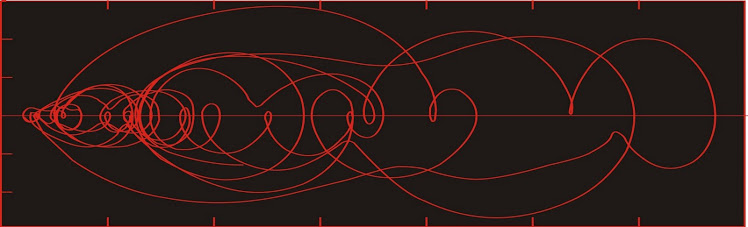
Two dimensional phase space reconstruction of dust flux from the Vostok core over the period 186-4 ka using the time derivative method. Dust flux on the x-axis, rate of change is on the y-axis. From Gipp (2001).
Showing posts with label extinction. Show all posts

Wednesday, March 27, 2013

Updating "scaling laws of life and death"

It has long been known that there is very long-term cyclical behaviour in a variety of geological records, including mass extinction events, stratigraphic sequences, and climate change. The lengths of these inferred cycles are approximately 60 million years, and 140 million years. Raup and Sepkoski argued for a cycle length of about 28 million years for major extinction events, and proposed the "Death Star" hypothesis, in which a companion star in mutual orbit with the Sun would cause catastrophic meteorite showers resulting in these extinctions.

The Death Star hypothesis has apparently been disproved--at least the Sun's companion has not been discovered despite prudent searching.

In the recent issue of Eos (only available by paid subscription, but your university library probably has it) the headline article suggests that the long-term cyclicity noted above may be present in mantle upwelling events.

The method of analysis makes much use of wavelet analysis, which reminiscent of Fourier analysis but also takes into consideration the portions of the time series in which the periodicities occur.


Wavelet analysis of biological diversity (top) compared with that 
of initiation of large igneous provinces (i.e., really big eruptions) 
over the last 525 million years. From Rampino and Prokoph (2013).

In the figure above, the lighter colours (green to red) represent significant peaks in cyclicity in a) number of marine genera (caused mainly by episodes of sudden loss and more gradual replacement) and b) the timing of the onset of large igneous provinces (which means eruption of huge volumes of magma). The period of the observed cycles is on the scale at left. The method allows us to consider that the cycles may only be active over portions of the records.

As you get closer to the ends of the record, there is a real possibility that the truncation of your data set will affect the data. The longer the period under investigation, the greater the impact on the data near the beginning and end of the record. Consequently, the yellow dashed arcs in both figures above show us the limit of viable interpretation--we only take seriously the portion of the graph in the "bowl" of the yellow arc.

Although the authors do not describe a precise mechanism by which such cyclicity may arise, they note that previous studies suggest that instabilities in the lowest level of the mantle may occur in a repetitive fashion, leading to cyclicity in the emplacement of large igneous provinces (eruptions that may cover > 100,000 sq-km in a geologically short interval).

Alternatively, the formation of supercontinents can act as a cap on the heat produced within the earth, resulting in mantle upwelling within the continent leading to emplacement of huge volumes of magma and rifting. The supercontinent cycle lasts from 300 to 500 million years and is thus too long to be recognizable on the above graphs.

Both graphs above suggest the sudden appearance of an oscillation with a period on the order of 30-35 My beginning a little less than 150 million years ago. That kind of sudden appearance of a new phenomenon in the geological record is an example of innovation in the earth system.


Plot of spectral power of extinctions vs originations. After Kirchner (2002).

In an earlier post (based on the variograms produced by Kirchner, 2002), I argued that extinction was more-or less random, on the basis of the lack of a consistent slope. There were some spectral peaks which could be correlated to the cycles described above--the ca. 28-million-year cyclicity is probably related to the 30-million-year periodicity noted above. An additional oscillation with a period of about 140 million years is also present.

The sudden appearance of cyclicity may be an example of an emergent property. As previously discussed, emergent properties are global-scale behaviours which arise in a manner which is not at all understood from the interaction of local subsystems. Interestingly, small changes at the local scale may bring about structural change at the global scale, which I have previously referred to as innovation.


Kirchner, J. W., 2002. Evolutionary speed limits inferred from the fossil record. Nature, 415: 65-68.

Rampino, M. R. and Prokoph, A., 2013. Are mantle plumes periodic? Eos, Transactions of the American Geophysical Union, 94 (12): 113-114.

Tuesday, July 5, 2011

The evolutionary arms race in the realm of HFT algos

The history of life is littered with abundant evidence for evolutionary arms races, by which one (or one group) of organism(s) develops some advantage over competitors, predators, or prey, which is soon after countered by the disadvantaged group. The dance has continued from the earliest times of life until the present, and is presumed to be ongoing. Indeed, it is one of the central selective pressures effecting evolution--by eliminating the losers of the arms race.

As I am not an evolutionary biologist, I was thinking in particular of asymmetric races, in which competing organisms adopt different methods, rather than symmetric races.

My interest in such things stems from having a son (and many, many relatives) with G6PD deficiency, a relatively common enzyme deficiency--selected for in humans most likely because it confers some resistance to malaria. The chief drawback of this genetic condition is that eating certain foods (and medications) can cause massive destruction of red blood cells.

How does such a condition appear? Like most genetic conditions it most likely is an example of a random mutation which hangs around because it is selected for in malarial environments.

Plants have developed toxins over evolutionary history, and one such class of toxins causes destruction of red blood cells. Mammals (among other animals) have developed enzymes that break down these toxins, and the breakdown products are now beneficial. In fact we call these toxins "antioxidants".

Ironically, the enzyme G6PD apparently plays a role in the life-cycle of the malaria parasite, as those who have this condition and who are infected by malaria typically carry lower parasite loads.

In the digital realm, the concept of evolutionary arms races has been around since about 1980, and are most commonly observed in the ongoing battle between computer viruses and antivirus products.

They also appear in the realm of high-frequency trading (HFT), although as no one is eager to produce manuals on how their specific systems work it is a little harder to see how.

Years ago we used to see stops getting busted on in-demand shares--which we soon recognized as a sign that the particular stocks targeted would soon see gains. It always happened during a quiet trading time, usually after about 11 in the morning, and suddenly all the bids would be hit until a massive stop-loss was triggered and picked up. I remember in 2002 seeing CDE-N knocked down 30% in a matter of minutes, followed by a massive pick-up of some sucker's stop-loss, followed by furious action as the price bounced back. That passed for HFT in those days.

One of the modern approaches to HFT is latency arbitrage, whereby some entities are able to see more up-to-date buy and sell orders than the general public sees, and use this info to either scoop up the market with an arbitraged advantage or withdraw orders only to replace them moments later at a higher price. For instance, you may be trying to buy shares in company ABC, but as there are differing time-delays for each of the markets on which you are seeking shares--as soon as your first order appears on an exchange, all other available share orders at your buy price are cancelled and resubmitted at a higher price.

Recently, RBC announced a new program called "Thor", meant to combat latency arbitrage. The idea was that RBC would monitor the latency for all markets and use that info to ensure their orders arrive on all markets simultaneously.

Well, what's an HF arbitrageur to do? Why not try quote stuffing? A large number of quotes on a single stock can slow down the reporting on an entire channel, so why not use it to vary the latencies by random factors, making it more difficult for a program like Thor to work. If the latency factors for each market starts varying randomly, choosing the appropriate lags for Thor becomes impossible.

Sunday, May 15, 2011

(Scaling) laws of life and death

Another blast from the past*

One of the enduring problems in historical geology is the relationship between speciation and extinction. Geological history is punctuated by episodes of mass extinction, when in response to tectonic, climatic, or even astronomic events, large numbers of species become extinct in a short period of time. What happens in the aftermath?

One idea is that with the Earth denuded of many lifeforms, there are a large number of ecological niches "up for grabs" by the first applicant. Natural selection may select for those organisms which have undergone morphological and/or behavioural changes that more efficiently exploit the opportunities of the vacant niche. The logical consequence is that speciation should increase rapidly after a mass extinction.

One problem with this idea is that natural selection is a mechanism for culling away the unfit--it is not a mechanism by which innovation occurs. Innovation has been linked to random mutation, although occasionally papers appear claiming that the mutations are not random. The Lamarckian idea of directed mutation in nature has been discredited.

We might say this is an existential problem, for just as one may contemplate one's own mortality, one may contemplate the mortality of the human race. Are there predictable laws of extinction, and are we governed by them?

In pondering this issue we are not helped by a belief in our own exceptionalism. So for the duration of this essay, let us consider merely the idea of extinction of any number of species, and only afterwards ponder its relevance for ourselves.

Extinction (for our purposes) represents termination of a species.

What can we say about the processes of speciation and extinction? Are they governed by the same dynamics?

Spectral power graphs for extinctions and originations of marine 
families over the last 500 million years. From Kirchner (2002).

The Fourier power spectra for rates of extinction and origination of fossil marine families provides insight into the dynamics of extinction and evolution. On the graph above, the extinction power spectrum is relatively constant, with undulations. The highest frequency undulation (the last wiggle on the left) is Raup and Sepkoski's (1984) "death star" peak--the extinction peak at 28 million year intervals attributed to the periodic approach of a neutron star to our solar system.

The graph for originations shows a steady decline with increasing frequency, so that at higher frequencies (shorter timescales) the rate of originations falls below the rate of extinction. Kirchner (2002) used this behaviour to infer that the rate of originations, especially at higher frequencies (periodicities less than 25 million years) was lower than the rates of extinctions; implying that there was a limit to the rate at which innovations could appear in the fossil record.

Although a correct observation, I believe the explanation for it is incorrect. The significance of the decline in rate of origination with frequency (note the nearly straight line of best fit on a log-scale) is that originations have a scale-invariant character, whereas extinctions (horizontal line of best fit) are random.

Over geologic time, rates of originations have to be at least as high as rates of extinction, or all life would be extinguished. We see that on long time intervals, rates of originations are higher than rates of extinction.

Scale invariance or random chance?

Scale invariance is a common characteristic of geological systems (Turcotte, 1997), and has been observed in such diverse phenomena as earthquakes, volcanic eruptions, and climate change. Such behaviour can be clearly demonstrated from the power spectra of some geological record. When projected on a log-log plot, the best fit of the power spectrum is a straight line of constant slope. The slope of this line is called the scaling exponent, and can be related to the fractal dimension which characterizes the size-time distribution of events.

Discrete scale invariance is a weaker form of invariance, where the scaling is not apparent at all frequencies, but only for a certain range of frequencies (Sornette, 1998). Discrete scale invariance is only described by a complex fractal dimension, the imaginary part of which is a simple function of the discrete scaling exponent (Saleur et al., 1996). Such behaviour is shown to exist in a wide variety of conditions, including diffusion, fracture propogation, fault rupture (in time), hydrodynamic cascades, turbulence, the Titus-Bode law and gravitational collapse of black holes (Sornette, 1998).

Thus, spectral power (P) varies as a function of frequency (f) so that for an arbitrary change f → λf there exists a number μ such that P(f) → μP(λf). This is a homogeneous function encountered in the theory of critical phenomena (Bak et al., 1988), and is solved by a power law P(f) = Af**(-α), where α = -log(μ)/log(λ). Power laws are the “fingerprint” of scale invariance, as the ratio of P(f):P(λf) is independent of f. Thus the relative spectral density is a function of the ratio of the two frequencies, and this property is the fundamental one which associates power laws to scale invariance, self-similarity, and self-organized criticality (Bak et al., 1988).

Fractal analyses of the scaling behaviour can be used to provide more information about the dynamics of speciation and diversification. The scaling exponent is the slope of the best fit line fitted to the log-log power spectrum. There is a correlation between the size-time distribution of events and the scaling exponent. If this slope is ~0, then the the distribution of events through time resembles white (i.e., random) noise.

Importantly, there is no trend observed in the power spectrum for extinctions. The implication to be drawn from this observation is that extinctions are randomly distributed, both in size and in time. They are not governed by processes at all like those that control diversification. The apparently random nature of extinctions is something of a mystery, as it would suggest that extinctions are not related to originations (new critters outcompeting the old). Nor does it fit with extinctions being related to large tectonic, climatic, or external events (bolides), all of which are believed to be systems at a state of self-organized criticality (Bak et al., 1988), and show a measured increase in power with decreasing frequency. Randomness in extinctions may imply that they are dominated by gambler's ruin.

By contrast, the power spectrum for the originations undulates about a line with a constant negative slope on the log-log graph. The slope of the eyeballed line of best fit (don't have access to the real data) is about -0.9 (i.e. a = 0.9). This is consistent with a system at a state of self-organized criticality.

Natural systems displaying self-organized criticality (SOC) are known throughout the geological realm. Tectonic and volcanic activity shows such a distribution, as does the distribution of large climatic disturbances. From the data analysis of Kirchner (2002), it is unclear whether the fingerprint of SOC arises from external influences or is an internal character of the evolutionary process.

From a geological perspective, it is natural to assume that SOC is imprinted on evolution by environmental processes. But scaling laws are observed at the level of proteins (Unger et al., 2003) as well as at the gene- and species level (Harrada et al., 2011), suggesting that SOC is inherent in life itself.

Bak, P., Tang, C., and Wiensenfeld, K., 1988. Self-organized criticality. Physical Review A, 38: 364-374.

Bonnet, E., Bour, O., Odling, N. E., Davy, P., Main, I., Cowie, P., and Berkowitz, B., 2001. Scaling of fracture systems in geological media. Reviews of Geophysics, 39: 347-383.

Erwin, D. H., 1998. The end and the beginning: recoveries from mass extinctions. Trends in Ecology and Evolution, 13: 344-349.

Herrada, E. A., et al., 2011. Scaling laws of protein family phylogenies. http://arxiv.org/PS_cache/arxiv/pdf/1102/1102.4540v2.pdf

Kirchner, J. W., 2002. Evolutionary speed limits inferred from the fossil record. Nature, 415: 65-68.

Kirchner, J. W. and Weil, A., 1997. No fractals in fossil extinction statistics. Nature, 395: 337-338.

Raup, D. M., and Sepkoski, J. Jr., 1984. Periodicity of extinctions in the geological past. Proceedings of the National Academy of Sciences 81 (3): 801–805.

Saleur, H., Sammis, C. G., and Sornette, D., 1996. Discrete scale invariance, complex fractal dimensions, and log-periodic fluctuations in seismicity. Journal of Geophysical Research, B101: 17,661-17,677.

Sepkoski, J. J. Jr., 1993. Ten years in the library: new data confirm paleontological patterns. Paleobiology, 19: 43-51.

Sornette, D., 1998. Discrete-scale invariance and complex dimensions. Physics Reports, 297: 239-270.

Unger, R., Ulierl, S., and Havlin, S., 2003. Scaling law in sizes of protein sequence families: from super-families to orphan genes. Proteins, 51 (4): 567-576. doi:10.1002/prot.10347.


* I wrote this article nearly ten years ago, which is why the references are so dated.Updated recently just for you.