Dust flux, Vostok ice core

Dust flux, Vostok ice core
Two dimensional phase space reconstruction of dust flux from the Vostok core over the period 186-4 ka using the time derivative method. Dust flux on the x-axis, rate of change is on the y-axis. From Gipp (2001).
Showing posts with label NI 43-101. Show all posts

Wednesday, March 5, 2014

PDAC, part deux

Now that the beer fog has cleared somewhat, here are some other observations.

Compared to previous years, the place was dead. Sure, there were people shuffling around. But I had broken a toe on Saturday in an unrelated event, and was a little nervous about getting it stepped on in the crowds (which would have been a given in any of the last three years). But I had no problems on Tuesday--in fact I hardly needed to exercise any vigilance at all, because the aisles seemed quite a bit wider than usual (fewer booths by far), and there were several booths missing at the ends of the crossways, so they were wider too. And there just weren't that many people there.

In other good news, somebody out of the blue asked me to do some work for them. I hadn't planned to look for any work, figuring it was probably pointless, at least among the companies that did show up.

There was a rumour that about 100 companies that had registered to have booths at the investor's exchange didn't bother coming.

These points seem to suggest we are close to a bottom in psychology--and the few financings that have occurred, and someone asking me if I could do some work for them, both point to an improving market. Unfortunately, my gut tells me that not enough bad companies died during the downturn.

One last point of interest--I was talking to a mining securities lawyer acquaintance of mine in one of the hospitality suites and I got to discussing one of my favourite topics--the manner in which NI 43-101 regulations skew the market in favour of larger interests, particularly institutional investors (to the detriment of the retail investor). It didn't surprise me that he agreed with me. It was the way he agreed with me. "Well, duh!". He did suggest that if the retail investor wants to front-run the market like a bank, then let him hire his own team of geos.

Sunday, February 9, 2014

Vindictus

I've been hearing stories lately from contacts in different junior explorecos about regulators questioning certain types of promotional literature.

In one company's case, the questions are driven by its inclusion of previously reported grades and tonnages of surrounding deposits in the same structural province. Now it is not clear to me whether the regulators are objecting because they are afraid that the casual reader will think that the neighbouring deposits belong to the company in question (it is clear they do not--the company has identified the owners/operators of the surrounding mines) or that they feel it is too promotional. I'm guessing the latter, in which case the fact that the grades/tonnages are already a matter of public record seems to render the problem moot.

How does excluding such information from the presentation help the retail investor? It doesn't. It is information which is potentially useful to the investor. In its absence, the retail investor will have less of an understanding of the area's potential than other, more sophisticated investors, who are capable of looking up such information themselves.

But perhaps that is the point. It is not yet time for the retail investor to enter the picture. Now is the time for institutions to get positioned. By excluding information from the eyes of the retail investor, the institutions can get safely positioned at a lower price. After the big move, it will be time for the retail investor to enter the picture, so that institutions can exit their positions safely. But don't worry--they'll leave the last few percent of the major move for you.

Tuesday, December 24, 2013

More commentary on NI 43-101 regulations

There have been a few discussions on NI 43-101 regulations at different sites the past couple of weeks.

I’m not as well-known as the other commentators on this topic—I probably don’t smell as nice either. But I’ll throw in my two cents.

The NI 43-101 reports fill a vital role in shareholder communication. That being said, there are some problems in that way that they are handled. My comments below are directed more at early-stage technical reports, not resource estimates.

A lot of weight is placed on the QP, and I think that the system should have more trust in them. Geology is not a precise science, and there are times when the QP could make a statement which may not be completely supported by hard data, but which represents an interpretation based on past experience in similar (and possibly even genetically related) projects. These sorts of judgement calls are frowned on under the current rules, but I think they may convey valuable information to the market, provided they are properly qualified. The guiding principle should be whether this is a reasonable inference to make based on the sum of available data and the knowledge of the QP. Remember, we are not talking about resource definition—we are answering the question, “Is it reasonable for a company to raise money on the market to invest in this property?”

For example, I wrote a technical report on a property in which there was a considerable amount of artisanal gold mining activity. The local villagers had carved a sluice 500 m long into the side of a mountain; then tore off the top of the mountain and sent it down the sluice into the river, where more sluices had been set up to further process the fines. The mountain was a greenschist, with the more resistant layers acting as the riffles. The river had been reduced to a sad stream choked by immense piles of detritus. I could see the same process underway at all the surrounding mountains. All of this work was being done by hand, so I inferred that it would be reasonable to spend a little money further exploring the property. The report was rejected—and one of the comments was that the artisanal mining operations were irrelevant, and I was to remove all mention of them from the report.

Irrelevant? It is probably the single most reliable indicator of gold on a property, next to digging a hole and pulling out a nugget. I could see it being considered irrelevant were I presenting a resource estimate, as I could not provide an adequate estimate of the volume of rock removed, and had no production figures for the operations. But in terms of addressing the question, “Is it reasonable to raise money on the public market to investigate this property?”, I felt that the operations were relevant.

I should add that the artisanal operations were not the only line of evidence I had—there were numerous soil geochemistry and geophysical surveys over the property, adits, and about 30 boreholes, all suggesting it would be reasonable to explore the property—some of these reports dated back over 60 years. But the artisanal mining operations were deemed irrelevant. This is the type of judgement in which the QP should not be second-guessed by a lawyer who has never left his desk in Toronto.

On the same project, the company ran into a problem with their spending requirements. They had supplied a list of expenses that totaled well over $100k, but someone at the OSC disallowed several items, leaving a total of a little over $98k. The report was rejected on the basis that the company had failed to spend at least $100k on the property. My first thought was to object over the arbitrary nature of disallowing some expenses, but as I thought more about it, I began to question the validity of having a fixed number at all.

I understand that the reason for having some sort of limit is to prevent me from staking my backyard, sending a dozen samples to the local lab (say, $600 in analyses) and then floating a company. But I think the decision as to whether the company has spent enough money should be made by the QP.

If you were lucky enough to get a nice property in Mexico that had been mined continuously from the days of the conquistadors until 1998, when it closed down due to low gold prices—and you proposed to investigate the mountains of tailings from 400+ years of operations—I daresay you could successfully answer the question “Is it reasonable to raise public money to explore the feasibility of this idea?” in the affirmative while spending a good deal less than $100k. At the same time, you could spend well over $100k on a singularly remote property in the Yukon and know little more than fuck-all about it. So this is another case where the honest judgement of the QP should be respected, and not second-guessed by a desk-jockey in Toronto.

To which I would add this, and I have already made the comment that the regs are not intended to protect the retail investor--they are there to provide benefit to: institutional investors at the expense of the retail investor; major consulting firms at the expense of the individual practitioner; and large companies at the expense of the juniors.

Why are you here on Christmas Eve?

Friday, October 11, 2013

The mark of regulatory failure

It isn't news that the market for junior mining companies is bad.


And we all have our reasons for it--ranging from poor performance in commodities in general to extreme and horrifying fears of a general collapse in society into barbarism. But if the latter were imminent, wouldn't we expect to see everything else performing just as badly? The rest of the market isn't great, but it isn't as awful as the junior golds.

After the Bre-X affair (portions of the Bre-X files are here), regulatory officials created a set of regulations to guide technical reports. The goal was to make the type of fraud that Bre-X represented impossible.

Unfortunately, there are still types of fraud that go on in the markets, which are not affected by the regulations.

There are good companies run by competent management, with competent geologists and good properties. Sadly, these are in the minority. There are companies with well-meaning, but incompetent management or poor properties. These are more common. They raise money, spend it properly, but lose your money. Maybe you don't feel so bad because the guys were at least trying.

Then there are the criminals. There are lots of these. The current regulatory regime has eliminated some of them--the ones that manipulated their share prices by faking their sampling results by numerous methods which need not be elaborated here.

But the regulations have done nothing to eliminate the more insidious criminals which run companies purely for the benefit of raising money through share issuances and directing the proceeds to themselves either as salaries or as private billings. Arguably, the regulations have enhanced these companies, because they provide a checklist by which diligient, but criminal, management can maximize their credibility on the markets for a minimum of exploration expense.

If your plan is to raise a whole lot of money in order to pay yourself, the blessing of Canadian market regulators officials gives you the credibility you need to keep at it. Such companies can be called "lifestyle companies"--as they exist solely to maintain the lifestyle of their management.

How did it come to this? The regulations were designed to solve a different problem--one of criminal management expressing its criminality through manipulation or misreporting geological information (although see this). As for the lifestyle companies, as long as they satisfy the various listing requirements, the regulators have plausible deniability, and the exchanges can happily collect their fees.

A lot of money came into the junior mining sector since the advent of the new regulations. A lot of money. And there has been little exploration success to show for it.

The poor performance of the junior exploration sector is a crushing indictment of the regulatory regime in the Canadian markets. The retail investor has judged the NI 43-101 regulations and they have been found wanting.

Wednesday, December 19, 2012

Why junior miners suck

It's no secret that junior miners are continuing to do poorly. The reasons include:

1) they are running out of money;
2) nobody cares about their @#%$ drill results;
3) they are caught in a death spiral positive feedback loop brought about by the expectation of low prices, making it hard to raise money, forcing the company to finance at excessively dilutive prices, which helps keep share prices low;
4) company finances are so weak that majors can postpone deals for decent projects until the junior either folds or vends the project for a pittance;
(but you already know all these)
5) and the Aristotlean first cause--NI 43-101 has rendered the business model of junior mining companies obsolete.

Let us review how that business model used to work.

A new company would list and raise a small amount of money at a low price to drill a few holes. With luck, one or more holes would have some promising results--the share price would rise and the company could finance some more work at a higher price. The additional work would hopefully bring about improved results implying an expansion in the area of mineralization. There would be another increase in the share price, and the company would finance again to finance further work. After a few iterations, the company would be able to raise enough money at a reasonable price to finance a program which would define a resource to a high level of confidence, or complete a feasibility study.

Alternatively, the first program would fail to find anything, and the company would be wound up. Thus, either failure (probable) or success would happen quickly. Salaries were minimal, as the principals in the company would have a considerable number of shares or options, so that the early rises in the share price would reward them for their successes.

The business model no longer functions. There is very little movement in share prices from drill results, unless they lead to a favourable resource calculation. This means that enough money has to be raised to define a resource at a very low share price, creating tremendous dilution. It also means that it will take a long time before the project either succeeds or fails. As a consequence, the principals now require salaries (in addition to their shares/options), which greatly adds to share dilution, as these, too, are financed at low share prices. Instead of either succeeding or failing quickly, the process is drawn out over a long time, requiring a lot of money raised at a low price.

What is the effect? In the short to medium term, it means producers will have their pick of excellent prospects from distressed companies which may be acquired at distressed prices. In the longer term it may be the end of discovery of new deposits.

NI 43-101 benefits major companies at the expense of junior miners, as it lowers the cost of picking up projects to replace the ore they mine.

As I have discussed before, NI 43-101 also favours institutional investors over retail investors and large consulting companies are favoured over individual practitioners (it really helps to have a lawyer and an accountant on staff when writing NI 43-101 reports).

Like most legislation, its true intent is the opposite of what has been stated.

Tuesday, June 19, 2012

More fun with NI 43-101

You wouldn't ordinarily think that more transparency in the reporting of exploration companies would be harmful to the investing public. Yet I think there is the potential of just such a counter-intuitive result from some of the new requirements in reporting according to the most recent updated requirements for NI 43-101 reporting.

According to section 3.3, article 2:
If an issuer discloses in writing sample, analytical or testing results on a property material to the issuer, the issuer must include in the written disclosure, with respect to the results being disclosed,
(a) the location and type of the samples;
(b) the location, azimuth, and dip of the drill holes and the depth of the sample intervals;   
Once again--intuitively speaking, additional disclosure can only benefit the public, right?

I'm not so sure it does in this case. What will the ordinary public do with the location, dip, azimuth, depth, and grades of the samples? This is information which, combined with the appropriate software, can be used to generate resource estimates--particularly if it is carried out by the geological help hired by a large financial institution, thus allowing that institution (and perhaps certain of its well-heeled clients) to front-run the investing public by estimating the resource before the company itself announces it. Does this protect the investing public? It seems to me that this is the exact opposite of protecting the investing public.

Companies need to present results to the market in a timely fashion. These results need to be accurate. But the totality of information offered above shouldn't be available to the market until the company releases a resource estimate. But some information about the spacing of the drillholes needs to be released so that investors can be reasonably sure that good results are not obtained by drilling many holes very close together, but are from holes that are reasonably spaced apart.

A general outline for a method that might work would be to report on the distances between each drillhole and its two (or three) nearest neighbours--the sum total all plotted as a histogram. If the drillholes are clustered together, that will be immediately apparent. It would also be immediately apparent if the drillholes are spaced out evenly over the area. The size of the area of investigation could be reported, thus allowing all investors the ability to assess the significance of the results without allowing any of them the ability to make a resource calculation.

Another approach might be something like this. The advantage of presenting the data this way are obvious--but at the same time there isn't enough there for sophisticated investors to front-run the market. My only objection would be to mandating that companies use a particular program.

When the company reports a resource, all the information about the drill collars can be reported, allowing the resource calculation to be verified.

Wednesday, October 5, 2011

As the impacts of NI 43-101 regulations flow through the system, gold companies may be revalued

There are many opinions about the value of gold in the ground, some of which have changed through time.

As people become more familiar with the NI 43-101 regulations, investors have come to distinguish between resources, proven reserves, and measured and indicated ounces. As a consequence, company prices no longer react much to raw results; investors now wait to see the result of a formal technical report to see if more ounces are discovered or upgraded to proven reserves.

The value of gold and the ground will depend on the price of gold. For some of the examples above, the value of proven and probable reserves was set at about one-quarter to one-fifth of the spot gold price. Other authors place a lower value on such gold.

There is a problem with the model for gold exploration. There does not appear to be enough money in it to make it worthwhile.

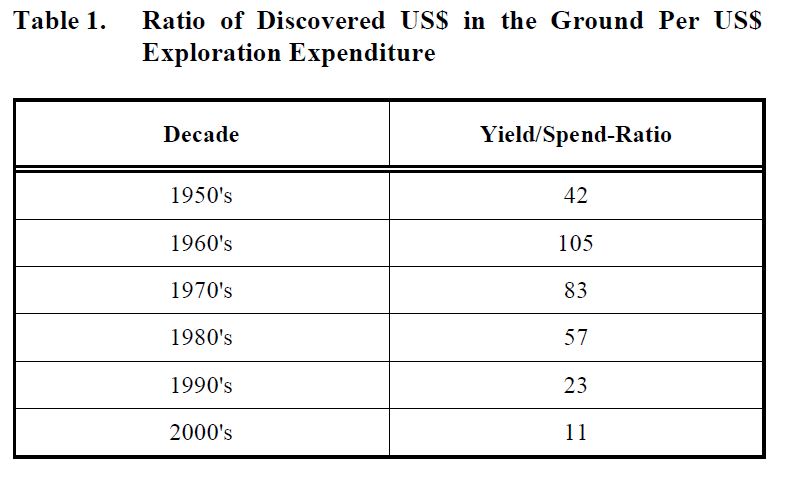
Value of gold discovered per dollar of exploration through time. 

In the face of a rising price of gold, the payback on gold exploration appears to have fallen alarmingly. The idea that an exploration company's price will rise tenfold on a discovery may have been valid forty years ago, but with the level of success indicated on the above table, such a payback would leave nothing for the poor developer of the eventual mine.

It is possible to infer from this chart that we are running out of gold to discover. Here at the World Complex, our view is that a significant factor in this decline is the increased level of regulatory complexity a company must navigate in order to officially "discover" an amount of gold. In particular, the amount of drilling required to define one million ounces of gold is much greater at present than was the case in, say, 1960.

Ultimately, the extra money is not wasted. The additional definition of the resource may not have been necessary to "prove" the deposit in years past--but it would have been done to define the reserve during the planning stages of the mine. So the effect of recent regulation has been to shift some of the spending burden from the mine developers to the junior explorers.

In effect, the increase in cost defining resources is mitigated somewhat in the development phase. In principal, it should cost slightly less to develop a mine after the definition of the mineral reserve than would have been the case in the distant past, suggesting a net benefit to developers and producers. I have not pulled together enough data to study whether the share price of producers has improved with respect to typical metrics (reserves or production) to see if this shift can be separated from the impact in the rising price of gold.

It may be that there is another revaluation to come for mining companies.

Tuesday, November 23, 2010

Some thoughts on NI 43-101

In mining work, dishonesty can have obvious rewards. Some of the scandals that occurred in the fairly recent past—Bre-X, Golden Rule, have led to an increasingly onerous set of regulations on reporting.

Some standardization in the rules of reporting mineral exploration results is a welcome step and the agencies which initiated these steps should be congratulated for their attempt to bring clarity to the market.

Nevertheless, it is important that while bringing clarity we don't make the entire system opaque. One problem with the NI 43-101 setup is in the review of reports. Many of the reviewers do not have expertise in geology--in fact, they are lawyers and accountants, and they expect the document to read like a legal acounting document. This places a burden on the poor geologist writing the report, and favours instead larger geological consulting companies who have legal and accounting staff to vet reports prior to submission.

It is a truism that when the major players in an industry feel threatened by smaller upstarts, the most certain way to overcome such competition is through enacting industry standards.

Additionally, geology is not like most of the other "hard" sciences. There is, of necessity, a great deal of interpretation of observations. Simply reporting observations is only part of the science--the interpretation is the key area. Much of this interpretation follows from previous experience. Consequently, it is common for geologists to make a key interpretation about a project on the basis of previous experience. But this is not something that translates easily into an accounting or legal document.

Two geologists may make the same observations about a project and arrive at different conclusions. This is a reflection of the nature of geology, and is not something that is helped by needless quantification. 

The rules of reporting on mineral properties make it very difficult for a geologist to express certain reasoned opinions which have arisen from interpretations of observations in light of past experiences. This means that a great deal of the value that a geologist can bring to a property is no longer reportable, and the exploration progress on a property must be reduced to the reporting of a series of dry numbers. The flavour is lost.

Consider this--in 1897, the Ashanti Mine began production. It was financed by the issuance of shares, at 100 pounds apiece, on the London Stock Market. How was it promoted? The founders of the company simply reported that they had visited the site in Ghana, and that the valley was full of artisanal miners recovering gold from rich seams within the bedrock.

Early this year I wrote an NI 43-101 report on a property in Sierra Leone--a report which is still bouncing back and forth between myself, the company in question, and Canadian securities regulators. One of the earlier issues, since resolved, was my contention that the number and extent of artisanal mining operations on the property meant that it would be reasonable to assume some chance of successfully exploring the property for gold.

The securities regulators took exception to that conclusion. I had no specific numerical measurements of the gold recovered by the miners. There were no numbers to report. So the observation had to be withdrawn, or at least, very heavily discounted.

Were the Ashanti Mine property being explored for the first time today, it is highly doubtful that it could be brought into production. The actual structure of the gold shoots are like long, thing, curving cylinders that plunge steeply near the surface, and gradually level out at depth. The gold-bearing zones of the shoots are only a few m in diameter, but they are perhaps 3 km in length, and each one carries 2-4 million ounces of gold.

A cylinder is very difficult to find, let alone completely define, by drilling. The only way they could have been found and mined was the way it was done. Artisanal mining was observed at the surface, and so a proposal is made to start at the surface and mine down. No drilling, just start mining. But in today's environment, it would be impossible to raise the financing for such a venture (what are the numbers?), and it would be practically impossible to define a resource using the normally accepted methods (which are more suitable for bodies with a tabular geometry).