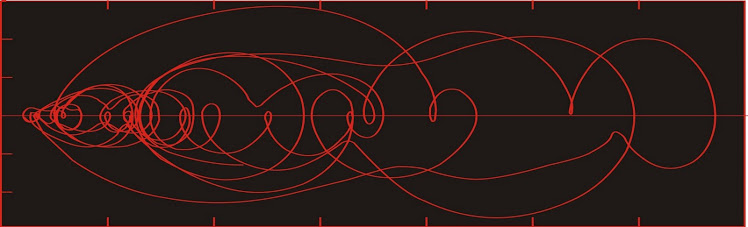
Dust flux, Vostok ice core

Dust flux, Vostok ice core
Two dimensional phase space reconstruction of dust flux from the Vostok core over the period 186-4 ka using the time derivative method. Dust flux on the x-axis, rate of change is on the y-axis. From Gipp (2001).
Showing posts with label dollar index. Show all posts

Wednesday, August 5, 2020

The inflationary hyperloop and other tales from the near future

Last time we looked at the recent transition from deflation to inflation as revealed in the USDX vs gold chart. This time I would like to put this into a somewhat larger perspective.


This chart compares the US dollar index with the gold price over the last 12+ years. The overall effect has been one of deflation (both gold and the dollar index have risen over that period), but the effect has not been steady. Much of the deflationary "progress" has been made through cycles of inflation and disinflation, although there have been substantial periods of "pure" deflation, mainly in early 2010, late 2014 to early 2015, and the longest stretch covering nearly all of 2019 into May 2020.

The question of inflation, disinflation, deflation, etc. are not just theoretical--they potentially affect the balance sheets and investors' perception of gold and silver stocks as investments (or, perhaps, speculations). During deflation, when both the US dollar price of gold and the US dollar index are increasing, the balance sheets of non-US-based gold miners (companies with mining operations outside of the US) improve markedly. The effect is not as strong for US-based gold miners, however they do benefit from inflation. During inflation, the non-US-based gold miners don't really benefit much (from the accounting perspective), however this tends to be the time when their perception of value increases the most in the minds of investors. Since it is also likely to be a time for US operations to increase in profitability, it improves the financial conditions of the Nevada-based producers (and California, Arizona, etc.).

Also take note of the effects of deflation on silver. It isn't pretty. The switch from deflation to inflation makes puts silver in play. The important thing to remember is to leave the party when the inflation turns to disinflation or deflation, which can happen suddenly. 

In May, the situation switched from deflation to inflation. That may suggest that American-based producers and silver companies are right in the sweet spot.

One feature that stands out is the "inflationary hyperloop" highlighted in gold. It represents a fairly long period of inflation followed a similar period of disinflation, the total lasting about four years. For gold and silver investors, only the first half or so was much fun. Now that we have entered into an inflationary period, are we going to experience another such loop? It seems plausible. 

But there is at least one significant differences in the current inflationary run and the beginning of the inflationary hyperloop--and that is battle. Almost the entire way around the loop there was a real struggle between bear and bull forces. That struggle on the way up is important, as it tends to lead to resistance on the way back down. Now observe our current smooth inflationary stretch since May. Where are the struggles?

One approach is to assume that the current situation will mimic the inflationary loop. If so, we might get two years of fun and about $600 of price out of this. Some approaches suggest magnitude and time increase due to [central bank-fueled liquidity; higher price levels; Mars is in conjunction with Apollo; your reason here]. But the reality is that this is a dynamical system, and in state space, once the system breaks out of a mode of stability, it can move rapidly to another. The new area of stability may be nearby, or it may be far afield, but in either case, without any previous observations of its existence, its location in phase space is unknowable. This is just a roundabout way of saying we can't know how high the gold price will go (or how low the gold-silver ratio will fall) during this period of inflation.

I just thought of this. Youtube here

Monday, July 27, 2020

A sharp transition from deflation to inflation

Today's chart is the US dollar index vs gold over the last two years (actually the last 94 weeks, which is not quite two years).


We have discussed why deflation and inflation are not opposites on this graph previously.

Here we see a sharp transition from deflation to inflation, occurring within a week of May 15 (two months ago). 

Note that deflation is the best condition for gold companies, in terms of improving fundamental strength. It is possible, however, that many market participants believe that inflationary conditions are better. So strength may continue. Past history shows that inflation may give and take away. When the gold price has risen strongly, governments have often applied "windfall taxes", reducing the real gain experienced by the company. And if gold is rising, while the US dollar is falling, and you are a mining company outside of the US banking US dollars for your gold, what is happening to your real income?

In at least one previous article, we have also discussed why silver is a dog during deflation, but outperforms gold during inflation.

And, as in all cases, let the buyer beware!

Wednesday, March 11, 2020

The possible coexistence of inflation and deflation

One comment came up a lot in the recent posting. Well, the comments were all on Zerohedge. Which was to dispute my conclusion of a switch to an inflationary setting.

In the biggest picture, we have had deflation for at least the past twelve years.


Sorry, haven't updated this one in the past few months. But on this scale, very little has changed. The long-term trend of rising gold price and rising USDX index that has been active for the past twelve years would still look the same as in this graph.

I remember Richard Russel, long before 2008, advocated for deflation, saying that the way to play it was 50% gold, 50% US dollar. So the deflation isn't really a surprise--it's a reflection of the excess levels of debt, and will remain until the debts disappear.

Yet on a year-by-year basis, we don't have continuous deflation at all. There have been year+ long cycles of inflation and disinflation which have resulted in deflation (the first year or so,  2011 to 2013, and 2016-2018). For this reason, it can be difficult to remain invested for deflation for the whole last twelve (and more) years.

The inflationary impulse that we may have embarked on (it will be safer to call this in a few weeks, assuming it continues) could be another event like we witnessed in 2011, which saw gold fall just short of $1900, with the US dollar falling sharply. And this was followed by the 2013-2013 period which saw sharp drops in the price of gold. 

Going forward, I think the next decade will be dominated by deflation (a rise to the upper right in the graph). But in the next year, we may see inflation (falling down and to the right in the graph) before disinflation (rising to the left) possibly ending up a little higher and to the right of our current position.

What's a prudent investor to do? Well, I'm not offering any advice. We may be starting an inflationary cycle. But then, I've thought that, and been wrong, before.

Saturday, March 7, 2020

Brace for impact

What a week we just had in the precious metals market.

From a huge drop last Friday--which in the past would have presaged further declines the following week--to a significant rebound in the gold price, coupled this time with a major drop in the US dollar--which I will argue may be the signal for a switch to inflationary conditions.

First the chart


We see the nice deflationary trend of the past 18 months looks to have been decisively broken by last week's action. Although it will be a few weeks before we can be absolutely sure, last week suggests that we are about to embark on another bout of inflation, no doubt as carefully calibrated by the Masters of the Universe as they can fill a shot-glass of whiskey from a pool of liquidity the size of a football field. Either, like a small child pouring very carefully, they have poured only too much, or they have sloshed out enough whiskey to fill a large swimming pool, and we are about to see what happens when it all lands in a shot glass.

Now, why the need for some liquidity?

Another chart:


This graph plots the gold-copper ratio against its rate of change. I typically interpret this ratio as an indicator of the real world preference between bricks and mortar and financials. When the ratio is low, it's a sign that people would rather make refrigerators than chase derivatives. Rate of change is the vertical axis. Near the top of the chart means that the plot is shifting towards the right at high speed. Currently, the system is moving toward the right (ratio is increasing) at the fastest rate in the last couple of years. To me, this means the real economy is degrading very quickly.

Thus the Fed may feel pressured to pump out some liquidity.

If we are moving into an inflationary cycle, then one consequence, according to this recent post, is a decrease in the gold-silver ratio. Given that moves tend to get larger as liquidity sloshes around the system, the gold-silver ratio could hit a significant low, implying a new all-time high for the silver price (in fiat terms).

Normally I would wait a few weeks to have greater certainty, but if there is a swimming pool full of whiskey heading for a shot glass I want to get as close to ground zero as possible with a bucket.

Friday, February 14, 2020

The Gold-Silver Ratio

For Valentine's Day, a little something for you who love silver.

Or gold

A couple of weeks ago, Wheaton Precious Metals released a very useful study on the gold-silver ratio. Today I would like to take a look at some of its implications.

The most important implication is one that everyone needs a little time to absorb. That is that there is no characteristic value for the gold-silver ratio.

That means that there is no "true north", or no mythic value (16, for instance) to which it is attracted, and to which it would return if only the world stopped manipulating its price.

The Wheaton conclusions are quite definite. The gold-silver rises during deflationary periods and disinflationary periods (we'll look at this distinction shortly). The gold-silver ratio falls during inflationary periods.


What is unclear is whether a rising GSR causes deflation, or deflation causes a rising GSR. I know which one I believe.

Let's test this against some measures I've used for deflation/inflation. I'll use the weekly chart of USDX vs gold price, weekly, going back to the beginning of 2008.


It is a busy visual, but what we want to do is look at longer-scale variations. Intervals when both the USDX index and the gold price rise are considered deflationary. If gold rises and the US dollar index falls, we have inflation (hence inflation and deflation are not opposites). Gold falling and the dollar rising will be disinflation, and I suppose that if both gold and the US dollar fall, we must have disdeflation, although I have never seen that word anywhere. It's a little hard to say, so it might be best to leave it nameless, and remember that if it ever happens, you should be shorting gold stocks.

Through most of 2008, the graph above suggests we were experiencing disinflation, and over that interval, GSR rises from 55.7 to 77.1

Much of 2009 was characterized by inflation, and the GSR fell from 77.1 to 63.3.

Until the middle of 2010, we had disinflation, and the GSR rose slightly.

The big inflationary pulse into late 2011 saw the GSR falling to 40.8. The final blow-off in the gold price did not see any movement in the US dollar index, so it technically lies between inflation and deflation, but I don't know what to call it. The GSR actually rose during that interval, which makes some sense as the gold price rose over $200 in that time.

The following disinflationary episode that lasted through 2013 saw the GSR rise to 65.9.

Since then, the dominant trend has been deflationary, although realistically there have only been two deflationary pulses--through early 2015 (GSR 74.5) and over the past 18 months (GSR at 88.6). Most of the time has been consumed by short inflation-disinflation cycles, with slight rises and falls of the GSR without significant trend.

Over the entire chart (twelve years) the big picture is deflation, but most of that has been accommodated through cycles of inflation and disinflation.

So long as deflationary conditions persist, the GSR may rise without limit. As long as debts are created beyond any ability to repay them, deflationary conditions will rule. Under such conditions, despite the GSR being pretty much the highest in history, gold remains a better investment than silver.

However, as much of the actual deflationary effect is brought about by cycles of inflation and disinflation, there are  brief intervals where silver makes a better investment than gold. But rather than using the level of the GSR as your selection criterion, you need to look closely at monetary policy instead.

Wednesday, December 11, 2019

A year of deflation was pretty good for gold miners

I have been showing the long-term graph of US dollar index vs gold for some time, arguing that the last twelve years have, on average, been deflationary.


Since early 2008, the gold price has risen from ~900USD per oz to nearly 1500 USD/oz, whereas the US dollar index has risen from about 72 to nearly 98. Richard Russell seems to have been right, with his bet of 50% gold and 50% US dollars.

Now, here's a thought. If the graph trending upward and to the right is deflation, how does inflation plot?

Down and to the right (rising gold, falling dollar). Deflation and inflation are not opposites . . . they are perpendicular.

In the above graph, even though the trend has been deflationary, there are inflationary and disinflationary intervals as well.


From about mid September last year until the end of August, we had pretty steady deflation. But on much shorter timescales, individual actions are on the inflation-disinflation axis. (I have not decided what to call the opposite of deflation - perhaps #$!?@!?).

My thesis of the past several years is that deflation is good for the price of gold companies. So let's see how one did.


Franco Nevada is a royalty streaming company with about 80% of its revenues coming from precious metals production. This company is a good one to test the hypothesis as it is more likely to be affected by economic factors such as the price of gold and less affected by company-specific factors as would be the case for a mid-tier producer.

From late September 2018 to about the end of August of this year, Franco Nevada embarked on a powerful price advance from about $80/share to $130/share--a 62% gain. This gain corresponded with the period of deflation, where both gold and the US dollar index were rising.

Similarly, a quick look at other companies including SSR Mining, Wheaton Precious Metals, Wesdome, Semafo, and even a small exploration company like Bravada showed strong gains over the same period.

Sunday, December 8, 2019

Gold x USDX has a convincing breakout in phase space

I'm getting back into the swing of phase space reconstructions in preparation for next month's presentation in Washington

Something we have been going through for some time.

Gold x USDX (the product of gold the gold price and the US dollar index) broke out in the summer of 2019 (similar to this post) in most convincing fashion. As we speak, the trajectory of the system has moved away from any of the previous areas of Lyapunov stability.


Generally speaking, the bigger this product, the better for mining companies. So economically, they ought to be doing pretty well right now. Unfortunately, that number seems set to decline for the near future, but we'll see how things go going forward. Trump seems determined to drive down the value of the US dollar

Note that the current excursion is much more substantive than the one we had in 2011, when the gold price ran to $1800/oz.

Monday, July 22, 2019

The changing face of deflation

As noted previously, the shared global economic system has been dominated by deflation for the past eleven years. Evidence for this can be seen in the chart of US dollar index vs gold price since 2008 (below).


Since 2008, the US dollar has risen about 35%, whereas the gold price (in US dollars) has risen over 50%. At the current level, where goldxUSDX approaches the 1400 isoquant, non-US gold mining companies are getting more for their gold than they were in August 2011, when the gold price was $1848/oz. This speaks of deflation. But if you look at shorter timescales, you mostly see the expected inverse relationship between gold and the dollar.

Do you hear of deflation? Most people worry about inflation--it's the banks that worry about deflation. And it's not hard to see why. In a deflation, people seek to hold real money--which for most people nowadays means cash. But the graph shows that two things are viewed--nearly equally--as cash: gold and the US dollar. They have been rising for ten years because of an undercurrent of urgent purchases. Banks don't like people removing cash from the system because it impedes their ability to lend. Removing cash from the banking system and hoarding it (or using it to buy gold) short circuits the "wealth-creating engine" of the past few decades, which has been responsible for the growing wealth inequality since the 1980s.

But if we look at the relationship between the US dollar index and the gold price over the last year, we see a change--perhaps an important one--in the style of deflation we are experiencing.


In the past year, gold has risen about 20% in price (in US dollars), whereas the US dollar has only increased about 2% over the same timeframe. My interpretation is that this suggests a shift in deflation protection from purchasing a mix of gold and US dollars to just gold. After all, President Trump is signalling he wants to drive the US dollar down in price, and we all know that governments have many tools they can use to destroy their own currency!

Sunday, June 23, 2019

USDX vs gold in new territory

Again.


The last deflationary move has carried the system out of the immense head that has been building for the past four-and-a-half years. We are in new territory, with the possibility of continuation along the deflationary trend that as been operating for over ten years, or a switch to an inflationary trend, which could potentially result in another big runaway reaction as begain in 2011.

The isoquants in the above figure are lines of constant product of the gold price and the USDX. They represent the apparent gold price to a company that is mining gold outside of the US, and are the theoretical trajectory that the system would show if the only factor affecting gold price was the US dollar.


If we just look at the last 14 months, we see three distinct behaviours in the system. From April until mid June 2018, the system followed the 1200 isoquant, showing an almost perfect inverse relationship between the gold price and USDX.  From mid-June to late September, there was a sharp fall in the gold price with a nearly constant value for the USDX index. This phase was bad for gold companies. Since September, we have seen both rising gold and rising USDX, which this space interprets as a deflationary indicator. This is the sweet spot for mining companies, especially those outside the US, who get more dollars per ounce produced, and also see the value of the dollars rise. This improvement in fundamentals is well reflected in the GDX index, as seen below.


Saturday, August 25, 2018

Something big is brewing

I have used the product of the gold price and the US dollar index as a metric for the profitability of (most) gold companies. I divide the product by 100 to end up with a convenient number.

Conventional thinking would have it that gold goes up when the US dollar goes down. If that were the case, this graph would consist of a straight horizontal line. Increases in this product represent times when non-US gold miners make more money. If the US dollar rises, and gold remains constant, the mining company outside the US with expenses in local currency benefits, arguably more than they would by a rise in the gold price, which is often accompanied by special windfall taxes.

As seen in other posts, the long-term trend over the past ten years has been a rise in both the gold price and the US dollar. But there is a lot of noise.

Today's chart is a simple look at the level of gold price x USDX since the beginning of 2012.


It looks to me like a setup for a big move, perhaps up by 400 points, which would bring the index close to 1600. For the record, the previous all-time high was 1448.

Wednesday, January 24, 2018

Breakout of USDX vs gold

It has been awhile since I last mentioned gold (at least as far as price is concerned). That was because nothing significant has been happening. Something seems to be now, however.

The diagram below shows the trajectory of the system defined by the US dollar index and the gold price. Contrary to common belief, the gold price does not simply rise as the dollar falls--

My interest in this is the effect of the US dollar index and the gold price on the profitability of mining companies. For a gold company outside the US, with revenues in dollars and expenses in local currencies, the value of the US dollar may be as important as the price of gold. In fact, the US dollar may be more important, because a rising gold price is sometimes accompanied by "windfall taxes". If the US dollar has fallen in accordance with the rising gold price, the company may not actually have received a windfall at all. Furthermore, if the US dollar were to rise instead (and gold remain roughly constant), this would be a real windfall for these companies, and normally taxes are not raised in such a case.

In some previous articles I introduced the concept of the "isoquant", which is a locus of points where the product of the gold price and the US dollar is a constant. Much of the time, the trajectory of the system follows one of these isoquants--they represent the path of least resistance, being the "default" that everyone expects. Most historical moves at least start along an isoquant.


Given the size of the blot represented by the last three years of activity on the above chart, a move above $1400 is imminent. Such a move would be very small in the chart above. My prediction is for this coming move to approach the cluster in early 2013, before the gold price fell dramatically in the middle of the year. That would put the price near $1600. A move of this magnitude should take about a year to complete.

Wednesday, July 13, 2016

Gold x USDX breaks out after Brexit

Last time I looked at the significance of rising gold price and dollar index and their impact on profitability of gold mining companies. One way to study this is to calculate the product of the gold price (in US dollars per ounce) and the US dollar index, divided by 100 to make the numbers easier to use.

As described here, I have been using reconstructed phase space portraits as an aid to describing dynamical behaviour of complex systems. The simplest way of reconstructing these is through the use of time-delay method, in which the value of a parameter is plotted against a lagged copy of itself. These plots show the evolution of the system illustrated by the succession of states through time. Typically, systems will remain locked in relative equilibria for substantial periods of time, punctuated by bursts of rapid evolution to a new area of stability.

Eighteen months ago, for instance, the reconstructed state space for the gold price x USDX over the preceding seven years was easily described by a rising phase, followed by a multi-year cycle that carried it from the middle of the plot to the circled area at the upper right, until in mid-2013 when it broke down and returned to the middle equilibrium.


The system has been locked in the middle equilibrium until what looks to be a breakout, immediately after the Brexit vote.

.
It has pushed the boundaries of that equilibrium in the last three years, but the action of the past few weeks is looking decisive. I expect to see gold x USD ascend and reach a stability in the 1400 range, which puts the told price near $1450/oz, given the current strength in the US dollar.

Friday, July 8, 2016

Third phase of deflation coming

But it's good news for gold miners--profits will rise.

The long-term plot of USDX index vs. the gold price shows that the US dollar gold price and the dollar index are inversely correlated much, but not all of the time. Empirically, money-making opportunities have arisen when both gold and the US dollar are rising together, as is happening now.


The blue trend line represents deflation--times when the US dollar gold price and the dollar index rose together. This trend enhances the profitability of most gold companies, as they are receiving a higher price for their product at the same time as the value of the dollars receiving is rising. The most important stretch where this was happening was in late 2009 to about mid-2010--a time when there were a lot of big moves in mining companies, especially those with production stories.

When the graph moves to successively higher isoquants the business of gold mining becomes more profitable. This happens during the deflationary segments, but can also happen if the gold price rises faster than the US dollar falls, as it did in early 2011, when the gold price rose quickly to over $1800 per ounce, bringing us to about the 1450 isoquant.

The segment of the blue line between the 1000 isoquant and the 1150 isoquant occurred in late 2014 to early 2015. Our current deflationary action started just after the Brexit vote. If it lasts as long as either of the last two episodes, we should have an excellent window for making good money in the gold stocks in the next six months to a year. If the dollar continues to be strong, a gold price of $1450 may bring us to the 1450 isoquant.

Saturday, June 25, 2016

Lots of excitement

. . . over Brexit. But I'm not convinced that this is the earth-shaking moment some seem to think.

Sure, it may mark a sea-change in the evolution towards larger polities. But I have always been skeptical of that movement. I have always wanted to see us evolve back towards city-states.

Gold had a nice move, but I'm always suspicious of moves that are tied to political/economic events. They tend to reverse quickly once everyone realizes that the world isn't going to end. Additionally, over the past decade, sharp moves tend to be in opposition to long-term trends. When the fast moves are down, that seems to happen when the long-term trend is upward. Sharp upward moves in the gold price were common in the late 90s, at a time when the long-term trend was still downward.

So, let's see how yesterday's close looks on our long-term graph of USDX vs gold.


This is a straight graph of the US dollar index vs the gold price. If gold simply moved in opposition to the dollar, then the graph would trace out a single isoquant (one of the yellow hyperbolae). In truth, while the graph does follow isoquants fairly often, there are also shifts from one isoquant to another, sometimes involving moves in which both the gold price and the US dollar index rise together (the blue trend line).

I have interpreted the movement along the blue line as a signal of deflation (provided we are moving toward the upper right). In the past several years, there have been two distinct pulses along the blue line - from late 2009 to mid-2010; and the last four months or so of 2014. I have been expecting a resumption of the impossible trend for some time. Yesterday's close does give us a one-week move in this direction, but we would need to see at least a couple of months of follow-through before identifying another deflationary impulse.

Last week's move is small compared to the movement along the blue trend in 2010.

In the reconstructed phase space portrait of the product of the gold price and the dollar index, Brexit looks like it may have forced a move out of an area of attracted that the system has been occupying for the last three years.


There have been little pop-ups like this at different times during the last three years, and none of them have stuck. The last time we had a break-out from this zone of attraction was in late 2011, culminating in the move in the gold price through $1800. Given the number of times the system has threatened to break out without doing so, we still need to wait and see.

Sunday, March 27, 2016

Counting down to another deflationary impulse

First the bad news.


That pop-up I talked about last month in the phase space portrait of gold x USDX has gone the same way as last year's. Back into the increasingly significant area of Lyapunov stability near the centre of the above plot.

- - - - - - - - - - - - - - - - - - - -

The plot of USDX index vs gold price over the past decade has shown extreme variability in the specific relationship between gold price and the US dollar index. Conventionally, one might assume that gold and the US dollar strength are inversely related. If so, on the graph below, the plot would trace out a single hyperbola. Instead, we see that while there is a general inverse relationship between the two variables most of the time, the relationship is not simple. Furthermore, there are intervals when both rise together.


This impossible trend represents the increasing demand/value of real money, and is interpreted as an indicator of deflation. From September '09 until June '10 and from October '14 to late January '15, we saw a deflationary reaction in USDX vs gold. Interestingly one such trend began at the endpoint of the previous reaction.


Of course, it helped that major bond purchases by the Fed supposedly ended in October 2014.

For the last year, USDX vs gold has been confined to a relatively small area of phase space, with most of the action showing an inverse relationship between the two variables. In the last four months, however, the state of the plot has shifted from the upper left to the upper right of the following plot, bringing us very close to the endpoint of the last deflationary impulse.


Presently, with other deflationary indicators perking up (Au/Cu), we see the system evolving to the end of the last deflationary impulse. In conjunction with the breaking of the world, buckle up for another deflationary move. We just need a policy trigger. End to NIRP, anybody?

Monday, March 7, 2016

Update on goldxUSDX

Following from this post last week, based on the Friday afternoon fix for gold, goldxUSDX has now surpassed the last high. 1243.52 vs 1229.93. Just in time for PDAC!


Laissez les bontemps rouler! 让你的赢家运行

Friday, February 26, 2016

Pop in gold x USDX reaching a critical point

Here at the World Complex I have been using gold x USDX (i.e., the gold price in US dollars per ounce multiplied by the US dollar index, divided by 100) as a proxy for the value of gold mined by companies not operating in the US. Assuming that their expenses are in some local currency, the cash flow of such companies can be improved either by a rising dollar (gold remaining constant) or a rising gold price. In fact, a rising dollar may be preferable, as when the gold price rises sharply, such companies are often hit with special "windfall taxes"--something I have yet to see when it is the dollar which rises (hopefully nobody gets any ideas about that).

There is a lot of excitement in the gold space in the past few weeks. As we saw over a year ago, there has been a breakout of the gold x USDX from a sizeable triangle.


The above chart lends itself to a couple of investment theses. One is that a lot of people seem to make a New Year's resolution to buy a lot of gold, as there is a notable move in the index at the beginning of each of the last three years.

With all the excitement of the last few weeks, it is time to take a closer look. We are at an important point in at least three important respects. At present, gold x USDX is at 1203.79. The peak in the index hit during the move last year was 1229.93. I would submit that the present peak has to exceed last year's level, or else it is just another lower high.


Here is a comparison of the performance of gold vs copper over the past six years (both are multiplied by USDX, gold is US$ per oz, copper in US$ per pound). The way this is plotted, wherever the two curves intersect, the gold-copper ratio is 400. Right now, gold is about 600x the price of copper. Historically, a ratio this high is uncommon--we last saw it briefly in 2009.

Ordinarily, I would say the above chart is a little scary for goldbugs, as it would seem to predict a drop in the price of gold (or a rise in copper, which seems a little unlikely in this economy). Your expectations will vary depending on your overall investment thesis. If deflationary forces grow stronger, this ratio could very well rise further, just as we are seeing in the gold-silver ratio. While Americans don't seem to think of gold as money, it looks as though someone does. If your hypothesis is that central banks are going to pull out all the stops to fight deflation, your future predictions depend on whether you believe they will be successful.


It's been awhile since I posted one of these. The idea here is that the gold price is behaves as do many other complex systems in nature--it spends long periods of time in certain areas of equilibrium, punctuated by rapid moves to some other area of equilibrium. There are three areas of relative equilibrium in the above figure. The gold x USDX index has been confined to the middle equilibrium since mid-2013, except for the hopeful little pop last year. Sadly, it didn't reach escape velocity, and fell back into the middle equilibrium.

Our current situation bears very close watching. Once again, we are at a possible breakout point. If we are to see a significant move in gold, we need to see a move towards the upper equilibrium. If the US dollar were to remain strong during such a move, this would suggest a gold price approaching $1400. The next eight weeks or so should tell the tale--either we will be well on the way to the next equilibrium, or we will fall back to the present one.

Saturday, August 15, 2015

USDX index vs gold, once more with isoquants

Both gold and the US dollar go up and down. If gold really were just the anti-dollar, then its rise would be mirrored by a fall in the USD and vice versa. The locus of points traced out on a graph of the US dollar index vs gold should be an hyperbola, and we often observe this relationship.


In the past year, the US dollar has risen quite sharply. For the first several months, gold also rose, apparently continuing the nearly linear trend we last observed in the first half of 2010. The last several months, gold and the US dollar seem to be acting in their somewhat inverse relationship, mostly at about the 1100 isoquant.

The 1000 isoquant seems to have been the key support since 2010, and I would be very surprised if that "level" were breached except transiently. Currently we are at about 1050 (you can calculate it by multiplying the USD price of gold per ounce by the USDX index value, dividing the result by 100).

Sunday, July 12, 2015

USDX vs gold settling in new area of attraction

For your viewing pleasure, today's chart depicts the USDX index vs gold on a weekly closing basis over the past ten months.


The system seems to be happy in the general area of 0.96 and $1200.

And here is the larger context.


Saturday, April 11, 2015

Gold and copper rising together for the first time in a long while

I only point this out because the last time it happened was a good time to make money.


For this graph both metals are actually their price multiplied by the value of the US dollar index. This reflects the impact on metals prices for companies mining outside of the United States.

A lot of money was made through 2010 and the first half or so of 2011. It almost looks like the weakening in copper in mid-2011 could have been a warning sign for the overall sector. Possibly a lesson for next time.

For most of 2015, gold x USDX and copper x USDX have risen together (I am speaking of trends, not literally rising each and every week). Hopefully we'll have more than a year this time too.