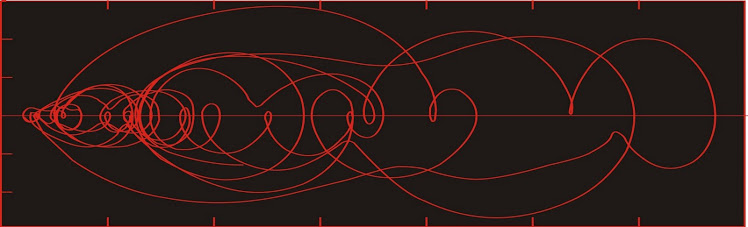
Dust flux, Vostok ice core

Dust flux, Vostok ice core
Two dimensional phase space reconstruction of dust flux from the Vostok core over the period 186-4 ka using the time derivative method. Dust flux on the x-axis, rate of change is on the y-axis. From Gipp (2001).
Showing posts with label Mongolia. Show all posts

Saturday, March 4, 2017

Dinosaurs

This will be short--there are extreme VPN problems in China now, and it is uncertain when I can post again. I am finding that almost all sites are blocked, even with the VPN.


Tarbosaurus sp., on display in Hustai Mall, Ulaanbaatar.

Mongolia's principal dinosaur museum is in a suburban mall. I guess the idea is to go where the kids are . . .


Sauropod on display in Chicago O'Hare airport.

Wednesday, January 11, 2017

The ruins of Manzushir temple

Mongolia just keeps giving.

The day after going to Hustai National Park, we planned to see the ruins of the Manzushir (also Manjusri) monastery.

A significant snowfall had occurred at night, which blanketed the area and added to the traffic chaos until we escaped the city.


Traffic back in the old days was quieter.


Larches and evergreens in the snow.


 The Manzushir monastery was established in the early 18th century, and was destroyed by the Communist regime in the 1930s. Prior to its destruction, it was one of the most important Buddhist monasteries in Mongolia.


Reconstructed temple, surrounded by ruins


Repainted door.
 

Ruins of the principal temple, currently grazing grounds for a herd of cattle.


Shrines have been reconstructed on the hill overlooking the monastery.


Tuesday, December 27, 2016

Wild horses of Mongolia


The nomadic life

Hustai National Park is south of Ulaanbaatar. There is a series of sand dunes just outside the park entrance, which acts as a first stop on most tours.


Within the park, we are back into the more common steppe, covered by long grasses. The park is famous for its birch trees (from which it gets its name), and its population of Przewalski horses, which are the only type of horse which has never been domesticated, making them the only known truly wild horses.


This is the sort of place where they hang out. When we went there, summer had just ended, and the days were beginning to get cold. The horses had a preferred area of the park in the summer, but tended to roam elsewhere when the weather turned cold. The guides weren't sure which of the two places the horses would be. Suffice it to say they weren't where we went at first.


On the steppe there was no sound but the wind and the roaring of the deer. They were well over a kilometre away, but the sound is unforgettable. But there was no sign of any horses.


Somewhere in there is a red deer.


After waiting for some time amongst the natural bonsai of the steppe, we retreated to the visitor's centre for a traditional meal. Our guides conferred with other guides, but nobody had seen any wild horses over the past few days. They decided to have us wait until the last group in the park came out.

Success! They had seen them. The horses had gone to a spot quite close to where we had been waiting for them. So back into the vehicles and over to a spot where the stream was incised quite steeply into the steppe.


The horses move in family groupings, with normally one male and a few females and foals.


Sunday, December 18, 2016

The second part of Terelj

Continuing through Terelj National Park . . .

Part of the experience on the tour was to visit one of the local families in their ger. Now, it's true, there is a certain level of artifice to the entire experience, but it was better than staying in the ger camp, which was entirely artificial.

The family had at least five children, and for some reason, there was an old school bus parked in their camp. (I was about to say 'on their property' - except they don't actually have "property" as we understand it).


So while we waited in the car for our guide to negotiate the terms of our visit, three of the children hid in the bus, popping out episodically to scream, "Hello!", after which they would hide in the bus again. I ducked below the window in the car for awhile, until my travelling companion told me they were looking for me.


After awhile, we were invited inside the ger. The father started up the fire in the stove in the middle of the tent, and then everyone went outside for a bit. From time to time, the younger sister would open the door, lean in and scream "Hello!" and then slam the door and run away. After about the third time, I crept over to the door so I was in the doorway when she opened the door. When she saw me, she ran away screaming.


There she is, the little rascal.


More children arrived on horseback. That's the older sister hiding behind her mother.


Some children in Mongolia are naturally blonde.


Assorted dairy made at the camp. Yoghurt at bottom, something like butter at middle (not quite churned enough to be butter, I think), and in the bowl, dried yoghurt. After making the yoghurt, they would spread it out on a surface until it dried. It was terrible. I highly recommend it.


Nomadic families tend to have herds--usually horses, cattle, yak, or sheep.

Eventually, we left to visit other sites at the park. As we drove off, the children chased us, shouting "Goodbye!" Our guide was impressed. "They really like you!"


Turtle Rock


Yellow

Not far away is the Aryabal Meditation Centre, an old Buddhist monastery about half-way up a hill


Rock paintings at the Meditation Centre.


You can spin the wheel of fortune, and get a number. Then you wander along the path looking for the aphorism that goes with your number.

Spinning prayer wheels is a common practice at the centre, but I'm not convinced people are really praying.


There were people praying inside. As in most Buddhist temples, there were central icons, and numerous arhats on the walls.


View from the monastery