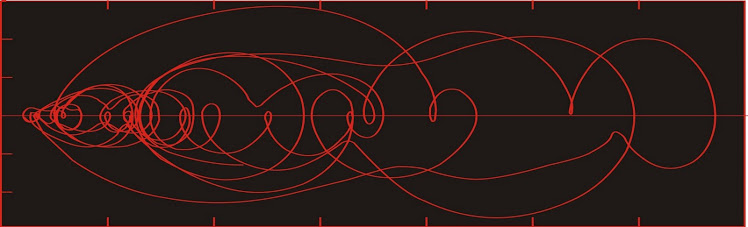
Dust flux, Vostok ice core

Dust flux, Vostok ice core
Two dimensional phase space reconstruction of dust flux from the Vostok core over the period 186-4 ka using the time derivative method. Dust flux on the x-axis, rate of change is on the y-axis. From Gipp (2001).
Showing posts with label disinflation. Show all posts

Wednesday, August 5, 2020

The inflationary hyperloop and other tales from the near future

Last time we looked at the recent transition from deflation to inflation as revealed in the USDX vs gold chart. This time I would like to put this into a somewhat larger perspective.


This chart compares the US dollar index with the gold price over the last 12+ years. The overall effect has been one of deflation (both gold and the dollar index have risen over that period), but the effect has not been steady. Much of the deflationary "progress" has been made through cycles of inflation and disinflation, although there have been substantial periods of "pure" deflation, mainly in early 2010, late 2014 to early 2015, and the longest stretch covering nearly all of 2019 into May 2020.

The question of inflation, disinflation, deflation, etc. are not just theoretical--they potentially affect the balance sheets and investors' perception of gold and silver stocks as investments (or, perhaps, speculations). During deflation, when both the US dollar price of gold and the US dollar index are increasing, the balance sheets of non-US-based gold miners (companies with mining operations outside of the US) improve markedly. The effect is not as strong for US-based gold miners, however they do benefit from inflation. During inflation, the non-US-based gold miners don't really benefit much (from the accounting perspective), however this tends to be the time when their perception of value increases the most in the minds of investors. Since it is also likely to be a time for US operations to increase in profitability, it improves the financial conditions of the Nevada-based producers (and California, Arizona, etc.).

Also take note of the effects of deflation on silver. It isn't pretty. The switch from deflation to inflation makes puts silver in play. The important thing to remember is to leave the party when the inflation turns to disinflation or deflation, which can happen suddenly. 

In May, the situation switched from deflation to inflation. That may suggest that American-based producers and silver companies are right in the sweet spot.

One feature that stands out is the "inflationary hyperloop" highlighted in gold. It represents a fairly long period of inflation followed a similar period of disinflation, the total lasting about four years. For gold and silver investors, only the first half or so was much fun. Now that we have entered into an inflationary period, are we going to experience another such loop? It seems plausible. 

But there is at least one significant differences in the current inflationary run and the beginning of the inflationary hyperloop--and that is battle. Almost the entire way around the loop there was a real struggle between bear and bull forces. That struggle on the way up is important, as it tends to lead to resistance on the way back down. Now observe our current smooth inflationary stretch since May. Where are the struggles?

One approach is to assume that the current situation will mimic the inflationary loop. If so, we might get two years of fun and about $600 of price out of this. Some approaches suggest magnitude and time increase due to [central bank-fueled liquidity; higher price levels; Mars is in conjunction with Apollo; your reason here]. But the reality is that this is a dynamical system, and in state space, once the system breaks out of a mode of stability, it can move rapidly to another. The new area of stability may be nearby, or it may be far afield, but in either case, without any previous observations of its existence, its location in phase space is unknowable. This is just a roundabout way of saying we can't know how high the gold price will go (or how low the gold-silver ratio will fall) during this period of inflation.

I just thought of this. Youtube here

Wednesday, March 11, 2020

The possible coexistence of inflation and deflation

One comment came up a lot in the recent posting. Well, the comments were all on Zerohedge. Which was to dispute my conclusion of a switch to an inflationary setting.

In the biggest picture, we have had deflation for at least the past twelve years.


Sorry, haven't updated this one in the past few months. But on this scale, very little has changed. The long-term trend of rising gold price and rising USDX index that has been active for the past twelve years would still look the same as in this graph.

I remember Richard Russel, long before 2008, advocated for deflation, saying that the way to play it was 50% gold, 50% US dollar. So the deflation isn't really a surprise--it's a reflection of the excess levels of debt, and will remain until the debts disappear.

Yet on a year-by-year basis, we don't have continuous deflation at all. There have been year+ long cycles of inflation and disinflation which have resulted in deflation (the first year or so,  2011 to 2013, and 2016-2018). For this reason, it can be difficult to remain invested for deflation for the whole last twelve (and more) years.

The inflationary impulse that we may have embarked on (it will be safer to call this in a few weeks, assuming it continues) could be another event like we witnessed in 2011, which saw gold fall just short of $1900, with the US dollar falling sharply. And this was followed by the 2013-2013 period which saw sharp drops in the price of gold. 

Going forward, I think the next decade will be dominated by deflation (a rise to the upper right in the graph). But in the next year, we may see inflation (falling down and to the right in the graph) before disinflation (rising to the left) possibly ending up a little higher and to the right of our current position.

What's a prudent investor to do? Well, I'm not offering any advice. We may be starting an inflationary cycle. But then, I've thought that, and been wrong, before.

Friday, February 14, 2020

The Gold-Silver Ratio

For Valentine's Day, a little something for you who love silver.

Or gold

A couple of weeks ago, Wheaton Precious Metals released a very useful study on the gold-silver ratio. Today I would like to take a look at some of its implications.

The most important implication is one that everyone needs a little time to absorb. That is that there is no characteristic value for the gold-silver ratio.

That means that there is no "true north", or no mythic value (16, for instance) to which it is attracted, and to which it would return if only the world stopped manipulating its price.

The Wheaton conclusions are quite definite. The gold-silver rises during deflationary periods and disinflationary periods (we'll look at this distinction shortly). The gold-silver ratio falls during inflationary periods.


What is unclear is whether a rising GSR causes deflation, or deflation causes a rising GSR. I know which one I believe.

Let's test this against some measures I've used for deflation/inflation. I'll use the weekly chart of USDX vs gold price, weekly, going back to the beginning of 2008.


It is a busy visual, but what we want to do is look at longer-scale variations. Intervals when both the USDX index and the gold price rise are considered deflationary. If gold rises and the US dollar index falls, we have inflation (hence inflation and deflation are not opposites). Gold falling and the dollar rising will be disinflation, and I suppose that if both gold and the US dollar fall, we must have disdeflation, although I have never seen that word anywhere. It's a little hard to say, so it might be best to leave it nameless, and remember that if it ever happens, you should be shorting gold stocks.

Through most of 2008, the graph above suggests we were experiencing disinflation, and over that interval, GSR rises from 55.7 to 77.1

Much of 2009 was characterized by inflation, and the GSR fell from 77.1 to 63.3.

Until the middle of 2010, we had disinflation, and the GSR rose slightly.

The big inflationary pulse into late 2011 saw the GSR falling to 40.8. The final blow-off in the gold price did not see any movement in the US dollar index, so it technically lies between inflation and deflation, but I don't know what to call it. The GSR actually rose during that interval, which makes some sense as the gold price rose over $200 in that time.

The following disinflationary episode that lasted through 2013 saw the GSR rise to 65.9.

Since then, the dominant trend has been deflationary, although realistically there have only been two deflationary pulses--through early 2015 (GSR 74.5) and over the past 18 months (GSR at 88.6). Most of the time has been consumed by short inflation-disinflation cycles, with slight rises and falls of the GSR without significant trend.

Over the entire chart (twelve years) the big picture is deflation, but most of that has been accommodated through cycles of inflation and disinflation.

So long as deflationary conditions persist, the GSR may rise without limit. As long as debts are created beyond any ability to repay them, deflationary conditions will rule. Under such conditions, despite the GSR being pretty much the highest in history, gold remains a better investment than silver.

However, as much of the actual deflationary effect is brought about by cycles of inflation and disinflation, there are  brief intervals where silver makes a better investment than gold. But rather than using the level of the GSR as your selection criterion, you need to look closely at monetary policy instead.