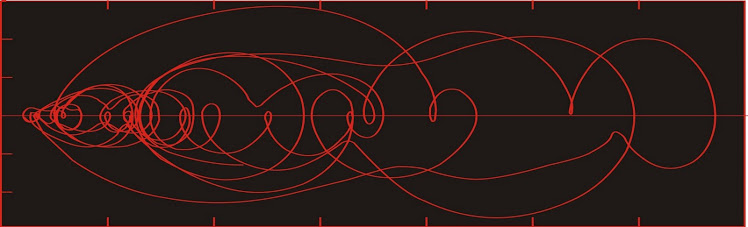
Dust flux, Vostok ice core

Dust flux, Vostok ice core
Two dimensional phase space reconstruction of dust flux from the Vostok core over the period 186-4 ka using the time derivative method. Dust flux on the x-axis, rate of change is on the y-axis. From Gipp (2001).
Showing posts with label multistability. Show all posts

Monday, February 24, 2020

I read the news today, oh boy

Things are happening quickly, but I've been tied up with various health maintenance issues and have not been able to keep up. It would help if I could sleep, but that has been beyond my reach for most of the past week. Since multistability is in the purview of this blog, we may consider consciousness to have several metastable equilibrium states, some of which lie in the realm of sleep, and some of which lie in the realm of wakefulness. I am stuck in the one best characterized as "tired and wired". To go to sleep I have to leave one metastable equilibrium and migrate to one in the sleep portion of state space. Unfortunately, it is as if I have forgotten how.

Two stories that are of interest to me and (I think) are somewhat related are the decision by Teck Resources to withdraw its application for development of its proposed Frontier Mine oilsands project.
The company cites the inability of government (Canada) to square the circle with its stated objectives of mitigating climate change and supporting resource development.

The government had been preparing to announce a decision about the project shortly. Now it seems they no longer need to.

Coincidentally, this morning police moved in to disperse protesters around the rail blockade in Tyendinaga. The RCMP also moved in on Unist'ot'en territory in northern BC, presumably to disperse protestors there as well. I haven't seen statements by the protestors and their allies about the reason for this move, but I suspect it has to do with the Canadian government's inability to square the circle with its stated objective of native reconciliation and a (subtly) unstated objective of ensuring corporate profitability.

This move, to me, looks like it was to signal the government's intention to approve the project. Until Teck decided to discontinue the project

The Teck decision, I think, is based on rather more than has been stated. Years ago I owned a pile of shares in an entity called Fording Coal, which in its brief life made a respectable amount of money, no doubt leading Teck to buy out Fording's stake in the Elk Valley project. In reflecting on Teck's assets--a lot of coal, oil, and oilsands projects--and I couldn't help wondering whether somebody in management might be thinking about a need to scale back on carbon-intensive energy products. That perhaps someone in management might be thinking that it is better to sell off these components of the company, because their value may shortly begin to fall, and the longer they wait, the less they will get for them. I think this viewpoint must still be a minority viewpoint within the company, but it is there nonetheless.

From an economic standpoint, the rise of e-cars (much of which is going to be legislated), means lower sales of oil products going forward. Is now the time to be developing large oil sands mines--especially given the political uncertainty around developing pipelines to take the stuff to market?

Saturday, September 26, 2015

Arctic sea ice extent 2015

Arctic sea ice still appears to be trending downwards.

This chart is a little different over last year's, as TPTB have re-evaluated some past years' extent of sea ice, and found the previous estimates wanting. Almost every value has declined somewhat. The updated values have been added into the analyses below. I have no comment on the updates or the methodology, which is available here.


The question at issue is whether the change we are observing is a secular trend towards zero (in-line with global warming arguments) or part of a larger cycle, in which sea ice extent may eventually return to the heights of the late 1970s.

Many natural systems (and some unnatural ones) are characterized by multistability, whereby there are more than one equilibrium within a system for a given set of boundary conditions. Multistable systems show long periods of relative stability about an area of phase space, punctuated by brief, rapid shifts to alternative long-term behaviours.


The phase space portrait projected above into two dimensions has been interpreted as representing a system that has "switched" from one metastable mode of operation to another. The existence of different modes of operation is tied to the presence of both negative and positive feedbacks within the system. The interpretation is based on empirical data, not on models.

Unfortunately we don't have enough data to be confident of the interpretation. If we had a longer record, we might be able to infer multistability--but ice extent records prior to the advent of continuous satellite monitoring are difficult to compare with more recent records. Unless some proxy record is discovered, we will just have to wait.

Friday, August 28, 2015

Recent behaviour of the Case Shiller index (or where are we now?)

One example of multistability I have used in the past few years is the reconstructed state space portrait of the Case Shiller index.

I have been studying state space of complex systems in the hope to better understand them. My original interest was in natural systems-I have gotten dragged into economic data sets because they are generally better.

Data for the Case Shiller index is found here (click the link labelled "US Home Prices 1890 to present"). The first two plots have been posted before, showing the index plotted against itself with a four-year lag.


The first plot shows the annual index to 2012, along with predictions of where in state space the system would plot in 2015, for declining house prices, constant house prices, or rising house prices (in inflation-adjusted terms). The major features are two very long-term islands of stability, at about the 70 level (from 1915 to 1945) and around the 110 level (until 1999); and the large crashing loop that has been traced out since 1999.


This plot shows the same information, but monthly from 1954. The area of stability occupied until 1999 is circled in yellow, and the large "cycle" is also visible, showing that the system was following the trajectory of rising house prices in 2014.


The last plot represents the most recently available data, projected monthly, but it shows the same thing--the long-term area of stability at lower left, and the big loop, now nearly closed. The last available point is reasonably close to the projected state for 2015 (which itself would be averaged over the year).

Is this a potential area of stability? Sadly, no. In this type of plot, long-term stability will have to occur along the y = x line shown on the second graph in this posting. Presently, we are far below or to the right of this line.

If house prices had been frozen at the levels of the end of 2011, we could have developed a region of stability. But the stable state would have been within the large area of stability that existed prior to 1999. Who the hell wants that (apart from young people hoping to buy a house)? So we are embarking on yet another price increase, once again into a market with no ability to support the higher prices. The long term prognosis is for another rise and collapse. Time will tell how big it gets.

Wednesday, July 8, 2015

Noise reduction and analysis of a long reconstructed record of atmospheric CO2

The CO2 record used last time was presented (largely by interpolation) at 100 year intervals. This provided rather more data than were really needed for the analysis that I had in mind. To produce the plot in yesterday's post, I subsampled the data to produce a record with sample intervals of 1000 years.

The first step is to define regions of stability over each time window. To do this, we reconstruct phase space portraits for each window of data (anywhere from 100 to 200 ky)*.


These graphs have previously been described as looking like they were constructed on an etch-a-sketch. I would say the one on the left looks more like the etch-a-sketch drawings I remember. I would have posted a link to the Zerohedge comments, but the site was down.

Both of the above graphs represent reconstructed phase space plots constructed over a 100-ky window. The one on the left is constructed from a time series with a 100-year sample interval. The one on the right is constructed from a time series with a 1000-year sample window (90% of the data were discarded). At the scale of my investigation, the overall structure of both graphs is the same. The higher resolution data just provides a noisier version of the well-known partially vivisected kangaroo formation.

Many paleoclimate records analyzed in this way commonly show multistability (interpreted as more than one possible equilibria). Multistability may be demonstrated in reconstructed phase space portraits through variable density of observations in phase space.


The above figure shows the successive evolution of the state space through time at 1000 year intervals. Between about 110 and 20 ka, the system evolved through phase space only very slowly--times of slow evolution suggest stability.


Multistability is probably best inferred from phase space density plots. The graph above suggests at least two major areas of stability (perhaps four if you are a splitter rather than a lumper).

Once regions of stability are identified, the next task is characterizing climate by the sequence and timings of the transitions between different regions of stability.

- - - - - - - - - - - - - - - - - - - - - - - - - - - - - - - - - - -

*Note ky = thousand years (i.e., an interval)
ka = thousand years ago (i.e., a specific time)
Similarly, Ma = million years ago, and My = million years (interval)

Tuesday, July 7, 2015

Stability of atmospheric CO2 over the last 20 million years

I've been playing with a "record" of atmospheric CO2 over the past 20 million years for some time, using the reconstruction of van de Wal et al. (2011). Today's graph is a representation of the various regions of Lyapunov stability teased out from state space reconstructions of segments of the data (windows), ranging from 150 to 250 ky (thousand years) in width.


The red dots all represent regions of stability defined using the methods described here. The blue dot represents approximately today's atmospheric CO2 concentration, which is about where it was 10 million years ago. More later, but I need to go for a walk now.

Tuesday, February 24, 2015

Multistability in the political world

In this blog I have tried to show that economic systems behave very like complex natural systems, which are often characterized by multistability. These demonstrations have been easy because of the data available from economic systems.

Political systems may similarly exhibit multistability. But this is not so easy to demonstrate in phase space.

Rosie Dimanno has a recent opinion in the Toronto Star about the ongoing horror in Afghanistan. Unfortunately, she draws the wrong conclusions, stating that the internecine warfare amongst groups of Muslims is occurring because "we" are withdrawing our troops. According to Rosie, all would be well if only the West would continue its benevolent humanitarian interventions in Afghanistan and other places around the world.

She doesn't pause to consider--why all this violence? Were all these countries this violent before the foreign interventions? How was Afghanistan before all the western intervention--which goes all the way back to the Russian invasion (if not earlier)? The pictures in the above links suggest it was a pretty nice place.

The current state of Afghanistan is completely different from the above earlier version of the country. What changes a peaceful place into one wracked by war, kidnappings, and all forms of extremism?

I believe we are looking at a state change much like we observe in complex natural and economic systems. Most systems find themselves in some stable state (which one is a function of the entire past history of the system). External forcing mechanisms (often in conjunction with internal mechanisms) may drive the system from its zone of stability.


Once the system leaves an area of stability, it tends to behave chaotically until it settles in another region of stability (or perhaps the same one).

What may have happened in Afghanistan is that western intervention drove the social system from its former stability and into a chaotic regime. Ordinarily, we would expect the system to evolve to some other stable state, but perhaps the ongoing interventions have kept this from happening.

It isn't clear if the social state in Afghanistan has switched to a new and very undesirable stable state, or whether it is winging through the realm of chaos. Trying to drive the system to a particular realm of stability is difficult--we have no theoretical framework for success. For this reason, it is typically better not to intervene in the first place.

Wednesday, January 28, 2015

House prices seek stability of long-term relationship

. . . somewhere in phase space.

I have often used the the index of home prices in the United States (the Case Shiller index) as an example of a complex system showing multistability. The data are updated monthly here.

The multistable nature of such systems is demonstrated in reconstructed phase space portraits, which can be generated by two principal methods--the time-delay approach and the time-derivative approach.


For nearly 40 years, the system remained confined to the area of the yellow circle. In fact, house prices were confined to this small area for much longer than that--for the longer term chart I've presented previously shows that this yellow area has been occupied for a total of about 70 years.

It looks like there was some kind of redefinition or recalculation of the time series on the Shiller website sometime in the last year or so, as the current time series available on the site (from which the above chart is drawn) differs from the previous time series available (from which my older graphs are drawn). For instance, in my older figure, the house price appears to have been above 100 over the last 60 years--this does not appear to be the case in the graphs I have produced in previous years.

The overall story has not changed--after 50 years of relative stability (the bubble of 1989-90 looks benign in the above figure), the system broke out of its area of Lyapunov stability, and has been meandering through phase space ever since. Two years ago, it seemed to be on a trajectory to return to the yellow area of stability. In the last two years the system trajectory veered away from that target, and is now headed . . . where?

Normally we expect it to migrate to an area which has previously acted as an area of stability--but both such areas are at much lower prices than is currently the case.

It is possible for the system to carve out a new area of stability. For reasons of geometry, stable areas must be located on the y = x line. Since we are close to that line now, it implies that perhaps Yellen can engineer a soft landing for housing at close to the current price range. Unfortunately, the future level of the trajectory in state space is partially determined by the past trajectory--and in 2013, the housing index was in the low 130s (on the horizontal axis). In two years, therefore, the trajectory will dip to the same level on the vertical axis. If house prices remain where they are now, the trajectory will be far enough from the y = x line to be unstable, and a further decline in house prices would be indicated.

If house prices rise again, we will find ourselves in a bubble destined for collapse, just as we were in about 2004. If the yellin' wants to bring housing to stability, the thing to do would be to engineer a slight decline in house prices over the next two years. Unfortunately, I don't think she wants to do that.

Thursday, January 22, 2015

Near-term struggle for gold

We have a new visitor with an interest in gold.


So let's give him (her?) something to read about, shall we?

Over the past few years I have use reconstructed phase space portraits to try to gain some insight into dynamic systems. Key features that we can identify in these diagrams are areas of stability, where some parameter is trapped into a fairly narrow range for a period of time. It appears to be nearly universal in interesting systems that there are multiple metastable equilibria, meaning more than one area where the system is stable--such systems are characterized by long periods of quiescence punctuated by rapid bursts of activity (volatility).


Since the plot shows the trajectory of the system through time, an area of stability is an area of phase space in which the system remains trapped for a long period of time relative to the shorter periods of time in which the system shifts from one region of the graph to another.

In the above phase space plot of gold x USDX, there are three regions of stability--one centered at about the 650 level, one at about the 1050 level, and one at about the 1350 level. The system has been locked into the area of stability at the 1050 level since about July 2013.

These areas of stability actually have nothing to do with gold or the US dollar. They exist because of mass psychology; and the sudden changes from one region of stability to another is a function of a rapid change in the perception of value.

What I usually look for in these plots is a sign of a breakout from an area of attraction. For instance, last week's print appears just outside the middle region of attraction. It isn't far enough outside the border (which has been placed in completely arbitrary fashion), but if the system trajectory continues to extend in its current direction for a couple more weeks, I would conclude the system is heading towards the area of attraction at the 1350 level.

Complicating this simple picture is the phase space portrait just for gold, seen below.


This graph looks remarkably like the phase space diagram for gold x USDX: there are three areas of attraction, and the system has been mired in the middle one for about a year-and-a-half. But there is a major difference--the present gold price is nowhere near to breaking out of its current area of attraction. It is currently somewhere in the middle of it, having spent most of the past year near the bottom of it.

So one chart suggests an imminent breakout, and one does not. Can they both be true?

The target for gold x USDX (assuming we do get a breakout) would be in the 1350 range, and it would be reached in about 18 weeks. Given the rate of rise of the US dollar, it would not be surprising if it reaches the 100 level in this time. The 1350 level, in this case, would be reached with a gold price of $1350 per oz, which would still be within the current area of attraction for the gold price.

It doesn't seem reasonable for both gold and the US dollar to rise so far together, unless we either accept Richard Russel's suggestion that debt represents a short position against the US dollar, or we are seeing the beginnings of a move in money down Exter's Pyramid.

Sunday, October 19, 2014

Silver falls to a lower state

The recent pummeling in price undergone by the precious metals is tied largely to the strength of the US dollar. Said strength appears to have passed its peak. While gold has not suffered any significant technical damage, the same cannot be said for silver.


I have been reconstructing phase space portraits to try to understand the dynamics of complex climatic and financial systems. The phase space portrait summarizes the differential dynamics in a way that illustrates multistability in these systems; meaning that for a given set of inputs and boundary conditions, the system possesses more than one equilibrium. Which equilibrium comes into play depends on the entire history of the system--hence such systems are also described as having long memory (pdf).

When silver collapsed in price last year, it appeared that it was headed for a previously established equilibrium in the $17 range. Instead, it stopped short and began filling in a new area of stability (S3 in this post).

The last six weeks have not been kind (figure below is on a linear scale).


The phase space has slipped out of S3 and has moved into the S2 area of stability. Is this a brief excursion or a long-term event? The past history of the moves in silver have had real consequences if the phase space enters a previously defined area of stability, commonly remaining in the area of stability for about a year. This suggests silver will remain in this area for some time.

Tuesday, June 18, 2013

Multistability in the gold-copper ratio

The gold copper ratio is commonly used to illustrate the state of the economy. Note that we usually take the ratio of the gold price per troy ounce and the copper price per pound. A recent graph of this ratio can be found here.

In past articles I have looked at how to study dynamic systems using reconstructed phase space portraits.


Here we see the reconstructed phase space of the gold-copper ratio over the past eight years, using a time-derivative method--plotting the value of the ratio against the average rate of change over six months. My convention is to plot the rate of change against the midpoint of the time window--for example, the last such calculation measures the change in the ratio from November 2012 to May 2013, and is plotted against the month-end price of February. This is why the graph ends at February even though we have month-end pricing to May.

There are three areas of stability in the above graph. In 2006 and 2007, the copper price rose dramatically, and the Au-Cu ratio fell, until there was a sudden pop in the economy in mid-2008, which is recorded in the figure above as a tremendous gyration lasting a year. The Au-Cu ratio settled for several months near the 350 level, before leaping to the 450 area, where it has remained for the past 18 months.

It could be that the economy as a whole was overheating in the middle of the last decade, what with all the demand for copper from China and the US housing boom. Then I suppose we returned to sanity.

Except the current economy doesn't feel sane to me.

The highs for copper in 2006 are not out of the ordinary. By inspection we can find numerous periods where the ratio was 200 or lower. In the late 1920s, Au/Cu fell to about 140, but when the depression hit, the ratio rose to over 400. In the wake of the post-war rebuilding, Au/Cu fell well below 100 and was still at that level when Nixon closed the gold window, although the pegging of the gold price and the military actions of the US both supported this low ratio.

More recently, we have the following . . .


. . . in which our hot, inflationary late '70s economy suddenly slowed. It helped that in the '80s the US wasn't involved in any wars of consequence (just little actions in Iran, the Sinai, El Salvador, Libya, Lebanon, Egypt,  Grenada, Honduras, Chad, the Persian Gulf, Italy, Libya again, Bolivia, the Persian Gulf again, Honduras again, Panama, Colombia, Bolivia, Peru, the Philippines, and Panama again).

Just after where I have ended the graph, the system returned to the area of stability at around 300, during the housing bubble at the end of the '80s. For a look at how terrifyingly huge it was, see below. ;)


So to my non-economically trained mind, the Au-Cu ratio only seems to fall below about 300 during credit-fuelled booms (and maybe during major postwar rebuilding phases). Presumably when it is higher than some level, we could say it indicates we are in a depression--but I haven't figured out what that level is yet. Early in the Depression, the ratio was at 400--but that was in the days of the gold peg at $20.

My gut feeling is that the present ratio is not far from depression levels.

Wednesday, June 13, 2012

Origins of multistability in economic systems: commentary on Soros (2012)

All over the world, the same message is relentlessly hammered home--conventional economics has failed. Policy makers did not foresee the 2008 crisis--and their attempts at remediation of the unemployment situation have had effects opposite to what was intended.

Why is this? Does economics in the real world differ so much from the theoretical? And if so, why?

Let us consider how complex behaviour arises in some natural systems.

Multistability in natural systems

The global climate system is a nonlinear, nonequilibrium system involving internal time-varying mechanisms, feedbacks, and external forcing. Systems with feedbacks are commonly multistable, prone to bifurcations, and hysteresis—even when those systems are driven by invariant driving functions.

In previous posts we have seen that the phase space projections of numerous climate functions show multistability--that is they tend to evolve not to a single equilibrium, but oscillate among any number of equilibria. The reason that multiple equilibria arise is because the dynamics of the climate system include both negative and positive feedbacks.


Different forms of stability. For asymptotic stability, given a limited range of  initial 
conditions, the system evolves towards a fixed point. For Lyapunov stability, once the system
reaches a limited region of phase space (b), the system tends to remain there. 


Where negative feedbacks dominate, the system tends to be stable. In the diagram above, there are different forms of stability, but the two most important are asymptotic stability (also called a point attractor) and Lyapunov stability. It will normally not be possible to distinguish between these on the basis of observation of some system.

Positive feedbacks tend to enhance the effects of external forcing, multiplying the magnitude of the stresses brought on by forcing. The presence of both negative and positive feedbacks supports a system with multiple disjoint regions of equilibria, bounded by separatrices. 


Time evolution of a system with multiple equilibria. In actuality, the separatrices 
are likely to show fractal interfingering.

I have commented on applications of this idea to unemployment, but have not discussed the origins of the necessary feedbacks required to generate multistability. Some comments by George Soros (below) seem to shed some light on this topic.

Soros' remarks on global economy

George Soros recently spoke at the Festival of Economics in Trento, Italy. What made his remarks interesting to me were his allusions to nonlinear dynamics in the evolution of the economic system, and their effects on policy. Soros begins by remarking on the lack of success policy makers have had in predicting economic outcomes in the past few years. The reasons for these failures . . .
go back to the foundations of economic theory. Economics tried to model itself on Newtonian physics. It sought to establish universally and timelessly valid laws governing reality. But economics is a social science and there is a fundamental difference between the natural and social sciences. Social phenomena have thinking participants who base their decisions on imperfect knowledge.
Anyone reading about Austrian Economics will be familiar with the argument. Market participants will try to act in a way that maximizes benefits to themselves, but what constitutes maximum benefit may vary from one to another. A highly technical treatment of this topic can be found here (probably not of interest to most of you, except for the part about aggressive participants with a strategy of investing in risky assets increasing the likelihood of a market crash for everyone).

The market participants do not perceive the true nature of the system in which they are operating, and so many will choose suboptimal strategies. However, as they act, they also change the nature of the system, so that what would have been an optimal strategy had all participants been "rational" may become suboptimal in the real world. Likewise, strategies which would be suboptimal in a purely rational world may become optimal.
I found a two-way connection between the participants’ thinking and the situations in which they participate. On the one hand people seek to understand the situation; that is the cognitive function. On the other, they seek to make an impact on the situation; I call that the causative or manipulative function. The two functions connect the thinking agents and the situations in which they participate in opposite directions. In the cognitive function the situation is supposed to determine the participants’ views; in the causative function the participants’ views are supposed to determine the outcome. When both functions are at work at the same time they interfere with each other. The two functions form a circular relationship or feedback loop. 
For instance, under normal circumstances it would not be advantageous to rush to the bank and withdraw all of your money. However, the economic system could be altered to the point where that might turn out to be the optimal strategy after all. 

Soros goes on to describe the inflation and bursting of a bubble in terms of the interaction between positive and negative feedbacks.
I developed a model of a boom-bust process or bubble which is endogenous to financial markets, not the result of external shocks. According to my theory, financial bubbles are not a purely psychological phenomenon. They have two components: a trend that prevails in reality and a misinterpretation of that trend. A bubble can develop when the feedback is initially positive in the sense that both the trend and its biased interpretation are mutually reinforced. Eventually the gap between the trend and its biased interpretation grows so wide that it becomes unsustainable. After a twilight period both the bias and the trend are reversed and reinforce each other in the opposite direction. Bubbles are usually asymmetric in shape: booms develop slowly but the bust tends to be sudden and devastating . . .
At any moment of time there are myriads of feedback loops at work, some of which are positive, others negative. They interact with each other, producing the irregular price patterns that prevail most of the time; but on the rare occasions that bubbles develop to their full potential they tend to overshadow all other influences.
What does the phase space of a system with myriads of feedback loops look like?


The recognition of multiple equilibria in economic systems does not go far enough, in Soros's view, because the collapse of bubbles can trigger policy responses which greatly alter the workings of the system. In other words, politics can become a potent driving force, with both secular components (such as the progressive concentration of wealth and power into fewer hands over the last forty years) and singular spectacular events (such as declaration of wage and price controls, short-duration spikes in interest rates; or even irreversible decisions like detaching the dollar from gold).

The addition of the political drivers adds a dimension which has no analog in nature. It also forces us to recognize that the future evolution of the economy will be not only a function of the feedbacks and forces we consider above, but also the entire history of the economy as well. For instance, Soros argues that the present European crisis is as much a function of history as of excessive government debt . . . 
because the financial problems were reinforced by a process of political disintegration. While the European Union was being created, the leadership was in the forefront of further integration; but after the outbreak of the financial crisis the authorities became wedded to preserving the status quo. This has forced all those who consider the status quo unsustainable or intolerable into an anti-European posture. That is the political dynamic that makes the disintegration of the European Union just as self-reinforcing as its creation has been. 
Unfortunately the non-linearities in the system make prediction hazardous. But given the preliminary indicators of bank runs in Europe, South America, and Africa, as well as Oanda's recent announcement . . . errm, yes, excuse me, but I have some preparations to see to.

Friday, March 2, 2012

Snapshots of multistability in the climate system

Today the World Complex presents images from the recently redrafted movie of the probability density plot of the proxy record for global ice volume over the past two million years. The reason for the redrafting was to shorten the window, improving the resolution of the individual frames.

The methodology for deriving these plots from original data has been previously described here. The O-18 data used below are from Shackleton et al. (1990). Variations in O-18 in the deep ocean reflect global volumes of glacial ice.


This figure is a map of a ice-volume phase space over the interval 189 ka to 39 ka (ka = thousand years ago). There are three distinct regions of higher probability (grey areas) in phase space, which represent stable global glacial volumes. This figure suggests that over the interval in question, there were three stable global ice configurations--one corresponding roughly to the interglacial condition we have today (at lower left), and two more with considerably more (glacial) ice--and that transitions from one to another happened relatively rapidly. As the probability of any state outside of the three LSAs is low, global climate change was rapid during the interval in question. Glacial ice volumes therefore have three conditions of equilibrium, which are punctuated by brief episodes of rapid change. Using our dynamic interpretations from previous articles, we have inferred three areas of Lyapunov stability in the time delay state space of global ice volume.

The graph only tells us about global ice volume, but not where the ice is. Thus we cannot infer the global glacial configurations for each of the three LSA.


In the 699-519 ka interval (still Late Quaternary) we still see multiple areas of stability. There may be a limit cycle in the low volume section of probability density diagram.


The interval 1509-1359 ka was characterized by a large limit cycle, with a couple of particular regions of higher probability. The high probability peak at lower left represents an area of Lyapunov stability. Limit cycle behaviour in the ice volume system suggests oscillatory growth and decay of ice sheets.


This plot shows a limit cycle and two areas of Lyapunov stability. The lower one, near (3.5, 3.5) is the same as the one in the next figure above. The second area of attraction, near (3.9, 3.9) is present in the figure at representing the interval 1599-1449 ka above.

In general, limit cycle behaviour is more common in the Early Quaternary, and simple LSA multistable behaviour is more common in the Late Quaternary. This observation is reinforced in observations of reconstructed phase space portraits of smoothed C-13 measurements from cibicidoides sp. (Raymo et al., 2004).


The C-13 data is purported to represent oceanographic conditions and are reflective of overall glacial conditions, with lower values corresponding to glacial maxima (Bickert et al., 1997). The phasing of variability in the C-13 differs from that of O-18 at different frequencies and is thought to reflect changes in oceanographic flow at least partially in response to glacial cycles (Raymo et al., 2004).

In the Early Quaternary, the probability density plots of the reconstructed state space mainly suggest limit cycle behaviour. The period of the oscillations is approximately 41 ky.


In the Late Quaternary, the oceanographic state is more suggestive of multiple metastable equilibria, punctuated by brief episodes of rapid change.


Limit cycle behaviour is still observed in some windows in the Late Quaternary . . .


 . . . but multiple equilibria is the predominant state in the Late Quaternary. 

I have recently completed epsilon machine reconstructions for the 13C predictive states (at least the forward-evolving e-machines as described briefly here in the references) and will be posting these shortly.

References

Bickert, T., Curry, W. B., and Wefer, G., 1997. Late Pliocene to Holocene (2.6-0 Ma) western equatorial Atlantic deep-water circulation: Inferences from benthic stable isotopes. In Shackleton, N. J., et al. (eds.), Proceedings of the Ocean Drilling Program, Scientific Results, v. 154: 241-254.

Raymo, M. E., Oppo, D. W., Flower, B. P., et al., 2004. Stability of North Atlantic water masses in face of pronounced climate variability during the Pleistocene. Paleoceanography, v. 19: 13p. doi: 10.1029/2003PA000921.

Shackleton, N. J., A. Berger, and W. R. Peltier, 1990. An alternative astronomical calibration of the Lower Pleistocene timescale based on ODP site 677, Trans. R. Soc. Edinburgh, Earth Sci., 81: 251-261.

Sunday, January 1, 2012

Change in state for Arctic sea ice?

The recent Arctic Report Card concludes that  . . .
 the Arctic Ocean climate has reached a new state with characteristics different than those observed previously. The new ocean climate is characterized by less sea ice (both extent and thickness) and a warmer and fresher upper ocean than in 1979-2000. 
Well, this sort of thing just happens to be a specialty here. Let's look at the data to see what they mean.

The record of sea ice can be inferred here.


The National Snow and Ice Data Center has kindly drawn a regression line through the points.

We'll use the time delay method to reconstruct the phase space in two dimensions.


The choice of a two-year time delay is somewhat arbitrary, as one year also serves. The two reconstructions do not appear materially different.

We observe that the state tends to occupy a small area in phase space, centred at about 7 million sq-km (yellow) from the initiation of the data set (1981 in this projection) until about 2002, after which the system has evolved into a new area of phase space characterized by reduced ice cover. It doesn't yet trace out anything that looks stable in this new area, so I would not exclude the possibility that it is currently tracing out a transient excursion.


The extent of sea-ice cover in November has declined in a stepwise fashion since the early 1980s. Here we have tenatively labelled three possible areas of Lyapunov stability.

- - - - - - - - - - - - - - - -

We observe a decline in Arctic sea-ice cover over the past 30 years. Like other components of the climate system, it appears that sea-ice cover is prone to sudden changes in state. The direction of the change appears to be consistent with projections of the global warming hypothesis.

The caveat is that the records presented here are too short. We cannot be certain that the period of observations--in particular those from 1980 to 2000--were representative of "normal" climate. Consequently, the statement quoted at the beginning of this post seems premature.

The 1970s were at the end of a multi-decade period of global cooling. The Arctic sea-ice cover at the end of the 1970s may therefore have been unusually large, and the observed shift to reduced cover may be simply the natural variability in the system. We can't tell for sure because we would need to observe at least one more cycle of variability, and we do not have the records we need.

The only way to obtain longer records will be through some form of proxy measurement, either through micropaleontology (dinoflagellates seem to be a favourite), or concentration of aerosols in nearby glacial ice.

Sunday, October 30, 2011

Inference of dynamics for complex systems, part 3

Equilibria in linear systems

It is common for linear systems to evolve towards a single fixed state.

The assumption that most dynamic systems have a single preferred fixed state for a given set of circumstances appears to be one of the drivers behind Central Bank policies. It is debatable whether the Central Banks recognize nonlinearities in socio-economic systems, or whether they do but are unable to express it it the typical 10-second soundbite that the average consumer of their "products" can absorb.

Certainly, the common example of using lower interest rates to combat unemployment sounds like the kind of thinking one expects about a system with a single equilibrium state. The notion that low interest rates ultimately lead to higher inflation reflects similar thinking.

Here are some examples in phase space of single equilibria in a simple linear system.


When all trajectories within a given region of phase space gradually and continually converge towards a single point, then the equilibrium can be described as being asymptotically stable, and is commonly referred to as a point attractor. Note that even though trajectories 1 and 3 appear to cross, they actually do not as one passes over the other in a three- (or higher-) dimensional projection.

Line crossings in a properly "unfolded" phase space portrait cannot cross, as each uniquely defined state represents a unique value and a unique sequence of values of the higher time derivatives of the time series from which they are projected. If two trajectories converged onto a single point, it would be impossible for them to diverge again--hence no crossings. If there appear to be crossings in a reconstructed phase space, then the phase space needs to be projected in more dimensions. Unfortunately, there are logistical problems with presenting even three (let alone more) dimensional figures, which is why I have limited the figures presented to two dimensions, with a caveat that apparent crossings mean we should really be looking at a projection in at least three dimensions.

Often we find that rather than continuous convergence, two states which originate close to one another as well as to a particular point in phase space tend to stay close together and near to the point. Such stability is called Lyapunov stability (sometimes a Lyapunov-stable area, or LSA). More formally, we might state that all states with a region of phase space (a) will tend to remain in another (possibly smaller) region of phase space (b). Once again, note that the apparent crossing of trajectories only suggests that we should construct this phase space in at least three dimensions.

Another form of equilibrium is the limit cycle. It represents a form of asymptotic stability whereby the final equilibrium is not a point but a continuous cycle. There is no reason that the cycle needs to form an ellipse--any closed shape is possible. In higher-dimensional projections, a limit cycle may be in the form of a shell, or a torus.

Equilibria in chaotic systems

A different form of equilibrium was discovered by Edward Lorenz in 1963. A system defined by three nonlinear differential equations reached a complex equilibrium in which any state evolved continually towards the "attractor"; however any two states starting arbitrarily close would diverge exponentially, even though at the same time they would both evolve in similar fashion through phase space.


This form of attractor was called a "strange attractor". Although it occupies a finite volume of phase space, the trajectory from any arbitrary point would evolve in unique fashion, so that all evolving trajectories from any arbitrary starting point would appear similar, yet would occupy subtly different regions of phase space.

Multiple equilibria (multistability)

In some complex systems, we observe any number of disjoint Lyapunov-stable areas (LSA), each separated in phase space by a separatrix [Kauffman, 1993]. At any given time, the state of the system occupies only one such LSA, so that their number therefore constitutes the total number of alternative long-term behaviors, or equilibrium states, of the system. Since an LSA is likely to be smaller than the total allowable range of states, the system tends to become boxed into an LSA unless it is subjected to external forcing. When the state approaches a separatrix, small perturbations can trigger a change to a nearby state (a bifurcation), resulting in chaotic changes in the evolution of the system [Parker and Chua, 1989]. Thus very complex behavior can arise in multistable systems.


Multistable behaviour generally arises from systems in which feedbacks, both negative and positive, impact a system which is perturbed by some sort of external forcing. Negative feedback tends to resist external forcing, resulting in stability in some regions of phase space. If the external forcing is sufficient to overcome the feedback, then positive feedback may actually accelerate the changes, causing the state to evolve rapidly towards another area of stability.

The smooth variation of one or more parameters in the system may result in a change in the type of or the number of attractors in the system, or even in the order in which the attractors are visited. Such a response is called a bifurcation. Bifurcations can represent a sudden transition within a system characterized by purely chaotic attractors to one with one or more LSA; between one LSA and multiple LSA; or between different configurations of LSA.

Bifurcations represent changes in the organization of the system, and their existence has been suggested by models [e.g., Ghil, 1994; Rahmstorf, 1995], and more rarely from observations [Livina et al., 2010; discussed here]  in future installments we will demonstrate such behaviour in natural systems. Initially, however, we will concentrate on interpretation of some of the phase space portraits presented last time.

References


Ghil, M. (1994), Cryothermodynamics: the chaotic dynamics of paleoclimate, Physica, 77D: 130-159.

Kauffman, S. (1993), The Origins of Order: Self-Organization and Selection in Evolution, Oxford Univ. Press, New York, 734 p.

Livina, V. N., Kwasniok, F., and Lenton, T. M. (2010), Potential analysis reveals changing number of climate states during the last 60 kyr. Climate of the Past, 6, 77-82, doi: 10.5194/cp-6-77-2010.

Parker, T. S. and L. O. Chua, (1989), Practical Numerical Algorithms for Chaotic Systems, Springer-Verlag, New York.

Rahmstorf, S. (1995), Bifurcation of the Atlantic thermohaline circulation in response to changes in the hydrologic cycle. Nature, 378, 145-149.

Wednesday, October 19, 2011

Inference of dynamics for complex systems, part 1

Today I will start over with the analysis of dynamic systems, describing a methodology and some of the rationale behind the interpretations from previous postings, as it occurs to me that all of this stuff, though discussed before, is buried in the archives and is not easy to pull together.

This will also be good for me as I have to put together some kind of paper on the topic for one or more conferences in the first half of next year. GAC, in St. John's next year, will be a given as it is my old alma mater, but I am giving thought to presenting at the upcoming 3rd Multiconference on Complexity, Informatics and Cybernetics.

You are studying an interesting system, with many components. You know that many of the components interact, but you don't know the details of their interaction. If the interactions vary with changing conditions  within the system (feedback) it may be described as a complex adaptive system. Examples of such systems include, but are not limited to, ecosystems and other biological systems, the stock market and other economic systems, the climate system, and some would argue, the entire earth system.

The behaviour of such systems is typically nonlinear, and typically characterized by self-organization and emergent phenomena. The presence of negative feedback gives the system a form of resilience, allowing it to resist perturbations; and the presence of positive feedback causes the system to experience episodes of rapid change, usually resulting in a shift from one equilibrium condition to another. Multistability (the presence of more than one equilibrium condition) is a common feature of such systems.

The system has input signals, which may be time-dependent, however it may be that you are only able to observe some of these signals; furthermore there may be input signals of which you are unaware. There are output signals, which you observe, and compile into one or more time series; however there is no way to know if your output signal is important in terms of developing a global understanding of the system of interest.

There are conditions within the system which influence the manner in which the input signals feed through to the output signals. You may have an inkling of some of these rules (commonly expressed as differential equations) but normally your understanding of these rules is incomplete. You hope to understand your system by deducing these equations on the basis of your observations.

Here are some examples of systems we may wish to study.


Daily closing prices for Detour Gold Corp. (DGC-T), from late November 2009 to October 2011.


Gold-silver ratio.


Case-Shiller index. Data from Robert Shiller data page.


Unemployment rate (from US BLS site).


Trading activity in Century Casinos, June 21, 2011. From Nanex.


Paleoclimate proxy records over the past two million years. Magnetic susceptibility of loess (proxy for Himalayan monsoon strength) at top. Deep water 18-O record (proxy for global glacial ice volume) at bottom.

At first glance, the problem seems insurmountable. How do you study a system when you can't even be sure that your observations are meaningful? What if you have failed to observe the most important observable parameters?

It is especially bad for the geological time series, for in addition to the above problem, there are both errors in measurement and errors in the date (or time) of each observation.

In future installments, we will work through the data sets shown above; but we will start with some thoughts on equilibrium.

Thursday, October 6, 2011

Wanted: more nuanced economic hammers

A little over a year ago we were treated to this article, suggesting that the Wise, All-Knowing Bearded One would bring us to a land of low unemployment via the harsh medicine of low interest rates. Now it's true that The World Complex has already hit this particular piece of low-hanging fruit, but I thought it worth a look to review how the plan is unfolding.


Yes, yes, we've seen this before. How do we explain what went wrong?

Askari and Krichene (in the paper at top) report that the US Fed reduced interest rates in order to preserve employment. Assuming this is a correct assessment of the Fed policy, we need to consider why it does not appear to have worked.

The alarming picture above appears to be a system displaying the property of multistability. Multistability is a concept related to that of equilibrium--except that unlike simple systems with only one equilibrium point, multistable systems have more than one (some authors use the term bistable to describe systems with two equilibria, and multistable for three or more. We shall use multistable to describe any system with more than one equilibrium state).

Multistability is a property of a system, which is neither completely stable nor unstable, but shifts from one stable state to another, at regular or irregular intervals. A short search for systems that display multistability yields living systems, neural networks, some control systems, and global climate subsystems. To this list I would add the unemployment/real-interest-rate system (and stock prices--and commodity prices--and the unemployment/money-creation system--and probably numerous other economic subsystems).

When you have a system with more than one equilibria--as in the unemployment rate/real-interest-rate system illustrated above, your ability to control which equilibrium you enter is limited. For instance both equilibria in the graph at top are characterized by low real interest rates. So how do we make sure the economy evolves towards the equilibrium with low unemployment, rather than the one with high unemployment?

A characteristic of multistable systems is memory. The equilibrium occupied at any particular time is dependent on the entire past history of the system. This makes control a tricky matter.

Are economists aware of the possibility of multistability? The Fed policy described above would suggest no, but the truth may be more nuanced. From a mathematical standpoint, it is very difficult to create a system of equations to describe a system with multistability. It is more likely that the equations will describe a system with a single equilibrium. If this system is used to inform policy, then that policy will be of the simplistic "press button A, bell B rings" type.

Perhaps economists are unaware of multistability. Perhaps they are aware of multistability but are unable to account for it through systems of equations and so use 'fudge factors' to explain why the equilibrium point moves around. Or perhaps they are fully aware of it and can explain it through their equations, but these explanations are so complex that no trace of them ever appears in the public record of their activities.

In any event, their policy, as reported, does not appear to be having the desired effect. Perhaps it is time to use a tool more delicate than a hammer. If a solution isn't found, the US may become New Europe.