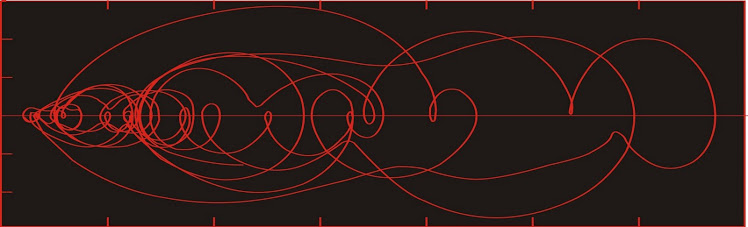
Dust flux, Vostok ice core

Dust flux, Vostok ice core
Two dimensional phase space reconstruction of dust flux from the Vostok core over the period 186-4 ka using the time derivative method. Dust flux on the x-axis, rate of change is on the y-axis. From Gipp (2001).
Showing posts with label gold. Show all posts

Wednesday, August 5, 2020

The inflationary hyperloop and other tales from the near future

Last time we looked at the recent transition from deflation to inflation as revealed in the USDX vs gold chart. This time I would like to put this into a somewhat larger perspective.


This chart compares the US dollar index with the gold price over the last 12+ years. The overall effect has been one of deflation (both gold and the dollar index have risen over that period), but the effect has not been steady. Much of the deflationary "progress" has been made through cycles of inflation and disinflation, although there have been substantial periods of "pure" deflation, mainly in early 2010, late 2014 to early 2015, and the longest stretch covering nearly all of 2019 into May 2020.

The question of inflation, disinflation, deflation, etc. are not just theoretical--they potentially affect the balance sheets and investors' perception of gold and silver stocks as investments (or, perhaps, speculations). During deflation, when both the US dollar price of gold and the US dollar index are increasing, the balance sheets of non-US-based gold miners (companies with mining operations outside of the US) improve markedly. The effect is not as strong for US-based gold miners, however they do benefit from inflation. During inflation, the non-US-based gold miners don't really benefit much (from the accounting perspective), however this tends to be the time when their perception of value increases the most in the minds of investors. Since it is also likely to be a time for US operations to increase in profitability, it improves the financial conditions of the Nevada-based producers (and California, Arizona, etc.).

Also take note of the effects of deflation on silver. It isn't pretty. The switch from deflation to inflation makes puts silver in play. The important thing to remember is to leave the party when the inflation turns to disinflation or deflation, which can happen suddenly. 

In May, the situation switched from deflation to inflation. That may suggest that American-based producers and silver companies are right in the sweet spot.

One feature that stands out is the "inflationary hyperloop" highlighted in gold. It represents a fairly long period of inflation followed a similar period of disinflation, the total lasting about four years. For gold and silver investors, only the first half or so was much fun. Now that we have entered into an inflationary period, are we going to experience another such loop? It seems plausible. 

But there is at least one significant differences in the current inflationary run and the beginning of the inflationary hyperloop--and that is battle. Almost the entire way around the loop there was a real struggle between bear and bull forces. That struggle on the way up is important, as it tends to lead to resistance on the way back down. Now observe our current smooth inflationary stretch since May. Where are the struggles?

One approach is to assume that the current situation will mimic the inflationary loop. If so, we might get two years of fun and about $600 of price out of this. Some approaches suggest magnitude and time increase due to [central bank-fueled liquidity; higher price levels; Mars is in conjunction with Apollo; your reason here]. But the reality is that this is a dynamical system, and in state space, once the system breaks out of a mode of stability, it can move rapidly to another. The new area of stability may be nearby, or it may be far afield, but in either case, without any previous observations of its existence, its location in phase space is unknowable. This is just a roundabout way of saying we can't know how high the gold price will go (or how low the gold-silver ratio will fall) during this period of inflation.

I just thought of this. Youtube here

Monday, July 27, 2020

A sharp transition from deflation to inflation

Today's chart is the US dollar index vs gold over the last two years (actually the last 94 weeks, which is not quite two years).


We have discussed why deflation and inflation are not opposites on this graph previously.

Here we see a sharp transition from deflation to inflation, occurring within a week of May 15 (two months ago). 

Note that deflation is the best condition for gold companies, in terms of improving fundamental strength. It is possible, however, that many market participants believe that inflationary conditions are better. So strength may continue. Past history shows that inflation may give and take away. When the gold price has risen strongly, governments have often applied "windfall taxes", reducing the real gain experienced by the company. And if gold is rising, while the US dollar is falling, and you are a mining company outside of the US banking US dollars for your gold, what is happening to your real income?

In at least one previous article, we have also discussed why silver is a dog during deflation, but outperforms gold during inflation.

And, as in all cases, let the buyer beware!

Saturday, May 16, 2020

The gold-copper ratio and the real economy

A couple of months ago when the turmoil began, I had one of these articles in Zerohedge, and I referred to the how the gold-copper ratio reflected what was going on in the real economy. Of course, commenters rose to the bait, asking what I meant by the real economy.

So today's post is an annotated graph of the weekly gold-copper ratio plotted against its smoothed rate of change, over the past three years (actually, about 34 months). The recent excitement is noted on the right side of the graph.

I normally view a high gold-copper ratio (say, over 450) as a bad sign for the economy. The current values are not quite unprecedented, but you have to go back to the early 1980s (not a great time, economically) to see something similar.


When I think of the real economy, the example in my mind is a factory making refrigerators. The annotations above are the thoughts and actions of the factory owner.

Tuesday, March 24, 2020

Violence! Death! Blood! Gold! Copper!

Let's check on the chaos in the market.


The chaos is proceeding splendidly. It will be some time before order can be restored.

First of all. I have to rescind my predictions of this post. As I stated in the post, it was early to make a prognostication, but the violence of the earlier move convinced me to make one anyway. That move has reversed sharply, blasting out of the deflationary channel in a disinflationary direction.

The graph of the gold-copper ratio shows the rapid deterioration of the real economy--by which I mean the part that buys copper and builds refrigerators. Typically the gold-copper ratio increases when the economy goes bad, which in our second graph would appear as a move to the right--something still underway.

In fact, the current situation is even worse than it appears, because in order to calculate the rate of change, I have to subtract the two calculated gold-copper ratios, and I avoid using trailing averages. So the above chart is one week behind reality, where the current ratio is closing in on 700. This is higher than any weekly closing GCR in the past ten years. Looking at monthly closing ratios, only twice since 1977 has the ratio been higher: in September 1980 (717); and in September 1986 (711).

What I think we may see going forward is more chaos. I think we are in a bear market, and the work of a bear market is to make the biggest downward move dragging the most money down with it. Money on the sidelines needs to be drawn in bit by bit until it is all destroyed.

In the long term, The World Complex is a fan of gold. It's always worth buying, but it's important to avoid leverage and keep cash available, because the cash calls always happen at the most inopportune moment.


Wednesday, March 11, 2020

The possible coexistence of inflation and deflation

One comment came up a lot in the recent posting. Well, the comments were all on Zerohedge. Which was to dispute my conclusion of a switch to an inflationary setting.

In the biggest picture, we have had deflation for at least the past twelve years.


Sorry, haven't updated this one in the past few months. But on this scale, very little has changed. The long-term trend of rising gold price and rising USDX index that has been active for the past twelve years would still look the same as in this graph.

I remember Richard Russel, long before 2008, advocated for deflation, saying that the way to play it was 50% gold, 50% US dollar. So the deflation isn't really a surprise--it's a reflection of the excess levels of debt, and will remain until the debts disappear.

Yet on a year-by-year basis, we don't have continuous deflation at all. There have been year+ long cycles of inflation and disinflation which have resulted in deflation (the first year or so,  2011 to 2013, and 2016-2018). For this reason, it can be difficult to remain invested for deflation for the whole last twelve (and more) years.

The inflationary impulse that we may have embarked on (it will be safer to call this in a few weeks, assuming it continues) could be another event like we witnessed in 2011, which saw gold fall just short of $1900, with the US dollar falling sharply. And this was followed by the 2013-2013 period which saw sharp drops in the price of gold. 

Going forward, I think the next decade will be dominated by deflation (a rise to the upper right in the graph). But in the next year, we may see inflation (falling down and to the right in the graph) before disinflation (rising to the left) possibly ending up a little higher and to the right of our current position.

What's a prudent investor to do? Well, I'm not offering any advice. We may be starting an inflationary cycle. But then, I've thought that, and been wrong, before.

Saturday, March 7, 2020

Brace for impact

What a week we just had in the precious metals market.

From a huge drop last Friday--which in the past would have presaged further declines the following week--to a significant rebound in the gold price, coupled this time with a major drop in the US dollar--which I will argue may be the signal for a switch to inflationary conditions.

First the chart


We see the nice deflationary trend of the past 18 months looks to have been decisively broken by last week's action. Although it will be a few weeks before we can be absolutely sure, last week suggests that we are about to embark on another bout of inflation, no doubt as carefully calibrated by the Masters of the Universe as they can fill a shot-glass of whiskey from a pool of liquidity the size of a football field. Either, like a small child pouring very carefully, they have poured only too much, or they have sloshed out enough whiskey to fill a large swimming pool, and we are about to see what happens when it all lands in a shot glass.

Now, why the need for some liquidity?

Another chart:


This graph plots the gold-copper ratio against its rate of change. I typically interpret this ratio as an indicator of the real world preference between bricks and mortar and financials. When the ratio is low, it's a sign that people would rather make refrigerators than chase derivatives. Rate of change is the vertical axis. Near the top of the chart means that the plot is shifting towards the right at high speed. Currently, the system is moving toward the right (ratio is increasing) at the fastest rate in the last couple of years. To me, this means the real economy is degrading very quickly.

Thus the Fed may feel pressured to pump out some liquidity.

If we are moving into an inflationary cycle, then one consequence, according to this recent post, is a decrease in the gold-silver ratio. Given that moves tend to get larger as liquidity sloshes around the system, the gold-silver ratio could hit a significant low, implying a new all-time high for the silver price (in fiat terms).

Normally I would wait a few weeks to have greater certainty, but if there is a swimming pool full of whiskey heading for a shot glass I want to get as close to ground zero as possible with a bucket.

Friday, February 14, 2020

The Gold-Silver Ratio

For Valentine's Day, a little something for you who love silver.

Or gold

A couple of weeks ago, Wheaton Precious Metals released a very useful study on the gold-silver ratio. Today I would like to take a look at some of its implications.

The most important implication is one that everyone needs a little time to absorb. That is that there is no characteristic value for the gold-silver ratio.

That means that there is no "true north", or no mythic value (16, for instance) to which it is attracted, and to which it would return if only the world stopped manipulating its price.

The Wheaton conclusions are quite definite. The gold-silver rises during deflationary periods and disinflationary periods (we'll look at this distinction shortly). The gold-silver ratio falls during inflationary periods.


What is unclear is whether a rising GSR causes deflation, or deflation causes a rising GSR. I know which one I believe.

Let's test this against some measures I've used for deflation/inflation. I'll use the weekly chart of USDX vs gold price, weekly, going back to the beginning of 2008.


It is a busy visual, but what we want to do is look at longer-scale variations. Intervals when both the USDX index and the gold price rise are considered deflationary. If gold rises and the US dollar index falls, we have inflation (hence inflation and deflation are not opposites). Gold falling and the dollar rising will be disinflation, and I suppose that if both gold and the US dollar fall, we must have disdeflation, although I have never seen that word anywhere. It's a little hard to say, so it might be best to leave it nameless, and remember that if it ever happens, you should be shorting gold stocks.

Through most of 2008, the graph above suggests we were experiencing disinflation, and over that interval, GSR rises from 55.7 to 77.1

Much of 2009 was characterized by inflation, and the GSR fell from 77.1 to 63.3.

Until the middle of 2010, we had disinflation, and the GSR rose slightly.

The big inflationary pulse into late 2011 saw the GSR falling to 40.8. The final blow-off in the gold price did not see any movement in the US dollar index, so it technically lies between inflation and deflation, but I don't know what to call it. The GSR actually rose during that interval, which makes some sense as the gold price rose over $200 in that time.

The following disinflationary episode that lasted through 2013 saw the GSR rise to 65.9.

Since then, the dominant trend has been deflationary, although realistically there have only been two deflationary pulses--through early 2015 (GSR 74.5) and over the past 18 months (GSR at 88.6). Most of the time has been consumed by short inflation-disinflation cycles, with slight rises and falls of the GSR without significant trend.

Over the entire chart (twelve years) the big picture is deflation, but most of that has been accommodated through cycles of inflation and disinflation.

So long as deflationary conditions persist, the GSR may rise without limit. As long as debts are created beyond any ability to repay them, deflationary conditions will rule. Under such conditions, despite the GSR being pretty much the highest in history, gold remains a better investment than silver.

However, as much of the actual deflationary effect is brought about by cycles of inflation and disinflation, there are  brief intervals where silver makes a better investment than gold. But rather than using the level of the GSR as your selection criterion, you need to look closely at monetary policy instead.

Wednesday, February 5, 2020

The colour is blue at the Aga Khan Museum

The Aga Khan is the head of a small, but wealthy, subset of Shia Islam.

He is known for charitable works around the world. Today's topic is about one of these, the Aga Khan Museum in Toronto. I had decided to visit late last year when I became aware of an exhibit based on trade in West Africa during the Medieval Era. I had been interested in this topic since the company I worked for at the time drew on the history of gold caravans in West Africa for promotional reasons back when it first began working in the area. During field work in different parts of Ghana, we discovered traces of the historical economic development of the region, some of which has been described previously.

I also took a tour of the museum, which detailed many of the architectural details which might otherwise go unappreciated. For instance, the theme of the museum was light, and the dominant colour for the exterior walls was to be white. Normally this would mean marble, but it was rejected because a study had shown that marble broke down too quickly for a building which is meant to last for hundreds of years. Instead, a white granite was located from a quarry in South America


White granite exterior walls, guaranteed to last

In keeping with the theme of light, most of the interior of the museum is bathed in light from various windows. Elaborate patterned shutters on the windows throw an ever-changing series of patterned shadows across the interior walls of the building as the day proceeds.


Pattern on most of the windows. Material is cast zinc


A Persian symbol for nothingness

Symbology is important in the museum. Apart from the above symbol for nothingess (as everything was created out of nothing, there must be a little bit of "nothing" in everything), there are hexagonal and more complex repeating motifs in the windows and vents, and even the drain in the centre of the courtyard.

Blue seems to be another common theme in the museum. Especially lapis.


The Dancer. A mosaic of lapis


Hexagonal staircase to the auditorium. Terrazzo from Italy


Looking straight up the centre of the spiral stair


Bar made from matching slabs of lapis


The auditorium. It's actually bluer than this


The dome of the auditorium


Shutter for the Bellerive Room in the museum

The principal symmetry element for the interior is a 1 m x 1 m square. All of the major features in the building line  up with the edge of the squares, or else with 2 m x 2 m squares. All of the double doorways are 2 m across, and the edge of the doorway lines up with the edges of the floor tiles (which are 1 m x 1 m). Even the tiling in the courtyard lines up with the outer edges of 2 m x 2 m squares (the straight segments in the tiles below)


Stone floor of the central courtyard, composed of the same white 
granite as the exterior walls, pink limestone from France, and 
blue lapis


A look at the surrounding grounds (the dark squares are reflecting 
pools in the summer) and the Ismaili Centre.


Nearby, the Toronto skyline says "Hello" 

Wednesday, December 11, 2019

A year of deflation was pretty good for gold miners

I have been showing the long-term graph of US dollar index vs gold for some time, arguing that the last twelve years have, on average, been deflationary.


Since early 2008, the gold price has risen from ~900USD per oz to nearly 1500 USD/oz, whereas the US dollar index has risen from about 72 to nearly 98. Richard Russell seems to have been right, with his bet of 50% gold and 50% US dollars.

Now, here's a thought. If the graph trending upward and to the right is deflation, how does inflation plot?

Down and to the right (rising gold, falling dollar). Deflation and inflation are not opposites . . . they are perpendicular.

In the above graph, even though the trend has been deflationary, there are inflationary and disinflationary intervals as well.


From about mid September last year until the end of August, we had pretty steady deflation. But on much shorter timescales, individual actions are on the inflation-disinflation axis. (I have not decided what to call the opposite of deflation - perhaps #$!?@!?).

My thesis of the past several years is that deflation is good for the price of gold companies. So let's see how one did.


Franco Nevada is a royalty streaming company with about 80% of its revenues coming from precious metals production. This company is a good one to test the hypothesis as it is more likely to be affected by economic factors such as the price of gold and less affected by company-specific factors as would be the case for a mid-tier producer.

From late September 2018 to about the end of August of this year, Franco Nevada embarked on a powerful price advance from about $80/share to $130/share--a 62% gain. This gain corresponded with the period of deflation, where both gold and the US dollar index were rising.

Similarly, a quick look at other companies including SSR Mining, Wheaton Precious Metals, Wesdome, Semafo, and even a small exploration company like Bravada showed strong gains over the same period.

Sunday, December 8, 2019

Gold x USDX has a convincing breakout in phase space

I'm getting back into the swing of phase space reconstructions in preparation for next month's presentation in Washington

Something we have been going through for some time.

Gold x USDX (the product of gold the gold price and the US dollar index) broke out in the summer of 2019 (similar to this post) in most convincing fashion. As we speak, the trajectory of the system has moved away from any of the previous areas of Lyapunov stability.


Generally speaking, the bigger this product, the better for mining companies. So economically, they ought to be doing pretty well right now. Unfortunately, that number seems set to decline for the near future, but we'll see how things go going forward. Trump seems determined to drive down the value of the US dollar

Note that the current excursion is much more substantive than the one we had in 2011, when the gold price ran to $1800/oz.

Friday, August 9, 2019

Human ingenuity and gold

I saw the figure below on this website, and felt compelled to comment.


No attribution was given, so I will assume it was put together by the site operator.

At first glance, it tells a simple (if somewhat horrifying) story of currency destruction. But I think there is another story it tells, which is a little more hopeful.

The picture as presented is a little misleading because it shows what an ounce of gold will buy now. (Gold was $20/oz in 1932, but there was a little less than an ounce of gold in the double eagle. But let's pretend it is an ounce of gold and look at what that $20 coin would buy you in 1932.

According to this site, a gallon of gas cost $0.18 in 1932. Accordingly, your $20 coin would buy you 111 gallons of gas.

According to this site, a gallon of milk cost $0.26 in 1930 and $0.47 in 1935. The reason for the price rise was due to the government introducing programs to help farmers during the Depression. Not knowing when exactly the program started, it's a little difficult to be sure what the price was in 1932. So let's go with $0.33, meaning $20 would get you 60 gallons.

According to this site, a dozen eggs cost $0.36 in 1937. I'll estimate $0.33 for the price in 1932, netting us 60 dozen eggs for $20.

This old New York Times article tells us that a first-class postage stamp in the US cost $0.03 in 1932. Your $20 coin would allow you to mail 666 letters and have 2 cents left to put in them.

All of which is a lot more than $20 buys you now. But notably, it is much less than an ounce of gold will buy you now.

Gas: 111 gallons vs 482 gallons
Milk: 60 gallons vs 427 gallons
Eggs: 60 dozen vs 675 dozen
Stamps: 666 vs 2700

These increases are the result of capital investment and human ingenuity, and are a reflection of real increases in productivity.

So let's not overlook the happy side of the story. A big hand for human ingenuity!

Monday, July 22, 2019

The changing face of deflation

As noted previously, the shared global economic system has been dominated by deflation for the past eleven years. Evidence for this can be seen in the chart of US dollar index vs gold price since 2008 (below).


Since 2008, the US dollar has risen about 35%, whereas the gold price (in US dollars) has risen over 50%. At the current level, where goldxUSDX approaches the 1400 isoquant, non-US gold mining companies are getting more for their gold than they were in August 2011, when the gold price was $1848/oz. This speaks of deflation. But if you look at shorter timescales, you mostly see the expected inverse relationship between gold and the dollar.

Do you hear of deflation? Most people worry about inflation--it's the banks that worry about deflation. And it's not hard to see why. In a deflation, people seek to hold real money--which for most people nowadays means cash. But the graph shows that two things are viewed--nearly equally--as cash: gold and the US dollar. They have been rising for ten years because of an undercurrent of urgent purchases. Banks don't like people removing cash from the system because it impedes their ability to lend. Removing cash from the banking system and hoarding it (or using it to buy gold) short circuits the "wealth-creating engine" of the past few decades, which has been responsible for the growing wealth inequality since the 1980s.

But if we look at the relationship between the US dollar index and the gold price over the last year, we see a change--perhaps an important one--in the style of deflation we are experiencing.


In the past year, gold has risen about 20% in price (in US dollars), whereas the US dollar has only increased about 2% over the same timeframe. My interpretation is that this suggests a shift in deflation protection from purchasing a mix of gold and US dollars to just gold. After all, President Trump is signalling he wants to drive the US dollar down in price, and we all know that governments have many tools they can use to destroy their own currency!

Sunday, June 23, 2019

USDX vs gold in new territory

Again.


The last deflationary move has carried the system out of the immense head that has been building for the past four-and-a-half years. We are in new territory, with the possibility of continuation along the deflationary trend that as been operating for over ten years, or a switch to an inflationary trend, which could potentially result in another big runaway reaction as begain in 2011.

The isoquants in the above figure are lines of constant product of the gold price and the USDX. They represent the apparent gold price to a company that is mining gold outside of the US, and are the theoretical trajectory that the system would show if the only factor affecting gold price was the US dollar.


If we just look at the last 14 months, we see three distinct behaviours in the system. From April until mid June 2018, the system followed the 1200 isoquant, showing an almost perfect inverse relationship between the gold price and USDX.  From mid-June to late September, there was a sharp fall in the gold price with a nearly constant value for the USDX index. This phase was bad for gold companies. Since September, we have seen both rising gold and rising USDX, which this space interprets as a deflationary indicator. This is the sweet spot for mining companies, especially those outside the US, who get more dollars per ounce produced, and also see the value of the dollars rise. This improvement in fundamentals is well reflected in the GDX index, as seen below.


Friday, March 29, 2019

How hard is it really to discover gold?

The question of peak gold has been on my mind lately.  I have looked at this problem in the past and  don't have a complete answer, although I am biased towards us being well short of peak gold..


Data from S&P Global Markets
Inflation adjustments calculated from here.

I would like to discuss this diagram. It seems reasonable to assume that an increase in exploration budgets should translate into gold discoveries. A glance at the above graph shows peaks in discoveries associated with the first two peaks in exploration expenses. The last peak in exploration expenses, around 2012, appears to be correlated with a spectacular lack of success on the exploration front, leading to the argument that we have reached (or passed) the time of peak gold.

The devil, however, may be in the details.

There are two confounding details that could change the interpretation of this diagram. The notes on the figure in the original diagram suggest that any new gold discovered on a project is attributed to the year in which the project was discovered. For instance, a junior miner might have discovered a 2 Moz deposit in 1994; and the project is developed over a number of years, probably changing hands in the process. In 2012, the major that now controls it embarks on an exploration program to expand the resource, and discovers a further 3 Moz. That 3 Moz discovery is attributed to 1994, as that is the year the project was discovered (see below).


This is the original version of the figure at the top of this post. The dark blue bars represent gold discovered in 2017, much of which is being attributed earlier years, as those years represent the time of the initial discovery of the projects on which this new gold is found. The small amount of gold attributed to the year 2017 represents new discoveries. If all gold found in 2017 had been attributed to 2017, it would look like a lot more gold was discovered that year--almost 150 Moz, as opposed to the 20-something Moz that appears on the graph instead. Now remember, that this is also true for 2016, and 2015, and 2014, and . . .

This is not an effect that can be easily removed. If it were, we would probably find that a lot of gold was indeed found in the past few years, and the discrepancy between the amount of gold discovered and the money spent on exploration might disappear.

So this graph cannot be used to make the argument that gold is much harder to find than it used to be. It may be used to make the argument that it is harder to find new gold deposits than it used to be, although unless you subtract out the money being spent by majors boosting the resources of existing projects, the graph is still misleading.

And there is another confounding detail that makes even this conclusion difficult to support.

The world of exploration has changed over the last two decades, particularly when it comes to resource definition. It was a lot easier to drill a few holes in 1990 and announce you had a 1 Moz deposit than it is now. It is also a lot easier to expand an existing resource than to define an entirely new one. For this reason, it seems to me that the economic incentives favour spending money on increasing existing resources rather than discovering new ones. At some point in the future this will probably no longer be the case, but it is difficult to predict when that will be; but at that point, there will be a lot more appetite for greenfields exploration again.

In conclusion, I don't consider this graph convincing evidence that gold is in increasingly short supply. It may be running low at a given price, but higher prices will liberate more. I still favour my earlier conclusion of up to 400 deposits in the 1-3 Moz category still to be discovered--and that doesn't include areas like the unexplored parts of Greenland, Antarctica, and the deep ocean.

Sunday, September 2, 2018

Crises in confidence

Today we revisit the graph of US "confidence" through time, a concept formerly discussed here.


The confidence ratio is the ratio of the face value of US debt divided by the value of the US gold holdings. As always, we are assuming that the US holds all the gold it claims to. Estimated debt for 2018 comes from here, historical debt is from here, and the average gold price for 2018 up to the end of August from kitco.com. I don't have the record of original gold holdings, which actually changed in the early part of this graph, and adding such information would improve the pre-1960 portion of the graph.

The reason I call this confidence is that the higher the ratio, the more confidence is required in the country for its currency to hold value.

Even though this measure is economic, I think its value is affected strongly by non-economic factors. One obvious example is the peak of confidence observed in 2001. After that peak, the ratio declines sharply, suggesting a loss of confidence in the US. The destruction of the World Trade Centre and damage to the Pentagon (and America's irrational reactions) contributed mightily to this loss in confidence, in my view.

The earlier decline in confidence, starting in the 1960s was probably related to the closing of the gold window, but may have been exacerbated by oil shocks, the impeachment of Nixon, and the withdrawal from Viet Nam.

Jim Sinclair, of jsmineset.com, has long had a thesis that the confidence ratio graphed above will eventually return to 1:1. This would imply a much higher price for gold--about 60x the current price if you believe that US holds all that it claimes; higher if you don't. The $174,000 question is about timing--Sinclair says it is now.

What triggers are there in the geopolitical sphere like those in 1970? Apart from the usual economic difficulties, America does face the possible impeachment of its president, and to be nearing defeat in Syria; both of which are similar to political issues in the early '70s.

Once confidence is lost, it can take a long time to be restored. Plan accordingly.

Saturday, August 25, 2018

Something big is brewing

I have used the product of the gold price and the US dollar index as a metric for the profitability of (most) gold companies. I divide the product by 100 to end up with a convenient number.

Conventional thinking would have it that gold goes up when the US dollar goes down. If that were the case, this graph would consist of a straight horizontal line. Increases in this product represent times when non-US gold miners make more money. If the US dollar rises, and gold remains constant, the mining company outside the US with expenses in local currency benefits, arguably more than they would by a rise in the gold price, which is often accompanied by special windfall taxes.

As seen in other posts, the long-term trend over the past ten years has been a rise in both the gold price and the US dollar. But there is a lot of noise.

Today's chart is a simple look at the level of gold price x USDX since the beginning of 2012.


It looks to me like a setup for a big move, perhaps up by 400 points, which would bring the index close to 1600. For the record, the previous all-time high was 1448.

Sunday, February 25, 2018

Forbidden City gold and silver, part 1

All those years in China, and I only went to Beijing for part of two days. One day was spent on the Great Wall, at Jinshanling. The other was spent fighting my way through the crowds at the Forbidden City.

It was a fight. Within minutes of entering, I was separated from my travelling companions, by the surging crowd, and only found one of them about an hour later by chance as I was deciding where to look next. We played WeChat tag, and managed to get together at the exit.

The Forbidden City was a palace that expanded greatly during the Qing Dynasty. The wealth of the place was truly amazing, even after the KMT sacked the place before retreating to Taiwan with the spoils. What they left behind is still impressive.


One of the thrones

The entire complex has been converted into a series of museums organized by topic. Like most Chinese tourist spots, there are ample opportunities to get dressed up in period costume and pose at different spots in the palace complex. 

The two best museums to see are the treasures museum and the clock museum. Bandwidth here in Ghana is a little limited, so I'll only show pictures of some chintzy stuff today, and save the good stuff for later.


Silver candlesticks


Chamberpot with silver and gold inlay


Various articles with gold or silver inlay


Silver axle endpiece for chariot


Wine vessel with gold and silver inlay

Most of these artifacts are older pieces, dating from the Han Dynasty and the Warring States period. None of these are in the main treasure museum, but are scattered in some of the others, along with a lot of bronze pieces and weapons (so many weapons).

Wednesday, January 24, 2018

Breakout of USDX vs gold

It has been awhile since I last mentioned gold (at least as far as price is concerned). That was because nothing significant has been happening. Something seems to be now, however.

The diagram below shows the trajectory of the system defined by the US dollar index and the gold price. Contrary to common belief, the gold price does not simply rise as the dollar falls--

My interest in this is the effect of the US dollar index and the gold price on the profitability of mining companies. For a gold company outside the US, with revenues in dollars and expenses in local currencies, the value of the US dollar may be as important as the price of gold. In fact, the US dollar may be more important, because a rising gold price is sometimes accompanied by "windfall taxes". If the US dollar has fallen in accordance with the rising gold price, the company may not actually have received a windfall at all. Furthermore, if the US dollar were to rise instead (and gold remain roughly constant), this would be a real windfall for these companies, and normally taxes are not raised in such a case.

In some previous articles I introduced the concept of the "isoquant", which is a locus of points where the product of the gold price and the US dollar is a constant. Much of the time, the trajectory of the system follows one of these isoquants--they represent the path of least resistance, being the "default" that everyone expects. Most historical moves at least start along an isoquant.


Given the size of the blot represented by the last three years of activity on the above chart, a move above $1400 is imminent. Such a move would be very small in the chart above. My prediction is for this coming move to approach the cluster in early 2013, before the gold price fell dramatically in the middle of the year. That would put the price near $1600. A move of this magnitude should take about a year to complete.

Sunday, October 15, 2017

Ancient gold in Henan

This post revisits some of the artifacts on display at the Henan Provincial museum; which is presently a shadow of itself, with the main building having been under renovations for at least the last two years.


Only one out-building is open, with displays of a fraction of the museum's artifacts, primarily showing cultural development in area influenced by Huang He. This is the oldest part of China.


Gold belt from the western Zhou dynasty, ca. 1000 BCE


First model of an Imperial Star Destroyer, for the movie, The Emperor rises in Guo State.


Gold and jewellery of the Ming dynasty

Of course, this is only a small fraction of what used to be on display.