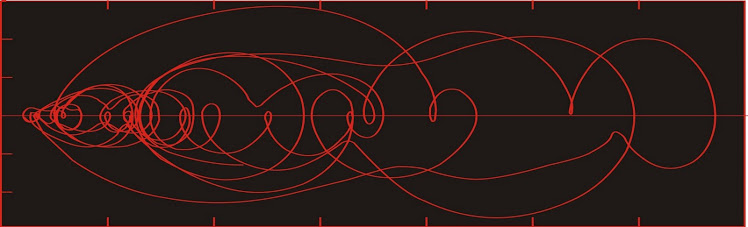
Dust flux, Vostok ice core

Dust flux, Vostok ice core
Two dimensional phase space reconstruction of dust flux from the Vostok core over the period 186-4 ka using the time derivative method. Dust flux on the x-axis, rate of change is on the y-axis. From Gipp (2001).
Showing posts with label Ghana. Show all posts

Wednesday, February 5, 2020

The colour is blue at the Aga Khan Museum

The Aga Khan is the head of a small, but wealthy, subset of Shia Islam.

He is known for charitable works around the world. Today's topic is about one of these, the Aga Khan Museum in Toronto. I had decided to visit late last year when I became aware of an exhibit based on trade in West Africa during the Medieval Era. I had been interested in this topic since the company I worked for at the time drew on the history of gold caravans in West Africa for promotional reasons back when it first began working in the area. During field work in different parts of Ghana, we discovered traces of the historical economic development of the region, some of which has been described previously.

I also took a tour of the museum, which detailed many of the architectural details which might otherwise go unappreciated. For instance, the theme of the museum was light, and the dominant colour for the exterior walls was to be white. Normally this would mean marble, but it was rejected because a study had shown that marble broke down too quickly for a building which is meant to last for hundreds of years. Instead, a white granite was located from a quarry in South America

White granite exterior walls, guaranteed to last

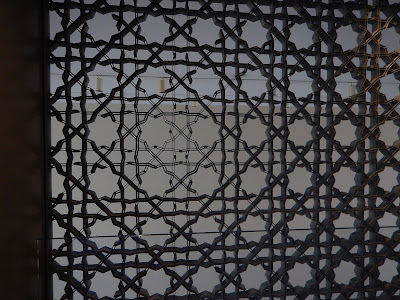
In keeping with the theme of light, most of the interior of the museum is bathed in light from various windows. Elaborate patterned shutters on the windows throw an ever-changing series of patterned shadows across the interior walls of the building as the day proceeds.


Pattern on most of the windows. Material is cast zinc


A Persian symbol for nothingness

Symbology is important in the museum. Apart from the above symbol for nothingess (as everything was created out of nothing, there must be a little bit of "nothing" in everything), there are hexagonal and more complex repeating motifs in the windows and vents, and even the drain in the centre of the courtyard.

Blue seems to be another common theme in the museum. Especially lapis.


The Dancer. A mosaic of lapis


Hexagonal staircase to the auditorium. Terrazzo from Italy


Looking straight up the centre of the spiral stair


Bar made from matching slabs of lapis


The auditorium. It's actually bluer than this


The dome of the auditorium


Shutter for the Bellerive Room in the museum

The principal symmetry element for the interior is a 1 m x 1 m square. All of the major features in the building line  up with the edge of the squares, or else with 2 m x 2 m squares. All of the double doorways are 2 m across, and the edge of the doorway lines up with the edges of the floor tiles (which are 1 m x 1 m). Even the tiling in the courtyard lines up with the outer edges of 2 m x 2 m squares (the straight segments in the tiles below)


Stone floor of the central courtyard, composed of the same white 
granite as the exterior walls, pink limestone from France, and 
blue lapis


A look at the surrounding grounds (the dark squares are reflecting 
pools in the summer) and the Ismaili Centre.


Nearby, the Toronto skyline says "Hello" 

Monday, July 1, 2019

The chickens come home to roost

Back when I first started going to Africa, I was annoyed to discover that the practice of charging foreigners (the only time I have ever been lumped together with the white men) higher prices (often much higher prices) for pretty much everything. Initially I tried to take this in good humour and the various assistants that I had travelling with me from time to time were inconsistent in the efforts they expended to ensure that I paid the same price for things as any African.

One stands out in particular--Kofi the Lion, drunken con artist though he was, fought hard on my behalf. I remember once being held up taking a boat across a river because the ferryman wanted to charge me double the trivial price that everyone else had to pay. Now this river was so narrow you could almost run and jump across it, and it probably took about 10 s to cross it (plus another minute or so getting into the docking space). Kofi fought with him, holding up the boat for at least 20 minutes until finally winning his point.

Another time when I was buying some carvings from a local artist, he spent a good bit of time in a lengthy argument over pricing with the artist. And when an agreement was reached, he suddenly demanded a commission from the artist. He pointed out that he had brought me to this man's store, but we could have gone to any other. Reluctantly, the artist agreed. As soon as we left the store, Kofi gave me his commission. I gathered that he was still unhappy with the price, but did his best to reduce my costs at every turn. And that is how shopping is in Ghana--you need to be prepared to fight for every advantage.


A rare photo of Kofi Jatah, at left.

With time, our staffing situation improved, and a consistent group of characters coalesced around us and our nascent project. And my thinking on the subject of higher prices for foreigners changed as well. Instead of having our local staff resist this policy as an act of altruism, I realized that it was in their interest as well.

They used to complain that if they helped me too much, they were criticized by the various shopkeepers I understand the impulse of sticking together and helping your fellow Ghanaians prosper by taking advantage of foreigners. But I pointed out that if they allow us to pay a higher price, that is the price that they and all other Ghanaians will soon pay as well.

The reason was that more and more foreigners were coming to Ghana because of varied business opportunities. Vendors will soon realize they could sell all of their product to foreigners. If the foreigners are paying a higher price than the locals, why sell anything to the locals? So my mantra became "whatever you allow to happen to others will eventually happen to you."

Tailings and troubles

Canadian mining companies do not have the best reputation overseas, especially in impoverished areas of the world (Latin America in particular). Human rights violations have resulted from conflict between mining companies and local inhabitants throughout Latin America over potential environmental impacts, and the economic problem of wealth extraction from impoverished areas without economic compensation.

These problems are poorly reported in Canada, so Canadians may have some excuse for largely being unaware of these issues. But one issue that is harder to claim ignorance about is the multiple examples of tailings dam failures. Tailings pond failures in Canada have a long history, and Canadian companies have been implicated in a few overseas collapses as well. So it isn't unlikely to find the local population very interested in the parameters of a tailings pond that will soon appear in their locale.

And here we come to the nub of it. Canada has allowed its mining companies to abuse protesters at overseas mining (and potential mining sites) for generations. So it is inevitable that such behaviour would eventually come home, as may have begun recently in Nova Scotia. Use of local/national police forces against such protesters - check. Government deciding not to investigate use of force - check.

Sunday, March 4, 2018

Saturday, February 24, 2018

Sahara

Arrived in Ghana a couple of days ago. Getting used to the heat. Here are some shots of the Sahara from the plane.


The sandy, sandy sea


Thursday, April 21, 2016

The fire last time


It was very sudden. I was in our field office, just outside Accra, when a nearly indescribable racket began. It was if the most intense rainstorm in history suddenly broke upon us and our tin roof. I knew that it was sunny out--I had just been outside minutes earlier. I rushed to the window and looked out--and it was still bright and sunny. But the sound was localized now, outside and to my right, but out of sight. Heavy black smoke rose into the sky from the opposite side of the block wall that demarked our property boundary.

Outside, there was panic. The dogs and chickens had run to the northern part of our plot, and the grounds staff were in a panic. The flames were more than 10 m high, right up against the other side of the wall. The wind was blowing the fire away from us and across the overgrown neighbouring plot, away to the northeast. Small Kwame told me that Grandpa (our old security guard) had gotten drunk and used far too much petrol in burning the trash--the result was this fire that was now threatening to sweep through our neighbourhood.

Great, I thought. Canadian mining company burns down neighbourhood.

We always had the hose hooked up to the spigot. I turned on the water, but as usual, there was no pressure. Fortunately, we had an elevated water tank, where we stored water as it was normally out. Unfortunately, we only had a few buckets, and in seconds, we had an impromptu bucket brigade snaking its way across the overgrown yard. I tried not to think about snakes. We had spitting cobras, and once a green mamba.


Vegetation in the neighbouring plot. It wasn't quite this green when the 
fire happened, as it was the end of the dry season.

Unfortunately, our few buckets were able to accomplish very little against the raging fire. A little more manpower arrived from the neighbours on the opposite side of the property, with a few more buckets, but it was clear that we were losing ground rapidly. The wind had picked up, the fire had advanced about 200 m and was reaching the concrete shell erected on the neighbour's plot, blackening it. At this point I realized that we had better get to the crossroads and take advantage of the firebreak, otherwise the fire could burn through the entire town.

We ran. The flames were well over 10 m--the building was to be three stories and flames were higher than the building. It was the end of the dry season, and there was plenty of fuel in the neighbour's yard. The roads in our neighbourhood were laterite with some gravel. With only a few damp cloths, we crossed the road and chased down wind-borne flaming debris, stamping them out before they could spread. Luckily the yards on the far side of the crossroads were well kept, and there was little there to burn.

After about fifteen minutes, the fire backed up against the road and ran out of fuel.

The surreal moment of the day - I was still chasing down windblown sparks, when a woman emerged from one of the houses on our block. At this point the flames were right against the side of her house, and they were still higher than her house, but the fire was mainly confined to a narrow space between her house and that of her neighbour. She spies me, and begins walking toward me very deliberately. I kept chasing down sparks, and every time I looked up, she made eye contact and kept approaching. I was almost out of breath when she caught up to me. "Here it comes," I thought.

"Nice to see you," she says. "When did you get back? How was Canada?"

Friday, February 19, 2016

Water resources in ancient China

Guangzhou has been an important city for at least 2000 years. The capital of the ancient kingdom of Nanyue was within modern-day Guangzhou. The former palace grounds were excavated starting in 1995, and have been turned into a museum, not far from the main business centre of the city.

The first thing you see on entering the museum is the excavation of the former gardens, which had a pond and a series of waterways.


One thing I really noticed was that there were a lot of former wells on the site. Water is, of course, fundamental. The philosophy of Chinese labour can be summed up as go out, plant rice, and dig wells for water.


These wells show different styles in the way the sides of the well are lined, the sophistication of the tiling or brickwork around the well, and the styles of the stone curbs, suggesting that these wells have been placed sequentially over a period of nearly 2000 years. The most recent well was emplaced during the Qing dynasty, which ended in 1911.


Qing dynasty well.


The above reproduction of an aerial photograph of the former garden/pond/waterway shows the number of wells (small circles).

A few years ago, we decided to dig a well on our property in Ghana. We put down a nice circular hole more than a metre in diameter over three metres down into the aquifer, which was a coarse sand. We used a couple of lengths of concrete pipe to line the lower part of the well, and lined the wider upper section with chicken wire, which we used to support concrete. We laid bricks around the well, and built a concrete curb to keep surface water from contaminating the well. It worked pretty well until one night a terrible storm created such a surge in the aquifer, that sand liquefied and flowed up the well, basically to ground level. That sand undermined the laterite around the well, which collapsed, disrupting all the brickwork. I had a picture of the final mess somewhere but can't find it.

Anyway, for this reason, I have a lot of respect for someone who can dig a well that still remains 2000 years later.


That is really fine work.

Friday, January 29, 2016

River dredging in China

Buzzing along on the bullet train down to Wuhan, we crossed a number of tributaries of the Yangtze River.


It's a little blurry, but that's what happens when you go blazing by at 280 kph. What is up with this river? It didn't look natural, but there wasn't a lot of time to think about it.

It looks like the river has been dredged. That is something I'm always on the lookout for. A little over a year ago I went blitzing past an alluvial gold operation by the Yellow River. But in that operation there was a lot of gravel. Nothing like that is evident in the above photo. My guess was that they were mining sand.

A little while layer, I saw this . . .


and then I was sure they were mining sand.


Near Hankou, we see this. This doesn't even look like it was a river--just a field that has had sand mined down to below the water table. Where does all this sand go?


It goes downriver. As far as Shanghai (above). But plenty of it only goes as far as Wuhan.


Barge on the Yangtze in Wuhan.

For some number of years, river dredgers from China have been causing chaos in Ghana. Now we see where they got their start.

Monday, December 15, 2014

One day on the beach

Winter is coming, and although it is not cold here as it is back home, my thoughts turn back to warmer days in Ghana.

The only food locally available was from a small restaurant run by a young woman named Sala. She has only a single charcoal stove, and can’t cook food quickly enough.

I wolfed down a hard-boiled egg, some boiled cabbage, onion, and pumpkin for breakfast. There was more of the same for lunch. We were on a parallel line approaching Shama when heavy rain came. We finished the line and ran into Shama towing the gear. The dorsal fin came off during the morning, but the instrument only flipped over once, and that was at high speed during our run in. Apparently at high speed, the weight at the front acts as a brake, and may flip the fish onto its back. Once it starts skipping across the water surface it will continue to do so. 

The data were still good despite the damage to the fish. Kabi has located some wood cut to shape that will be delivered in the morning.

We returned to port and unloaded the boat. As I was paying the boys, an old man came up to me and said he had not eaten and needed some chop money. I demurred, paid the boys and the boat owner. Once again the old man came asking for chop money. I am hungry he said. I too am hungry, I told him. Kabi explained to him that we too were under people, and that our money was not really our own but had to spent only on appropriate things. Oh, he begged, he was hungry. Then I remembered I still had lunch. I climbed into the back of the van, opened my bowl of food, and offered him a hard-boiled egg. He asked what else I had. I showed him the contents. Boiled onion, pumpkin, okra, a garden egg, and some cabbage. This food is too rough for me! he said. He returned the egg. He wanted a cedi. This is the food I am eating! I said. I will not give you a cedi so you can eat better than me. I took back the egg, but now didn’t really want to eat it. A quick, enterprising child held out his hand and I gave it to him. He ran off delighted, pursued by his peers.

The old man who refused my food came by the next morning, saying he would go and come and he would bring me money, so I could eat better too.

I did, actually. Sala had given me the same collection of boiled vegetables (including a whole onion) and eggs. But this time, the boys cooked light soup on the boat. They had brought a charcoal furnace (a hibachi, really), chopped up a fish, and cooked the whole thing on the rolling sea in less than an hour. The soup was explosively hot, but made a nice addition to my egg and boiled vegetables I had, turning it into a stew.

Monday, February 17, 2014

The village hammer

In response to the higher than usual amount of spam being sent to the World Complex, here's a little story. (BTW, thank you for your story about trying to get a loan from a god-fearing man, Mrs. Monica Roland. But the last time I was in Singapore, the unit of currency was not the pound).

We were about to run a small survey from a fishing vessel out of a small village in the western region. The geophysical gear had to be towed from the side, so I prepared to nail a beam to the boat, so we could tow the gear from a fixed point about 2 m off the side of the vessel. Unfortunately, my hammer had gone missing sometime during the trip--but one of our local employees told me he had one in his house just around the corner, so off he goes to get the hammer.

So we wait. And wait. And wait. A few hours pass, and then he returns with the hammer. I asked him what took so long. "Someone else was using it." Two minutes of hammering and we were done. Out to sea.


Not sure how clear this is to you, but this is a bit of raw seafloor acoustic imagery, with no navigational corrections (we wobble a bit and our speed changes due to wave action). The width of the image is about 90 m, and the length is a little over 500 m. The prominent light coloured bodies with the ripple marks are sand bodies with dunes; the darker material is soft sediment (silt), and the light blotches are bedrock outcrop.

Update: The image upload isn't that good. Bloody google.

Friday, June 7, 2013

The mystery of Robertson screwdrivers in Ghana

Every Canadian blog eventually has to have a post about Robertson screwdrivers. We are told they are uniquely Canadian. Especially when they start showing up in Ghana.

I remember once working on an oceanographic vessel out of Bedford Institute--almost 30 years ago. Some of the (at that time analog) recording equipment had been fastened in place with Robertsons. We had to move some of the equipment, and an American colleague remarked, "We need to have some kind of a special tool to undo these."

Some years ago I was running a marine survey in Ghana. We had a variety of braces and mounts assembled here and shipped over. In the course of operations I found myself having to modify our home-made mount for the GPS, which was held together with Robertsons. I had a multi-tool, but there was one screw that had was hard to access, and impossible for the tool (the knuckle couldn't get into the access) so I was stuck unless I could find a dedicated Robertson screwdriver, which was impossible in Ghana.

Uniquely Canadian.

A few years later I needed to buy some screws at a hardware store in Accra, and ended up picking up a few packets of Robertson screws. They even had some of the screwdrivers too. But since cleaning them out that day, I have never found any at any store in Ghana.

Why did they appear in such limited numbers, only to disappear?

In checking out the new Robertson webpage, I did see one clue. It is now part of the Berkshire Hathaway empire.

But a brief market flirtation doesn't really seem like their style. My present guess is that it was some kind of Canadian government initiative--get the Robertson out there. But without any follow-through.

Friday, December 7, 2012

Election day

One of my last days here, so I'll make a few observations.

People here are still enthusiastic about elections. They are passionate about their parties. Earlier this week on our way to the Minerals Commission we were held up by traffic going to political rallies. They still hope that government will make their lives better--at the same time, until now, the government's ability to interfere with their lives is still limited as the institutions of total control are undeveloped. But the signs are that they are coming.

People began lining up last night so they could vote today. Accusations of electoral fraud and warnings of ballot box snatchers are the talk of today's news.

One item really caught my eye as it went across the bottom of the TV. "Religious leaders warn politicians not to be too desperate for power as it will incite violence." I wish we saw such warnings at home.

Tuesday, December 4, 2012

Electricity and the election in Ghana


Once again the national electrical authority has promised that the load-shedding practice (which you might call rolling blackouts or power-sharing) will be suspended before the election--although the starting date has been rolled back to Wednesday.

The election is Friday.

Tonight there was breathless reporting on a major conspiracy to plunge all of Ghana into darkness during the election and vote-counting, so that unnamed nefarious powers could gain some unspecified advantage. Our staff have advised us that this sort of thing is announced before every election.

If they can avoid power-sharing for a few days, why can't they do it all the time?

According to interviews on Joy News, the required additional supply is coming from three sources. An extra 100 MW has been purchased from Cote d'Ivoire, 30 MW is coming from (or rather not being exported) to Togo and Benin, and interestingly, 30 MW is coming from an 80 MW power station built by a consortium of four mining companies. It was not clear whether they meant that the mining companies were generating this power and selling it to the network, or whether it represented power normally supplied by the grid that would be diverted elsewhere.

In case you are wondering why your mining stocks in Ghanaian jurisdictions have been performing poorly lately, there is this.

Sunday, November 18, 2012

Another exciting day

Saw something I hadn't seen before (but knew was theoretically possible).

The power went out early this morning. But it wasn't completely out--my computer reported it was still charging, and the lightbulbs in the kitchen were flickering dimly. So I got out the multimeter and measured the  voltage coming out of the wall. It came in at a grand 18 V, less than one-tenth normal. But there were little transient flickers of higher voltage, so I unplugged the computer.

The power came back--sort of. Some things started to run, although the lights seemed unusually bright and the fans were spinning much faster than normal.

When I measured the voltage in one of the kitchen outlets, I measured about 370 V. Again, with transient flickers of much higher voltages. But there were other outlets only producing about 20 V.

Theoretically I knew such a thing was possible. The power coming into the building was three-phase, and many electricians here have hands-on experience without any theoretical knowledge of what they are doing, so after we had the building wired and connected to the grid, the first thing I did was to check the voltage output everywhere possible.

For three-phase power you have a ground and three active terminals. In Ghana, the voltage between the ground and any active terminal is 230-240 V (ideally--although on most days it is considerably less). The voltage across two active terminals will be around 370 V. If the house is wired properly, one-third of the outlets will run off each one of the active terminals and a ground. If the house is wired improperly, it is possible that one-third of the outlets will be run off two active terminals, giving you a voltage at that outlet of 370 V.

In our case I knew the house was wired properly. So the only explanation was that after the first power outage, the electrical workers must have connected their wiring improperly, crossing the ground with an active terminal, blowing up appliances from Bortianor to Kokrobitie.

You'd like to think that electrical utility workers would be better than that. Yes, you'd like to think that.

Tuesday, November 13, 2012

Argentina sues Ghana over the Libertad


The story of Ghana's seizure of the ARA Libertad caught my eye while on my way to Accra last month. It seems that when Argentina's currency peg collapsed about a decade ago, some private creditors refused to accept the government's repudiation of its sovereign debt. In this case, an investment fund called Elliot Management (with court rulings in its favour) has asked Ghana to sieze Argentinean property--in this case, a tall ship.

What has tongues wagging here in Ghana is the announcement that Argentina will now sue Ghana of this seizure.

Elliot claims to be owed $1.6 billion, so without a highly favourable valuation, the Libertad represents only a drop in the bucket.

It seemed odd to me for Argentineans to be hiring Kwesi and Kwabinah as hired muscle. Ghanaians are too happy-go-lucky to make convincing enforcers. Even in the event that a Ghanaian court agrees that the Libertad is fair game for seizure, history here favours a suboptimal outcome for Elliot &c.


"I'm here for the money you owe my boss! But if you don't have it, that's okay too."

On my first trip here (in 1996), there were highwaymen along the main road, with a noted concentration near Liberian and Leonian refugee camps. Other highwaymen could be encountered on roads all over Ghana, and a common trick was to pound nails through sandals which would be left on the road. When the vehicles stopped to repair tire damage, the thieves would strike.

The encounters went something like this:

"Hand over all your money!"
"Here."
The villains move off.
"Wait! You can't just leave me out here in the middle of the forest with flat tires".
The villains return. They help the victim repair his tires. The villains start to leave.
"Wait! I don't have enough petrol to return home!"
The villains return. They give the victim money for fuel. The villains start to leave.
"Wait! I don't have any money for food on the road!"
The villains return. They give the victim money for food. The villains start to leave.
"Wait! I am going to need a drink with my meal to calm my nerves after this robbery!"
The villains return. They give the victim money so he can buy a beer (or alternatively, apeteshie).
The villains leave, possibly with less money than they started with.

In Ghana it is not uncommon for a Ghanaian to find that he owes the government some heavy sum. But the difference between the stated debt and what is finally paid can be immense--and usually in favour of the Ghanaian. That is because the government here--or, rather, its agens--recognize that they can't destroy someone's livelihood just to collect an arbitrary debt. So debt repayment becomes a negotiation--sometimes a very long one--with a lot of compromise on both sides.

That probably seems incredible to someone in North America or Europe, but it is the reality here where the government's ability to pursue its "creditors" is extremely limited.

The Ghanaian court is apt to look at this whole scenario, and rule that due to the trouble this ship represents, Elliot (or its sub, NML) upon taking delivery of the ship will be paid in full. Of course, they can only take delivery after paying the docking fee and the storage fee at Tema. Then they will have to pay a fee for the security provided by the government of Ghana while the ship was in storage. Then there will be the release fee, the exit fee, the immunization fee for whatever crew are brought in to take the ship back to New York . . .

Thursday, November 8, 2012

The creeping death of a fishery: Ghana (1980-2012)

On the short cool afternoons on our complex outside of Accra, we go up on the balcony, beverage in hand, and contemplate the sea.


Unfortunately the view isn't as good as it used to be, as there has been an explosion of building along the coast, especially hotels. In particular, hotels between us and the beach. So the picture above (taken last year) is not exactly current. But you can occasionally get a glimpse of the fishing boats returning in the afternoon between the block wall that now obscure our view.

Here's how it works. Around sunset, the fishing boats sail off and in the late morning--or possibly the afternoon, they return. The fishing is still pretty good near Accra if you go far enough offshore. The late upwelling has prolonged the good catches this year.

But fishing is meager in the eastern and central portions of Ghana. There used to be far more boats plying their trade than do now.

The artisanal fishery is of critical importance. Nearly 25% of Ghana's population lives in the coastal zone. Until the past decade, approximately 10% of the population depended on the fishery for their livelihood (Quaatey, 1996). It seems that that number has declined in recent years. I recall seeing estimates exceeding 30% for the amount of protein in the Ghanaian diet that came from the sea.


Climatic fluctuations over the past fifty years are reflected in the catches of artisanal fishermen (Minta, 2003), but it is not as clear whether the more or less monotonic decline in fish catches over the past decades can entirely be laid at the feet of climate change. Different species respond in different ways to climatic fluctuations--the most important being temperature, rainfall, and strength and duration of upwelling. But against climate change we need to consider the backdrop of changing technology in both the artisanal and mechanized fishing fleets.

In 1996, when I began work in coastal Ghana, I saw significant fishing fleets at many villages along the coast. In particular, the village of Nakwa, at the mouth of the Nakwa River, behind a lagoon fronted by an impressive sand barrier, had a large fishing fleet full of vessels at least sixty feet in length which landed on the barrier. The fishing boats were brightly painted and festooned with colourful banners. There were ferries constantly running across the lagoon between the village and the landing ground for the fishing fleet.

Two years ago I ran a sidescan sonar survey out of Nakwa between the river mouth and the offshore oil platform (GNPC-Saltpond). The fishing fleet was gone, but for a couple of dilapidated wrecks drawn up on shore. The locals told me there was no more fishing--anyone from the village who wanted to fish had to travel 150 km west to Axim, where the fishing was still good.


Nakwa lagoon in 2010.


Flaring gas near Saltpond.

In 1997, in the course of offshore work near Axim, we encountered the artisanal fishing fleet several km offshore at night. The canoes all used lights to lure the fish in where they could be netted. At the time, this was the most technologically sophisticated method of artisanal fishing. Since then, new technologies have been deployed, including underwater lights and the use of chemicals.

The use of technology by the artisanal fishing industry varies from locality to locality. In the far west of Ghana, there has been an attempt to manage the fishery by limiting certain methods (CRC), but such efforts are nearly always local.

This year (so it has been reported), the fishing has ceased off Axim, and the fishermen have been forced further west to Cote d'Ivoire.

Overshadowing the increased efforts of the artisanal fishery is the steady increase in industrial fishing effort.

In 2010 I observed pair-trawling (which is illegal in most places). Sidescan surveys show that the seafloor is crossed by abundant trawl marks, even in nearshore areas that are supposed to be off-limits to such techniques. Trawling disturbs large areas of the seafloor, reducing marine productivity for years.

As the trawling has entered into the waters which were reserved for the artisanal fishermen, it is little surprise that the inshore fishery has suffered.


References


[CRC] Coastal Resources Center / Friends of the Nation (2011). Assessment of Critical Coastal Habitats of the Western Region, Ghana. Integrated Coastal and Fisheries Governance Initiative for the Western Region of Ghana. Coastal Resources Center, University of Rhode Island,132 pages.

Minta, S. O., 2003. An assessment of the vulnerability of Ghana's coastal artisanal fishery to climate change. M. Sc. thesis, University of Tromso, Norway.

Quaatey, S. N. K., 1996. Report on the synthesis of recent evaluations undertaken on the major fish stock in Ghanaian waters. Marine Fisheries Research Division, Fisheries Directorate of the Ministry of Food and Agriculture, Tema, Ghana.

Wednesday, November 7, 2012

Melcom building collapses in Achimota (Accra)


A six-story building collapsed in Accra today. It is the first time such a thing has ever happened.

The principal tenant of the building, occupying the lower three floors, was Melcom, a department/grocery store (think of something like Walmart).

Luckily the building collapsed before opening, otherwise there would have been hundreds of people trapped inside. As it is, about 55 employees were inside the building when it collapsed. One report says that 48 people have been removed from the ruins, with only five deaths. Furthermore, there are still people inside calling on cellphones asking for help and water, so it seems that the number of deaths will be much smaller than first assumed.

I've been watching images of it all day on one of the local channels. The building completely pancaked except for part of the ground level (or perhaps it was the basement). The concrete slabs of all of the remaining floors have all piled on top of one another, with the external support columns failing outward. It is as bad as any collapse I have seen after an earthquake. I would put it up there with Armenia (1988). It is still too early to be sure, but I would suspect faulty building materials (also the case in the Armenian earthquake).

The building was considered to be a fine example of a high-tech building. It was built in only two months, using new (to Ghana) construction techniques, but the reporting has been unclear as to the identity of the builder.

We have built a few small buildings ourselves in the course of our project here in Ghana. In general, the quality of available concrete block is very poor, with many block-makers using inadequate amounts of cement to bind together material that includes sticks, grass, leaves, and charcoal.


Block factory production in Weija (note sticks).


Wall in Weija made with low-quality block.

During today's coverage, the reporters revealed that Accra is in an earthquake zone, and cast doubt as to whether many of the modern buildings recently constructed have been built to a standard suitable for one. Furthermore, the same company that built the collapsed building has also built buildings in downtown Accra, which is making some people nervous.

Update Nov. 8 6:40 p.m. local

They are now saying 69 people have been rescued alive from the collapsed building, along with eight deceased.

An Israeli rescue team has arrived with sniffer dogs and various listening/looking devices to look for more survivors.

The owner of the building has been asked to turn himself in (but has not taken up the offer--no surprise there).

I had avoided comments on the age of the building in the original post, as there was too much conflicting information, with some sources saying the building had been recently completed in only two months, while the tenant claimed to have rented the building for ten years. It seems that the tenant has rented the building for ten years, but recently had three floors added to it--this new construction was done in only two months.

Such a project would raise concerns in my mind. Given the nature of the ground conditions (laterite/sand)--was the original low-rise situated on a slab which was adequate for a two-story building but not a five-story one?

Update Nov. 9 evening

More struggles with power and internet. Joy News reports 75 rescued and 10 fatalities, but still numerous survivors known to be in the wreckage, some of whom have been communicating by cell phone.

Wednesday, October 31, 2012

Ghana needs power . . .

. . .  desperately.

Power was out all day yesterday. It came on around 7 in the evening for just over an hour, and went out again.

Ran down all the batteries so I was just starting to charge them when power went out for the second time.

Came on again late at night, but couldn't charge batteries due to heavy lightning (plugged-in things here tend to explode when lightning strikes).

Power is on again this morning, but for how long?


A recent publication (which bandwidth is too limited for me to find) states that Ghana will produce enough power to supply its needs by 2020. Given that this is a government paper, it is vitally important to investigate its premises.

The authors of these papers tend to adjust their model parameters to suit the desired output. Yes, I understand that power plants are being built, and it is reasonable to assume that their projected capacity will be met. I will also allow their assumption that they will build out the required transmission capabilities as well.

What I don't accept is their projection of future demand. The reason for this is that since the present demand cannot be met, it is certain that it is underestimated. Likewise, the rate of growth of demand tends to be similarly underestimated. For this reason I think that their projected demand in 2020 will fall far short of the real demand, meaning that episodic blackouts, brownouts, and power sharing will continue here far into the future.

Tuesday, October 16, 2012

A worrying data point . . .

. . . in the climate change debate.

West African climate is monsoonal. The rainy season here in Ghana runs from about March to November (with some fluctuation). In the middle of the rainy season is a short dry spell which is caused by the upwelling of cold waters in July and August. This upwelling is a critical time for fish spawning as it leads to algal blooms. When the cold water rises to the surface, warm humid air offshore condenses and the rain falls on the sea.

Since my arrival I have noticed how cool it is here, especially by the coast. From the local fishermen, I have heard that the sea is unusually cold for this time of year, and the fishing is unusually good. It would seem that the upwelling which normally ends in August or at latest the first week in September has persisted now into the middle of October.

The upwelling means more algal blooms, which ought to be visible on NOAA imagery. I have always thought that the upwelling here was driven by south Atlantic winter storms--does anyone know if the Antarctic winter was unusual in this regard?

Monday, October 15, 2012

News from Ghana

Once again back in Ghana. The power goes off for a few hours every evening, although last night it went off and never came back.

Ghanaians like peace. They don't like war. They will argue loudly in public, but just when you think they are about to come to blows, they stop.

Ghanaians are watching the unfolding situation in Mali closely (I wrote a bit about this before).

Our housekeeper is telling us that Ghanaians are terrified the Islamists will move into Ghana once they have finished with Mali. She told us that everyone is praying that the Americans will come to intervene.

It's awfully convenient for America that two new oil-producing states are suddenly gripped with problems requiring their intervention. Especially when they were involved in the episode which led to the current unstable situation.

Wednesday, October 10, 2012

Leaving town

Off to Ghana for the next while. As per usual, this will likely lead to a change in emphasis on stories here from North American/European to African.

Here's the view from the front of our office in Accra.


Update (Halloween):

Unfortunately the neighbours have cleared the lot including the trees where this clever fellow built numerous nests. Such is progress . . .