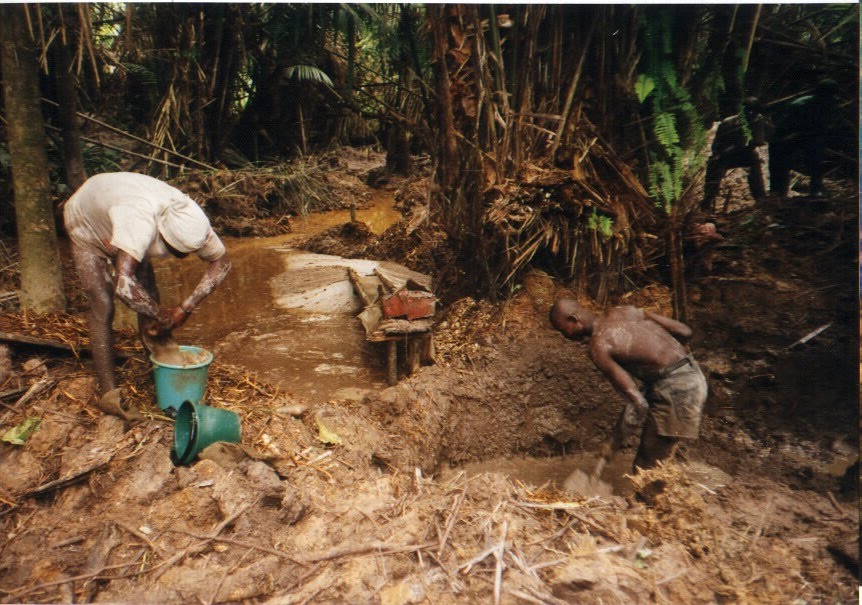
Dust flux, Vostok ice core

Dust flux, Vostok ice core
Two dimensional phase space reconstruction of dust flux from the Vostok core over the period 186-4 ka using the time derivative method. Dust flux on the x-axis, rate of change is on the y-axis. From Gipp (2001).
Showing posts with label artisanal mining. Show all posts

Friday, January 29, 2016

River dredging in China

Buzzing along on the bullet train down to Wuhan, we crossed a number of tributaries of the Yangtze River.


It's a little blurry, but that's what happens when you go blazing by at 280 kph. What is up with this river? It didn't look natural, but there wasn't a lot of time to think about it.

It looks like the river has been dredged. That is something I'm always on the lookout for. A little over a year ago I went blitzing past an alluvial gold operation by the Yellow River. But in that operation there was a lot of gravel. Nothing like that is evident in the above photo. My guess was that they were mining sand.

A little while layer, I saw this . . .


and then I was sure they were mining sand.


Near Hankou, we see this. This doesn't even look like it was a river--just a field that has had sand mined down to below the water table. Where does all this sand go?


It goes downriver. As far as Shanghai (above). But plenty of it only goes as far as Wuhan.


Barge on the Yangtze in Wuhan.

For some number of years, river dredgers from China have been causing chaos in Ghana. Now we see where they got their start.

Thursday, October 9, 2014

Artisanal gold mining on the Loess Plateau (updated)

On the bullet train the other day, I caught a glimpse of an artisanal mining operation. I snapped several pictures of it as it flew past--not great pictures, as it is hard to capture something so close to the train when you are whipping by at 300 km/h.

I didn't know for sure that it was a gold mining operation, but there aren't too many other kinds of artisanal operations. However, this paper (pdf) confirms that artisanal gold mining is common in the Loess Plateau, at least near the border between Shaanxi and Henan provinces, which the route map confirms as the location of these photos.


The crew are just left of centre in this picture. They appear to be sucking up loess interbedded with gravels from the old river bed.


(Update: Now that I look more carefully, I think the concentrator has to be in that shack near the top of this photo. It makes more sense looking at its position relative to the tailings.)


"Tailings" pile (discarded fines from gravity recovery or just screening) of loess, which is composed of wind-borne silt-sized particles.


Gravel beds in the river channel--this river flows north, feeding the Yellow River. There are gold mines upstream on the river, according to the report in the above link. The equipment at the bottom is probably a concentrator, but the image isn't very clear.


Looks like there's been a lot of work down here too. All these photos overlap to an extent, but in some of them I am looking forward and in others I am looking back, so they are not easy to stitch together.

Friday, December 2, 2011

A day in Ghana redux

Today was spent cruising up the Ankobra River, in our mighty fishing vessel, which we will be taking out to sea tomorrow.


We set out from our dock just north of the highway bridge crossing the Ankobra (in the background), near the coast, and headed upriver. About 2 km upstream was a nice artisanal gold mining operation.


If you look closely you can see the man working under the tarp. The operation draws water from the river to run through the sluices. All that bare rock represents forest cleared for the mining operation.

If my memory serves me correctly, this land is on a concession held by Adamus Resources Ltd. (excuse me, that's now Endeavour Mining Corp., with which I have no relationship, and of which I own no shares). So this is most likely an illegal operation.

Speaking of questionable mining operations, last week on the Ankobra we stumbled across these.


The dredge is rigged for running up the river, not for operation. The locals here tell of a very large contingent of Chinese miners working with artisanal miners near Prestea. The dredges were not on this part of the river today.

The high price of gold has caused an explosion in artisanal mining all over Ghana. New operations were reported last week on the beach at Elmina, in the Central Region, but local authorities have shut these down. We saw a very large operation along the south side of the coastal highway about twenty minutes west of Agona Nkwanta, which still appears to be active.

Tuesday, November 23, 2010

Some thoughts on NI 43-101

In mining work, dishonesty can have obvious rewards. Some of the scandals that occurred in the fairly recent past—Bre-X, Golden Rule, have led to an increasingly onerous set of regulations on reporting.

Some standardization in the rules of reporting mineral exploration results is a welcome step and the agencies which initiated these steps should be congratulated for their attempt to bring clarity to the market.

Nevertheless, it is important that while bringing clarity we don't make the entire system opaque. One problem with the NI 43-101 setup is in the review of reports. Many of the reviewers do not have expertise in geology--in fact, they are lawyers and accountants, and they expect the document to read like a legal acounting document. This places a burden on the poor geologist writing the report, and favours instead larger geological consulting companies who have legal and accounting staff to vet reports prior to submission.

It is a truism that when the major players in an industry feel threatened by smaller upstarts, the most certain way to overcome such competition is through enacting industry standards.

Additionally, geology is not like most of the other "hard" sciences. There is, of necessity, a great deal of interpretation of observations. Simply reporting observations is only part of the science--the interpretation is the key area. Much of this interpretation follows from previous experience. Consequently, it is common for geologists to make a key interpretation about a project on the basis of previous experience. But this is not something that translates easily into an accounting or legal document.

Two geologists may make the same observations about a project and arrive at different conclusions. This is a reflection of the nature of geology, and is not something that is helped by needless quantification. 

The rules of reporting on mineral properties make it very difficult for a geologist to express certain reasoned opinions which have arisen from interpretations of observations in light of past experiences. This means that a great deal of the value that a geologist can bring to a property is no longer reportable, and the exploration progress on a property must be reduced to the reporting of a series of dry numbers. The flavour is lost.

Consider this--in 1897, the Ashanti Mine began production. It was financed by the issuance of shares, at 100 pounds apiece, on the London Stock Market. How was it promoted? The founders of the company simply reported that they had visited the site in Ghana, and that the valley was full of artisanal miners recovering gold from rich seams within the bedrock.

Early this year I wrote an NI 43-101 report on a property in Sierra Leone--a report which is still bouncing back and forth between myself, the company in question, and Canadian securities regulators. One of the earlier issues, since resolved, was my contention that the number and extent of artisanal mining operations on the property meant that it would be reasonable to assume some chance of successfully exploring the property for gold.

The securities regulators took exception to that conclusion. I had no specific numerical measurements of the gold recovered by the miners. There were no numbers to report. So the observation had to be withdrawn, or at least, very heavily discounted.

Were the Ashanti Mine property being explored for the first time today, it is highly doubtful that it could be brought into production. The actual structure of the gold shoots are like long, thing, curving cylinders that plunge steeply near the surface, and gradually level out at depth. The gold-bearing zones of the shoots are only a few m in diameter, but they are perhaps 3 km in length, and each one carries 2-4 million ounces of gold.

A cylinder is very difficult to find, let alone completely define, by drilling. The only way they could have been found and mined was the way it was done. Artisanal mining was observed at the surface, and so a proposal is made to start at the surface and mine down. No drilling, just start mining. But in today's environment, it would be impossible to raise the financing for such a venture (what are the numbers?), and it would be practically impossible to define a resource using the normally accepted methods (which are more suitable for bodies with a tabular geometry).


Monday, September 13, 2010

Modeling is hard part 2

Now let's look at what seems to be a straightforward problem with a straightforward answer, and then consider the complexities that make prediction difficult. We will see that once again, the individual elements in the system behave unpredictably.

Some years ago, the woman who later became my wife was practicing her panning technique in the Don River, in Toronto. (She was about to to recover gold grains from some of our fine concentrates from a West African sampling program).
 
I myself am not good at panning. I never had the patience for it. My wife does, which is a blessing as she is married to me.

She got an unpleasant surprise from the gravels at the first bend north of the Viaduct, where the river runs up against the railroad tracks.

The pan was full of mercury.

What happened after alerting the authorities was somewhat amusing but a digression from our current discussion (complex indeed, but not entirely unpredictable). So it has been omitted.

A few years later she carried out a sampling program looking for mercury in the Don River. The samples were collected in locations as advised by another local geologist, who had many years of experience in placer operations worldwide. I also helped with some of the heavy lifting.

Samples were collected in the winter, when the chances were greatest of finding elemental mercury.

Elemental mercury was indeed recovered. Some of the droplets were beautiful. Also noted many interesting textures where mercury had alloyed with other metals.
Many droplets were covered with small plates of metal amalgam. Some of these small plates were covered with spheres, as if the mercury vapour itself condensed on the plates.


Electron microscope imagery of a mercury droplet (left). Scale bar
is 100 microns in lenght. Detail of droplet (right) showing spherical
textures on mercury-amalgam plates. The small "bubbles" at upper 
left are due to electric charges building on the mercury droplet while
under the electron beam.


Small spheres of mercury amalgam were common at many sites in the Don River, but the richest sites were at the location of old landfills.

There is a lot ornamentation on some of these spheres--but am not sure of the causes of it. I would note that we see the same thing on iron spheres of about the same size that we find in West Africa.

There were no surprises during the study--no pans full of mercury. Concentrations at several sites multiplied by volume of sediment in river divided by total surface area of the drainage basin resulted in a mass balance calculation consistent with the amount of mercury expected purely from rainfall.

It turns out that the mercury surprise found earlier came from a spill of sewage from the North Leaside treatment plant in August of 1997 (a few days before the panning expedition). The references to the spill seem to have vanished from the internet, but the article by McAndrew (1997) in the Toronto Star covered it.

At the time we calculated that given the size of the spill, the amount of mercury that may have entered the river could have been in the hundreds of kg, while still satisfying the government regulations on mercury concentration in discharged effluent. Such an even released many times more mercury into the river than enters through rainfall (I hesitate to call it "natural" as most atmospheric mercury results from coal burning).

The local authorities monitor mercury levels in the Don River by measuring mercury content of all of its feeder streams, but make no measurements within the Don itself. The sewage spill went directly into the river, so it is no surprise that our Dear Leaders had no idea of its presence until they were told of my wife's discovery. Now who would have predicted that?

Artisanal mining

Mercury use is endemic among artisanal miners. While I did not find it in use in the coastal region of Ghana (where some of the gold is very coarse), Company representatives did find "white gold" in sands and gravels in the Pra River.

By white gold, I mean an amalgam of gold and mercury. Such a finding means that somebody is using mercury to amalgamate the fine gold grains (it makes them stick together), but is also somehow still losing some of it off the end of the sluice.

Traditionally, the amalgam is purified by heating the white gold over a fire. But other methods work as well.

The hazard of course is that by breathing the fumes you end up like the Mad Hatter.


"Would you like a drop of mercury with that?"


So we used to show off this bag of white gold at shareholder meetings, and somehow after each meeting there seemed to be less of it than before.

One shareholder scoffed that the grains in the bag weren't gold. We let him take one home. I explained that it was amalgamated with mercury and that he shouldn't heat the grain up. He told me he didn't believe me.

He phoned back very excitedly the next day. It was amazing! He put the grain on his stove burner, turned it on, and the grain turned to gold.

And a little more mercury entered the Toronto atmosphere. Now who would have predicted that?

Reference

McAndrew, B., 1997. Don River spill may threaten city beaches. Toronto Star, August 19, 1997. 
Thursday, September 9, 2010

Are Africans Really This Bored?


I've been slow posting lately because I've had to fix up some deficiencies with an NI 43-101 report I've been writing as well as deficiencies in a recently submitted paper.

Today's topic is about gold and where it comes from. I will show you some images from artisanal mining activities in West Africa.

This goes with the introduction, as one of the main deficiencies I had to fix were statements about artisanal mining on the property which was the subject of the NI 43-101. In particular, the securities commission took exception to my statement that vigorous artisanal mining activity was an indicator of the presence of gold.

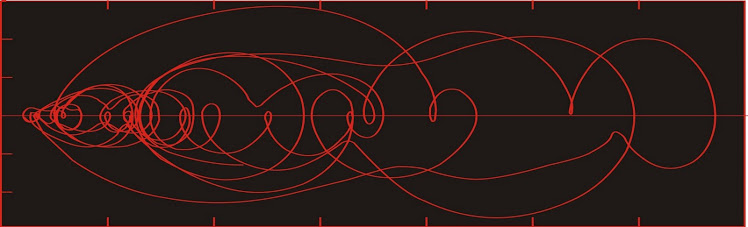
No, apparently these guys dig holes because of all the time they have on their hands after they are done fishing, hunting, farming, or making things. 

They are just bored.

These particular bored guys are aimlessly digging holes at the edge of the Iduapriem mine property in western Ghana (owned by Anglogold Ashanti, a company in which I own no shares, do not work for, do not consult for, and have no relationship with).

Just whiling away the empty hours . . .


It's hard to get a sense of scale for some of these holes. But I would guess that a lot of people have been bored for a very long time.

Artisanal diamond diggings, Bonsa River, western Ghana.

Notice the line of stakes. You may well be very bored, but you are only allowed to relieve your boredom in a fairly small area. Don't think of alleviating your boredom on someone else's plot.


Here are some Ghanaians who are so bored they are pumping water out of an old mineshaft prior to entering it.

Artisanal gold mining activity near Akwantambra, in western Ghana. Don't know who has this property now.


Parts of West Africa are so rich with gold you can literally find some anywhere. Mining it profitably is, however, something else.


Another galamsay (artisanal mining) camp in western Ghana, about 5 km northwest of Axim. This land is currently held by Adamus Resources (no shares, no shorts, no work, no consult, no relationship apart from having a couple of beers with one of their geologists).

Yes, that man is wearing a life jacket. In the middle of the jungle.


Just to show you the lengths to which these people will go to alleviate their boredom, here is a punchplate screen (hand-punched through steel--ok, ok, they used a tool).

This is to separate the gravels from the sands.

Perhaps you get bored too. Have you ever tried digging holes?


Life was pretty boring in the 17th century too. Here, the locals from what is now called Sawoma village, in western Ghana, relieve their boredom by taking a swim in the lower Ankobra River, gathering up the rocks at the bottom, then grind them and pan for gold.


Evidence that South Africans get bored too (Big Hole in Kimberley).


People were pretty bored in Sierra Leone too.

This field is by the Makele River in central Sierra Leone--the holes are from previous artisanal gold mining.


The Sula Mountains are in the background.


Artisanal miners have mined out gold-bearing quartz veins from various hills in the Sula Mountains.


The rock is crushed, and carried to the top of a sluice carved into the side of the mountain.

This little channel is dug down the side of the hill. Natural foliation in the bedrock is used to create riffles. 


The locals collect gold stuff from the pockets between the riffles. They have no pumps, so the site is only active during the rainy season.


Ho hum.


Climbing over piles of tailings (crushed rock) in the Yirisen river, central Sierra Leone. The rock is excavated from nearby hills, and avalanched into the river.

The locals crush the rock and sluice the fines.


Gold from the Butre River, western Ghana (below). 


Anybody think Africans are interested in this stuff? Hello?