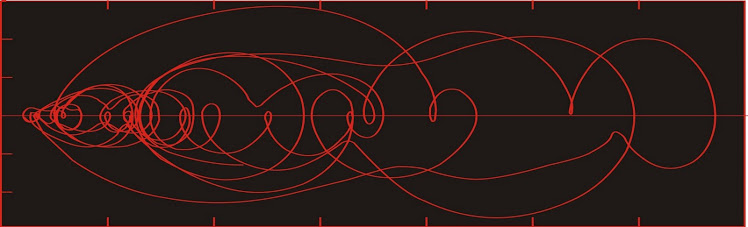
Dust flux, Vostok ice core

Dust flux, Vostok ice core
Two dimensional phase space reconstruction of dust flux from the Vostok core over the period 186-4 ka using the time derivative method. Dust flux on the x-axis, rate of change is on the y-axis. From Gipp (2001).
Showing posts with label Iran. Show all posts

Monday, January 6, 2014

Vignette

Twenty years ago; a woman I adored. She said, "I keep wondering how long this nightmare will last. If we hadn't left Iran, [her brother] would still be alive."
We were always happy. In pictures of us from my early years we are always laughing. My father used to teach at the university of Tehran, and he often treated patients who could not otherwise afford treatment at home, late at night.
But the nightmare has gone on and on. It goes back to 1979. The Revolution.
Those were great days, exciting days, when we overthrew the Shah. We were so optimistic. We knew that democracy was in reach. Khomeini, the Ayatollah, was not the first choice of everybody, but he was someone that nobody could have objected to. But he said he would not come to Iran unless everyone wanted him.
My father was a political moderate. He wanted democracy. His faction agreed with the choice of the Ayatollah, although privately they had reservations. But you do not know the mood that prevailed. We were so carefree, so we agreed and I remember him saying if the Ayatollah becomes a problem we will remove him as well! We were so optimistic.
But on the second day, we found out how it was going to be. My father's group made an application to appear before Khomeini, and the Ayatollah said he would not see us because we were--we were . . . religiously unclean
 It was purely because of our political stance, not our religion.
After that, in all our pictures I am in a shawl. We still wore jeans underneath. But it showed we were not one of them. 
From then on, we were in danger. I was young then--too young to be suspected. But as years passed, one by one my friends began to disappear. Some were arrested; some died. We could not remove Khomeini. 
When he announced a cultural revolution, the universities were closed for three years. In Iran, the university has always been an important part of the community. For meetings. For theatre. For organizing. The movement to overthrow the Shah began in the universities.
We went underground. We moved from place to place. I do not know how we survived. In 1988, we finally decided to leave. Why did we stay so long? It was our home, and we did not want to give up on it. For so long we believed if we could only bear a little more, it would all come to an end.
I had the easiest time of it. I had a passport, so I flew to Turkey. My parents got there too, but they never really told me how. My brother had the most difficult time. My parents had paid a merchant a lot of money to smuggle him across the border, which he did, but then he abandoned him in the mountains. He had to walk hundreds of kilometres to reach us. When we were reunited, we could not recognize him.
We were in Turkey for a year, but things became dangerous for us there, too. I loved Turkey.
My parents tried to get a tourist visa into Canada, but they were denied. It is too easy to apply for refugee status once you arrive. They did get one into the United States, so they went there and applied for refugee status--which is still ongoing. My brother and I were placed in Canada by the UN High Commission on Refugees, which tried different countries until one agreed to accept us. So we came here. 

Monday, October 21, 2013

The World Complex attracts readers with taste

Potential advertisers take note.


The IP address was in Iran, so take that, Netanyahu!

I did verify that this site did come up as #1 on google searches using the given keywords, so I'm doing something right.


Sunday, October 6, 2013

Syria and the decline

This certainly feels different from previous run-ups to war.

I don't know what's going to happen any more than you do. Certainly I am gratified to see that there is no immediate attack, but we still have miles to go.

The biggest difference I see between now and ten years ago is the immense skepticism the American people are showing towards possible action in Syria. Even the comments in the Washington Post are far more anti-war than I've ever seen them (also very anti-Kristol and anti-Krauthammer). Yes, there are still comments in favour of war--but they are a notable minority.

It is depressing to see our foreign minister express that Syria should not be given time to comply with the demand to hand over control of its chemical weapons to the international community. It's as if the Harper government wants to see an attack go ahead, even as they have not appetite to join in.

All of this gives me more hope than I've had these last few years.

- - - - - - - - -

Internet at casa Mickeyman will go dark for a few days as we've exceeded our bandwidth. I'll be in the local hotspot intermittently this next while.

Tuesday, September 25, 2012

A lesson for Al-Qaeda

The Mujahadeen-e-Khalq (MEK) is a militant group which participated in the overthrow of the Shah in 1979 as well as attacks against American targets prior to 1979. Subsequently they came into opposition with the Islamic government there, and carried out attacks until 2001.

The MEK is still recognized as a terrorist group in Canada. However it has recently been announced that this designation is going to be removed in the US. At least part of the reason for this change is that MEK is now working with Mossad to kill Iranian scientists. Additionally, the MEK has lobbyists working Congress and have paid for speeches by at least one ex-state governor.

As often happens, the lesson is there is a political path off the terror list that does not necessarily include renouncing terror.


Monday, May 14, 2012

The futility of scientific secrecy

"We are, I rather assume, going to have a whole series of crises as a result of increasing scientific knowledge that is adaptable to blowing the hell out of the world."  -- David Lilienthal, chairman of AEC, September 1945.
So why do government actions tend to spawn the opposite result of what was intended? We have already seen how forcing down interest rates may have raised unemployment (rather than lowering it), just as raising interest rates three decades ago had the counter-intuitive effect of reducing unemployment.

We now find that banning texting while driving results in a slight increase in accident rates, probably because texting drivers have to hold the their device below normal sightlines and scan for police, in addition to the task of driving.

The international community (by and large) seems determined to keep Iran from developing the technology required to build a nuclear weapon. At first glance this seems a laudable task. But how effective can it be? Not long ago Shimon Peres gave a speech on the futility of restricting scientific advancement. Knowledge can be disseminated by too many routes.

In 1945 American scientists faced a very similar situation. America had successfully tested and then used nuclear weapons against Japan, and while the scientists involved in the Manhattan Project were not permitted to disseminate the knowledge of what they had done to the world, they recognized that muzzling free scientific communication was doomed to failure.

This story is conveyed very nicely in the May 2012 edition of Physics Today, in this article, which is available free of charge.

A group of scientists, who had not been involved in the atomic bomb project, set themselves about duplicating the procedure, and by 1946, had basically succeeded. They attempted to publish their findings in a book. And that's when the trouble began. Among the things the scientists had done is conjectured possible methods of triggering nuclear detonation--which was the idea the AEC most urgently wished to keep secret. The AEC wanted to censor the book--but there was a problem. If they pointed out what they wanted removed, that would send a clear signal to the authors that their conjectures were probably correct. Furthermore, since these scientists had already given a series of public lectures, anyone who had attended the lectures could read the book and deduce which information the AEC viewed as most sensitive. So there really was no way to prevent the most sensitive information on nuclear weapons from being disseminated.

Eventually the AEC did force some material to be censored (the censored material has thoughtfully been made available here as a pdf).

(As an aside, here is my solution--let's say there are 40 ideas in the book, and six of them are sensitive. Toss a coin, or use some other random method to censor, say ten of the ideas, and allow the rest to pass, even if they turn out to be sensitive material.)

Nevertheless, every so often some physics graduate student would read the material that had been published, and from that deduce how to build a nuclear bomb. Assuming that Iranian scientists are at least as smart as American graduate students, they must already have the knowledge to build a bomb. Assassinating nuclear scientists is futile, and merely establishes a precedent for assassinating scientists engaged in scientific endeavours that might be inconvenient to your country. When American (or, perhaps, Israeli) scientists start dying mysteriously we will know that some form of international parity has been realized.

Tuesday, May 8, 2012

Unconquerable science

. . . says Shimon Peres in a speech delivered today in Ottawa, as reported here.
Science has changed global governance and can be neither conquered nor defended by armies, Israeli President Shimon Peres said today. His opening remarks to a round table discussion on education and innovation at Rideau Hall drew obvious parallels to Israel's current fears of Iranian nuclear development.
But does it really? He appears to be saying (we are waiting for full text of his remarks before passing full judgement) that information travels freely, without borders. If so, any attack on Iran calculated to keep her from developing nuclear technology would be fruitless.

I am a bit curious as to the exact target of his remarks. He is an old shrewd man--is he calling out Harper?

Tuesday, July 26, 2011

Feces-throwing primates rule the world!

As humans have a primate origin, sometimes we can gain valuable insight into human behaviour by studying primates. For instance, primates are known for throwing shit at things when we are angry.

It is true we don't literally do this anymore. Well, not often. But it is still embedded within our psychology. In our language--we might say, "my boss just shit all over me after presentation," or perhaps, "I'm tired of all your crap", or even, "let's go over there and beat the shit out of them!". 

I find it terribly amusing and a little frightening to consider that psychologically we do not much differ from those little monkeys up in the trees throwing shit at each other.

Only we have rockets and nuclear weapons.

In fact we can view the history of warfare as the development of better and better means of throwing shit. The relentless march of technological progress in warfare has been driven by the need to improve three parameters--1) range; 2) accuracy; 3) explosive yield.

Over the years we have progressed from the invention of the catapult to the ultimate dream of primate-kind--brave American technicians sitting in bunkers in Nevada hurling shit at unsuspecting Afghan villagers by remote control. Intercontinental shit-throwing!

We've even managed to hurl some of our shit right out of the solar system!

The war policy of the western powers ever since WWII has been predicated around throwing large volumes of shit from aircraft. Victory through air power!

Viewing some of our modern political problems through the prism of our primate past may provide an interesting perspective.

There is currently considerable consternation over the Iranian regime developing the ability to hurl shit 2,000 km. Why a country that can hurl shit right out of the solar system feels this is a problem is unclear.

There is a lot of noise coming from Israel, which is close enough to be struck by the Iranian shit-flinging devices. But they have tremendous retaliatory capacity--enough to completely bury Iran. Nevertheless they endlessly lobby the US to ensure that American shit will be added to Israeli shit in an attack on Iran.

Meanwhile, the shit-throwing continues in Libya.


"As of March 20, Royal Canadian Armed Forces have been ordered to begin 
flinging poo at forces loyal to Colonel Qadaffi."

Wednesday, August 4, 2010

Please, do be so kind . . .

. . . as to look these people in the eye before you decide to kill them.

I know you believe that Iranians live in the Stone Age.

But try to get to know them. Iran is the natural ally for America in the Middle East. Much more so than that other country.