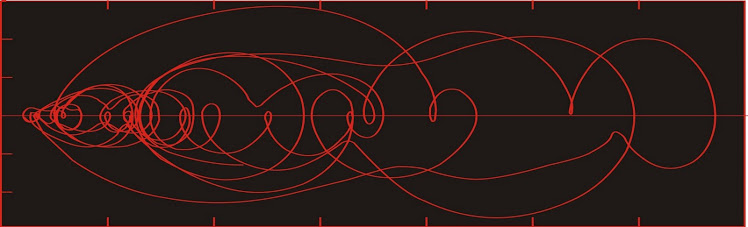
Dust flux, Vostok ice core

Dust flux, Vostok ice core
Two dimensional phase space reconstruction of dust flux from the Vostok core over the period 186-4 ka using the time derivative method. Dust flux on the x-axis, rate of change is on the y-axis. From Gipp (2001).
Showing posts with label war. Show all posts

Sunday, September 24, 2017

Massacre

A few days ago, air raid sirens went off all over China. I asked one of the locals if we should report to a shelter; he told me not to worry about it. The sirens were not for any foolishness emanating from North Korea, or even the United States, but were commemorating the invasion of China by Japan in 1931.

In Nanjing, the invasion culminated in a massacre that killed an  estimated 300,000 people in late 1937 (but this number is still a matter of some controversy)..This event is commemorated in a large memorial in Nanjing. In fact, it is a very large memorial. Too large to find a good vantage point to photograph the whole thing, except maybe by air.


Also, I have to say it is an ugly monument. Perhaps this was the intent, as it commemorates an ugly event. One of the first areas you pass consists of statues showing varioius outrages committed by Japanese troops.


One thing I found disturbing was the display of the contents of one of the mass graves, over which the monument was built. The remains of approximately 10,000 people were found in this one mass grave, and the display consists of a large number of bones from it. The disturbing part was the number of pictures people took of the scattered bones, although to be fair, at least none of them appeared to be selfies.

Tuesday, September 24, 2013

Is war really the health of the State?

I've just started looking at this paper (link corrected) by Turchin et al. (2013) (model results here). The basic premise is that the organization of humanity from small hunter-gatherer tribes into cohesive states was driven by intense competition between neighbouring groups--such competition being in the form of warfare. Cultures which developed superior military technology (cavalry, chariots, strategy) defeated their neighbours, which then either adopted the culture or were annihilated.

The model was run on a realistic landscape of the Afro-Eurasian landmass, and the authors claim that the results mirror the historical record nicely, suggesting that war and geography are the key controls on the development of the nation-state.

All figures below come from the Turchin et al. (2013) paper.


Imperial density map (visual likelihood that any particular 100x100 cell 
was occupied by part of a large-scale political unit) during time-slices from 
1500 BCE to 1500 CE.

I'd like to put together a more detailed critique in the future when I have a little more to digest it. My first impression of the model output is that I am not as optimistic about the model as are the authors. To me, it looks like the real world is a lot more culturally cohesive than any of their model outputs.


Imperial density map for 500-1500 CE. History (at left) vs. the model (right).

Reality is richer than the model (it usually is), although the model better matched history in earlier time-slices. I think the authors' world view is somewhat bleak, but admit that it is probably a fairly good explanation in the earliest stages of human history. In later stages, I think cooperative trade played a much larger role the transmission of cultural norms and the formation of large states.

h/t Non Equilibrium Social Science

Reference:

Turchin, P., Currie, T. E., Turner, E. A. L., and Gavrilets, S., 2013. War, space, and the evolution of Old World complex societies. Proceedings of the National Academy of Sciences, early edition (Sept. 23, 2013). doi: 10.1073/pnas.1308825110

Thursday, January 24, 2013

The temple builders

So many of us in life start out building temples: temples of character, temples of justice, temples of peace. And so often we don’t finish them. Because life is like Schubert’s "Unfinished Symphony." At so many points we start, we try, we set out to build our various temples. And I guess one of the great agonies of life is that we are constantly trying to finish that which is unfinishable.
                             - Martin Luther King, 3 March 1968

One fact of life is that we can't fulfill all of our dreams. We have only limited time and resources. But modern life has a major additional obstacle which makes building temples more difficult than it needs to be--government. In particular, government's confiscation of resources which you might choose to use for your own benefit.

 - - - - - - - - - - - - - - - - - - - - - - - - - -

Bali is full of temples. Not only are there large public temples and town temples, but every home has a temple as well.


Temple in a lake. Too tired to look up its name.

The family temples start off simple, using blocks cut and fabricated on a mass scale from sandstone or lava. The temples are nevertheless ornate as the blocs are combined in an exceptionally creative manner, and decorated with intricate finials. As the family becomes wealthier, they will add more finials to the gate, and the temples themselves, as well as add more (pagodas), decorate them with finials of stone or metal. It is clear that a significant portion of the family's capital and time have gone into them. Temples are key focal points for the family, and the village.


One shrine within a homeowner's temple

Lest you feel superior for not succumbing to superstition, I should remind you (as a North American or European) also devote a large portion of your income to the building of temples. However, these temples are not in your backyard, nor do you have much input into them. Instead, your income is diverted, often before you see it, towards temples built supposedly on your behalf by your elected representatives. Examples follow:

 Source: mindfrieze
Here's a Canadian one. Source: Jcart1534

Did you ask for these? Did you want them built? Would you have built a different temple with your resources had they not been taken from you? Did building them fill you with serenity?

Have you seen the upkeep on them (especially the first two examples)? At least when you build a temple in your backyard, if you can't afford the maintenance, you can let it fall apart. What happens next is between you and God. But you aren't given the choice to let the Pentagon fall apart.

It's already hard to build the temples you want to build. Building a bunch of temples you don't want makes it harder.

Monday, September 19, 2011

Brilliant discovery in economics: A review of Johansen and Simonsen (2011)

This paper shows the kind of brilliant research that gets done now that economic commentary is only pursued by Ph.D.s.

In this paper, Johansen and Simonsen (2011) come to the surprising conclusion that (spoiler alert!) the US economy operates on Keynesian principles; which differs significantly from its official policy of creating credit whenever a problem appears.

The principal evidence offered in support of the author's conclusions is the following chart, showing that both the value of the Dow Jones Industrial Average (DJIA) and the amount of public debt have increased logarithmically since the late 18th century. And since correlation implies causation, the rise of the DJIA must be due to the increasing public debt.

Correlation between DJIA and U.S. public debt. From Johansen and Simonsen (2011).

Now that we understand how the economy works, it becomes clear how we move forward. Raise public debt. Boost the DJIA! The trickle down effects on the economy shall enrich us all.

Notice how public debt jumps at particular intervals--especially around 1812, 1860, 1914, 1940, and steadily after about 1965. These increases in debt relate to wars, proving the Keynesian adage that war is good for the economy.

Of course there might be a few other variables that increased over the same time, which might also contribute to that rising DJIA.

Population increased, as did infrastructure construction and economic activity. Might these factors have influenced the DJIA? Most of that economic activity had nothing to do with wars, but did have a lot do with increasing the American standard of living.

Probably the most important factor is the increased availability of cheap energy.

Looking at the chart again, I worry a bit about that last increase in the DJIA just before the end of the chart. Looks like it's about 5x more expensive than the historical trend. Quick! Somebody borrow more money!

Reference:

Johansen, A., and Simonsen, I., 2011. Keynesian Economics After All. Submitted (but they don't admit where).

Tuesday, July 26, 2011

Feces-throwing primates rule the world!

As humans have a primate origin, sometimes we can gain valuable insight into human behaviour by studying primates. For instance, primates are known for throwing shit at things when we are angry.

It is true we don't literally do this anymore. Well, not often. But it is still embedded within our psychology. In our language--we might say, "my boss just shit all over me after presentation," or perhaps, "I'm tired of all your crap", or even, "let's go over there and beat the shit out of them!". 

I find it terribly amusing and a little frightening to consider that psychologically we do not much differ from those little monkeys up in the trees throwing shit at each other.

Only we have rockets and nuclear weapons.

In fact we can view the history of warfare as the development of better and better means of throwing shit. The relentless march of technological progress in warfare has been driven by the need to improve three parameters--1) range; 2) accuracy; 3) explosive yield.

Over the years we have progressed from the invention of the catapult to the ultimate dream of primate-kind--brave American technicians sitting in bunkers in Nevada hurling shit at unsuspecting Afghan villagers by remote control. Intercontinental shit-throwing!

We've even managed to hurl some of our shit right out of the solar system!

The war policy of the western powers ever since WWII has been predicated around throwing large volumes of shit from aircraft. Victory through air power!

Viewing some of our modern political problems through the prism of our primate past may provide an interesting perspective.

There is currently considerable consternation over the Iranian regime developing the ability to hurl shit 2,000 km. Why a country that can hurl shit right out of the solar system feels this is a problem is unclear.

There is a lot of noise coming from Israel, which is close enough to be struck by the Iranian shit-flinging devices. But they have tremendous retaliatory capacity--enough to completely bury Iran. Nevertheless they endlessly lobby the US to ensure that American shit will be added to Israeli shit in an attack on Iran.

Meanwhile, the shit-throwing continues in Libya.


"As of March 20, Royal Canadian Armed Forces have been ordered to begin 
flinging poo at forces loyal to Colonel Qadaffi."