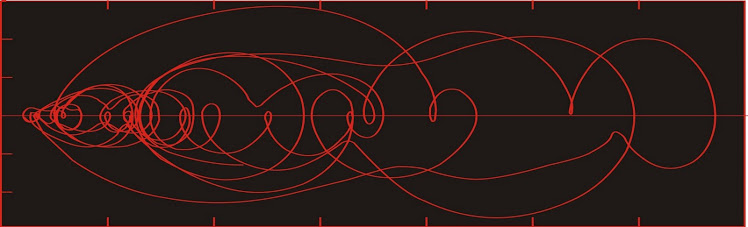
Dust flux, Vostok ice core

Dust flux, Vostok ice core
Two dimensional phase space reconstruction of dust flux from the Vostok core over the period 186-4 ka using the time derivative method. Dust flux on the x-axis, rate of change is on the y-axis. From Gipp (2001).
Showing posts with label carbon. Show all posts

Friday, November 16, 2018

Anthropocene exhibit at the AGO

Last week I took my son to the AGO to see the Anthropocene exhibition. There were other things I wanted to see as well--mainly the famous staircase.


The Anthropocene Project is about reclassifying our current geological age as one dominated by human activity--at least on and around the Earth's surface. An important goal of the project is to be "revelatory rather than accusatory", and the pictures certainly are a revelation.


The gallery was well attended, mainly by families, and with some of the enriched content (encoded digital goodies that could be seen on your smart phone, or with supplied ipads), the kids that were there remained interested.

I was struck by the printing of some of the images, which almost seemed three-dimensional to my eye.

Unfortunately, there was something of a sour note at the end of the exhibit. At the exit, there was a small exhibit which was only superficially connected to the main exhibition. In fact, I thought it struck a bit of a sour note.


The image shows the concentration of carbon dioxide in the atmosphere. In the same room, there was a survey, where you were permitted to choose one word to summarize your feelings about this display. Of course, it isn't clear if it is about the non-accusatory Anthropocene exhibition, or the short CO2 exhibition. Most of the words you were allowed to select (there were seven) were synonyms for alarmed. There was also one for relaxed and one for suspicious, in case you were a Trump supporter or a conspiracy theorist.

The goal of the Anthropocene project is informing, not alarming. But someone, presumably at the AGO wants you to be alarmed.

There were plenty of other exhibits at the gallery, but we didn't stay much longer. We climbed the staircase.


The top of the staircase ended in a gallery which was closed. Partway down, we entered the modern art exhibit.


A plaque tells us the artist is sealed in the cocoon on the floor.

Wednesday, July 8, 2015

Noise reduction and analysis of a long reconstructed record of atmospheric CO2

The CO2 record used last time was presented (largely by interpolation) at 100 year intervals. This provided rather more data than were really needed for the analysis that I had in mind. To produce the plot in yesterday's post, I subsampled the data to produce a record with sample intervals of 1000 years.

The first step is to define regions of stability over each time window. To do this, we reconstruct phase space portraits for each window of data (anywhere from 100 to 200 ky)*.


These graphs have previously been described as looking like they were constructed on an etch-a-sketch. I would say the one on the left looks more like the etch-a-sketch drawings I remember. I would have posted a link to the Zerohedge comments, but the site was down.

Both of the above graphs represent reconstructed phase space plots constructed over a 100-ky window. The one on the left is constructed from a time series with a 100-year sample interval. The one on the right is constructed from a time series with a 1000-year sample window (90% of the data were discarded). At the scale of my investigation, the overall structure of both graphs is the same. The higher resolution data just provides a noisier version of the well-known partially vivisected kangaroo formation.

Many paleoclimate records analyzed in this way commonly show multistability (interpreted as more than one possible equilibria). Multistability may be demonstrated in reconstructed phase space portraits through variable density of observations in phase space.


The above figure shows the successive evolution of the state space through time at 1000 year intervals. Between about 110 and 20 ka, the system evolved through phase space only very slowly--times of slow evolution suggest stability.


Multistability is probably best inferred from phase space density plots. The graph above suggests at least two major areas of stability (perhaps four if you are a splitter rather than a lumper).

Once regions of stability are identified, the next task is characterizing climate by the sequence and timings of the transitions between different regions of stability.

- - - - - - - - - - - - - - - - - - - - - - - - - - - - - - - - - - -

*Note ky = thousand years (i.e., an interval)
ka = thousand years ago (i.e., a specific time)
Similarly, Ma = million years ago, and My = million years (interval)

Tuesday, July 7, 2015

Stability of atmospheric CO2 over the last 20 million years

I've been playing with a "record" of atmospheric CO2 over the past 20 million years for some time, using the reconstruction of van de Wal et al. (2011). Today's graph is a representation of the various regions of Lyapunov stability teased out from state space reconstructions of segments of the data (windows), ranging from 150 to 250 ky (thousand years) in width.


The red dots all represent regions of stability defined using the methods described here. The blue dot represents approximately today's atmospheric CO2 concentration, which is about where it was 10 million years ago. More later, but I need to go for a walk now.

Sunday, July 6, 2014

Some notes on network and hierarchy in complex systems

Well, now, this is an interesting point of view.

But it is a false dichotomy. It is like titling an article "Men vs women--which will win?" when in fact life goes better when both are present.

I offer a little perspective from the natural world. Networks and hierarchies are both present in complex natural systems. In fact, the two appear to be inseparable. There is presently considerable debate as to what exactly the role of each is in complex systems which are both robust and adaptable.

Natural complex systems show a complex hierarchical structure, which can be partially extracted using some of the techniques described on this blog here and here, and presented here and here. The technique represents an extension of the method of reconstructing state spaces from observations of a single variable--the more recent work (including much in progress) suggests that a hierarchy of processes from large-scale tectonic evolution to shorter sea-level variations to shorter-still climatic cycles driven by variations in the earth orbital parameters can be extracted from a 20 million-year long "record" of atmospheric CO2 (reconstructed from isotopic records from sediments).

The figures below show multiple regions of stability for atmospheric CO2 at different points in time (ka means thousands of years ago). Although the amount of global CO2 has varied widely over the last 20 Ma, there is always stability in the system, which is due to the network architecture of global climate (whether we would be happy at radically different levels of atmospheric CO2 has not been established).


We are able to indirectly perceive the hierarchical structure of the earth system, but cannot deduce the detailed structure of the hierarchical levels. To interpret these we look at what we do understand about the earth system. It appears that each level in the hierarchy is composed of interlocking networks. The network architecture is largely responsible for the stability of the system, by way of interacting feedbacks, both positive and negative.

Although this aspect of the science is young, there is much to suggest that the hierarchical structure is responsible for the interesting behaviour of complex systems. Hofstadter argued that improperly nested hierarchical structure may lead to evolution in the behaviour of complex systems (his argument related to the origination of conscious thought within natural and artifical brains).

The hierarchical structure lends itself to adaptibility--although the networking is a necessary part of this. High-level hierarchical changes lead to stunning reorganizations of complex systems--which the network architecture allows to happen without the system dissolving into chaos.

An unfettered economic system will naturally develop both networks and hierarchy--both of which are key to its healthy operations. Think of what Ford Motor Co. was like 60 years ago--or what Google was like (before we knew it was telling everything it knew about us to the bad guys).

The conflict today is not hierarchy vs. networks--the conflict is between an artificial hierarchy that has been superimposed on the economy by agents with political power--which is siphoning wealth and power from the system--and the natural hierarchical agents that have arisen through natural organizing processes.


Saturday, May 17, 2014

A clear example . . .

. . . of the extremely rare "high-heeled-shoe" formation.


Data sourced from van de Wal (2011). The inferred data are accessible from the supplementary material (instructions to retrieve are in the paper, which can be found here).

The heel is a transient signal which is almost certainly an artifact of the method of approximation used by the authors. Even that spike transient, on the scale of our investigation, implies it takes the natural system at least 2000 years to reduce atmospheric CO2 from 400 ppm (roughly today's value) to 380 ppm.