Dust flux, Vostok ice core

Dust flux, Vostok ice core
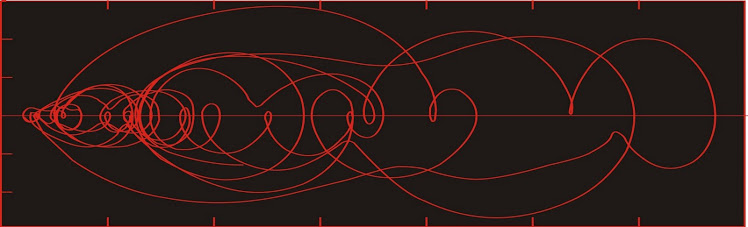
Two dimensional phase space reconstruction of dust flux from the Vostok core over the period 186-4 ka using the time derivative method. Dust flux on the x-axis, rate of change is on the y-axis. From Gipp (2001).
Showing posts with label climate change. Show all posts

Monday, February 24, 2020

I read the news today, oh boy

Things are happening quickly, but I've been tied up with various health maintenance issues and have not been able to keep up. It would help if I could sleep, but that has been beyond my reach for most of the past week. Since multistability is in the purview of this blog, we may consider consciousness to have several metastable equilibrium states, some of which lie in the realm of sleep, and some of which lie in the realm of wakefulness. I am stuck in the one best characterized as "tired and wired". To go to sleep I have to leave one metastable equilibrium and migrate to one in the sleep portion of state space. Unfortunately, it is as if I have forgotten how.

Two stories that are of interest to me and (I think) are somewhat related are the decision by Teck Resources to withdraw its application for development of its proposed Frontier Mine oilsands project.
The company cites the inability of government (Canada) to square the circle with its stated objectives of mitigating climate change and supporting resource development.

The government had been preparing to announce a decision about the project shortly. Now it seems they no longer need to.

Coincidentally, this morning police moved in to disperse protesters around the rail blockade in Tyendinaga. The RCMP also moved in on Unist'ot'en territory in northern BC, presumably to disperse protestors there as well. I haven't seen statements by the protestors and their allies about the reason for this move, but I suspect it has to do with the Canadian government's inability to square the circle with its stated objective of native reconciliation and a (subtly) unstated objective of ensuring corporate profitability.

This move, to me, looks like it was to signal the government's intention to approve the project. Until Teck decided to discontinue the project

The Teck decision, I think, is based on rather more than has been stated. Years ago I owned a pile of shares in an entity called Fording Coal, which in its brief life made a respectable amount of money, no doubt leading Teck to buy out Fording's stake in the Elk Valley project. In reflecting on Teck's assets--a lot of coal, oil, and oilsands projects--and I couldn't help wondering whether somebody in management might be thinking about a need to scale back on carbon-intensive energy products. That perhaps someone in management might be thinking that it is better to sell off these components of the company, because their value may shortly begin to fall, and the longer they wait, the less they will get for them. I think this viewpoint must still be a minority viewpoint within the company, but it is there nonetheless.

From an economic standpoint, the rise of e-cars (much of which is going to be legislated), means lower sales of oil products going forward. Is now the time to be developing large oil sands mines--especially given the political uncertainty around developing pipelines to take the stuff to market?

Saturday, January 18, 2020

The History of the East Asia Monsoon

So I went to Washington DC last week for the AGU Chapman Conference on the East Asian monsoon. I found it to be a very rewarding conference, and even learned a bit about navigating around Washington on transit, as I was on a limited budget.

The conference was in AGU headquarters, which is near to Dupont Circle.


Not all that far from the Mall, although I didn't visit this time.


Speaking of scientists . . .

I was speaking during the opening session, which was about climate dynamics (and its role on the changes in monsoonal strengths through geologic history). A major dynamic role has been the rise of the Himalayan mountains and the Tibetan Plateau during the period of interest, and there is still a lot of debate about the importance of these tectonic events on the development of the monsoon. Some of the modeling studies suggest that the mountains only change the specific location of the rainfall, and that monsoon behaviour may occur even if there were no continents at all.

My work was based on analysis of global to regional proxy data sets, and has been summarized in all these places. Unfortunately, due to limited time, after working through the phase space reconstructions, I had to rush through the statistical computation part, and wasn't certain whether any of the message made it to the audience ungarbled. Fortunately, I was able to learn that at least some members of the audience understood the message.

The afternoon sessions were all about paleoceanographic records of the monsoon. Over the past decade, the International Ocean Discovery Program (IODP, formerly ODP and DSDP) has put down a number of boreholes in the Indus and Bengal Fans, and other boreholes in the Huang He fan and the Sea of Japan also provide useful records of at least some parts of the monsoon. The records I studied were generally global in scope--these other records allow for regional variations to be studied.

The next day's sessions dealt with continental environments (a common issue was the change in photosynthetic pathways of plants in response to environmental change during the Miocene) and records of continental erosion. Erosion is important because either rising mountains or increased rainfall will lead to increased erosion.

The last session was on modeling the effects of tectonic uplift as well as changes in the timing of the uplift, because there is still some disagreement about when the Tibetan Plateau was formed. I mean disagreement between it being less than 10 million years ago to more than 40 million years ago, which is a significant difference of opinion for something so recent.

The last portion of the conference was to break up into groups for focussed discussions on topics of interest leading to the testing of several hypotheses proposed at the start of the conference. I started off in the wrong room, so I was  with the tectonic modeling people rather than the climate modeling people, but was still able to ask about whether anyone had successfully had chaos appear in their model output. Results were inconclusive.

For the second group meeting I joined the combined discussion between the climate modelers and the paleoceanographic records group. Over the course of the discussion I eventually managed to come up with a proposal. See if the modelers observe chaos, and see if they can tell which style of chaos they have. Such chaos will be manifested as spatial variability in some climate effects, such as the location of the maximum rainfall. The models may have the type of spatial variability modeled correctly, but the specific timing of variations will be incorrect. That spatial variability will be recorded in the widely spaced paleoceanographic records which already exist. They type of chaos observed in the models will tell us what to look for in the cores; from the cores we can obtain the correct timing of the modeled chaotic spatial variations of the monsoon system.


Exiting the Metro Station at Dupont Circle

I wasn't sure how the last part of the conference would go--early on, many of the old hands were of the opinion that nothing ever comes from these things. But I thought it was pretty rewarding, particularly as it was during these sessions that I came to realize that people felt that whatever I was doing was worthwhile.

Alone in my corner of the world, I had never been sure.


Night flight back to Toronto

Friday, November 16, 2018

Anthropocene exhibit at the AGO

Last week I took my son to the AGO to see the Anthropocene exhibition. There were other things I wanted to see as well--mainly the famous staircase.


The Anthropocene Project is about reclassifying our current geological age as one dominated by human activity--at least on and around the Earth's surface. An important goal of the project is to be "revelatory rather than accusatory", and the pictures certainly are a revelation.


The gallery was well attended, mainly by families, and with some of the enriched content (encoded digital goodies that could be seen on your smart phone, or with supplied ipads), the kids that were there remained interested.

I was struck by the printing of some of the images, which almost seemed three-dimensional to my eye.

Unfortunately, there was something of a sour note at the end of the exhibit. At the exit, there was a small exhibit which was only superficially connected to the main exhibition. In fact, I thought it struck a bit of a sour note.


The image shows the concentration of carbon dioxide in the atmosphere. In the same room, there was a survey, where you were permitted to choose one word to summarize your feelings about this display. Of course, it isn't clear if it is about the non-accusatory Anthropocene exhibition, or the short CO2 exhibition. Most of the words you were allowed to select (there were seven) were synonyms for alarmed. There was also one for relaxed and one for suspicious, in case you were a Trump supporter or a conspiracy theorist.

The goal of the Anthropocene project is informing, not alarming. But someone, presumably at the AGO wants you to be alarmed.

There were plenty of other exhibits at the gallery, but we didn't stay much longer. We climbed the staircase.


The top of the staircase ended in a gallery which was closed. Partway down, we entered the modern art exhibit.


A plaque tells us the artist is sealed in the cocoon on the floor.

Thursday, October 11, 2018

The new New Age

Anthropocene is a movie which appeared in the Toronto Film Festival this year. It has since gone on to appear in a few cinemas hereabouts.

It is a visually striking film. But if you are already familiar with its message, it is a little slow.

The movie trailer is unfair to the gentleman from Hong Kong who owns the ivory shop. All of the ivory depicted in his segment in his store is fossil ivory, something made clear in the film, but not the trailer. I went to one such shop when I visited Hong Kong--if you want a carved tusk, you can have one for about the price of a house.

I first encountered the term "Anthropocene" as a proposed name for a new geological epoch--one in which the forces modifying the earth's surface are dominated by human activities--in 1987 or 1988, in an issue of Geology. I only remember the time because it was when I was in Newfoundland, and looking back casually through recent publications only shows more recent references.

The original article was very short, and as I recall, attracted a firestorm of responses in the form of letters to the editor. Most of these suggested alternative names to this epoch, ranging from "Neocene" and "Cenocene" (often accompanied by dry, pedantic discussions about why one name was superior to another), but there was one clever wag who proposed we call this new epoch the "Shouldhavecene". Yes, we should have.

Anthropocene seems to have won out, or at least it has the upper hand.

Thirty years ago the world was a different place. At the time the first article appeared, it seemed like a joke, this idea that humans could dominate the surface features of the planet. Part of this is a kind of blindness. Grow up in cities surrounded by farms and this landscape seems like the most natural in the world. Add to this Canada's managed forests, some tourism commercials, and it was easy to think that nearly the entire country was untouched wilderness.

Onwards in the theme of human impacts on the world. Yesterday we had the second (annual?) Progressive Mine Forum, held in the MaRS Discovery District, which is a sort of breeding tank for tech industries. It covered numerous themes related to modernizing the industry, from mechanization, reducing fossil fuel usage, "green" mining, battery metals, and so forth.

Quote of the day: "You know who likes big trucks? Ten-year-old boys and mining engineers." I think that was Nathan Stubina of McEwen Mining.

Interesting idea of the day: Just as Uber is the largest taxi company in the world (which owns no taxis) and Airbnb is the largest hotel chain in the world (which owns no hotels), might there arise a large mining company that owns no mines? The speaker, George Hemingway of The Stratalis Group mentioned that Apple is proposing to use only recycled material in their products. What if they do the recycling? What if they became so good at it that they begin to supply recycled material to everyone else. Apple (or any other large tech company) has a huge advantage over traditional mining companies--they have no trouble attracting financing to projects with no projected return.

Tuesday, July 7, 2015

Stability of atmospheric CO2 over the last 20 million years

I've been playing with a "record" of atmospheric CO2 over the past 20 million years for some time, using the reconstruction of van de Wal et al. (2011). Today's graph is a representation of the various regions of Lyapunov stability teased out from state space reconstructions of segments of the data (windows), ranging from 150 to 250 ky (thousand years) in width.


The red dots all represent regions of stability defined using the methods described here. The blue dot represents approximately today's atmospheric CO2 concentration, which is about where it was 10 million years ago. More later, but I need to go for a walk now.

Monday, May 27, 2013

Denial of authoritarianism--no, end the Fed

Salon has an article on denial of science by mainstream society. The article asks why people deny the unpleasant truths that modern science has to offer--apparently preferring to chance of the impending hell of global warming and non-fluoridated drinking water.

The thing the authors don't understand is that the general public is not pushing back against the science per se. They like the science. Science gives them big, flat-screen TVs, Blu-Ray players, cars, airplanes, special effects, laptops with more computing power than ENIAC, the internet, and so forth. They love science.

They don't like authoritarians telling them what to do. So bugger off.

-  -  -  -  -  -  -  -  -  -  -  -  -  -  -  -  -  -  -  -  -  -

Okay, I'm a little calmer now. There is another point in this entire discussion I would like to mention.

Past environmental issues have been dealt in a top-down, authoritarian fashion. Acid rain and ozone depletion were both attacked, with considerable success, by legislating against the sources. But this only worked because the main sources were few in number, easily tracked, and there were solutions available for the problem. CFCs were replaced by other coolants with less effect on the ozone layer, but this solution was only possible because the alternate coolants existed.

In earlier articles we have discussed the issue of multistability in the climate system. During periods of relative stability, negative feedbacks dominate, with the effect that the system appears to resist changes. The capacity for resistance to change is not infinite, and eventually a tipping point is reached, beyond which positive feedbacks dominate, leading to very rapid change. This idea would suggest that the climate system will resist changes to atmospheric composition for a time, which may be why there hasn't been the warming that was predicted by the IPCC models (pdf).

Governments would like people to stop emitting so much CO2 (through driving, power requirements, and industrial use). Well, alright then. 1) What replacement is there that won't significantly impact on lifestyle; and 2) has the government considered its role in the CO2 problem?

In an earlier article I discussed how the increasing number of disasters in the US is more a function of urban sprawl than any increase in frequency of natural events.

A big part of the reason that per capita CO2 emissions are higher in North America than in Europe is our urban structure--in particular the vast suburbs that surround most city centres. The big suburbs mean lots of people commuting, but the density of the sprawl is too low to favour high-capacity transit.

Big suburbs are only possible due to easy money. With no easy money, working families would not aspire to owning (alongside their bank) a huge home with a vast lawn and with neighbours within 5 m. Without easy money there wouldn't be two or three cars in the driveway.

Governments like this model of city development--it gives people hope, which helps keep the system going. Banks certainly like it--there's a lot of interest payments stretched out over 30 years, and until recently, people would practically starve rather than miss mortgage payments. People imagine they are happy, although I wonder what the future generations will think of people who willingly bought homes that took 30 years to pay for, instead of the more historically common few weeks to months. But I don't think the owners of these houses have done as well on the deal as the government or the banks.

So having created the template for massive CO2 emissions, the authoritarians wish to deny responsibility and shift the blame to their debt-serfs. Because the debt-serfs are refusing to absorb the costs, the authoritarians decry their denial of science.

If you really care about global warming, end the Fed.

Thursday, November 8, 2012

The creeping death of a fishery: Ghana (1980-2012)

On the short cool afternoons on our complex outside of Accra, we go up on the balcony, beverage in hand, and contemplate the sea.


Unfortunately the view isn't as good as it used to be, as there has been an explosion of building along the coast, especially hotels. In particular, hotels between us and the beach. So the picture above (taken last year) is not exactly current. But you can occasionally get a glimpse of the fishing boats returning in the afternoon between the block wall that now obscure our view.

Here's how it works. Around sunset, the fishing boats sail off and in the late morning--or possibly the afternoon, they return. The fishing is still pretty good near Accra if you go far enough offshore. The late upwelling has prolonged the good catches this year.

But fishing is meager in the eastern and central portions of Ghana. There used to be far more boats plying their trade than do now.

The artisanal fishery is of critical importance. Nearly 25% of Ghana's population lives in the coastal zone. Until the past decade, approximately 10% of the population depended on the fishery for their livelihood (Quaatey, 1996). It seems that that number has declined in recent years. I recall seeing estimates exceeding 30% for the amount of protein in the Ghanaian diet that came from the sea.


Climatic fluctuations over the past fifty years are reflected in the catches of artisanal fishermen (Minta, 2003), but it is not as clear whether the more or less monotonic decline in fish catches over the past decades can entirely be laid at the feet of climate change. Different species respond in different ways to climatic fluctuations--the most important being temperature, rainfall, and strength and duration of upwelling. But against climate change we need to consider the backdrop of changing technology in both the artisanal and mechanized fishing fleets.

In 1996, when I began work in coastal Ghana, I saw significant fishing fleets at many villages along the coast. In particular, the village of Nakwa, at the mouth of the Nakwa River, behind a lagoon fronted by an impressive sand barrier, had a large fishing fleet full of vessels at least sixty feet in length which landed on the barrier. The fishing boats were brightly painted and festooned with colourful banners. There were ferries constantly running across the lagoon between the village and the landing ground for the fishing fleet.

Two years ago I ran a sidescan sonar survey out of Nakwa between the river mouth and the offshore oil platform (GNPC-Saltpond). The fishing fleet was gone, but for a couple of dilapidated wrecks drawn up on shore. The locals told me there was no more fishing--anyone from the village who wanted to fish had to travel 150 km west to Axim, where the fishing was still good.


Nakwa lagoon in 2010.


Flaring gas near Saltpond.

In 1997, in the course of offshore work near Axim, we encountered the artisanal fishing fleet several km offshore at night. The canoes all used lights to lure the fish in where they could be netted. At the time, this was the most technologically sophisticated method of artisanal fishing. Since then, new technologies have been deployed, including underwater lights and the use of chemicals.

The use of technology by the artisanal fishing industry varies from locality to locality. In the far west of Ghana, there has been an attempt to manage the fishery by limiting certain methods (CRC), but such efforts are nearly always local.

This year (so it has been reported), the fishing has ceased off Axim, and the fishermen have been forced further west to Cote d'Ivoire.

Overshadowing the increased efforts of the artisanal fishery is the steady increase in industrial fishing effort.

In 2010 I observed pair-trawling (which is illegal in most places). Sidescan surveys show that the seafloor is crossed by abundant trawl marks, even in nearshore areas that are supposed to be off-limits to such techniques. Trawling disturbs large areas of the seafloor, reducing marine productivity for years.

As the trawling has entered into the waters which were reserved for the artisanal fishermen, it is little surprise that the inshore fishery has suffered.


References


[CRC] Coastal Resources Center / Friends of the Nation (2011). Assessment of Critical Coastal Habitats of the Western Region, Ghana. Integrated Coastal and Fisheries Governance Initiative for the Western Region of Ghana. Coastal Resources Center, University of Rhode Island,132 pages.

Minta, S. O., 2003. An assessment of the vulnerability of Ghana's coastal artisanal fishery to climate change. M. Sc. thesis, University of Tromso, Norway.

Quaatey, S. N. K., 1996. Report on the synthesis of recent evaluations undertaken on the major fish stock in Ghanaian waters. Marine Fisheries Research Division, Fisheries Directorate of the Ministry of Food and Agriculture, Tema, Ghana.

Tuesday, October 16, 2012

A worrying data point . . .

. . . in the climate change debate.

West African climate is monsoonal. The rainy season here in Ghana runs from about March to November (with some fluctuation). In the middle of the rainy season is a short dry spell which is caused by the upwelling of cold waters in July and August. This upwelling is a critical time for fish spawning as it leads to algal blooms. When the cold water rises to the surface, warm humid air offshore condenses and the rain falls on the sea.

Since my arrival I have noticed how cool it is here, especially by the coast. From the local fishermen, I have heard that the sea is unusually cold for this time of year, and the fishing is unusually good. It would seem that the upwelling which normally ends in August or at latest the first week in September has persisted now into the middle of October.

The upwelling means more algal blooms, which ought to be visible on NOAA imagery. I have always thought that the upwelling here was driven by south Atlantic winter storms--does anyone know if the Antarctic winter was unusual in this regard?

Saturday, October 6, 2012

September Arctic sea ice chart buster

Further to this post, we append new measurements for September of 2011 and 2012 to the state space for Arctic sea ice.


I apologize for the cartoonish extension, but I can't find my original data file and don't want to recreate it just now.

Since the system broke out of the area of stability in 2004, there has been a rapid decline in September ice extent (September is normally the minimum for Arctic sea ice extent)--to what some observers believe will be a new zone of stability at approximately zero.

I'm an optimistic kind of guy. It looks like we may be forming a new zone of stability right around the values of the last three years, but need to stay here for several more years to be sure. And it is of some import to note that Antarctic sea ice has been increasing over the same period, so it may be we may be observing some kind of multi-decadal oscillation in sea ice volumes between the two hemispheres. As I've said before, we need more data.

Friday, June 8, 2012

Innovation in earth systems poster presentation

Presented at GAC in St. Johns early last week.


It looks like it can't be enlarged in this format. Later I'll try breaking it up into different panels and posting separately. The 3-d projection at lower right will be the hardest to present.

Update:

This is just the long 3-d image set at original size. Not sure about your best viewing options.


The main issue I note is that after trying to trace particular attractors through all of the different windows all at once, my interpretation of the number of areas of Lyapunov stability is a little different than when I looked at them sequentially. I now think that the ice-minimum attractor in the Early Quaternary is the same as that in the late Quaternary, even though the range of O-18 values represented in it has drifted over the last two million years. In earlier postings I had interpreted these as different attractors on the basis of the different values.

Secular drift in the positions of attractors in phase space speaks to slow changes in governing parameters of the climate system. On the scale of two million years, likely candidates are tectonic uplift (particularly around the North Atlantic), strengthening of the modern oceanographic circulation system after the closing of the Panamanian isthmus, drawdown of atmospheric CO2 due to enhanced erosion of uplifted highlands--at least these occur to me off the top of my head.

Friday, June 1, 2012

Sea level rise will not be illegal . . .

. . . just ill-advised.

recent blog posting on SciAm states that North Carolina has declared sea-level rise to be illegal.
This could potentially be a brilliant solution, depending on your political persuasion and/or view of reality. Perhaps they can do the same for global warming.

Upon closer inspection of the legislation states something different.


(sourced from here)

It looks here like the legislation limits who can make projections about rising sea levels. Not that this isn't a serious issue--as it is possible that the "Division of Coastal Management", being a political body will provide sea level estimates that satisfy its client--but this is a far cry from declaring sea level to be illegal.

The legislation also limits the kind of projections which can be made. Never mind what the data may show, extrapolations have to be linear.

The penalty for such foolishness will be under-insured, ill-advised construction projects in soon-to-be-inundated coasts. The cure would normally be to make the General Assembly responsible--but that seems a little unfair as the penalties would simply be paid by the taxpayers of the state. Dumping the mess into the hands of the insurance companies could work--they at least have a lobby that might push the government to do the right thing (something the taxpayers lack), although they, too, would probably just get bailed out by the taxpayers.

No, the taxpayers are simply going to have to break out the torches and pitchforks.

Saturday, February 4, 2012

Temperature records from the North Atlantic show cyclicity

Let's consider this post to be an update of an earlier missive about possible climate change from Arctic records.

Change in state for Arctic sea ice?

In the article linked above we agreed that the recent change in the extent of Arctic sea ice was consistent with warming over the duration of the records (since 1979), but this warming was not conclusively anthropogenic. Below, with minimal comment I present some records presented in a recent International Council for the Exploration of the Sea (ICES) Report on Ocean Climate (2010). (Available as a pdf here).

The following graphs are all screen caps from figure 1 of the ICES report.


I have only selected a few of the records available. What I would take from this, especially from the longer records, is that ocean temperatures have varied in a cyclical fashion over multi-decadal periods. I would also note that most of the records show warming since 1979 (although many suggest cooling over the past few years).

This is to reinforce the point I raised last time--the time-frame since 1979 is not sufficient to conclude that anthropogenic warming is responsible for the reduction in sea ice extent over the past three decades. I would go further and point out that the temperature records we look at today are not sufficient to exclude anthropogenic warming--for instance, it is not clear whether the amplitude or period of the cycles is increasing, which is an important question. But we need to recognize the importance of natural variability in any discussion of recent climate change.

Sunday, January 1, 2012

Change in state for Arctic sea ice?

The recent Arctic Report Card concludes that  . . .
 the Arctic Ocean climate has reached a new state with characteristics different than those observed previously. The new ocean climate is characterized by less sea ice (both extent and thickness) and a warmer and fresher upper ocean than in 1979-2000. 
Well, this sort of thing just happens to be a specialty here. Let's look at the data to see what they mean.

The record of sea ice can be inferred here.


The National Snow and Ice Data Center has kindly drawn a regression line through the points.

We'll use the time delay method to reconstruct the phase space in two dimensions.


The choice of a two-year time delay is somewhat arbitrary, as one year also serves. The two reconstructions do not appear materially different.

We observe that the state tends to occupy a small area in phase space, centred at about 7 million sq-km (yellow) from the initiation of the data set (1981 in this projection) until about 2002, after which the system has evolved into a new area of phase space characterized by reduced ice cover. It doesn't yet trace out anything that looks stable in this new area, so I would not exclude the possibility that it is currently tracing out a transient excursion.


The extent of sea-ice cover in November has declined in a stepwise fashion since the early 1980s. Here we have tenatively labelled three possible areas of Lyapunov stability.

- - - - - - - - - - - - - - - -

We observe a decline in Arctic sea-ice cover over the past 30 years. Like other components of the climate system, it appears that sea-ice cover is prone to sudden changes in state. The direction of the change appears to be consistent with projections of the global warming hypothesis.

The caveat is that the records presented here are too short. We cannot be certain that the period of observations--in particular those from 1980 to 2000--were representative of "normal" climate. Consequently, the statement quoted at the beginning of this post seems premature.

The 1970s were at the end of a multi-decade period of global cooling. The Arctic sea-ice cover at the end of the 1970s may therefore have been unusually large, and the observed shift to reduced cover may be simply the natural variability in the system. We can't tell for sure because we would need to observe at least one more cycle of variability, and we do not have the records we need.

The only way to obtain longer records will be through some form of proxy measurement, either through micropaleontology (dinoflagellates seem to be a favourite), or concentration of aerosols in nearby glacial ice.

Friday, December 23, 2011

Innovation in complex systems

Innovation has been on my mind a lot lately. Unfortunately, not the kind that results in iPhones and the like.

We normally think of innovation as a good thing. But not all innovations are good ones. As counterexamples, let's consider recent political innovations in the US that allow indefinite detention without trial of anyone accused of terror-related activities; or the use of Predator drones to target American citizens.

My interest has been innovation in the Earth system--particularly in the behaviour of the climate system over the past two million years. The problem with recognizing innovation is that we tend to interpret any activities in light of what we already know--consequently it is difficult to discover anything new. Our first tendency would be to explain our new observations as a special case of what we already know. We resist the idea that something new is occurring.

The Earth system is driven by a few global parameters which interact with myriads of local agents; yet contrary to expectations instead of dissolving into noise, highly ordered global-scale structure arises. We may call such structures emergent properties, and the means by which they arise is termed emergence.

The problem of how these global structures arise from multitudes of interacting local agents is, shall we say, a non-trivial problem. They are in no way predictable from our knowledge of the local interactions; nevertheless we agree that emergence is in accordance with physical laws.

In earth systems, such emergent properties include plate tectonics, glaciations, superplume events, and some mass extinction events.

The emergent properties of a system may change. These changes may or may not be related to specific change(s) on the local level. For the purpose of this essay, I am referring to such changes as innovation.

Possible examples of innovation in Earth systems include the (somewhat controversial) proposed change in mode of tectonics in Archaean time; (very controversial) Neoproterozoic glaciation (i.e., "snowball Earth"); and magnetic pole reversals.

I have been considering change in operation of the climate system during the Mid-Pleistocene (from about 1 million years ago to about 500 thousand years ago).

I present the following probability density plots of the 2-d phase space reconstructions of the ice volume proxy, produced using the time delay method with a delay of 6 thousand years. Each of the figures below is calculated from 150 thousand years of data.

Starting from the Early Pleistocene . . .


Limit cycles (green dashed ellipses) are common in the Early Pleistocene, less so later.

Areas of Lyapunov stability, labelled A1 and A2, represent relatively ice-free conditions. Current global ice volume is comparable to A2, and A1 represents even less ice than at present. Limit cycles in the Early Pleistocene (representing slow, steady growth and decay of ice sheets) start from either the A1 or A2 condition.


The Late Pleistocene is characterized by discrete areas of high probability, suggesting rapid transitions between longer periods of stability. A2 represents an interglacial condition, and A3 to A6 represent separate metastable ice configurations of greater volume respectively. A6 represents a glacial maximum condition, as we experienced about 18,000 years ago.

Climate dynamics as inferred from global ice volume seems to have changed during the Pleistocene epoch. Was it innovation?

Opinions about what happened during the Mid-Pleistocene include changes in atmospheric CO2 leading to greater glaciations, cumulative cooling in the deep ocean changing the nature of the glacial-interglacial transition, erosive uncovering of crystalline bedrock leading to greater thickness of ice sheets, and spontaneous (chaotic) change. There is general agreement that there is no obvious external forcing or any fundamental change in the low-level dynamics leading to the change in climate behaviour, so it is at least possible to argue that the climate system began to act in an "innovative" fashion (provided we state that we do not view this innovation as having been directed in any way).

Let's look at another system instead--one represented by the share price of Century Casinos.


The chart of the daily closing price looks a little like my portfolio--up to a high in April, and all downhill from there.

The two-dimensional reconstructed phase space doesn't look much different from those of other stocks I've looked at in the past.


Actually, this has been smoothed a little, using a 3-point moving average.

There appears to be nothing interesting in the share price activity over the past year--unless we look at daily high prices instead of closing prices.


And here we see something unexpected--a singular spike in share price on June 21, where the share price bounced between about $3 and $8 several times over the day, on first a one-minute timescale, and around mid-day at a one-second timescale.

To investigate dynamics on this timescale, we have to construct our time-delay phase space with a small lag.


In two seconds of trading we have numerous fluctuations between $3 and $7. Lots of money to be made here! (or there would have been had the exchanges not cancelled all the trades).

A few minutes later we get this over one second.


This is orders of magnitude different from what we see in the annual behaviour of the stock, and even considerably different from the bowl of spaghetti above. This figure actually represents a phase space portrait of a random walk. Yes, you can trade randomly if you are quick enough.

So what is the difference between the trading in CNTY on June 21 and every other day this year? Another innovation--high-frequency trading, but in a form which creates the illusion of liquidity by placing lots of orders and then cancelling them as they begin to be filled. The resulting moves in a stock can be dramatic.

Suppose an institutional investor needs to buy a million shares of CNTY (perhaps part of some proprietary arbitrage position). The buyer looks at the depth chart and sees that there are a million shares being offered at $3, so the buyer attempts to fill the order--only to discover that he gets perhaps a thousand shares, the rest of the offer is cancelled, and there are now a million shares offered at $3.05. The tug-of-war may continue, but if the buyer is motivated, the share price may rise considerably in a remarkably short period of time.

Remember that the original intent of having a bid and ask price is that the various offerings were intended to be sold. The idea that these offerings would be used only as bait and not represent real liquidity is indeed innovative, but unhelpful.

Unlike the change in climate dynamics in the mid-Pleistocene, the change in dynamics in share price of CNTY is symptomatic of a fundamental change in the operation of the market, and this change is detrimental to the majority of its participants.

Thursday, September 22, 2011

Information theoretic approaches to characterizing complex systems, part 4: Formalizing a method for optimizing window lengths for probability density diagrams from phase space

When the market looks like it does today, it is better to think about other things.

Some time ago we began looking at the problem of determining the optimum window over which the probability density of the phase space should be calculated. The problem is essentially one of optimization, where if the window is too short the probability density plot will not be accurately represented, but if it is too long, then interesting features may be smoothed out.

Once again we look at a > 2 million year proxy for the strength of the Himalayan paleomonsoon (top figure).


Reconstructing a phase space portrait over small (say 30 thousand years) intervals gives us highly variable results because of the variability in the dynamic behaviour of the system over comparatively short timeframes. As we have seen elsewhere, many of these complex climatic systems are characterized by intervals during which the state space is confined within a comparatively small area of Lyapunov stability, interspersed with intervals during which the system evolves rapidly towards another area of stability.


While confined within an LSA, the probability density will consist of a few large values spread over a small area. The entropy (in an information theory sense) will be small.

When the system is evolving towards a new LSA, the probability density will consist of many small values spread over a large area. The entropy will be large.

Successive values of entropy calculated over small time windows will show a lot of variability. Some of that variability will be due to secular changes in the complexity of the system, and some will be due to the granularity of our observations. If we start choosing longer time windows, we get tend to get both episodes of stability and bifurcation within each window, so the effects of granularity ideally vanish and only the secular variations remain.


Variability declines as the window length increases from 30 ky (thousand years) to 150 ky. Now, each of the above graphs consists of a string of data, so we can do better than eyeballing a comparison.

The methodology proposed then is to normalize each of the strings of data above, and then compare the zero-lag cross-correlation of the entropy of two successive window-lengths to the zero-lag autocorrelation of the entropy observed in shorter of the two windows.

For instance, in the figure above, the entropy observed over 30-ky windows varies from about 1.5 to 3.5. We normalize the data by dividing the difference between each observation and the mean of the series by its standard deviation   i.e. x(norm)= (x - mean)/(standard deviation)

We similarly normalize the entropy values for the 60-ky window. The zero-lag cross-correlation will have a lower value than the zero-lag autocorrelation--but how much lower is a measure of how different the two curves are. We find that the ratio of the two values improves as we look at longer windows, as below.


The graph converges in the general direction of the value of 1 as the window gets longer. A value of one would imply perfect correlation between the two entropy functions. So we choose the window length for which the zero-lag cross-correlation is sufficiently high for our purposes. In the example above, I would find that the 150 ky window is sufficient.


For the late Quaternary, a window length of 150 ky also appears suitable.

I'm pretty sure that the different rates at which the cross-correlations approach 1 in the Late and Early Quaternary paleomonsoon proxy are telling us something about the dynamics of the system over these two intervals--but I'm not yet sure what.

Tuesday, June 14, 2011

Information theoretic approaches to characterizing complex systems, part 1: complexity of reconstructed epsilon machines

Introduction

In earlier posts, I opined that the behaviour of various climate subsystems showed greater complexity in the Late Pleistocene than in the early Pleistocene. This opinion is shaped by observations of the behaviour of these varying subsystems (Himalayan monsoon strength, global ice volume, and oceanographic conditions) inferred from proxy records up to about 2 million years in length.

Any such argument would be strengthened by a number. So the challenge I will address over the next few posts in this series will be--how to characterize the complexity of the output of a dynamic series by a single number. After all, in order to compare complexity between two periods, it would be helpful to have a single parameter to compare.

The principal information theoretic concept we shall use is Shannon's (1949) measurement of entropy. The trick is deciding how to apply this parameter.

Entropy of the epsilon machine for the ice volume proxy

Let's look at epsilon machine reconstructions of the ice volume proxy.


Three separate first-order epsilon machines describe portions of the Early Pleistocene variations in the ice volume proxy. A1 represents a minimum ice state, A2 is roughly what goes for an interglacial at present, and A3 is the maximum ice state of the early Pleistocene, which would pass for a minor glacial event in the late Pleistocene.


The Mid-Pleistocene epsilon machine looks more complex.


The Late Pleistocene epsilon machine reconstruction for the ice volume looks to be more complex than any of the Early Pleistocene reconstructions. But is it? How can we tell?

The approach we will try here is to characterize the complexity by the entropy of all of the state transitions. Entropy is expressed as -ÎŁp(i)log p(i) for all values of p(i).* Entropy is considered to be a measure of the "information" in a stream of data. This expression is normally applied in systems where ÎŁp(i) = 1, a condition not met in the figures above. The probabilities of each pathway leading from each of the predictive states adds up to 1; so that the total of all "probabilities" adds up to the number of predictive states in the epsilon machine (two or three in the Early Quaternary, four in the mid Quaternary, six in the late Quaternary.


Do we add up the probabilities as they appear? Should we divide all probabilities by the total number of predictive states so we end up with ÎŁ p(i) = 1? Should we weight the various probabilities to reflect the relative importance of an individual predictive state?


Let's see what happens.


First off, consider a system based not on the proxy data, but on a model. Say, the Late Quaternary global ice volume model of Paillard (1998).


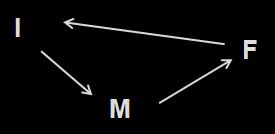
Quite provocative given the current state of the economy! Actually, the I stands for interglacial regime, the M for mild glacial regime, and the F for full glacial regime. The system bumps along from state to state, but there are no probabilities listed as there is only one possible successor state from each predictive state.


Is the above system more complex, less complex, or the same as one with a single state--say, "I".


From a dynamic system, which would use topological arguments--both systems would be equally complex (or  simple, in this case), as there is no choice of successor state from each predictive state. From an information sense, it is not at all clear the two systems are the same.


I M F I M F I M F I M F I M F I M F . . . 


I I I I I I I I I I I I I I I I I I I I I I . . .


It depends on whether you allow yourself to 'group' the Is, Ms, and Fs into words, which repeat. From a geological perspective, there is a difference in the complexity between the two systems--having three separate predictive states is different than having a single repeated predictive state. 


However, if we calculate entropy [-ÎŁp(i)log p(i)] for all the states in both systems, we come up with a value of zero. This is because the probability of each transition (I  M, M F, F → I or I  I in the second example) is 1. If, on the other hand, we establish the probability of each of the transitions (I  M, M  F, and F  I) as 1/3, then the entropy is 1.585, as compared to zero for the system with a single predictive state.


The implied complexity is 3x greater for the I M F system as compared to I. Seems reasonable. Now let's consider the epsilon machine construction for the Early Quaternary ice volume proxy.


There are two possibilities to recalculating the probabilities of each transition for Î±1, for instance: we could divide each of the probabilities by by the number of predictive states (remembering that the probability on the unlabelled A1 → A3 arrow is 1), or we could multiply the probability of each transition by the probability of the originating predictive state. In the interval from 1870-1700 ka, we find p(A1) = 0.2, p(A2) = 0.4, p(A3) = 0.4.


By method 1, the entropy for Î±1 is 2.13. By method 2, the entropy for Î±1 is 2.17. Not too different.


By both methods, the entropy for both Î±2 and Î±3 is 1.


For the Mid Pleistocene, the entropy for Î±4 (by method 1) is 3.23. We observe p(A1) = 0.19, p(A2) = 0.125, p(A3) = 0.31, p(A4) = 0.375, so by method 2, entropy for Î±4 is 3.21. Again, not much different from method 1.


For the Late Pleistocene, the entropy of Î±5 (by method 1) is 3.42. We observe p(A1) = 0.027, p(A2) = 0.243, p(A3) = 0.243, p(A4) = 0.297, p(A5) = 0.162, p(A6) = 0.027. The entropy of Î±5 is 2.85, which is considerably lower than by method 1. I think this is because observations of A1 and A6 are rare, as these predictive states are only observed once each during the Late Pleistocene.


Entropy of epsilon machines for paleomonsoon strength proxy


Now consider the reconstructed epsilon machines for the paleomonsoon strength proxy. We shall only use method 2 in calculating entropy.


Three predictive states in the Early Quaternary, dominated by M1 and M2. Given p(M1) = 0.50, p(M2) = 0.41, p(M3) = 0.09, then the entropy of ÎĽ1 is 1.83.


In the Late Quaternary, there are six predictive states, with observed probabilities as follows: p(M1) = 0.4, p(M2) = 0.2, p(M3) = 0.17, p(M4) = 0.1, p(M5) = 0.1, p(M6) = 0.03. The entropy of ÎĽ2 is 3.67.


Conclusions


Method 1 is the easier calculation, however method 2 is a better calculation. However, method 1 can be used as long as the distribution of predictive states is not too far from even.


In summary


   Time                                             Entropy (ice volume)       Entropy (paleomonsoon)


Late Pleistocene                                    2.85                                    3.67


Mid-Pleistocene                                     3.21                                   1.83


Early Pleistocene                                   1-2.1                                   1.83


By this test, the behaviour of the climate system has been more complex in the Late Pleistocene than it was in the Early Pleistocene.


In our next installment, we look at how we can use the characterize the complexity for the probability density calculation for each window shown here, to give us a nice smooth graph of complexity of the climate system through time.


References


Crutchfield, J. P., 1994. The calculi of emergence: Computation, dynamics, and induction. Physica D 75: 11-54.
Gipp, M. R., 2001. Interpretation of climate dynamics from phase space portraits: Is the climate system strange or just different? Paleoceanography, 16, 335-351.
Kukla, G., Z. S. An, J. L. Melice, J. Gavin, and J. L. Xiao, 1990. Magnetic susceptibility record of Chinese loess. Trans. R. Soc. Edinburgh Earth Sci., 81: 263-288.
Paillard, D., 2001. Glacial cycles: Toward a new paradigm. Reviews of Geophysics, 3: 325-346.
Shackleton, N. J., A. Berger, and W. R. Peltier, 1990. An alternative astronomical calibration of the Lower Pleistocene timescale based on ODP site 677, Trans. R. Soc. Edinburgh, Earth Sci., 81: 251-261.
Shannon, Claude (1949). "Communication Theory of Secrecy Systems". Bell System Technical Journal 28 (4): 656–715.


* We calculate all logarithms in a base of 2, in accordance with the nerds who came up with this concept.