Dust flux, Vostok ice core

Dust flux, Vostok ice core
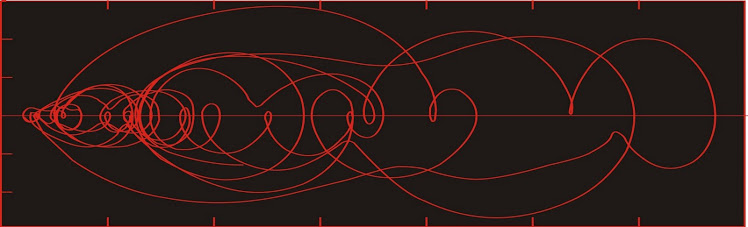
Two dimensional phase space reconstruction of dust flux from the Vostok core over the period 186-4 ka using the time derivative method. Dust flux on the x-axis, rate of change is on the y-axis. From Gipp (2001).
Showing posts with label copper. Show all posts

Saturday, May 16, 2020

The gold-copper ratio and the real economy

A couple of months ago when the turmoil began, I had one of these articles in Zerohedge, and I referred to the how the gold-copper ratio reflected what was going on in the real economy. Of course, commenters rose to the bait, asking what I meant by the real economy.

So today's post is an annotated graph of the weekly gold-copper ratio plotted against its smoothed rate of change, over the past three years (actually, about 34 months). The recent excitement is noted on the right side of the graph.

I normally view a high gold-copper ratio (say, over 450) as a bad sign for the economy. The current values are not quite unprecedented, but you have to go back to the early 1980s (not a great time, economically) to see something similar.


When I think of the real economy, the example in my mind is a factory making refrigerators. The annotations above are the thoughts and actions of the factory owner.

Tuesday, March 24, 2020

Violence! Death! Blood! Gold! Copper!

Let's check on the chaos in the market.


The chaos is proceeding splendidly. It will be some time before order can be restored.

First of all. I have to rescind my predictions of this post. As I stated in the post, it was early to make a prognostication, but the violence of the earlier move convinced me to make one anyway. That move has reversed sharply, blasting out of the deflationary channel in a disinflationary direction.

The graph of the gold-copper ratio shows the rapid deterioration of the real economy--by which I mean the part that buys copper and builds refrigerators. Typically the gold-copper ratio increases when the economy goes bad, which in our second graph would appear as a move to the right--something still underway.

In fact, the current situation is even worse than it appears, because in order to calculate the rate of change, I have to subtract the two calculated gold-copper ratios, and I avoid using trailing averages. So the above chart is one week behind reality, where the current ratio is closing in on 700. This is higher than any weekly closing GCR in the past ten years. Looking at monthly closing ratios, only twice since 1977 has the ratio been higher: in September 1980 (717); and in September 1986 (711).

What I think we may see going forward is more chaos. I think we are in a bear market, and the work of a bear market is to make the biggest downward move dragging the most money down with it. Money on the sidelines needs to be drawn in bit by bit until it is all destroyed.

In the long term, The World Complex is a fan of gold. It's always worth buying, but it's important to avoid leverage and keep cash available, because the cash calls always happen at the most inopportune moment.


Saturday, March 7, 2020

Brace for impact

What a week we just had in the precious metals market.

From a huge drop last Friday--which in the past would have presaged further declines the following week--to a significant rebound in the gold price, coupled this time with a major drop in the US dollar--which I will argue may be the signal for a switch to inflationary conditions.

First the chart


We see the nice deflationary trend of the past 18 months looks to have been decisively broken by last week's action. Although it will be a few weeks before we can be absolutely sure, last week suggests that we are about to embark on another bout of inflation, no doubt as carefully calibrated by the Masters of the Universe as they can fill a shot-glass of whiskey from a pool of liquidity the size of a football field. Either, like a small child pouring very carefully, they have poured only too much, or they have sloshed out enough whiskey to fill a large swimming pool, and we are about to see what happens when it all lands in a shot glass.

Now, why the need for some liquidity?

Another chart:


This graph plots the gold-copper ratio against its rate of change. I typically interpret this ratio as an indicator of the real world preference between bricks and mortar and financials. When the ratio is low, it's a sign that people would rather make refrigerators than chase derivatives. Rate of change is the vertical axis. Near the top of the chart means that the plot is shifting towards the right at high speed. Currently, the system is moving toward the right (ratio is increasing) at the fastest rate in the last couple of years. To me, this means the real economy is degrading very quickly.

Thus the Fed may feel pressured to pump out some liquidity.

If we are moving into an inflationary cycle, then one consequence, according to this recent post, is a decrease in the gold-silver ratio. Given that moves tend to get larger as liquidity sloshes around the system, the gold-silver ratio could hit a significant low, implying a new all-time high for the silver price (in fiat terms).

Normally I would wait a few weeks to have greater certainty, but if there is a swimming pool full of whiskey heading for a shot glass I want to get as close to ground zero as possible with a bucket.

Sunday, August 20, 2017

Metals (updated)

Some gold and silver on display at Ottawa's Museum of Nature.


I've always like dendritic gold


Wiry native silver


Native copper

Had some problems with my SD card reader, and found a few more:


Another dendritic gold


Looks like a euhedral gold grain suffering from some wear.


Nice nugget

Monday, November 28, 2016

Dr. Copper strikes back

Some time ago I compared the price of copper to an old man falling slowly down the stairs.

Not anymore.


The current move marks a major change. Whether this is supply driven or demand driven is unclear to this author. So I can't say whether a new developing country (India, or perhaps the US?) has appeared, or whether China has re-ignited its building boom. I do note that subway line 2 has now opened in Zhengzhou, and several more are under construction. The same is true in Changsha, and undoubtedly in other cities across China.

Let's see what I mean.

I have used reconstructed state space portraits as a way of highlighting changes in dynamics in systems, particularly in pricing. One of the easiest graphs to plot is an absolute measure against its rate of change. Below we see the gold-copper ratio plotted against its rate of change since the start of 2015.


Because I calculate the rate of change over a five-week period, and plot it in the middle--it means the most recent point on the graph reflects the ratio about two weeks ago. Currently, the gold-copper ratio is about 450.

Essentially, the graph shows two metastable states--one where the gold/copper ratio is between 400 and 500, and one with the ratio between 550 and 650. The transition from one state to the other occurred in January this year, prompting this.

Well, if we assume that a lower gold/copper ratio means the perception of increased demand, and given the timing of the breakout relative to the recent election, maybe the market is taking Mr. Trump's remarks about a major infrastructure build-out in the US seriously.

Monday, March 7, 2016

The world is breaking again

It's been awhile since I looked in detail at the relationship between Dr. Copper and Mr. Gold.


Last time the world broke, we saw the gold-copper ratio rip upwards from about 270 to roughly 600, in only a few short months. It never held that level, instead falling to a Lyapunov-stable area somewhat over 300.

The gold-copper ratio has generally increase since then, but is showing signs of some kind of break. Is this a sign of deflation? A crash of copper, and rising gold? In the last few weeks, copper is looking a little better--or is this just a prelude to PDAC?

Sadly*, I won't be going this year. China won't let me.


*Actually, I'm not that sad.

Friday, February 26, 2016

Pop in gold x USDX reaching a critical point

Here at the World Complex I have been using gold x USDX (i.e., the gold price in US dollars per ounce multiplied by the US dollar index, divided by 100) as a proxy for the value of gold mined by companies not operating in the US. Assuming that their expenses are in some local currency, the cash flow of such companies can be improved either by a rising dollar (gold remaining constant) or a rising gold price. In fact, a rising dollar may be preferable, as when the gold price rises sharply, such companies are often hit with special "windfall taxes"--something I have yet to see when it is the dollar which rises (hopefully nobody gets any ideas about that).

There is a lot of excitement in the gold space in the past few weeks. As we saw over a year ago, there has been a breakout of the gold x USDX from a sizeable triangle.


The above chart lends itself to a couple of investment theses. One is that a lot of people seem to make a New Year's resolution to buy a lot of gold, as there is a notable move in the index at the beginning of each of the last three years.

With all the excitement of the last few weeks, it is time to take a closer look. We are at an important point in at least three important respects. At present, gold x USDX is at 1203.79. The peak in the index hit during the move last year was 1229.93. I would submit that the present peak has to exceed last year's level, or else it is just another lower high.


Here is a comparison of the performance of gold vs copper over the past six years (both are multiplied by USDX, gold is US$ per oz, copper in US$ per pound). The way this is plotted, wherever the two curves intersect, the gold-copper ratio is 400. Right now, gold is about 600x the price of copper. Historically, a ratio this high is uncommon--we last saw it briefly in 2009.

Ordinarily, I would say the above chart is a little scary for goldbugs, as it would seem to predict a drop in the price of gold (or a rise in copper, which seems a little unlikely in this economy). Your expectations will vary depending on your overall investment thesis. If deflationary forces grow stronger, this ratio could very well rise further, just as we are seeing in the gold-silver ratio. While Americans don't seem to think of gold as money, it looks as though someone does. If your hypothesis is that central banks are going to pull out all the stops to fight deflation, your future predictions depend on whether you believe they will be successful.


It's been awhile since I posted one of these. The idea here is that the gold price is behaves as do many other complex systems in nature--it spends long periods of time in certain areas of equilibrium, punctuated by rapid moves to some other area of equilibrium. There are three areas of relative equilibrium in the above figure. The gold x USDX index has been confined to the middle equilibrium since mid-2013, except for the hopeful little pop last year. Sadly, it didn't reach escape velocity, and fell back into the middle equilibrium.

Our current situation bears very close watching. Once again, we are at a possible breakout point. If we are to see a significant move in gold, we need to see a move towards the upper equilibrium. If the US dollar were to remain strong during such a move, this would suggest a gold price approaching $1400. The next eight weeks or so should tell the tale--either we will be well on the way to the next equilibrium, or we will fall back to the present one.

Thursday, February 4, 2016

The two towers in Guilin

The pagodas of the Sun and Moon are supposedly the top tourist attractions within Guilin, China.

I'll let you decide which is which.


Local information claims that the tower of the Sun is made of copper. I'm not sure if they just mean the eaves, or if the tower is clad in copper. But just for fun, let's say the entire tower is pure copper. 


I'll check it out tomorrow morning and let you know.

No word on what the tower of the Moon is made of. My guess is silver.


I took a motorcycle cab from the train station to the hotel--well, at least to the vicinity of the hotel. The driver couldn't find it. The ride was only mildly terrifying, except for that one time when the driver decided to cut into traffic by jumping off the sidewalk into a gap between the curb and a taxi that looked much too narrow for my suitcase, then gunned the engine to cut in front of the cab. The weaving in and out of traffic afterwards was quite relaxing.

Saturday, January 23, 2016

Gold vs copper

Below is the graph of gold and copper (gold and copper prices in US dollars multiplied by the US dollar index - representing the price that non-US-based companies receive for their products) over the past six years.


A tale of two commodities.

As said before, copper looks like an old man falling down the stairs. Just lately, the drop looks worse. I don't usually do simple technical analysis, but I'm not liking the looks of that breakdown. The last bounce of copper off the long trendline looks to correlate with the bubble in Chinese stocks, as if the faith in copper grew with the faith in the Chinese economy. The popping of the Chinese stock bubble may have been the signal for the copper bulls to give up the ghost.

Gold by contrast looks a lot better. Starting in late 2014, when the US dollar begin a rapid climb, gold x USDX has diverged favourably from copper x USDX. This looks like support for the argument of a major economic slowdown, marked by a move towards safety.

What happens next? I think much will depend on the US dollar. We will soon learn whether the US dollar really is a safe haven in tough economic times. If it begins to decline, I don't think we'll see a copper recovery--and the copper x USDX graph will get uglier still--but we should see a rise in gold. 

Monday, August 10, 2015

Copper, silver, gold

Dendritic forms.


From the Smithsonian Museum of Natural History.

Saturday, April 11, 2015

Gold and copper rising together for the first time in a long while

I only point this out because the last time it happened was a good time to make money.


For this graph both metals are actually their price multiplied by the value of the US dollar index. This reflects the impact on metals prices for companies mining outside of the United States.

A lot of money was made through 2010 and the first half or so of 2011. It almost looks like the weakening in copper in mid-2011 could have been a warning sign for the overall sector. Possibly a lesson for next time.

For most of 2015, gold x USDX and copper x USDX have risen together (I am speaking of trends, not literally rising each and every week). Hopefully we'll have more than a year this time too.

Tuesday, March 31, 2015

Five years of gold and copper

Today's chart is a kind of state space diagram obtained by plotting the gold price (dollars per ounce) against the copper price (dollars per pound).


There are a couple of regions of pitched battle outlined in blue; the first lasting about 18 months, and the second going on about two years (with the little tail poking out the back).

Overall the graph resembles the dogs in the following:

Tuesday, February 3, 2015

Differing trajectories of gold and copper

As discussed previously, the real economics of mining for non-US based companies needs to include not only the price of the commodity of interest, but also the value of the dollar. I have used the product of the US dollar index and the gold price (in US dollars) to try to assess the real impact on gold mining companies. As both of these components have been rising of late, we should see improvements in the bottom lines of well-run operating mines (poorly run mines may be a different story).

Today we try the same idea with copper. I managed to locate a fairly user-friendly site from which I obtained weekly closing prices of copper. The copper price has fallen quite substantially lately, but at the same time the US dollar has been rising. Do they cancel out?


I also have gold x USDX on the same graph for comparison. Gold x USDX has popped out of a fairly long trading range. Copper x USDX by contrast, resembles an old man slowly falling down the stairs. Until quite recently, it looked like the 2.5 level was an important low, but that has recently been broken. So if your copper mining companies haven't been doing all that impressively lately, this may be one explanation.

I can't say for sure what's behind it. It would be interesting to perhaps note QE decisions/PBOC pronouncements on the chart to see if there's a political angle. Maybe China is gradually transitioning from building way too many empty buildings to just building too many.

Incidentally, on the chart above, the gold x USDX has been scaled by a factor of 400. This means that where the two curves meet, the gold-copper ratio is 400. When the yellow line is higher (like now), that ratio is higher.

Friday, January 30, 2015

The gold-copper ratio

IKN asks (well, not really), and the World Complex delivers.

Is the current gold-copper ratio unusually high? Based on the month-end closing price, the ratio stands at about 504.


The ratio has only very briefly touched such highs in the last ten years--most notably (and briefly) the last time the world broke.

In fact, over the last 25 years or so, the ratio has pretty much always been below 500. We only see little pop-ups that last no more than a couple of months. This has created a normalcy bias in many observers' minds.

If we go back a few years more, we see this:


In the mid-1980s, the gold-copper ratio spent years higher than 500. And there are at least three areas of stability in this range.

So what happened? Were either gold or copper fundamentally different from today? Did they gain some neutrons or protons or quarks or something in the last quarter century?

As I recall, in the early '80s we had an economic slowdown in much of the developed parts of the world, and the China-growth story hadn't yet got going. The relatively lower gold-copper ratio of the last 25 years may be due to the great build in China. If the rate of building here (China) is going to be a little lower going forward (and people here are worried about falling real estate prices as it is), then it is perfectly reasonable for the gold-copper ratio to not only remain where it is, but possibly surge to levels we haven't seen for 30 years.

Even if China's economy doesn't fall off a cliff, it may have reached the point where the rate of building slows. And while there are other places in the world that need building (Africa and Indonesia really come to mind here), there isn't a lot of money willing to go there just yet. 

Thursday, December 4, 2014

Another thing to try before you die

Accupuncture . . . with big blunt copper needles.

It only takes a few tries for them to penetrate. Then he twists them around. It's so good.

And the needles really are copper. Apparently, this is important.

Had that today. I went in because of my back. Now everything hurts so much I don't notice my back any more. Eventually everything that is cramped up should relax and stop hurting, according to theory.

Anyway, I can't hold my hands up to type anymore.

Thursday, November 13, 2014

Estimating final global production of resources, part 1

This post was going to be about copper, which is not my favourite metal, but at least it has character (i.e., is not grey).

Apparently there is lots of the stuff around---so much that, unlike gold, it is difficult to see the end of mining it. This is great--I need a new fridge.

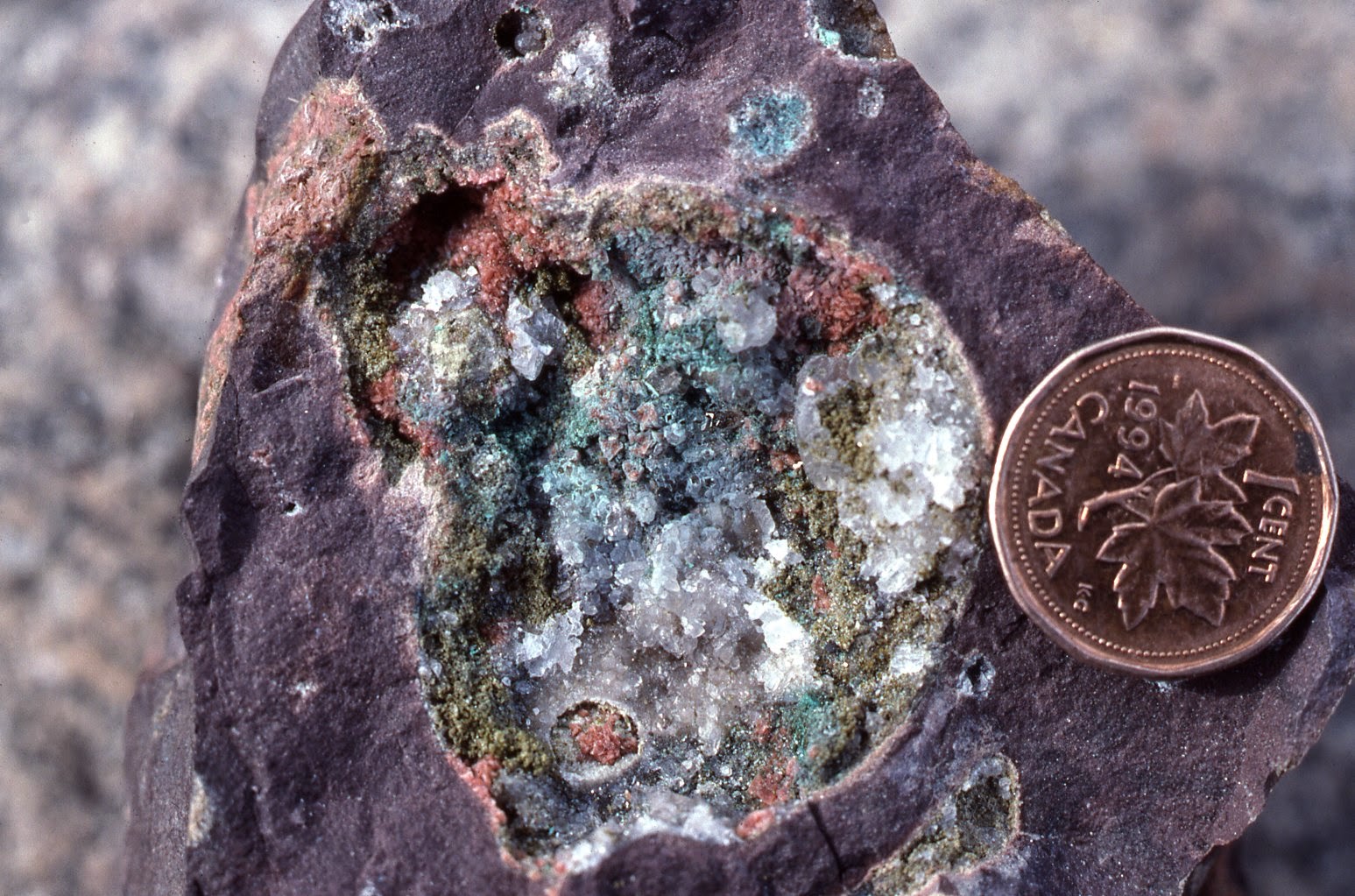
I have a copper nugget somewhere among my personal effects in Canada. I had thought I had a photo of it to post here, but no such luck--just a copper coin.


This is the best I can come up with--a smashed open vesicle from a basalt I found in the Rae-Richardson river system ages ago, filled in with what might be a copper mineral. The penny is copper, too.

My interest today concerns long-term forecasts of metal production. In an earlier posting, I discussed estimates of the total amount of gold remaining to be mined (on Earth). My comments today concern Hubbert linearization in the application to forecasting the amounts of oil, gold, copper, and other minerals that have yet to be found.

The linearization approach can be viewed as a technical approach whereby in the graph of annual production/cumulative production vs cumulative production, the extension of the linear line towards the cumulative production axis gives the maximum cumulative production. Alternatively, one can attempt to plot the logistic curve, of P vs Q, and look to fit the total plot to a parabola, where annual production falls to zero when the total amount of the resource has been extracted.


P/Q linearization for US oil production. Data from EIA.

Oil was a classic example--but in the graph above we see a little wrinkle in the plot. The current fracking phenomenon in oil shales has caused the US to re-enter the climbing production phase (for as long as it lasts). If this climbing phase is no more than a small blip, then it will only result in a small change in the final estimate of total oil production (somewhat shy of 250 billion barrels). If it continues, however, then we can make no estimate of final production.

Copper, for instance, is still in the climbing production phase, so it turns out to be impossible to use this method to estimate the total amount to be mined. The problem is that the current slope of the graph is positive, so the line will not extrapolate to the cumulative production axis.

Scanning around the interwebpipes for estimates of the total amount of gold expected to be mined here on Earth leads to estimates ranging from about 250,000 t to around 390,000 t (much larger amounts considered possible mainly by lunatics).

But perhaps I am among them. The method by which these estimates turns out to be highly sensitive to estimates of historical production (generally prior to 1850, for which records are incomplete) but is also highly influenced by the recent historical production. In particular, where relative production is declining, we can use Hubbert linearization to predict a final cumulative resource.

But for this method to give a reasonable estimate, the history of production has to be relatively smooth. And this is something we do not see. Mining tends to occur in cycles--gold for instance.


For gold, some of these cycles are tied to discoveries--South Africa, for instance, or California, and the Yukon, are all visible on the chart. Large cycles may also be driven by finance, especially the current cycle, which is the result of the rise in price through the late 1970s into 1980.

Permitting of mines is taking a long time, and it would not be unreasonable to assume that another peak in production may occur in response to the rise in gold prices since 2000. Any resulting increase in production will have a sharp impact on the estimate of the total amount of gold to be mined in future.

Another potential cause of production increase is technological change. Such change can lower the price of extracting resources, making otherwise uneconomic deposits economic. More importantly, technological change can reduce the energy cost, which may greatly increase the resources that may be extracted.

As an example, the relatively recent development of heap leaching has made a host of near-surface, low-grade deposits mineable. What would a miner in 1885 think if you told him we would one day mine gold deposits with grades of 0.01 oz/ton?

Friday, September 26, 2014

Gold still number one . . .

. . . in exploration expenditures, according to Wilburn and Stanley (2014).


It's been awhile since I updated this info here, and actually forgot about it when the data became available earlier this year amidst my life falling apart and my relocation to China.

Gold is still the principal goal of exploration--but my eyes may detect a long-term trend. Mayhap that dominance is decreasing. It is still a long way from the heyday of life when expenditures on gold exploration were dwarfed by exploration for base (pdf) metals.

The copper results have not been reported independently since 2005, so I have assumed that Cu expenditures are 58% of total base metal exploration costs since then--that number representing the average value for that ratio over the preceding nine years. The exploration expenditure on copper over the last nine years is therefore an estimate.

Reference: Wilburn, D. R., and Stanley, K. A., 2014. Annual Exploration Review 2013, Mining Engineering, v. 66 (5); 18-39. Lots of other good info in this article (subscription required)

Tuesday, December 10, 2013

The rise of the virtual economy, part 2--retail consumption indicators

I recently received some publications from Dr. Ray Huffaker, who studies reconstructed phase space portraits from agricultural cycles. There are some interesting data sets presented in these papers which echo some of the themes I've argued in earlier postings.


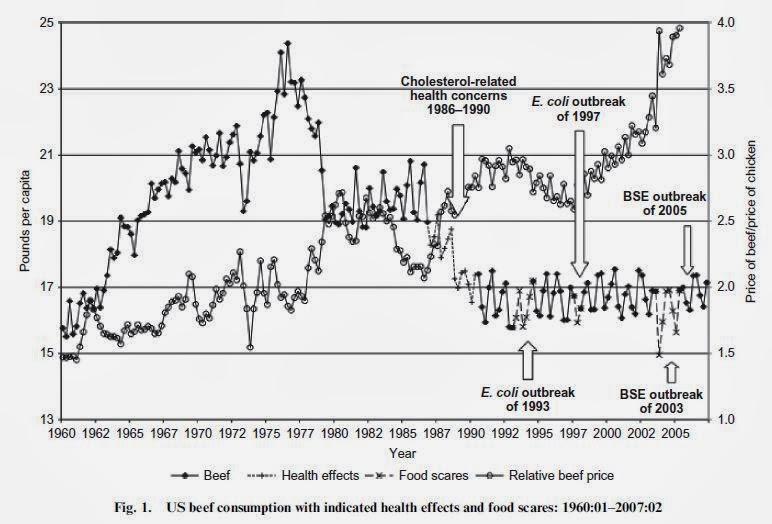
The above figure shows retail beef consumption per capita. Data comes from the USDA, the figure is snipped from McCullough et al. (2012). Notice the large decline in the late 1970s. Perhaps you think that decline was due to changing preferences in meat--perhaps more Americans chose to eat pork instead.


Data and figure as above--notice there is also a decline in per capita pork consumption at the same time. Not as marked as the decline in beef, but still present.


Comparison of metal usage to global GDP. Chart from 
Handselbanken Capital Markets.

As posted before, something appears to have happened to the economy in the late 1970s, which puts the lie to the reported GDP growth figures. Would the government exaggerate these numbers? Perhaps to tell you that the economy is doing fine, and if you happen to be experiencing a drop in your standard of living, well, you just need to work harder. Or go buy something with no money down and no payments for three years.

One last figure. Perhaps the decline in beef consumption was due to the "cholesterol scare".


In this figure from McCullough et al. (2013), we see that the cholesterol scare happened after the major decline in beef consumption. Furthermore, the major declines in beef consumption both correlate to increases in the relative price of beef (the beef/chicken ratio on the right axis).

Some comments on previous articles suggested that the decline in copper and zinc production was due to replacement with plastics or aluminum. My counter to that was that copper cannot be replaced in most of its applications, and the decline in copper consumption speaks to a real decline in economic activity--one which was not reflected in reported GDP numbers. The simultaneous per-capita decline in beef and pork consumption supports this conclusion.

References:

McCullough, M. P., Huffaker, R., and Marsh, T. L., 2012. Endogenously determined cycles: Empirical evidence from livestock industries. Nonlinear Dynamics, Psychology, and Life Sciences, 16: 205-231.

McCullough, M. P., Marsh, T. L., and Huffaker, R., 2013. Reconstructing market reactions to consumption harms. Applied Economics Letters, 20: 173-179. doi: 10.1080/13504851.2012.687091.

Thursday, August 29, 2013

The magic ends, part 2:

In part 1 we looked at some examples of what happens when the audience can no longer suspend its disbelief in a currency.

What was the magic? The magic was the magnificent illusion that money printing increased wealth. It certainly looked that way, despite all the common-sense interpretation that would have you believe that it doesn't. But that's the beauty of a wonderfully performed magic trick. Something impossible seems to happen. You know it can't happen, but it looks like it did, and what's the harm in letting yourself believe?

The latest round of the great trick really began in the late 1950s. Spending by the US government increased the demand for labour by the millions, which allowed women to enter the workforce in large numbers.


Data source: Bureau of Labor Statistics (BLS)

The main uptick in the labour force participation rate began in the early '60s, but the real bottom (on this graph) was in the mid '50s. One obvious source of stimulus in the 1960s would have been the Vietnam War, on which the US gov't spent the equivalent of $738 billion, in 2011 dollars (pdf). That kind of money created a lot of jobs--mainly in the military industries, but also for lobbyists.

At the same time, the "Great Society" was in full swing. Lots of public works projects. The same thing happened up here in Canada, with a huge increase in universities, highways, and transit systems. All this spending created a lot of jobs. Nobody asked whether these jobs were really necessary. Would the public works projects pay off?

Certainly they appeared to make society more prosperous. But was it real prosperity or just a magic trick? Was it an illusion, or something more sinister . . .
A thief and a magician enter a convenience store. The thief says to the magician, "Watch this", and promptly places three chocolate bars into his pocket so smoothly that nobody else notices. He is just about to leave when the magician calls him back and says, "I've got a better trick." The magician approaches the shopkeeper, and asks if he'd like to see a trick. "I can make three chocolate bars disappear and reappear." He unwraps three chocolate bars and eats them. When the shopkeeper asks to see them reappear, the magician points to the thief and says, "They are in my friend's pocket."
In the earliest part of my education I recall, we were fed the belief that it was right for women to enter the workforce, and it followed that once women wanted to work, all these jobs opened up for them. Millions of them.

Why can't it happen now?

Look at the unemployed--the real unemployed. Their numbers are reflected in a massive increase in duration of unemployment not to mention the increase in the reported unemployment rate.


I thought the unemployment rate was supposed to drop when interest 
rates were low. Data from BLS.

Don't the unemployed want jobs? Why don't jobs magically appear for them like they did in the 60s?


Impressive job creation from the 1960s until about 2000. 
It stalled briefly during the Volcker high-interest-rate period
of the early 80s. Data from BLS.

The trouble is similar to what our magician friend in the story above might face if the shopkeeper suddenly demanded a repeat performance, this time with meat pies. The magician can only perform a trick like that so many times. Perhaps he becomes too engorged with chocolate bars and meat pies. Perhaps there aren't any that can "appear" in his friend's pocket. Or maybe the shopkeeper simply won't be fooled any more.


That's funny. All that money of yours that disappeared was 
supposed to reappear in my hand. Errrm, sorry?

At least is isn't as bad as Siegfried and Roy's last trick with the tiger.

What does the rest of the world think?


Too lazy to update this. Sorry. To mid 2011. But I doubt it's gotten better.

It looks like the rest of the world started to lose faith in the US dollar in the '90s. Remember the Strong Dollar Policy under Clinton? Looks like somebody thought it was a selling opportunity.

But the problems with the money-creating approach became apparent by 1970. Nixon kept the system going a bit longer with his trick of taking the dollar off the gold standard, so the US would not have to exhaust its stored gold redeeming green coupons. The system ran out of gas again at the end of the 70s, but Volcker's trick of raising interest rates gave the US 20+ years of slowly falling interest rates, which allowed the audience to keep believing the illusion.

But even then, it should have been clear that something was up. GDP as it was defined at the time was climbing, but some of its ancillaries were not keeping up.


Data from Handselbanken Capital Markets.

It is difficult to imagine just how the economy grows without similar increases in the use of copper and zinc, both of which are tough to replace. One comment wondered if we replaced copper and zinc with plastics. Some piping maybe. But not much wiring.

As I proposed earlier, what really happened in the late 1970s was a contraction in the economy, which was hidden by fudging reported GDP. If real GDP is tied to demand for copper and zinc, then I would say that (from the above chart) world GDP was overstated by approximately 80% as of 2005. It's hard to imagine that that number has gotten smaller subsequently. Either that, or the "value" of lawyers bills, lobby groups, US medical expenses, overspending on military wonder weapons, financial charges and skimming, and other less than productive enterprises now constitutes just under 50% of the world "economy". I hope it makes you feel rich.

With lower demand came lower exploration expenditures--at least for base metals.


Source here (pdf)

I think this graph shows the change in mindset from the past to the present. Don't mine base metals; mine money (gold). And this established the precedent for today's industrial ideal: don't make products, make money. And so the business model changed: from producing real products, which improved lives and increased the wealth of everyone; to making money through methods including outsourcing and speculation, which improved the lives and wealth of only a few.

Back to jobs.


After the little scare in 1980, we had 20 years of lower interest rates, during which the US labour force participation rate increased to its highest level in history. After the internet bubble popped, the US Fed shoved interest rates down, igniting a nice housing bubble, which created a lot of construction, real estate, and retail jobs. Unfortunately, these only matched the losses of manufacturing jobs--until about 2007. More recently, the number of full-time jobs is falling.

The magician has pulled all the rabbits there are out of the hat.

If money printing can't create jobs anymore, the pain that is to come will dwarf the pain already felt. The labour force participation rate will fall to the level of the 1950s unless there is another rabbit in there somewhere.

Too bad they'll all be low-paying jobs.
Monday, August 12, 2013

Silver's big adventure

The move in the price of silver that began in early 2010 is the largest move of the last 20 years. According to the chart attached, the excursion is complete, and we have returned to the status quo that has been generally observed since 1996.


It really looked for awhile that the system was defining a new region of stability. But we have returned to the old one.