Dust flux, Vostok ice core

Dust flux, Vostok ice core
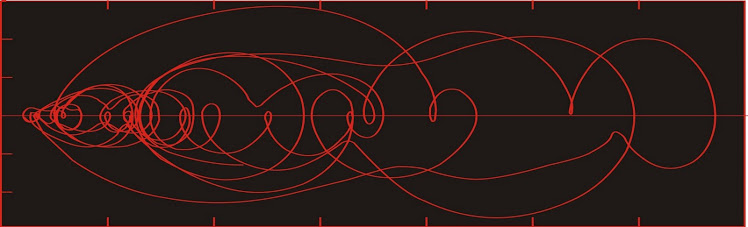
Two dimensional phase space reconstruction of dust flux from the Vostok core over the period 186-4 ka using the time derivative method. Dust flux on the x-axis, rate of change is on the y-axis. From Gipp (2001).
Showing posts with label fossils. Show all posts

Saturday, March 4, 2017

Dinosaurs

This will be short--there are extreme VPN problems in China now, and it is uncertain when I can post again. I am finding that almost all sites are blocked, even with the VPN.


Tarbosaurus sp., on display in Hustai Mall, Ulaanbaatar.

Mongolia's principal dinosaur museum is in a suburban mall. I guess the idea is to go where the kids are . . .


Sauropod on display in Chicago O'Hare airport.

Tuesday, February 9, 2016

A little stratigraphic correlation

The sidewalks in Guilin are paved with fossiliferous shales.


Bryozoa


Gastropod. Part of my shoe for scale.


More bryozoa (bottom), a gastropod (centre, top), and an orthoceratid (upper left), which is a kind of cephalopod.


A large orthoceratid, and at least one brachiopod.


A rugose coral (also called a horn coral).


Various crinoid ossicles (echinoderms).


A tabulate coral. I had found a better example, but can't find the photo (or maybe it was blurred and deleted).


A couple of brachiopods, with the section cut through both valves, plus assorted fossil debris.

What is interesting to me is how similar this collection of organisms is to that of Devonian sediments near Port Colborne, Ontario.

Actually, the following photos are from various sites near where I have described--but some of these are nearly 30 years old (from slides) so I may not really remember where they are from.


Rugose corals from the Port Colborne quarry.


A tabulate coral from the Port Colborne quarry.

These fossils are Devonian in age, and more closely resemble the corals in Guilin than other corals from my image collections of Ordovician age. The other fossils don't (to my unpracticed eye) seem to have changed much over the same interval.

I asked one of the locals where the sidewalk tiles come from. She claimed that they were quarried nearby, but not from any of Guilin's famous dragon's teeth. Although I did notice quarries on a few of them.
Friday, May 25, 2012

Visit to Mistaken Point

Visited Mistaken Point today.

Mistaken Point lies on the southern tip of the Avalon Peninsula, and is famous for its Ediacaran fossils. Ediacaran fossils are extremely rare and are among the first multicellular lifeforms on Earth. As they had no hard parts (skeletons or shells), they are only expected to be preserved under anoxic conditions or in areas where they were rapidly buried (like the early Cambrian fossils of the Burgess Shale), or (as here) where they have been buried by volcanic ash.

The Mistaken Point fossils are exposed on bedding planes, each of which was covered by the ash of a single volcanic eruption. There are numerous such bedding planes, and as the burial event was so rapid, each bedding surface represents a snapshot of the seafloor at a different times all around 565 million years ago.

There is still some uncertainty as to the phylogeny of these fossils. They appear to be different from any known animals. There have been suggestions that these all belong in a separate multicellular kingdom that is no longer extant. Not all of them have been given formal scientific names. The most common type, which are colloquially called "spindles", are assigned to the Fractofusus genera.


Fractofusus sp. on fossil bed at Mistaken Point.

The animals lived on the seafloor, and most of them seem to have lived like barnacles today--anchored on the seafloor, sweeping the seawater for organic material.


Bacteria colony at Mistaken Point.


Charnodiscus procers (left of centre) with recent damage done to the anchoring point- with another Fractofusus at top and possibly Beothikus mistakensis at right, just above the coin.

The animals were probably pretty common 565 million years ago. What makes them rare now is the difficulty of their preservation. These lived in deep water, in a time of frequent volcanic activity, possibly due to rifting of the Iapetus Ocean.


Fossil bed (at bottom) with overlying rocks of the Mistaken Pt. Formation. An ash bed is at most a few cm thick.


Fractofusus surface with thin ash cover (darker areas at upper and lower left, and middle right).


The falling ash (apparently an airborne ash cloud) almost instantaneously killed all the animals at the site, creating a "snapshot" in time.

Edit: This post seems appropriate here.