Dust flux, Vostok ice core

Dust flux, Vostok ice core
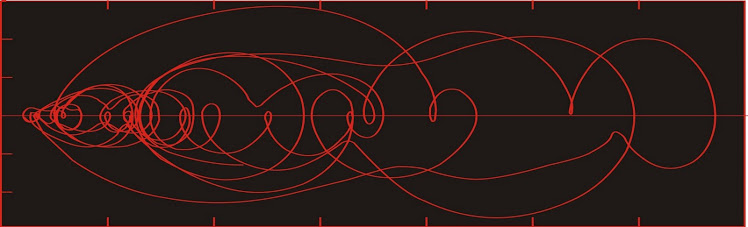
Two dimensional phase space reconstruction of dust flux from the Vostok core over the period 186-4 ka using the time derivative method. Dust flux on the x-axis, rate of change is on the y-axis. From Gipp (2001).
Showing posts with label QE2. Show all posts

Sunday, February 8, 2015

How QE helped Main Street, Example 2: Maserati dealerships

I haven't written on this topic in a long time, but it is time once again to look at the magnificent benefits that have accrued to main street businesses as a result of bailing out bad bets of banks. Today I have selected another typical main street business--the car dealership. I have randomly selected the Maserati brand as the subject of today's investigation.

Sales data for Maserati sold in North America are available here.


Annual sales of the Maserati brand (in number of cars sold) ranged from less than a thousand per year in 2002 to nearly 13,000 in 2014, thanks to the benevolent leadership of the Fed.

This is a chart that truly screams "Recovery!" In fact, it is quite clear that things are far better now than they have ever been before. If your life seems to be at odds with the obvious economic reality, you are clearly not working hard enough (or perhaps not at all).

All the propaganda to the effect that the goal of quantitative easing was to make the richer even richer still is thoroughly debunked. We can see that small, struggling family businesses like high-end diamond retailers and Maserati dealerships have indeed benefited from quantitative easing.

Sunday, June 17, 2012

Extended price fall for diamonds--is QE3 on the way?

We have presented price info for diamonds previously, with particular attention paid to the impact of quantitative easing programs on diamond prices.

The price of diamonds has fallen more or less steadily since its peak in June of last year.


The price of the RAPI index for 1-ct diamonds is off about 15% from last year's peak.

The RAPI index for 3-ct diamonds was off nearly 2% in May alone, as compared to 1-ct diamonds which were down only about 0.5%. As the larger diamonds are in the $90,000 price range (which is a bit high for me), I interpret this as a sign that the well-heeled clients have spent the last of their bonus money and are in need of another bailout.

It may be worth repeating here that diamond exploration effort has fallen dramatically over the past few years--currently about 2.5% of (non-fuel mineral )exploration money is spent on diamonds--in 2006, it was 12%.

Wednesday, December 7, 2011

How QE helped Main Street, example 2: Collectors of fine wines

Following earlier discussion posted here, we investigate another way in which typical Main Street individuals benefited from quantitative easing.

Below we show the graph of the Liv-Ex Wine 100 Index over the past four years. The Wine 100 Index is an index based on the auction prices of the 100 wines selected as most representative of the secondary market. It represents an indicator of the price of the typical wine in your neighbourhood liquor outlet, such as Lafite Rothschild 2006.


For a blue-collar worker who's just lost his job and had his mortgage go underwater, the 20% decline in value of his wine collection in late 2008 would have been a devastating blow. But fortunately the Fed stepped in, first with TARP and then with quantitative easing. The resulting 80% rise in the price of fine wines has certainly helped our friend. It's true his mortgage is still underwater and he has no jobs, but as he must feel enriched as he drinks to his misfortune.


For myself, I prefer cocoa.

Your correspondent in Africa.

Friday, September 23, 2011

Market declines

What's it all about?


European markets at least seem to be declining on low volume. Is this all due to major players pulling their bids? Perhaps they are sending a message to the political realm. Certain individuals who may shortly seek re-election may be under pressure to change.

Monday, September 12, 2011

How QE2 helped Main Street, example 1: High-end diamond retailers

One justification for bailing out Wall Street was that it would ultimately help Main Street.  Last time we looked at the diamond price index for 1-ct diamonds. Today we investigate the effects of QE2 on that most Main Street of businesses--the high-end diamond retailer.

Below is a chart for the price of 3-carat diamonds (the RAPI index, based on the price of the best 25 diamonds of a given size, clarity, and colour).


At the prices quoted, a single diamond of this size would set you back about $110,000. Hopefully she's worth it.

There are two significant periods of rising prices--early 2010 (at the tail of the first QE), and November 2010 to June 2011, during which time prices rose about 30%. The official CPI (excluding food and energy) was 1-2% over the same interval. We note that this last interval corresponds approximately with the timing of QE2, and congratulate the Federal Reserve for aiding Main Street business.

In a related chart, we see that jewellry prices and sales rose through the first half of 2011.


In our next installment we will compile the caviar index and the well-known 100-year-old-port index to see how these Main Street retailers have been affected by QE2.

Sunday, September 11, 2011

Diamonds as investment since 2009

Every few years, my name comes to the top of a list somewhere and an impressive-looking package arrives in the mail from an outfit called Pastor-Genève B.V.B.A. In it there is always a glossy newsletter explaining why diamonds are a superior investment. No doubt the Company's motto is: "Everyone should have a couple of hundred thousand dollars invested in diamonds."


And yet within their literature one can discern many of the reasons why diamonds are not a good investment. Many of these reasons may be found here, but they can be summarized as illiquidity, non-fungibility, non-divisibility, and the difficulty of valuing a diamond in the field (or in the marketplace). One statement from the literature which supposedly states reasons for investing in diamonds:


In a market where pricing is a closely held secret, tied to the absolute uniqueness of most colored diamonds, the auction market provides a stunningly open price venue.
Really. That makes me feel much better about not having any predictive power over the price I might receive for my investment.
Potential buyers form an ever-growing market that seems to have no limit.
I've heard that one before, usually from an advisor just before something starts to go down.


Can diamonds be a good investment? I remember reading something about the diamond exploration business when I was an undergraduate geology student. On the topic of colour, the consensus at the time was that "brown" diamonds were only suitable for industrial use. A couple of years ago, the Pastor-Genève newsletter discussed the growing demand for "champagne" diamonds. I looked at the pictures and realized these were the same brown diamonds previously considered worthless; now rebranded and advertised at a premium.


Just how does this work for an investment. Imagine you buy shares in Worthless, Inc., and one day, after relentless advertising, the company turns into Apple and the shares are worth a fortune. Alternative scenario--you buy shares in Enron and overnight it becomes Worthless, Inc. It is one thing if such a change happens due to fundamental changes in the operations and finances of the company. It is entirely different if the change happens simply because some analysts or media talking heads promotion.


We can assess the performance of diamonds as an investment by inspecting the RapNet Diamond Index (RAPI) for 1 carat polished stones.


The index is the asking price, in hundred of dollars per carat, of the best 25 round 1-ct diamonds within a certain range of colour and clarity. Your diamonds may be worth more, or less, depending on factors too numerous to belabour here. Also, the spread is unknown, but understood to be considerable.

Data availability isn't the greatest. Actual numerical index values are only given for the past three or four months--the remainder of the curve has been reconstructed from monthly percentage gains. The errors tend to compound, so the older portions of the curve may have significant inaccuracies.

The industry reports suggest that the rapid rise in diamond prices was the recovery from the falling prices that occurred since 2007. We cannot comment as we weren't looking at diamond prices at that time. The rapid increase from last December until June of this year looks suspiciously like the timeline for QE2.


Below we see a graph of the gold/diamond ratio over the same timeframe.


I have used the price for an ounce of gold (closing price) against the RAPI index price from the graph above. Where values are rising, gold is rising in price faster than diamonds, and vice versa. Form our limited data set, it appears diamonds were a better investment than gold during QE2, but not at other times. 


What does this tell us? During episodes of Quantitative Easing, the inflation trade wins out. Diamonds have historically helped preserve wealth during inflationary or hyperinflationary episodes, despite their lack of liquidity. In this case I wonder whether the market for investing in diamonds had more available money during QE2 than at other times.


-  -  -  -  -  -  -  -  -  -  -  -  -  -  -  -  -  -  -  -  -  -  -  -  -  -  -

For myself, I only invested in diamonds once--shortly before getting married. The returns, while satisfactory, are difficult to quantify.