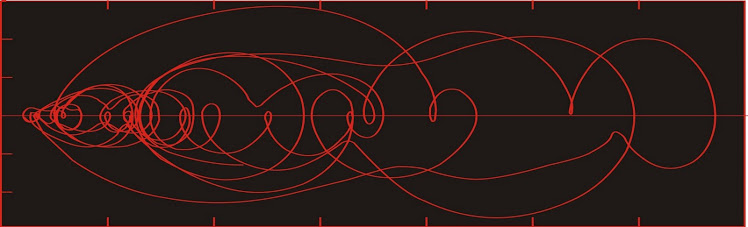
Dust flux, Vostok ice core

Dust flux, Vostok ice core
Two dimensional phase space reconstruction of dust flux from the Vostok core over the period 186-4 ka using the time derivative method. Dust flux on the x-axis, rate of change is on the y-axis. From Gipp (2001).
Showing posts with label phase space reconstructions. Show all posts

Friday, March 20, 2020

New charts - northern hemisphere Arctic sea ice maxima

A recent publication has highlighted the importance of the maximum extent of seasonal ice cover in the Arctic Ocean to the stability of the over all sea-ice system. So I have acquired data from NOAA of the daily sea ice extent since 1979, which I have used to find the maximum annual extent and the date (expressed as a Julian Day - so March 1, 2019 would be day 60, but March 1, 2020 would be day 61). These data sets will be studied in the usual manner, if appropriate. (I used the five-day trailing average, by the way).


The maximum sea-ice coverage has declined since 1979

The graph suggests that the maximum extent of ice coverage has declined more or less constantly over the observation period. There are a few ups and downs. In fact, something popped out at me. In the graph above, what do 1998, 2001, 2008, 2012, and 2020 have in common? They all represent years where sea ice extent increased - presumably due to cooling. They were also years with somewhat trying economic circumstances, at least for some people. Coincidence? Probably--but maybe it means there was an agricultural trigger to some of the economic crises of the past few decades.


There has been an idea that as global warming proceeds, the timing of certain important events will change, becoming either earlier or later. Investigating the above graph for a trend in the timing of the ice extent maximum each year tells me . . . nothing. If there is a trend, it is very weak.

Below we have the 2-d reconstructed state space portrait of the annual maxima sea ice extent, using the time-delay method with a 2-year lag. 


The state space reconstruction shows three regions of stability. The S1 and S2 correspond roughly to the major area of stability in the sea-ice minima phase space, which may actually be two separate such regions, one larger than the other. S3 corresponds with the most recent low-area sea-ice minima.

As with the sea-ice minima plots, there is not enough data to determine the long-term future of this system. It is possible we are in a declining phase of a century-scale cyclical system. Alternatively, we could be on a decline to zero. We may even be in a biased cycle, where the natural cycle is being influenced by global warming. The problem is that the data are not sufficient to tell us which is the correct interpretation.

Saturday, January 18, 2020

The History of the East Asia Monsoon

So I went to Washington DC last week for the AGU Chapman Conference on the East Asian monsoon. I found it to be a very rewarding conference, and even learned a bit about navigating around Washington on transit, as I was on a limited budget.

The conference was in AGU headquarters, which is near to Dupont Circle.


Not all that far from the Mall, although I didn't visit this time.


Speaking of scientists . . .

I was speaking during the opening session, which was about climate dynamics (and its role on the changes in monsoonal strengths through geologic history). A major dynamic role has been the rise of the Himalayan mountains and the Tibetan Plateau during the period of interest, and there is still a lot of debate about the importance of these tectonic events on the development of the monsoon. Some of the modeling studies suggest that the mountains only change the specific location of the rainfall, and that monsoon behaviour may occur even if there were no continents at all.

My work was based on analysis of global to regional proxy data sets, and has been summarized in all these places. Unfortunately, due to limited time, after working through the phase space reconstructions, I had to rush through the statistical computation part, and wasn't certain whether any of the message made it to the audience ungarbled. Fortunately, I was able to learn that at least some members of the audience understood the message.

The afternoon sessions were all about paleoceanographic records of the monsoon. Over the past decade, the International Ocean Discovery Program (IODP, formerly ODP and DSDP) has put down a number of boreholes in the Indus and Bengal Fans, and other boreholes in the Huang He fan and the Sea of Japan also provide useful records of at least some parts of the monsoon. The records I studied were generally global in scope--these other records allow for regional variations to be studied.

The next day's sessions dealt with continental environments (a common issue was the change in photosynthetic pathways of plants in response to environmental change during the Miocene) and records of continental erosion. Erosion is important because either rising mountains or increased rainfall will lead to increased erosion.

The last session was on modeling the effects of tectonic uplift as well as changes in the timing of the uplift, because there is still some disagreement about when the Tibetan Plateau was formed. I mean disagreement between it being less than 10 million years ago to more than 40 million years ago, which is a significant difference of opinion for something so recent.

The last portion of the conference was to break up into groups for focussed discussions on topics of interest leading to the testing of several hypotheses proposed at the start of the conference. I started off in the wrong room, so I was  with the tectonic modeling people rather than the climate modeling people, but was still able to ask about whether anyone had successfully had chaos appear in their model output. Results were inconclusive.

For the second group meeting I joined the combined discussion between the climate modelers and the paleoceanographic records group. Over the course of the discussion I eventually managed to come up with a proposal. See if the modelers observe chaos, and see if they can tell which style of chaos they have. Such chaos will be manifested as spatial variability in some climate effects, such as the location of the maximum rainfall. The models may have the type of spatial variability modeled correctly, but the specific timing of variations will be incorrect. That spatial variability will be recorded in the widely spaced paleoceanographic records which already exist. They type of chaos observed in the models will tell us what to look for in the cores; from the cores we can obtain the correct timing of the modeled chaotic spatial variations of the monsoon system.


Exiting the Metro Station at Dupont Circle

I wasn't sure how the last part of the conference would go--early on, many of the old hands were of the opinion that nothing ever comes from these things. But I thought it was pretty rewarding, particularly as it was during these sessions that I came to realize that people felt that whatever I was doing was worthwhile.

Alone in my corner of the world, I had never been sure.


Night flight back to Toronto

Sunday, October 6, 2019

Abstract accepted to Chapman conference on the Evolution of the Monsoon

https://www.agu.org/chapmans-asian-monsoons

So I'll be going to Washington in the New Year.

No word yet on the format of the presentation.

I've never taken part in a Chapman conference before, but I gather they are rather more collaborative than typical conferences

Friday, September 27, 2019

We have passed this year's Arctic sea ice minimum

and what do we see?

This site informs us that we have tied with 2007 and 2016 for the second lowest sea ice extent in the satellite era--4.15 million sq km.

This gives us the wherewithal to update our phase space reconstruction of the sea ice extent.


We are near the middle of the same area of metastability we have been in since 2007. There is no way to tell how long we shall continue in this region of metastability; nor do we know if we will return to the higher region of stability occupied prior to 2004, or drop to another lower region of stability or fall to zero (as many disaster models predict).

All we can do is keep watch.

Saturday, September 22, 2018

Arctic sea ice minimum 2018

We are near the Arctic sea-ice minimum for 2018, which is projected to be 4.6 million square km


This gives us another point on our 2-d phase space projection. There is actually very little change from last year. I still only see two main areas of Lyapunov stability, although its possible there was a separate solution prior to the mid-1980s, when the system was confined to a much smaller region of phase space.

If the hypothesis of human activity on climate is correct, then we might interpret the first significant change as having happened around 1980, when the system expanded into a greater area of phase space. In colloquial terms, we would say that the variability of the system increased markedly.


Increased variability is potentially one of the markers of human influence on climate. If so, then the first irreversible change we see in our data occurred around 1980. The next one happened shortly after 2000 when the system migrated from one area of Lyapunov stability to another.

Monday, September 25, 2017

After the recent Arctic sea ice minimum . . .

. . . we have a new reconstructed state space diagram.


This year's minimum is 4.64 million sq km, which is a nice improvement from last year, and keeps the chart well within the lower area of Lyapunov stability proposed here about four years ago. With each passing year, my confidence that we have really entered an area of stability grows.

It is still unclear when the system will break out of its current area of stability, and what it's most likely behaviour will be (the two main contenders being a return toward the earlier area of stability at upper right, or a continuation towards the ice-free conditions forecast by so many. .

Wednesday, July 13, 2016

Gold x USDX breaks out after Brexit

Last time I looked at the significance of rising gold price and dollar index and their impact on profitability of gold mining companies. One way to study this is to calculate the product of the gold price (in US dollars per ounce) and the US dollar index, divided by 100 to make the numbers easier to use.

As described here, I have been using reconstructed phase space portraits as an aid to describing dynamical behaviour of complex systems. The simplest way of reconstructing these is through the use of time-delay method, in which the value of a parameter is plotted against a lagged copy of itself. These plots show the evolution of the system illustrated by the succession of states through time. Typically, systems will remain locked in relative equilibria for substantial periods of time, punctuated by bursts of rapid evolution to a new area of stability.

Eighteen months ago, for instance, the reconstructed state space for the gold price x USDX over the preceding seven years was easily described by a rising phase, followed by a multi-year cycle that carried it from the middle of the plot to the circled area at the upper right, until in mid-2013 when it broke down and returned to the middle equilibrium.


The system has been locked in the middle equilibrium until what looks to be a breakout, immediately after the Brexit vote.

.
It has pushed the boundaries of that equilibrium in the last three years, but the action of the past few weeks is looking decisive. I expect to see gold x USD ascend and reach a stability in the 1400 range, which puts the told price near $1450/oz, given the current strength in the US dollar.

Saturday, June 25, 2016

Lots of excitement

. . . over Brexit. But I'm not convinced that this is the earth-shaking moment some seem to think.

Sure, it may mark a sea-change in the evolution towards larger polities. But I have always been skeptical of that movement. I have always wanted to see us evolve back towards city-states.

Gold had a nice move, but I'm always suspicious of moves that are tied to political/economic events. They tend to reverse quickly once everyone realizes that the world isn't going to end. Additionally, over the past decade, sharp moves tend to be in opposition to long-term trends. When the fast moves are down, that seems to happen when the long-term trend is upward. Sharp upward moves in the gold price were common in the late 90s, at a time when the long-term trend was still downward.

So, let's see how yesterday's close looks on our long-term graph of USDX vs gold.


This is a straight graph of the US dollar index vs the gold price. If gold simply moved in opposition to the dollar, then the graph would trace out a single isoquant (one of the yellow hyperbolae). In truth, while the graph does follow isoquants fairly often, there are also shifts from one isoquant to another, sometimes involving moves in which both the gold price and the US dollar index rise together (the blue trend line).

I have interpreted the movement along the blue line as a signal of deflation (provided we are moving toward the upper right). In the past several years, there have been two distinct pulses along the blue line - from late 2009 to mid-2010; and the last four months or so of 2014. I have been expecting a resumption of the impossible trend for some time. Yesterday's close does give us a one-week move in this direction, but we would need to see at least a couple of months of follow-through before identifying another deflationary impulse.

Last week's move is small compared to the movement along the blue trend in 2010.

In the reconstructed phase space portrait of the product of the gold price and the dollar index, Brexit looks like it may have forced a move out of an area of attracted that the system has been occupying for the last three years.


There have been little pop-ups like this at different times during the last three years, and none of them have stuck. The last time we had a break-out from this zone of attraction was in late 2011, culminating in the move in the gold price through $1800. Given the number of times the system has threatened to break out without doing so, we still need to wait and see.

Sunday, March 27, 2016

Counting down to another deflationary impulse

First the bad news.


That pop-up I talked about last month in the phase space portrait of gold x USDX has gone the same way as last year's. Back into the increasingly significant area of Lyapunov stability near the centre of the above plot.

- - - - - - - - - - - - - - - - - - - -

The plot of USDX index vs gold price over the past decade has shown extreme variability in the specific relationship between gold price and the US dollar index. Conventionally, one might assume that gold and the US dollar strength are inversely related. If so, on the graph below, the plot would trace out a single hyperbola. Instead, we see that while there is a general inverse relationship between the two variables most of the time, the relationship is not simple. Furthermore, there are intervals when both rise together.


This impossible trend represents the increasing demand/value of real money, and is interpreted as an indicator of deflation. From September '09 until June '10 and from October '14 to late January '15, we saw a deflationary reaction in USDX vs gold. Interestingly one such trend began at the endpoint of the previous reaction.


Of course, it helped that major bond purchases by the Fed supposedly ended in October 2014.

For the last year, USDX vs gold has been confined to a relatively small area of phase space, with most of the action showing an inverse relationship between the two variables. In the last four months, however, the state of the plot has shifted from the upper left to the upper right of the following plot, bringing us very close to the endpoint of the last deflationary impulse.


Presently, with other deflationary indicators perking up (Au/Cu), we see the system evolving to the end of the last deflationary impulse. In conjunction with the breaking of the world, buckle up for another deflationary move. We just need a policy trigger. End to NIRP, anybody?

Friday, February 26, 2016

Pop in gold x USDX reaching a critical point

Here at the World Complex I have been using gold x USDX (i.e., the gold price in US dollars per ounce multiplied by the US dollar index, divided by 100) as a proxy for the value of gold mined by companies not operating in the US. Assuming that their expenses are in some local currency, the cash flow of such companies can be improved either by a rising dollar (gold remaining constant) or a rising gold price. In fact, a rising dollar may be preferable, as when the gold price rises sharply, such companies are often hit with special "windfall taxes"--something I have yet to see when it is the dollar which rises (hopefully nobody gets any ideas about that).

There is a lot of excitement in the gold space in the past few weeks. As we saw over a year ago, there has been a breakout of the gold x USDX from a sizeable triangle.


The above chart lends itself to a couple of investment theses. One is that a lot of people seem to make a New Year's resolution to buy a lot of gold, as there is a notable move in the index at the beginning of each of the last three years.

With all the excitement of the last few weeks, it is time to take a closer look. We are at an important point in at least three important respects. At present, gold x USDX is at 1203.79. The peak in the index hit during the move last year was 1229.93. I would submit that the present peak has to exceed last year's level, or else it is just another lower high.


Here is a comparison of the performance of gold vs copper over the past six years (both are multiplied by USDX, gold is US$ per oz, copper in US$ per pound). The way this is plotted, wherever the two curves intersect, the gold-copper ratio is 400. Right now, gold is about 600x the price of copper. Historically, a ratio this high is uncommon--we last saw it briefly in 2009.

Ordinarily, I would say the above chart is a little scary for goldbugs, as it would seem to predict a drop in the price of gold (or a rise in copper, which seems a little unlikely in this economy). Your expectations will vary depending on your overall investment thesis. If deflationary forces grow stronger, this ratio could very well rise further, just as we are seeing in the gold-silver ratio. While Americans don't seem to think of gold as money, it looks as though someone does. If your hypothesis is that central banks are going to pull out all the stops to fight deflation, your future predictions depend on whether you believe they will be successful.


It's been awhile since I posted one of these. The idea here is that the gold price is behaves as do many other complex systems in nature--it spends long periods of time in certain areas of equilibrium, punctuated by rapid moves to some other area of equilibrium. There are three areas of relative equilibrium in the above figure. The gold x USDX index has been confined to the middle equilibrium since mid-2013, except for the hopeful little pop last year. Sadly, it didn't reach escape velocity, and fell back into the middle equilibrium.

Our current situation bears very close watching. Once again, we are at a possible breakout point. If we are to see a significant move in gold, we need to see a move towards the upper equilibrium. If the US dollar were to remain strong during such a move, this would suggest a gold price approaching $1400. The next eight weeks or so should tell the tale--either we will be well on the way to the next equilibrium, or we will fall back to the present one.

Friday, August 28, 2015

Recent behaviour of the Case Shiller index (or where are we now?)

One example of multistability I have used in the past few years is the reconstructed state space portrait of the Case Shiller index.

I have been studying state space of complex systems in the hope to better understand them. My original interest was in natural systems-I have gotten dragged into economic data sets because they are generally better.

Data for the Case Shiller index is found here (click the link labelled "US Home Prices 1890 to present"). The first two plots have been posted before, showing the index plotted against itself with a four-year lag.


The first plot shows the annual index to 2012, along with predictions of where in state space the system would plot in 2015, for declining house prices, constant house prices, or rising house prices (in inflation-adjusted terms). The major features are two very long-term islands of stability, at about the 70 level (from 1915 to 1945) and around the 110 level (until 1999); and the large crashing loop that has been traced out since 1999.


This plot shows the same information, but monthly from 1954. The area of stability occupied until 1999 is circled in yellow, and the large "cycle" is also visible, showing that the system was following the trajectory of rising house prices in 2014.


The last plot represents the most recently available data, projected monthly, but it shows the same thing--the long-term area of stability at lower left, and the big loop, now nearly closed. The last available point is reasonably close to the projected state for 2015 (which itself would be averaged over the year).

Is this a potential area of stability? Sadly, no. In this type of plot, long-term stability will have to occur along the y = x line shown on the second graph in this posting. Presently, we are far below or to the right of this line.

If house prices had been frozen at the levels of the end of 2011, we could have developed a region of stability. But the stable state would have been within the large area of stability that existed prior to 1999. Who the hell wants that (apart from young people hoping to buy a house)? So we are embarking on yet another price increase, once again into a market with no ability to support the higher prices. The long term prognosis is for another rise and collapse. Time will tell how big it gets.

Wednesday, July 8, 2015

Noise reduction and analysis of a long reconstructed record of atmospheric CO2

The CO2 record used last time was presented (largely by interpolation) at 100 year intervals. This provided rather more data than were really needed for the analysis that I had in mind. To produce the plot in yesterday's post, I subsampled the data to produce a record with sample intervals of 1000 years.

The first step is to define regions of stability over each time window. To do this, we reconstruct phase space portraits for each window of data (anywhere from 100 to 200 ky)*.


These graphs have previously been described as looking like they were constructed on an etch-a-sketch. I would say the one on the left looks more like the etch-a-sketch drawings I remember. I would have posted a link to the Zerohedge comments, but the site was down.

Both of the above graphs represent reconstructed phase space plots constructed over a 100-ky window. The one on the left is constructed from a time series with a 100-year sample interval. The one on the right is constructed from a time series with a 1000-year sample window (90% of the data were discarded). At the scale of my investigation, the overall structure of both graphs is the same. The higher resolution data just provides a noisier version of the well-known partially vivisected kangaroo formation.

Many paleoclimate records analyzed in this way commonly show multistability (interpreted as more than one possible equilibria). Multistability may be demonstrated in reconstructed phase space portraits through variable density of observations in phase space.


The above figure shows the successive evolution of the state space through time at 1000 year intervals. Between about 110 and 20 ka, the system evolved through phase space only very slowly--times of slow evolution suggest stability.


Multistability is probably best inferred from phase space density plots. The graph above suggests at least two major areas of stability (perhaps four if you are a splitter rather than a lumper).

Once regions of stability are identified, the next task is characterizing climate by the sequence and timings of the transitions between different regions of stability.

- - - - - - - - - - - - - - - - - - - - - - - - - - - - - - - - - - -

*Note ky = thousand years (i.e., an interval)
ka = thousand years ago (i.e., a specific time)
Similarly, Ma = million years ago, and My = million years (interval)

Saturday, February 28, 2015

Gold-silver ratio over 20 years in phase space

Today's chart is the rate of change of the gold-silver ratio plotted against the ratio itself over the last 21 years (beginning of 1994 to the end of 2014).


The major features are three regions of stability--one in the low 50s, one in the low 60s, and one in the mid 70s.

For stackers of both gold and silver, the lesson here is to buy silver when the ratio is in the 70s and trade it for gold when it is in the 50s (or on rare opportunities when it is lower, as in 2011). I traded about 200 oz of silver for gold at about a ratio of 45 back then, and in hindsight wish I had traded a lot more.

Concentrate more on gold when the ratio is in the 50s. Sometimes this is difficult because of all the voices clamouring for silver to "go to the moon", but that never quite seems to happen, unless the moon is $50.

Wednesday, January 28, 2015

House prices seek stability of long-term relationship

. . . somewhere in phase space.

I have often used the the index of home prices in the United States (the Case Shiller index) as an example of a complex system showing multistability. The data are updated monthly here.

The multistable nature of such systems is demonstrated in reconstructed phase space portraits, which can be generated by two principal methods--the time-delay approach and the time-derivative approach.


For nearly 40 years, the system remained confined to the area of the yellow circle. In fact, house prices were confined to this small area for much longer than that--for the longer term chart I've presented previously shows that this yellow area has been occupied for a total of about 70 years.

It looks like there was some kind of redefinition or recalculation of the time series on the Shiller website sometime in the last year or so, as the current time series available on the site (from which the above chart is drawn) differs from the previous time series available (from which my older graphs are drawn). For instance, in my older figure, the house price appears to have been above 100 over the last 60 years--this does not appear to be the case in the graphs I have produced in previous years.

The overall story has not changed--after 50 years of relative stability (the bubble of 1989-90 looks benign in the above figure), the system broke out of its area of Lyapunov stability, and has been meandering through phase space ever since. Two years ago, it seemed to be on a trajectory to return to the yellow area of stability. In the last two years the system trajectory veered away from that target, and is now headed . . . where?

Normally we expect it to migrate to an area which has previously acted as an area of stability--but both such areas are at much lower prices than is currently the case.

It is possible for the system to carve out a new area of stability. For reasons of geometry, stable areas must be located on the y = x line. Since we are close to that line now, it implies that perhaps Yellen can engineer a soft landing for housing at close to the current price range. Unfortunately, the future level of the trajectory in state space is partially determined by the past trajectory--and in 2013, the housing index was in the low 130s (on the horizontal axis). In two years, therefore, the trajectory will dip to the same level on the vertical axis. If house prices remain where they are now, the trajectory will be far enough from the y = x line to be unstable, and a further decline in house prices would be indicated.

If house prices rise again, we will find ourselves in a bubble destined for collapse, just as we were in about 2004. If the yellin' wants to bring housing to stability, the thing to do would be to engineer a slight decline in house prices over the next two years. Unfortunately, I don't think she wants to do that.

Thursday, January 22, 2015

Near-term struggle for gold

We have a new visitor with an interest in gold.


So let's give him (her?) something to read about, shall we?

Over the past few years I have use reconstructed phase space portraits to try to gain some insight into dynamic systems. Key features that we can identify in these diagrams are areas of stability, where some parameter is trapped into a fairly narrow range for a period of time. It appears to be nearly universal in interesting systems that there are multiple metastable equilibria, meaning more than one area where the system is stable--such systems are characterized by long periods of quiescence punctuated by rapid bursts of activity (volatility).


Since the plot shows the trajectory of the system through time, an area of stability is an area of phase space in which the system remains trapped for a long period of time relative to the shorter periods of time in which the system shifts from one region of the graph to another.

In the above phase space plot of gold x USDX, there are three regions of stability--one centered at about the 650 level, one at about the 1050 level, and one at about the 1350 level. The system has been locked into the area of stability at the 1050 level since about July 2013.

These areas of stability actually have nothing to do with gold or the US dollar. They exist because of mass psychology; and the sudden changes from one region of stability to another is a function of a rapid change in the perception of value.

What I usually look for in these plots is a sign of a breakout from an area of attraction. For instance, last week's print appears just outside the middle region of attraction. It isn't far enough outside the border (which has been placed in completely arbitrary fashion), but if the system trajectory continues to extend in its current direction for a couple more weeks, I would conclude the system is heading towards the area of attraction at the 1350 level.

Complicating this simple picture is the phase space portrait just for gold, seen below.


This graph looks remarkably like the phase space diagram for gold x USDX: there are three areas of attraction, and the system has been mired in the middle one for about a year-and-a-half. But there is a major difference--the present gold price is nowhere near to breaking out of its current area of attraction. It is currently somewhere in the middle of it, having spent most of the past year near the bottom of it.

So one chart suggests an imminent breakout, and one does not. Can they both be true?

The target for gold x USDX (assuming we do get a breakout) would be in the 1350 range, and it would be reached in about 18 weeks. Given the rate of rise of the US dollar, it would not be surprising if it reaches the 100 level in this time. The 1350 level, in this case, would be reached with a gold price of $1350 per oz, which would still be within the current area of attraction for the gold price.

It doesn't seem reasonable for both gold and the US dollar to rise so far together, unless we either accept Richard Russel's suggestion that debt represents a short position against the US dollar, or we are seeing the beginnings of a move in money down Exter's Pyramid.

Sunday, October 19, 2014

Silver falls to a lower state

The recent pummeling in price undergone by the precious metals is tied largely to the strength of the US dollar. Said strength appears to have passed its peak. While gold has not suffered any significant technical damage, the same cannot be said for silver.


I have been reconstructing phase space portraits to try to understand the dynamics of complex climatic and financial systems. The phase space portrait summarizes the differential dynamics in a way that illustrates multistability in these systems; meaning that for a given set of inputs and boundary conditions, the system possesses more than one equilibrium. Which equilibrium comes into play depends on the entire history of the system--hence such systems are also described as having long memory (pdf).

When silver collapsed in price last year, it appeared that it was headed for a previously established equilibrium in the $17 range. Instead, it stopped short and began filling in a new area of stability (S3 in this post).

The last six weeks have not been kind (figure below is on a linear scale).


The phase space has slipped out of S3 and has moved into the S2 area of stability. Is this a brief excursion or a long-term event? The past history of the moves in silver have had real consequences if the phase space enters a previously defined area of stability, commonly remaining in the area of stability for about a year. This suggests silver will remain in this area for some time.

Saturday, September 27, 2014

Annual post on Arctic sea ice

Once again, it's time for The World Complex post on Arctic sea ice extent, viewed through the lens of a reconstructed state space.

The minimum extent for sea ice this year appears to have been reached on September 17. This extent is marginally below the extent from last year.


This figure has not changed significantly from last year. We see no evidence of a breakout out from the declining trend line. The slope of the trend line I have drawn is a little shallower than it was last year.


As before, I do not see any evidence to cause me to discard the hypothesis that the change in ice extent since the mid-1980s represents a change from one area of stability to another. What is still uncertain is whether this new area of stability represents a brief respite in a function that is heading to zero, or whether it is a part of normal long-term cyclical behaviour.

The horizontal lines labelled 2015 and 2016 show the level of the ordinate of the state space in those years. 

Sunday, July 6, 2014

Some notes on network and hierarchy in complex systems

Well, now, this is an interesting point of view.

But it is a false dichotomy. It is like titling an article "Men vs women--which will win?" when in fact life goes better when both are present.

I offer a little perspective from the natural world. Networks and hierarchies are both present in complex natural systems. In fact, the two appear to be inseparable. There is presently considerable debate as to what exactly the role of each is in complex systems which are both robust and adaptable.

Natural complex systems show a complex hierarchical structure, which can be partially extracted using some of the techniques described on this blog here and here, and presented here and here. The technique represents an extension of the method of reconstructing state spaces from observations of a single variable--the more recent work (including much in progress) suggests that a hierarchy of processes from large-scale tectonic evolution to shorter sea-level variations to shorter-still climatic cycles driven by variations in the earth orbital parameters can be extracted from a 20 million-year long "record" of atmospheric CO2 (reconstructed from isotopic records from sediments).

The figures below show multiple regions of stability for atmospheric CO2 at different points in time (ka means thousands of years ago). Although the amount of global CO2 has varied widely over the last 20 Ma, there is always stability in the system, which is due to the network architecture of global climate (whether we would be happy at radically different levels of atmospheric CO2 has not been established).


We are able to indirectly perceive the hierarchical structure of the earth system, but cannot deduce the detailed structure of the hierarchical levels. To interpret these we look at what we do understand about the earth system. It appears that each level in the hierarchy is composed of interlocking networks. The network architecture is largely responsible for the stability of the system, by way of interacting feedbacks, both positive and negative.

Although this aspect of the science is young, there is much to suggest that the hierarchical structure is responsible for the interesting behaviour of complex systems. Hofstadter argued that improperly nested hierarchical structure may lead to evolution in the behaviour of complex systems (his argument related to the origination of conscious thought within natural and artifical brains).

The hierarchical structure lends itself to adaptibility--although the networking is a necessary part of this. High-level hierarchical changes lead to stunning reorganizations of complex systems--which the network architecture allows to happen without the system dissolving into chaos.

An unfettered economic system will naturally develop both networks and hierarchy--both of which are key to its healthy operations. Think of what Ford Motor Co. was like 60 years ago--or what Google was like (before we knew it was telling everything it knew about us to the bad guys).

The conflict today is not hierarchy vs. networks--the conflict is between an artificial hierarchy that has been superimposed on the economy by agents with political power--which is siphoning wealth and power from the system--and the natural hierarchical agents that have arisen through natural organizing processes.


Saturday, May 17, 2014

A clear example . . .

. . . of the extremely rare "high-heeled-shoe" formation.


Data sourced from van de Wal (2011). The inferred data are accessible from the supplementary material (instructions to retrieve are in the paper, which can be found here).

The heel is a transient signal which is almost certainly an artifact of the method of approximation used by the authors. Even that spike transient, on the scale of our investigation, implies it takes the natural system at least 2000 years to reduce atmospheric CO2 from 400 ppm (roughly today's value) to 380 ppm.

Monday, April 21, 2014

Housing bubble reflation

Time for our annual look at the Case-Shiller index (data here - link to the excel file on housing data is about 2/3 of the way down the page). I have calculated the yearly index values from the average of the four quarterly index values where present, and used only the annual index values from the beginning of the data set.

Below we see the phase space portrait (four year lag) since 1894 (annual).


The housing bubble is being reinflated. The projected future trajectory of the system has been deflected away from the big area of stability (1896-1915 and 1948-1999) back towards the bubble that followed Y2K.

Sadly, it is likely to be wasted, as there is no area of stability to occupy. The most likely scenario is another bubble like the last one; one that makes people rich and excited for a brief time.

Maybe they are hoping to create an area of stability if they can force the market to a desired level and hold it there. It might work. But maintaining a false equilibrium in a self-organizing system is like maintaining the balance of a bathtub on top of a broomstick by pouring increasing volumes of water into the tub. From a distance.

Here is the quarterly chart.


It's Yellen's move. Just a couple of quick pointers--for reasons of geometry, any area of stability has to lie along the y=x line; and a move down to the 112 level on the y-axis is baked in the cake for first quarter of 2016. Whether the curve will approach the plotted point for the first quarter of 2003 or some other point will be up to you.