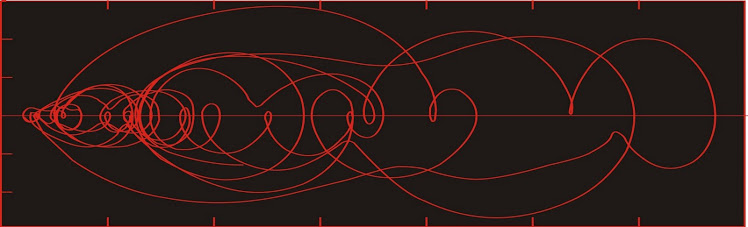
Dust flux, Vostok ice core

Dust flux, Vostok ice core
Two dimensional phase space reconstruction of dust flux from the Vostok core over the period 186-4 ka using the time derivative method. Dust flux on the x-axis, rate of change is on the y-axis. From Gipp (2001).
Showing posts with label Inflation. Show all posts

Wednesday, August 5, 2020

The inflationary hyperloop and other tales from the near future

Last time we looked at the recent transition from deflation to inflation as revealed in the USDX vs gold chart. This time I would like to put this into a somewhat larger perspective.


This chart compares the US dollar index with the gold price over the last 12+ years. The overall effect has been one of deflation (both gold and the dollar index have risen over that period), but the effect has not been steady. Much of the deflationary "progress" has been made through cycles of inflation and disinflation, although there have been substantial periods of "pure" deflation, mainly in early 2010, late 2014 to early 2015, and the longest stretch covering nearly all of 2019 into May 2020.

The question of inflation, disinflation, deflation, etc. are not just theoretical--they potentially affect the balance sheets and investors' perception of gold and silver stocks as investments (or, perhaps, speculations). During deflation, when both the US dollar price of gold and the US dollar index are increasing, the balance sheets of non-US-based gold miners (companies with mining operations outside of the US) improve markedly. The effect is not as strong for US-based gold miners, however they do benefit from inflation. During inflation, the non-US-based gold miners don't really benefit much (from the accounting perspective), however this tends to be the time when their perception of value increases the most in the minds of investors. Since it is also likely to be a time for US operations to increase in profitability, it improves the financial conditions of the Nevada-based producers (and California, Arizona, etc.).

Also take note of the effects of deflation on silver. It isn't pretty. The switch from deflation to inflation makes puts silver in play. The important thing to remember is to leave the party when the inflation turns to disinflation or deflation, which can happen suddenly. 

In May, the situation switched from deflation to inflation. That may suggest that American-based producers and silver companies are right in the sweet spot.

One feature that stands out is the "inflationary hyperloop" highlighted in gold. It represents a fairly long period of inflation followed a similar period of disinflation, the total lasting about four years. For gold and silver investors, only the first half or so was much fun. Now that we have entered into an inflationary period, are we going to experience another such loop? It seems plausible. 

But there is at least one significant differences in the current inflationary run and the beginning of the inflationary hyperloop--and that is battle. Almost the entire way around the loop there was a real struggle between bear and bull forces. That struggle on the way up is important, as it tends to lead to resistance on the way back down. Now observe our current smooth inflationary stretch since May. Where are the struggles?

One approach is to assume that the current situation will mimic the inflationary loop. If so, we might get two years of fun and about $600 of price out of this. Some approaches suggest magnitude and time increase due to [central bank-fueled liquidity; higher price levels; Mars is in conjunction with Apollo; your reason here]. But the reality is that this is a dynamical system, and in state space, once the system breaks out of a mode of stability, it can move rapidly to another. The new area of stability may be nearby, or it may be far afield, but in either case, without any previous observations of its existence, its location in phase space is unknowable. This is just a roundabout way of saying we can't know how high the gold price will go (or how low the gold-silver ratio will fall) during this period of inflation.

I just thought of this. Youtube here

Wednesday, March 11, 2020

The possible coexistence of inflation and deflation

One comment came up a lot in the recent posting. Well, the comments were all on Zerohedge. Which was to dispute my conclusion of a switch to an inflationary setting.

In the biggest picture, we have had deflation for at least the past twelve years.


Sorry, haven't updated this one in the past few months. But on this scale, very little has changed. The long-term trend of rising gold price and rising USDX index that has been active for the past twelve years would still look the same as in this graph.

I remember Richard Russel, long before 2008, advocated for deflation, saying that the way to play it was 50% gold, 50% US dollar. So the deflation isn't really a surprise--it's a reflection of the excess levels of debt, and will remain until the debts disappear.

Yet on a year-by-year basis, we don't have continuous deflation at all. There have been year+ long cycles of inflation and disinflation which have resulted in deflation (the first year or so,  2011 to 2013, and 2016-2018). For this reason, it can be difficult to remain invested for deflation for the whole last twelve (and more) years.

The inflationary impulse that we may have embarked on (it will be safer to call this in a few weeks, assuming it continues) could be another event like we witnessed in 2011, which saw gold fall just short of $1900, with the US dollar falling sharply. And this was followed by the 2013-2013 period which saw sharp drops in the price of gold. 

Going forward, I think the next decade will be dominated by deflation (a rise to the upper right in the graph). But in the next year, we may see inflation (falling down and to the right in the graph) before disinflation (rising to the left) possibly ending up a little higher and to the right of our current position.

What's a prudent investor to do? Well, I'm not offering any advice. We may be starting an inflationary cycle. But then, I've thought that, and been wrong, before.

Friday, February 14, 2020

The Gold-Silver Ratio

For Valentine's Day, a little something for you who love silver.

Or gold

A couple of weeks ago, Wheaton Precious Metals released a very useful study on the gold-silver ratio. Today I would like to take a look at some of its implications.

The most important implication is one that everyone needs a little time to absorb. That is that there is no characteristic value for the gold-silver ratio.

That means that there is no "true north", or no mythic value (16, for instance) to which it is attracted, and to which it would return if only the world stopped manipulating its price.

The Wheaton conclusions are quite definite. The gold-silver rises during deflationary periods and disinflationary periods (we'll look at this distinction shortly). The gold-silver ratio falls during inflationary periods.


What is unclear is whether a rising GSR causes deflation, or deflation causes a rising GSR. I know which one I believe.

Let's test this against some measures I've used for deflation/inflation. I'll use the weekly chart of USDX vs gold price, weekly, going back to the beginning of 2008.


It is a busy visual, but what we want to do is look at longer-scale variations. Intervals when both the USDX index and the gold price rise are considered deflationary. If gold rises and the US dollar index falls, we have inflation (hence inflation and deflation are not opposites). Gold falling and the dollar rising will be disinflation, and I suppose that if both gold and the US dollar fall, we must have disdeflation, although I have never seen that word anywhere. It's a little hard to say, so it might be best to leave it nameless, and remember that if it ever happens, you should be shorting gold stocks.

Through most of 2008, the graph above suggests we were experiencing disinflation, and over that interval, GSR rises from 55.7 to 77.1

Much of 2009 was characterized by inflation, and the GSR fell from 77.1 to 63.3.

Until the middle of 2010, we had disinflation, and the GSR rose slightly.

The big inflationary pulse into late 2011 saw the GSR falling to 40.8. The final blow-off in the gold price did not see any movement in the US dollar index, so it technically lies between inflation and deflation, but I don't know what to call it. The GSR actually rose during that interval, which makes some sense as the gold price rose over $200 in that time.

The following disinflationary episode that lasted through 2013 saw the GSR rise to 65.9.

Since then, the dominant trend has been deflationary, although realistically there have only been two deflationary pulses--through early 2015 (GSR 74.5) and over the past 18 months (GSR at 88.6). Most of the time has been consumed by short inflation-disinflation cycles, with slight rises and falls of the GSR without significant trend.

Over the entire chart (twelve years) the big picture is deflation, but most of that has been accommodated through cycles of inflation and disinflation.

So long as deflationary conditions persist, the GSR may rise without limit. As long as debts are created beyond any ability to repay them, deflationary conditions will rule. Under such conditions, despite the GSR being pretty much the highest in history, gold remains a better investment than silver.

However, as much of the actual deflationary effect is brought about by cycles of inflation and disinflation, there are  brief intervals where silver makes a better investment than gold. But rather than using the level of the GSR as your selection criterion, you need to look closely at monetary policy instead.

Wednesday, December 11, 2019

A year of deflation was pretty good for gold miners

I have been showing the long-term graph of US dollar index vs gold for some time, arguing that the last twelve years have, on average, been deflationary.


Since early 2008, the gold price has risen from ~900USD per oz to nearly 1500 USD/oz, whereas the US dollar index has risen from about 72 to nearly 98. Richard Russell seems to have been right, with his bet of 50% gold and 50% US dollars.

Now, here's a thought. If the graph trending upward and to the right is deflation, how does inflation plot?

Down and to the right (rising gold, falling dollar). Deflation and inflation are not opposites . . . they are perpendicular.

In the above graph, even though the trend has been deflationary, there are inflationary and disinflationary intervals as well.


From about mid September last year until the end of August, we had pretty steady deflation. But on much shorter timescales, individual actions are on the inflation-disinflation axis. (I have not decided what to call the opposite of deflation - perhaps #$!?@!?).

My thesis of the past several years is that deflation is good for the price of gold companies. So let's see how one did.


Franco Nevada is a royalty streaming company with about 80% of its revenues coming from precious metals production. This company is a good one to test the hypothesis as it is more likely to be affected by economic factors such as the price of gold and less affected by company-specific factors as would be the case for a mid-tier producer.

From late September 2018 to about the end of August of this year, Franco Nevada embarked on a powerful price advance from about $80/share to $130/share--a 62% gain. This gain corresponded with the period of deflation, where both gold and the US dollar index were rising.

Similarly, a quick look at other companies including SSR Mining, Wheaton Precious Metals, Wesdome, Semafo, and even a small exploration company like Bravada showed strong gains over the same period.

Friday, August 9, 2019

Human ingenuity and gold

I saw the figure below on this website, and felt compelled to comment.


No attribution was given, so I will assume it was put together by the site operator.

At first glance, it tells a simple (if somewhat horrifying) story of currency destruction. But I think there is another story it tells, which is a little more hopeful.

The picture as presented is a little misleading because it shows what an ounce of gold will buy now. (Gold was $20/oz in 1932, but there was a little less than an ounce of gold in the double eagle. But let's pretend it is an ounce of gold and look at what that $20 coin would buy you in 1932.

According to this site, a gallon of gas cost $0.18 in 1932. Accordingly, your $20 coin would buy you 111 gallons of gas.

According to this site, a gallon of milk cost $0.26 in 1930 and $0.47 in 1935. The reason for the price rise was due to the government introducing programs to help farmers during the Depression. Not knowing when exactly the program started, it's a little difficult to be sure what the price was in 1932. So let's go with $0.33, meaning $20 would get you 60 gallons.

According to this site, a dozen eggs cost $0.36 in 1937. I'll estimate $0.33 for the price in 1932, netting us 60 dozen eggs for $20.

This old New York Times article tells us that a first-class postage stamp in the US cost $0.03 in 1932. Your $20 coin would allow you to mail 666 letters and have 2 cents left to put in them.

All of which is a lot more than $20 buys you now. But notably, it is much less than an ounce of gold will buy you now.

Gas: 111 gallons vs 482 gallons
Milk: 60 gallons vs 427 gallons
Eggs: 60 dozen vs 675 dozen
Stamps: 666 vs 2700

These increases are the result of capital investment and human ingenuity, and are a reflection of real increases in productivity.

So let's not overlook the happy side of the story. A big hand for human ingenuity!

Saturday, April 23, 2016

A picture of inflation in China


Lunch yesterday. Same price, notably smaller amount of food. Definitely fewer mushrooms.

Garlic price is up nearly 100%. I was shocked buying some last week. Sure, it isn't rising from a very high level. But for people here on the edge, every little bit hurts. Pork is up by about 50%

Saturday, March 8, 2014

The changing dynamics of generational wealth transfer in the bubble economy

About fifteen years ago I started travelling around various local church sales, buying silver--mostly jewellry, but also spoons, candlesticks, cutlery, whatever could be found. At the time, the stuff was dirt cheap, and there was no competition. That all changed in the following years, and it has been a few years since I last went looking for the stuff.

An acquaintance of mine pointed out that that was the traditional way to accumulate wealth--the young take advantage of the old, buying the things they no longer wanted. It sounds distasteful, but there is a kind of logic to it.

The classic, of course, was property. The archetypical scenario, with the young fellow cajoling the elderly pensioner to sell his house. "Come on, grandpa. You don't really want to keep going to the trouble of maintaining this place, do you? I'll give you a good price for it."

In older times, I don't think we thought of our homes as having value--other than the value of a place to live. With this mindset, the value of a house changes constantly throughout your life--having greater value when you are young, as its value becomes the net present value of all your future years living in it minus the costs of maintaining it. As you age, that value declines. So if the owner is elderly, we have a situation where the value of the house is much higher to the (presumably young) interested buyer than it does to the seller.

That discrepancy in value creates the opportunity for a really good deal for both sides. The pensioner can receive a sum of money much greater than the house is worth to him, while the buyer pays less than his perception of the house's value.

Since the fall in interest rates that began in 1980, house prices rose so much, creating a "wealth effect" that enriched the majority of homeowners, and changed their perception of the value of a house. Now the value of a house is "objectively" determined by other sales in the area--and not by an individual's life circumstances. It's no longer a purely personal decision either--a homeowner's choice to sell at a lower price will affect the prices of other houses in the neighbourhood, and would be looked upon as a betrayal by the seller's former neighbours.

The new perception of a house as objectively definable wealth now seems to be ubiquitous, but is a recent state of the human condition. The old dynamic, a form of inter-generational wealth transfer, has disappeared in the depersonalization of financial affairs.

Friday, February 14, 2014

Setting up a people for hyperinflation--the Canadian example

The World Complex is not a fan of Stephen Harper and His Government (see here, for instance). But I am forced to conclude that he may be a cannier economist than I originally gave him credit for.

When a country destroys its debts by inflation, it ruins its creditors. The proper progressive approach is to ruin them all equally--thus it is imperative that there be no avenue by which creditors might protect themselves. At the same time, the government wishes no doubt to have its citizens continue to honour its currency, worthless though it might be.

During the Wiemar hyperinflation, despite the frenzied printing, the sum total of foreign currency that could be purchased by all the marks in circulation fell precipitously. There is a Keynesian argument to be made that the Germans didn't print quickly enough! Of course, having Germans individually destroying the currency in great amounts by putting it to such uses as cigarette rolling papers and firewood didn't help either.


It's not always nice to have money to burn.


And consider this--using the currency in lieu of hard-to-locate toilet paper may clog pipes.

Canada recently unveiled polymer bills. Just the perfect cross between plastic and paper money. And the brilliant part is, they are perfect in a hyperinflationary environment.

Plastic. Not really suitable for use as cigarette wrappers or firewood. You wouldn't want to be burning it indoors, anyway.

And as far as toilet paper--although it is a little uncomfortable, the microtexture on the bills does seem to be helpful for cleaning up the really tough spots. And although the bills have not been field-tested for flushability, the beauty of the polymer bills is that you can just wash them and reuse! Or spend, if you prefer.

The only problem the beta testers have reported is that the bills are a little small to be used comfortably.

Monday, October 21, 2013

Why we face ruin

A nice compendium of UK economic data has recently appeared (h/t NESS). You are encouraged to download data sets for your own nefarious purposes.

As an example, I have decided to plot UK unemployment rate against the measure of confidence I proposed on these pages a couple of years ago. To recap, the confidence ratio is the ratio of outstanding public debt (in dollars) to the dollar value of the country's gold holdings. I chose "confidence" as presumably this ratio can only be high for a country in which investors have great confidence. For those of a different mindset, it can be viewed as a measure of a country's ruin (although it would be better to include other foreign currency reserves).


UK unemployment data from the site mentioned above. UK debt came from google public data. UK gold holdings came from the data sets available from the World Gold Council. To find the dollar value of gold holdings, I used averaged annual prices available at Kitco. Average conversion rate of GBP to USD available here (although I don't remember where I got it for the original posting, which was up to 2011).

That is a good-looking example of negative correlation. It tells us that the unemployment falls when the confidence ratio is high. Now, there are three ways for a government to increase that confidence ratio:

1) increase debt
2) sell off gold
3) pray for the price of gold to fall (obviously in a non-manipulative manner that doesn't direct profits to favoured entities).

The fall in confidence that we observed in the latter half of the last decade was entirely due to the rising price of gold. Look at what that did to the unemployment rate! Clearly the fault of gold-bugs and conspiracy theorists. The rising price of gold completely overrode the excellent work of the British Parliament in driving up the country's debt. As for Gordon Brown, he was a hero! His only flaw was in not going far enough. If he had sold all the UK's gold, imagine how low unemployment would be today!

This wouldn't be a post on the World Complex if we didn't do some kind of state space portrait, so here it is: unemployment rate vs. confidence ratio.


Policy decisions of British Parliament and their impact on unemployment can be followed from the above chart. Clearly the government in the 1970s laboured under the delusion that reducing debts would benefit the economy(1). They were rewarded for their imprudence by spiking unemployment in the early 1980s.

By the mid-1990s, they had discovered the golden ticket. With the rising confidence ratio, the UK was rewarded with a falling unemployment rate. Then came Gordon Brown's heroics--by aggressively selling gold he caused the confidence ratio to rise and the UK was showered with new jobs!

There was a small crisis in the latter part of the last decade. But since then--clearly back on track. If the forward evolution of the system follows a similar catenary to the period 1993-2005, then a mere quadrupling of the confidence ratio will restore the unemployment rate to about 6%. The most prudent way to achieve this would be to immediately sell off 75% of Britain's remaining gold (2).

I find this approach to finances inspiring, and am willing to give it a try. Here at The World Complex, the unemployment rate is unusually high (technically I am welcome to go to the office, but the treasury is empty). Looking at my finances, I see the problem--I have very little debt and high savings (although much lower than they were two years ago, thanks to the ongoing turmoil in the junior mining market). To rectify this oversight, I will be issuing bonds. For reasons of fiscal prudence, I will try to keep my confidence ratio below 100, and will begin an auction for $25 million in debt next Thursday (3). No cheap google ad payouts here!

Notes:

(1) the rising price of gold may have had something to do with this. But this proves my point! Rising gold price = rising unemployment, you naughty gold bugs.

(2) in my opinion it would be too difficult to drive the gold price back down to $300/oz.

(3) securities officers and other sarcastically challenged individuals take note--this is intended as sarcasm. Your participation is welcome.

Tuesday, August 27, 2013

The magic ends, part 1--snapshots of dying currencies

Even a single [penny] is a gift from Hell, minted in human lives.
                                        - Kazuo Koike

The penny is, of course, no longer a gift from Hell--at least not in Canada. They have been eliminated. Even so, over the years, they changed from real money (when they were copper), to a reflection of real money (when they were zinc), and since 2000, they had been nothing but tokens, created at will (coated steel).

I remember when I discovered that Canadian pennies were no longer copper. A friend of mine showed me a neat trick with a zinc penny and a blowtorch. You can roast the copper penny as long as you wanted under the blowtorch, and apart from glowing red hot, and temporarily losing its oxidized coating, nothing happened. The zinc penny, by contrast, lasted a few seconds before erupting into brilliant flame, the deformed outer copper sheath collapsing onto nothing. I actually thought it was a plastic token before looking up its content on the internet.

The above quote didn't actually refer to pennies--the exact word was sen, a Japanese copper coin, worth 1/100 of a yen. Nowadays, it doesn't have much value, but in the story from which the quote was taken, it was valuable enough to buy the silence of an accessory to a crime. What happened to its value? Did the copper become worthless? The answer is that too many yen were printed.

My wife's grandmother left us a collection of dirty coins, which she had kept hidden through the years of the Japanese occupation of Singapore. A piastre de commerce of French Indochina, dated 1908. A few Straits Settlements 5c pieces ranging from 1890 to 1935. A gorgeous Straits Settlement dollar from 1908. There was a US quarter and a half-dollar, a Chinese coin from Kiang Nan province, which can be ascribed to 1904 from the chop marks (but which wikipedia tells me was restruck several times in the 1920s). A couple of franc coins from 1899 and 1915. A couple of Thai (then Siam) coins, of uncertain age and value. Silver, all of them, but in total, not much. I assume there were rather more of them when the occupation started.


During the occupation, as occupiers typically do, the Japanese issued their own currency--one which (like the occupiers in America) the denizens of Singapore were forced to accept. The power to make money without limit is its own temptation, and the subsequent inflation combined with the disappearance of capital goods and food was the consequence.

After their defeat, the banana currency became worthless. Unfortunately, the British were a few days late in delivering the new currency intended to replace it, so for several days there was no legal money in Singapore. Only those who managed to keep US dollars, British pounds, or gold or silver hidden through the war years could go to the market and exchange them for a bit of rice. It's during these sorts of times that the value of those gold necklaces Indian women are so partial to really comes to the fore. It's so easy to pinch off a link or two.

Silver coins for Malaya (now Malaysia and Singapore) were minted by the British Mint during the war (dates of 1943 and 1945 are common). However, they weren't delivered until after the end of the war, and I have been given to understand that the first thing the local population did upon their delivery was hoard them. Many of these coins never circulated, and a good number of them in all denominations were left to us as well.


In the Japanese movie "For Those We Love", which depicts the lives of kamikaze pilots near the end of the war in Japan, there is a scene in which the local noodle-shop owner wants to cook noodles with egg for one of the pilots about to head off on his final mission. She has no eggs, so she sends one of her assistants to buy some from a local farmer. "But he doesn't take money any more," she protests, so the elder women has to dig up a family heirloom to trade for eggs.

Destruction of the value of currency has recurred through history, with famous examples in Germany, throughout much of Europe, most African countries (Zimbabwe most famously, but even stalwarts like Ghana have had problems).

Monday, October 10, 2011

How a housing bubble looks (in phase space)

On Canadian Thanksgiving Day, let us give thanks that Alan Greenspan and Ben Bernanake are not Canadian.

Today we present a plot of the Case-Shiller index (an inflation-adjusted index of US house prices) against US real interest rates over the past 60 years.

Inflation data from this site. The other data came from Robert Shiller's data site.


Unlike the last plot, the real interest rate here was based on the difference between the long rate (reported in the Shiller data file) and the CPI (reported on the inflation site above).

These guys blew a bubble of astounding proportions.

The key feature I think is that in the absence of the bubble, we see only a slight negative correlation between real interest rates and the house price index. I do question that odd-looking spike in the early '70's. Perhaps there was a real lag in house prices as inflation first began to take off.

There is a small bubble which peaked in 1989, followed shortly by an impressive excursion through phase space from about 1999 to present. Unfortunately, no respectable economist could recognize that any unusual behaviour was occurring. It certainly wasn't a bubble.

Using the methods described here, we can produce reconstruct the two-dimensional phase space to show how unusual the recent behaviour in home prices has been.


Since 1894, we recognize two areas of stability in the Case-Shiller index, highlighted in orange. The entire record is spent either in them, or shuttling between them, until the breakout in the year 2000.

In retrospect, it was fair to say in 2002 that a bubble in housing was apparent. Certainly it was a bit of an excursion in phase space. But by 2005 it should have been obvious even to a Ph.D. (and yes, I have one) that a bubble was in progress. Perhaps Bernanke et al. were all hoping that the system would start tracing out a new area of stability somewhere nearby. If so, it was a vain hope.

Sad to say, the only reasonable prospect is for a return to the larger area of Lyapunov stability. If you are really unlucky, perhaps you will fall to the smaller one. The good news is that the process probably won't take more than about five years.

Lest I sound like a smug Canadian, let me state here that I acknowledge we have a dandy housing bubble of our own.

Friday, September 16, 2011

Are the Swiss joining the Weimar movement?

The graph below shows the ratio between Swiss debt and their gold holdings, as described here. Materials sourced here, here, and here.


I have seen different estimates for debt/GDP ratios for Switzerland, and have used one longer time series, even though it seems to have been lower than other shorter series. The longer series is consistent with the shorter series (highest debt/GDP ratios happened in the same years) so I can only conclude that the data I have used is omitting some type of debt. Overall, I believe the above graph to be correct in form, but the values on the confidence axis might be larger.

As is the case for the US, the UK, Germany, and Japan, we see that ratio increased until the turn of the century, and has been declining since. Like Germany, debt is declining. The gold price is rising, but Switzerland actually sold half of its gold between 1999 and 2005.

In principle, these declining ratios are good--they suggest that these countries are becoming increasingly solvent with respect to gold.

My concern is the shadow of an inflationary past. Must it arise in the future? I don't think so. But might it? This is harder to reject, as now that the Swiss have announced that they will defend the 1.20 euro level, the entire world seems bent on inflating. And that, according to Sennholz was the political choice that tipped Germany into hyperinflation in 1923.

And we should be clear--it was a choice. Monetary authorities had the choice between accepting the devaluation imposed on the mark by the market, and trying to force the market to accept the "value" of the mark assigned by the monetary authorities. By the time they were finished attempting to show the market who was boss, the German middle-class had disappeared in a blizzard of paper. Tyranny followed.

The market is devaluing paper all over the world. Will the monetary authorities accept deflation--or will they try to impose by force their own values on the world? History shows us the most likely answer. And tyranny will follow.


Monday, September 5, 2011

Confidence or recklessness: The onset of inflationary deflation in the Anglo-American economies

Today we apply the same methodology that we previously used to study the rise and fall of confidence in the American economy to the UK. The chart below is the historical plot of the ratio of the UK public debt (in pounds sterling) to the value of the UK Central Bank gold holdings (similarly in pounds). A low ratio generally suggests economic soundness, and the ratio tends to increase with increased debt load. The ratio can fall due to increased holdings of gold, but for the UK and the US since WWII, the ratio falls due to a rising price of gold.

Gold reserve data to 1998 comes from the World Gold Council website (you need to create an account and sign in to download files).


Information concerning the UK gold holdings is a little sparse before 1950, but it appears that the confidence ratio shot up during WWI, as public debt rose ten-fold and gold holdings tripled. Gold holdings increased through the 1930s, no doubt escaping the continent.

The fluctuations in the 1950s were due to fluctuations in gold holdings, as were the spikes in the late 1960s and about 1970. By the mid-70s, debt was increasing rapidly, but was more than matched by the rising gold price, resulting in a fall in the confidence ratio.

The famed Brown gold sales beginning in 1999 led to the last enormous spike (perhaps this should be the recklessness ratio instead of confidence ratio). This ratio peaked in 2005, and its subsequent decline is entirely due to the rising price of gold.

In fact, the UK public debt has more than doubled since 2005. And even though the UK gold holdings have declined further since then (albeit by only about 0.5 tonnes), their value has more than tripled since then.

Here, once again, is the graph of US confidence.


If we consider gold to be a currency, then what we are looking at (for both the US and UK) is a situation where the government is inflating but the market is deflating. The number of dollars (or pounds) has increased, but the total purchasing power of all of these pounds or dollars (in terms of gold) has declined. The rate at which this is occurring is perhaps low enough we may call this inflationary deflation, but one wonders which line do we cross before we recognize this situation as hyperinflationary deflation.

Of course the interesting question then becomes--can Helicopter Ben really print faster than the market can destroy? We may soon find out.